In EOR at @AMS_AIES: "Using machine learning to predict convection-allowing ensemble forecast skill: Evaluation with the NSSL Warn-on-Forecast System" https://t.co/eEpSAvtvQc
Can we use AI to predict thunderstorm evolution?
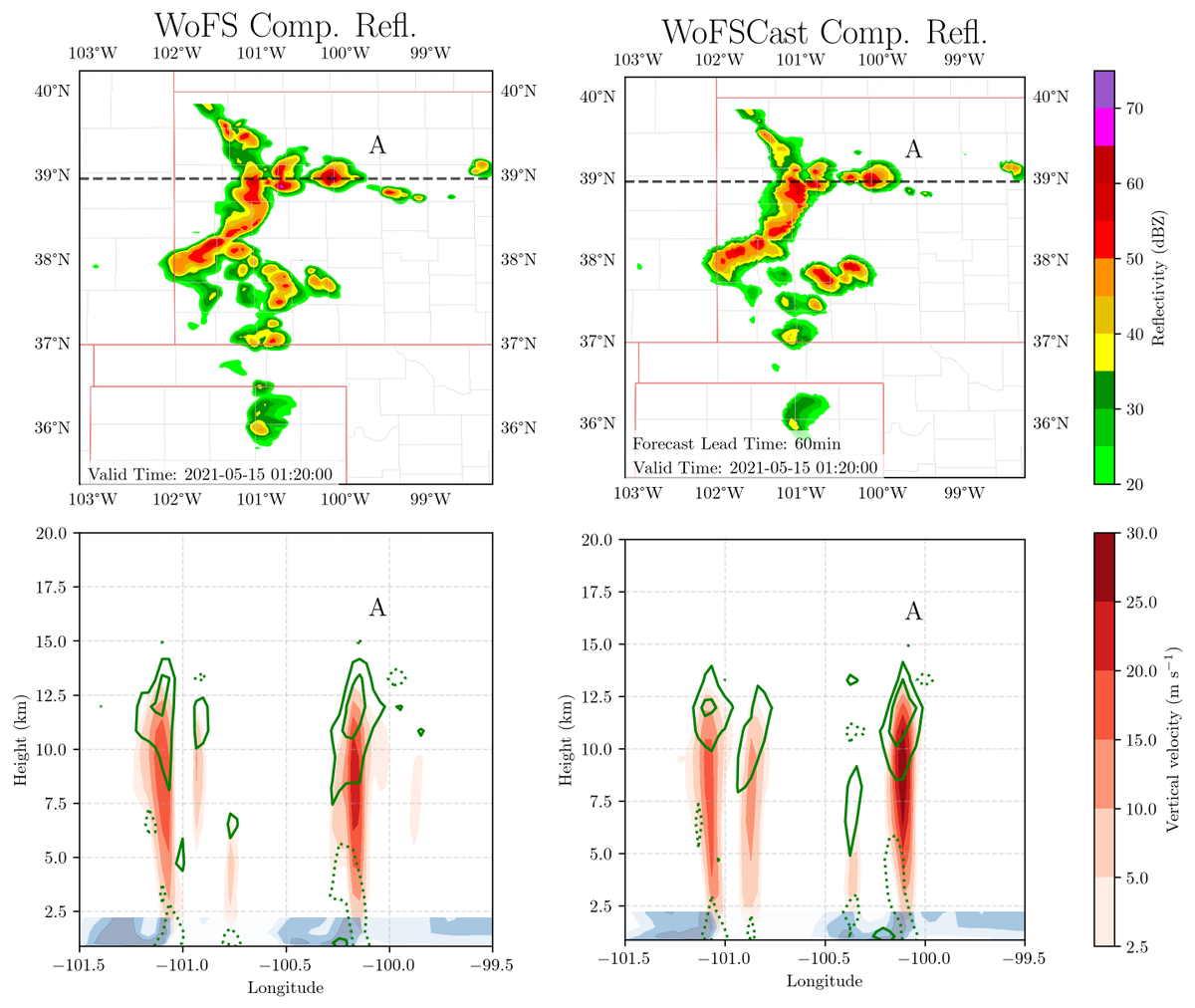
Recently published in @theAGU GRL, we refactored @GoogleDeepMind's GraphCast for regional modeling and trained it on @CIWRO_ / @NOAANSSL's archived Warn-on-Forecast System (WoFS) data.
Meteorologists are turning to AI as a quick, efficient alternative to traditional weather prediction algorithms.
Now researchers including @MontePhD & @corey_potvin have extended this tech to cover localized extreme weather as well as global forecasts. https://t.co/pcSccHjqJS
🤖 How can AI help scientists predict thunderstorms faster? 🤔
A new paper from NSSL and @CIWRO_ discusses how WoFSCast, a new AI-powered model, can accurately predict how storms will evolve up to two hours in advance. ⛈️
📝: https://t.co/2UVcchBJ35
🌪️🌩️ Studying tornadoes in the field has always been at the heart of the NSSL mission. With roots in the 90s, the VORTEX-USA project continues to blaze a trail in tornado science with the ultimate goal to protect lives and property.
🌪️ UP CLOSE: https://t.co/X8gEB9Jz1p
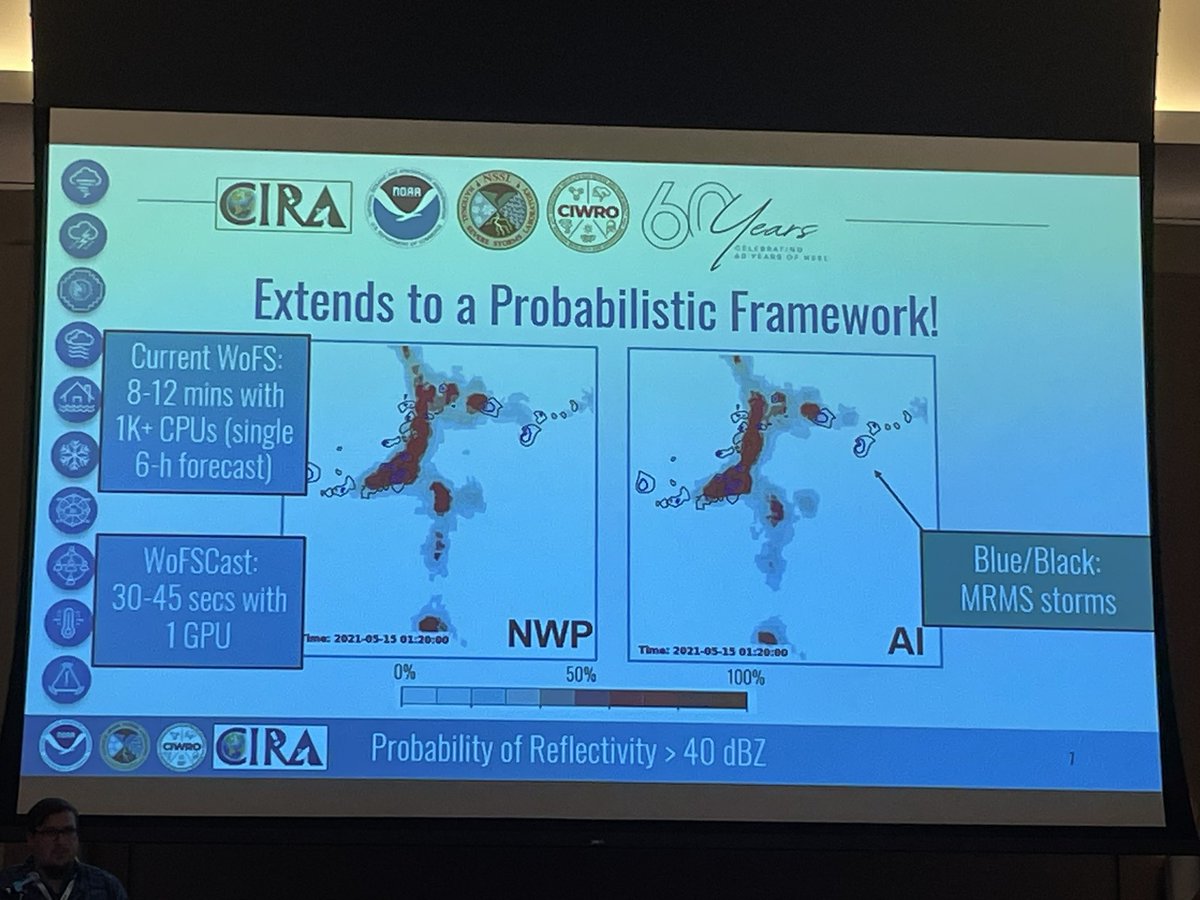
WoFSCast is the first AI system trained and developed to emulate a sub-hourly convection-allowing weather model (CAM). WoFSCast speeds up forecast generation versus WoFS by at least a factor of ten, from minutes to seconds. #AMS2025
Monte Flora: Future of storm-scale AI: generating large-member (100+) hi-res (~1-km) ensemble forecasts in seconds.
AI system in the WoFS framework already can produce “closely matching” forecasts with far less computational burden than #WoFS (far faster). #31sls
Our paper combining AI/ML, storm-scale ensemble prediction, and "forecasting forecast skill" is now in final form in @AMS_AIES:
https://t.co/eEpSAvtvQc
Co-authors: @MontePhD, Patrick Skinner, @tonyreinhart, @BrianWxFLA
🤔How can science provide more warning when 🌪️tornadoes threaten?
The Warn-on-Forecast System, equips forecasters with critical information between watches and warnings, enabling them to give longer lead times in the face of severe weather and tornadoes.
https://t.co/9TJdGu1Bf6
Our paper on the usefulness of the "WoFS-ML-Severe" products examined during the 2022 HWT-SFE is available in EOR. This paper explores subjective verification, objective verification, and qualitative analysis of the participant's feedback. https://t.co/JrAuS8dpzn
In EOR at @AMS_AIES: "Using machine learning to predict convection-allowing ensemble forecast skill: Evaluation with the NSSL Warn-on-Forecast System" https://t.co/eEpSAvtvQc
I believe this is the first published application of machine learning to predicting storm-scale forecast skill. This work motivates additional applications of ML to predicting forecast skill, including at larger scales / longer lead times.
Great presentations from #NSSL scientists continue here at #AMS2024, including researchers Kim Hoogewind and Adam Clark at the @NOAA booth talking about trends in severe thunderstorms and tornadoes in a changing climate.
Hot off the press: The OU School of Meteorology (@ousom) & School of Civil Engineering and Environmental Science have a joint tenure-track faculty position focused on the broad areas of Hydrometeorology and Hydrology that is now open. Apply here: https://t.co/VuEwTcFq8z
The Feb 1 deadline for NRC postdoc apps is coming up! I am looking for someone to work with me on a topic related to our Warn-on-Forecast System. Search "Potvin" at https://t.co/R6FGucCkIF. These project descriptions are flexible. Possible topics in next post....
Possible NRC postdoc topics:
(1) WoFS forecast emulation via deep learning
(2) Other ML applications
(3) Thunderstorm predictability
(4) Multi-resolution ensemble design
(5) Novel verification techniques
(6) ???
Feel free to reach out here or at [email protected].
The Feb 1 deadline for NRC postdoc apps is coming up! I am looking for someone to work with me on a topic related to our Warn-on-Forecast System. Search "Potvin" at https://t.co/R6FGucCkIF. These project descriptions are flexible. Possible topics in next post....