End of official thread.
Any replies below are not part of this thread. Verify any link against the official @DuskFoundation account before interacting.
Hello again, everyone! We really appreciate all the support we have received so far. Let's start by taking a look at our first public building block: Atlas.
Atlas is a small smart contract registry that manages a list of names. Each entry names a service and includes the address of the contract that provides it.
An Atlas instance is deployed for a specific purpose. Each project maintains its own list on its Atlas instance, and another project deploys a separate one, so many lists exist on the chain at the same time. A contract only follows the Atlas instance whose address it carries. This instance is deployed first. The contracts that use it are deployed afterwards, each carrying the correct Atlas address. When one of these contracts requires a service, it queries Atlas for the name and receives the assigned address. Later, a new contract can be connected to the same name. When the deployed contracts query Atlas again, they find the new address.
Someone has to be authorized to update that list. This role is assigned to the guardian, as specified in the Atlas contract itself. The guardian can be replaced at a later date, and this takes effect after a waiting period. If the guardian is a key, they can change the name on the list and Atlas will then apply the change immediately.
To delay a name change and/or enable MultiSig decisions, the guardian role is given to a warden instead. The warden holds the change and writes it onto Atlas after a set waiting period. This process is based on our Knot BLS MultiSig implementation, which we will discuss next time.
For Rust, the call types are the crate nocturne-atlas-encoding, and the event decoder is nocturne-atlas-event-decoder. The Atlas contract is built from the repository: https://t.co/QSMDPAwfQM
Our first product, Vigil, keeps your $DUSK in a secure vault. The vault asks Atlas which contract to call for each purpose, and it asks again on every call, so that contract can be replaced while the vault stays put.
So far, we have only deployed and tested Atlas on Nocturne and it has not yet been audited.
Take a look at the docs for more information https://t.co/O79fYvYUZS
been exploring @DuskFoundation and the thing that stands out is how much sits on one settlement layer. duskvm runs native contracts, duskevm runs plain solidity, and the base chain handles both public and shielded balances, which is a lot of surface to learn from docs alone.
built an mcp server that lets claude do the exploring with you. ask it for the top provisioners on mainnet, what a transaction actually did, a contract’s abi, a duskevm receipt or how to deploy something, and it answers from the live chain and the docs. wallets live in it too, each with its own password, and it can send DUSK on any network.
nothing goes out blind. you see the network, recipient and fee first, and the password is what releases the transfer.
adding more features like staking, shielding/unshielding, contract interaction, bridging soon
repo: https://t.co/im8j0ohZk1
cc: @opendusk_org , @nocturne_stds
It is fantastic to see that independent developers are building essential tools for #DuskDS and #DuskEVM. The focus on security, open-source development, and practical infrastructure is particularly encouraging.
A strong ecosystem around $DUSK needs more than a solid protocol; it needs developers who create the tools that make it usable and accessible to others.
Private KYC.
On a public chain, an investor allowlist is a public list of wallets.
With Citadel, a provider verifies your eligibility and issues a private credential. No personal data goes onchain.
See how it works ↓
Hello everyone,
We would like to introduce ourselves to the public by sharing a few handwritten words, as a contrast to our AI polluted timelines.
We are developing services, smart contracts, tooling, and more across DuskDS and DuskEVM, with the aim of providing valuable building blocks for our ecosystem.
Security is a cornerstone of our agenda, and the first upcoming release will be Vigil, a $DUSK Vault, that allows you to control your funds and interact with the chain in a secure environment.
It uses two open source building blocks:
- Atlas, a contract registry https://t.co/QSMDPAwfQM (credit to @tminus_dusk for making us aware of the concept)
- Knot, a BLS multisig contract implementation https://t.co/4o3JwFRzMY.
We will test on Nocturne (DuskDS Testnet) and see where we can go from there, one step at a time. We are very excited to show you the first version of our vision.
We have already collaborated with the Dusk Foundation on small enhancements to the Dusk stack, identified through exploring use cases on DuskDS. We want to continue this work, and we also want to encourage other developers to join us in demonstrating Dusk's potential to the world.
This project began purely out of curiosity, leading to the development of a solid knowledge base that we are continuing to build on and share as open source. We are currently building a clean workflow and set up our infrastructure, so excuse us if you encounter any issues when exploring our organization on the website and beyond.
We will leave you with the website, where you can find out more about us. Thank you for reading.
https://t.co/MnllhU8xqG
2/ Simplified transfers from the Web Wallet.
→ Send to a .dusk name instead of a long address
→ Follow each transaction until it completes or fails
→ Save contacts, with a check that their .dusk name hasn't moved
As promised, Dusk Domains testnet testers who registered their names on mainnet with the same address got their 50% back, paid on-chain from the protocol's share of the treasury.
The rest of the Dusk Domains protocol's share goes into DUSK liquidity on PancakeSwap.
Those of us who spend hours in crypto can forget how strange it looks to someone arriving for the first time.
An unfamiliar address. A staking menu. A transaction they aren’t sure went through.
Dusk’s Wallet and Explorer redesign, with .dusk names built in, addresses that everyday experience.
I like seeing attention given to this. Familiarity shouldn’t be the price of entry. People deserve tools that help them feel capable while they’re still learning.
$DUSK
3/ Managing your wallet got easier too.
→ History page with filters and CSV export
→ Native staking and liquid staking with @sozu_dusk, side by side
→ Bridge to DuskEVM from one card
→ Multi-wallet support
→ Hide your balances on screen in one click
recently discovered @DuskFoundation and the angle is actually pretty different from most l1s.
it’s built for regulated assets from the base layer up, so privacy and compliance aren’t bolted on later. you get confidential transfers with selective disclosure, meaning auditors and regulators can see what they need while the rest of the market doesn’t see everything, and settlement is final in around 10 seconds.
@npex is running real securities on it with over 300m euros in issuance, and they’re shipping duskevm so solidity devs can build there without learning a new stack.
if you’re a dev who’s been curious about rwa and privacy, this is worth a weekend of poking around.
learn more: https://t.co/zEyLgg8kSj
docs : https://t.co/uYEandi6PW
discord : https://t.co/V494lMEUKH
$DUSK apps now include .dusk names.
Both apps now make sending, staking
and transaction lookup simpler.
Built in .dusk names make this more
than a visual refresh for users.
Both the wallet and explorer benefit.
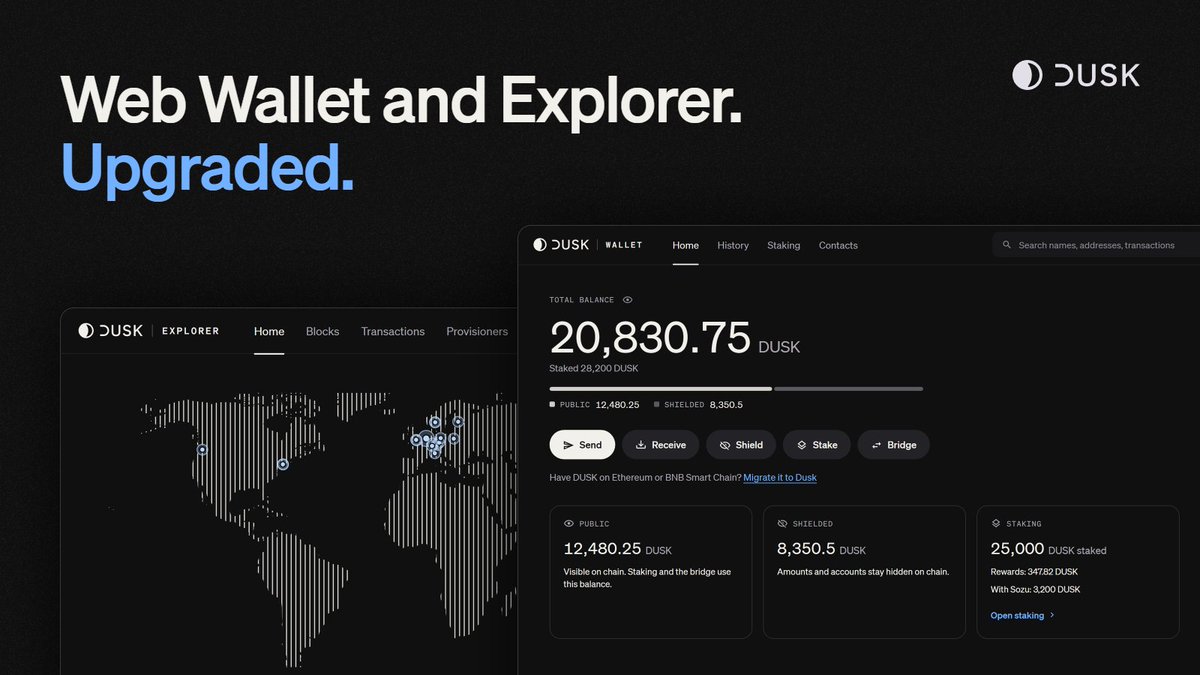
The Dusk Web Wallet and Explorer got an upgrade.
A new design across both apps makes sending, staking and looking up transactions simpler, with .dusk names built in.
What's new ↓