Founder & CEO, Karesis: AI for cancer genomics. Indel accuracy (F1): Karesis 0.99 vs Google DeepSomatic 0.88. Public benchmark, research use only. Ph.D. EE.
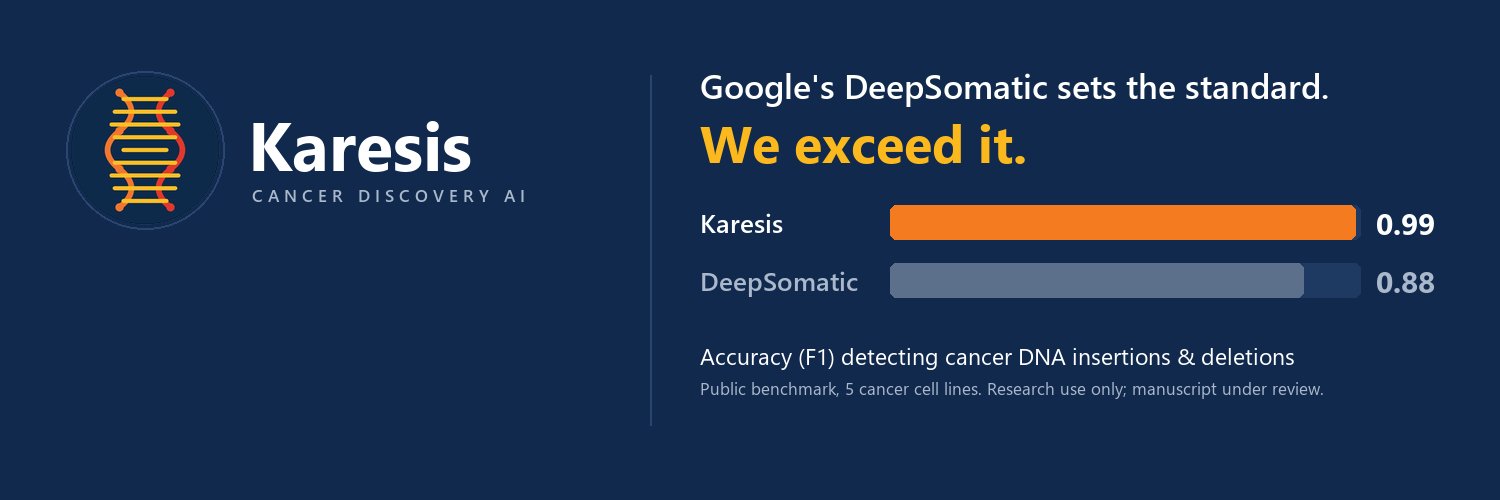
Google's DeepSomatic sets the standard. We exceed it on some of the hardest cancer mutations to call: 0.99 vs 0.88 on small insertions and deletions (public benchmark, 5 cancer cell lines, higher on all 5).
Karesis is an AI company. Cancer genomics is where we started.
In 3 minutes: one AI engine for Illumina, PacBio, Oxford Nanopore and MGI, and the AI behind it: self-improving, agentic (an assistant built on Claude), auditable, and small enough to run on one notebook.
Labs and partners: try it on your own samples. Investors in AI × bio: we're raising our seed round. [email protected]
Research use only; not FDA cleared. Manuscript under review.
#AI #Genomics
Google's DeepSomatic sets the standard. We exceed its performance: 0.99 vs 0.88 on small insertions and deletions.
For CROs and sequencing services: a plug-in analysis layer instead of one pipeline per sequencer 👇
@eclecticV@boardyai Thanks @eclecticV for the kind words and for looping in @boardyai. I really appreciate it. If any sequencing teams want to try Karesis on their own data, my DMs are open.
Google's DeepSomatic sets the standard.
On Oxford Nanopore data, we exceed its performance: indel F1 0.86 vs 0.83, ahead on 4 of 5 cancer genomes.
Long reads, explained in 90 seconds 👇
Long reads can span a whole repeat, but a run of the same letter is still easy to miscount, so small insertions and deletions are the hardest changes to call.
On Oxford Nanopore data from a public benchmark of five cancer cell lines, our indel F1 is 0.86 vs 0.83 for DeepSomatic, ahead on 4 of 5 (only 1 is a confirmed held-out sample). PacBio HiFi: tied. Research use only; manuscript under review.
90-second explainer: https://t.co/j0F33bf1KJ
Google's DeepSomatic sets the standard.
On Oxford Nanopore data, we exceed its performance: indel F1 0.86 vs 0.83, ahead on 4 of 5 cancer genomes.
Long reads, explained in 90 seconds 👇
Sequencing platform teams: we're open to collaboration.
Try it on your own data: [email protected]
We're also raising our seed round. Investors and strategic partners: DMs are open.
Research use only; not FDA cleared.
The numbers, stated plainly:
• Nanopore indel F1 0.8623 vs DeepSomatic 0.8308 (5-sample average, public CASTLE benchmark)
• Only 1 of 5 samples is a confirmed held-out sample
• PacBio HiFi: tied
• Methylation in the same model: early stage
Try it on your own data: [email protected]
We're also raising our seed round. Investors and strategic partners: DMs are open.
Research use only; not FDA cleared.
Google's DeepSomatic sets the standard. Same test, same cancer genomes: we exceed its performance (0.99 vs 0.88 on small insertions and deletions).
Now meet the platform behind that number 👇
Honest scope:
• 11 model domains; 6 of 11 validated on real matched data, the rest in validation
• DeepSomatic is strong on tissue but doesn't read blood samples
• Guardant, Natera and Tempus sell clinical tests; GC-Platform is research software
@eladgil One structural reason: in clinical genomics, proving a better method takes years of new samples and review, so tools improve slowly even when models jump. Open benchmarks plus fast validation on held-out samples would shorten that loop more than any single breakthrough.
@patricksmalone Same shift in genomics: sequencing got cheap, so the bottleneck moved to calling variants correctly and validating them on samples the model never saw. The valuable data is expert-reviewed truth sets, not raw reads, and whoever owns that feedback loop keeps the margin.
@dr_alphalyrae Agree on the closed loop. In genomics the bottleneck isn't model size, it's feedback: getting expert-reviewed calls back into training fast, and only promoting a new model when it beats the old one on held-out data. Make that loop cheap and biology speeds up.
For the Biology & AI community: we compared our AI variant caller with Google's DeepSomatic on a public cancer benchmark. Indel F1 0.99 vs 0.88 (research use only; manuscript under review).
60-second explainer below. Questions and pushback welcome.
https://t.co/dXL6C8fnQw
Google's DeepSomatic sets the standard for finding cancer mutations.
On small insertions and deletions, some of the hardest to call, we exceed its performance: 0.99 vs 0.88 on a public benchmark of 5 cancer genomes.
What that means, in 60 seconds 👇
Try it on your own data: [email protected]
We're also raising our seed round. Investors and strategic partners: DMs are open.
Research use only; not FDA cleared.
Google's DeepSomatic sets the standard for finding cancer mutations.
On small insertions and deletions, some of the hardest to call, we exceed its performance: 0.99 vs 0.88 on a public benchmark of 5 cancer genomes.
What that means, in 60 seconds 👇
The numbers, stated plainly:
• Indel F1: Karesis 0.9902 vs DeepSomatic 0.8774 (5-sample average, public CASTLE benchmark, Illumina)
• Single-letter changes: on par
• Only 1 of 5 samples is a confirmed held-out sample
• Manuscript under review