humbled to announce KdT IV, an oversubscribed $100M+ fund dedicated to supporting early-stage, science-driven companies.
at KdT, we believe the most iconic companies of our time are those that leverage scientific breakthroughs to build enduring businesses with significant societal impact. our conviction is that science-driven ventures require a focused, technical, and strategic team of investors to support founders from the earliest stages.
our mission remains the same: to partner with founders building at the intersection of technology and the physical layer of the world, across multiple verticals including therapeutics, digital health, chemicals, materials, and beyond.
capital alone is not enough; we are committed to providing technical expertise and strategic guidance to help navigate the long, windy road from scientific discovery to commercial success.
we are deeply grateful to our limited partners for their trust, co-investors for their collaboration, and most importantly, the founders who give us the privilege of participating in their journey. we have the best job in the world.
coverage in the comments below.
a few observations on value creation + neoCROs (aka bio data factories, aka lab-in-the-loop)
> there is an intense thirst for continuous data generation from frontier labs and neobio labs
> but severe dislocation between what pharma wants and what frontier labs want
>> pharma wants to augment existing data streams, with wet lab validation and benchmarking
>> frontier labs want net new data sources that scale fast, with lab-in-the-loop validation
>>> frontier labs are a shortcut to revenue and real-time experimentation, and what they're really buying is know-how and data
>>> pharma is slower, but it's the bigger and longer budget, given how messy and guarded its data is and how bespoke its needs are - many GTM motions will be FDE-like
>>>> there is transitory risk in leaning on frontier labs is that your proprietary knowledge ends up in their weights and you become the harness for someone else's model, which is a place to sit
>>>> those that bridge both worlds (harnessing, evals and model dev with frontier + neobio labs AND making the data and infra legible to large pharma) will be the long-term price setters and market makers
>>>>> but the ultimate moat is the pipeline itself: royalties and milestones on assets (who will be the first AI model co to do this?) - either co-developed by frontier labs + pharma, or internal (the neopharmas emerging).
broaden IP protection to include novel biology, give those that prove human modulation of an undrugged pathway a time-limited marketing-exclusivity right for that target. others can still research, but they must license the “pathway patent” to launch commercially, similar to orphan-drug or priority-review vouchers.
When @tasuku_kitada and I started @StrandTx, we had a vision of a new generation of medicines based on mRNA. We wanted to build therapies with the programmability to express powerful proteins where needed, while staying quiet in healthy cells.
most interesting thing in Anthropic S-1 for bio: how much of the story is still about building the capacity to run experiments and generate data. discoveries, drugs, and the businesses built on them are all still downstream. a reminder of how early we are.
the biggest question for biotech in treasury’s proposed COINS rules is where the line is drawn between a license and a JV.
standalone licenses aren’t expressly covered, but some newco arrangements could be captured as JVs and therefore restricted. newcos often involve equity, which may make them more likely to be deemed JVs.
investors could change deal terms to only involve cash / milestones / royalties instead of equity, but more upfront cash increases financing needs.
where treasury draws that line will help determine whether chinese assets keep flowing into us newcos under revised terms or shift toward chinese pharma or other buyers, and whether us venture capital is redirected toward domestic discovery.
some of it yea, but these findings will come from lots of places. the risk models i’m imagining would need to link scans to downstream biopsy results, molecular data, and what actually happens to patients over time. that would require aggregating data and care across specialties, labs, etc. screening cos could build/buy some of this, but i think there is opp for company serving many of them.
startup i want to help build/fund: infrastructure for the coming wave of incidental findings.
between consumer screening companies like Prenuvo/Neko and AI detecting more abnormalities in routine imaging, we’re going to find a lot more things we weren’t looking for.
“incidental finding” will become one of the most anxiety-provoking phrases in healthcare. “indeterminate 6mm lesion, recommend follow-up" will leave millions of patients asking whether this matters and what to do next.
they need a system: triage, risk stratification, surveillance, and routing to the right care. there’s a huge opportunity to combine better diagnostics with longitudinal follow-up, using what happens to each patient to improve risk prediction for the next.
who’s building this?
@VishalGulati_ yea, it's connecting imaging/labs to right clinical context and risk prediction to figure out what needs further work up vs surveillance, then making sure it actually happens and isn't lost to follow up.
interesting to think through this. wouldn’t this require a dramatic improvement (and i would argue unlikely) in clinical PoS? cheaper molecule generation doesn’t make successful medicines abundant. if clinical validation remains the bottleneck and patents/exclusivity protect the drug, why would value shift away from it? curious @shelbynewsad view too
Despite pipelines filling with SOST x DKK1 bispecifics and RANKL x PTH fusion proteins there is actually a lot of bonafide innovation needed in osteoporosis and fracture prevention. Boston is a bone town!
when purchasing data, pharma wants to know how the data will help advance a particular program or make a specific development decision. for the AI labs, the question is whether the dataset improves a model’s ability to understand and predict biology across many problems. that creates demand for data/experiments who’s value is distributed across many future programs.
initially, the labs may buy whatever useful biological datasets exist (indiscriminate), but eventually demand will shift toward commissioning specific experiments that resolve gaps in a model’s understanding (discriminate).
6-12 months ago the large labs started buying bio data
this spend is starting to ramp very aggressively. the labs are somewhat indiscriminate buyers with enormous budgets. the therapeutics market has long had buyers of data (large and small pharma) but they've historically been the exact opposite of huge-budget and indiscriminate
this shift will distort the bio startup market in a bunch of ways. there will be a lot of short-termist behavior to try to get in front of this capital firehouse. but unlike the AI data labelers (mercor, et al) and the robotics labelers (mecka, et al), the bio startups serving up this data have a chance to emerge from this period with businesses that don't rely on selling data
the best bio startups will use these sudden resources the labs are dumping on them to supercharge their novel assay and work towards independently powerful models and eventually directly produce therapies
bio is the final frontier and its a very exciting time ahead for bio startups IMO
something interesting happening in AI drug discovery: Twist and GenScript may be getting paid to reduce their own future demand. both are increasingly selling datasets linking sequence to expression/binding/developability, not just DNA and protein. the molecules are becoming intermediate products.
these businesses have mostly made money when customers order molecules to test, but the data they're now selling trains models that get better at de novo binder design, so customers will need fewer designs and fewer synthesis rounds to find a good binder. building the model takes a ton of data/experiments (the spend we're now seeing), but using it in a mature workflow will take far fewer.
more programs could offset that. but as binders get cheaper to make, spending will shift from synthesis/design toward functional testing: does the molecule actually do what you want in cells and in vivo.
for Twist/GenScript and similar businesses, the question is whether customer spending follows them as the bottleneck moves from binder design to nominating drug candidates, and whether they can maintain attractive margins on that more complex work.
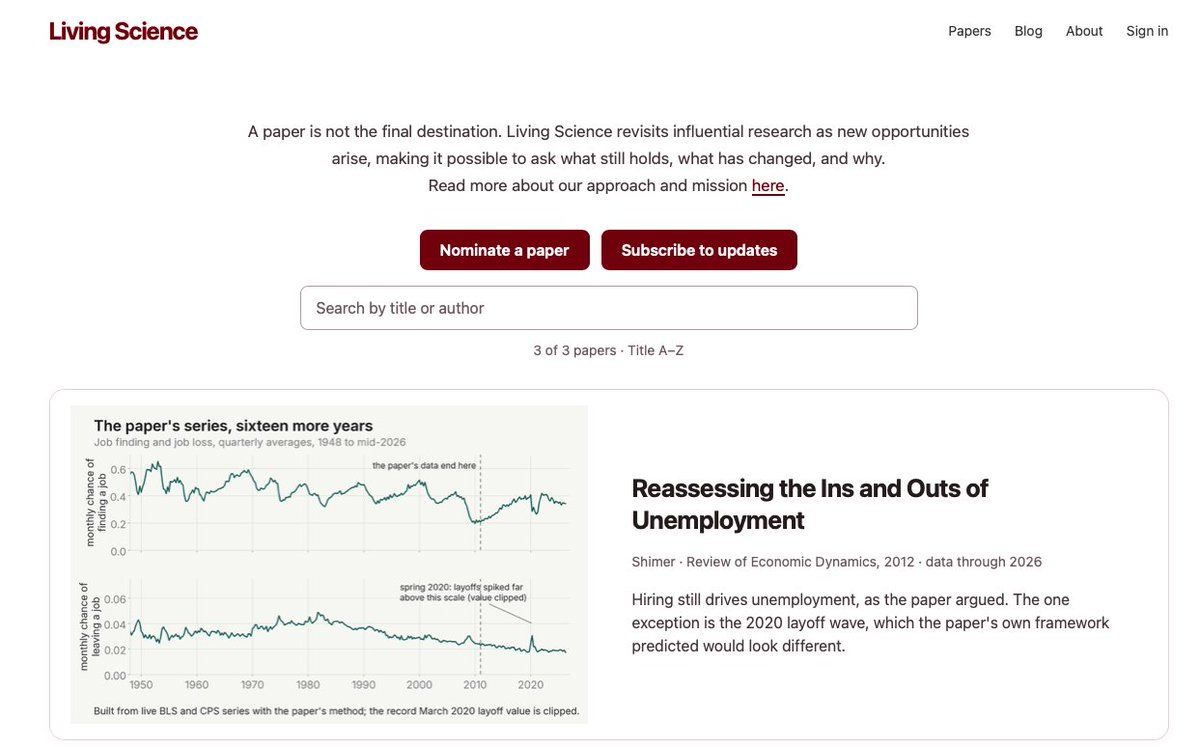
would love to see this extended to bio/chem/physics. lots of effort into using AI to generate new science, but figuring out which existing findings are solid enough to build on will arguably be more impactful.
Very interesting project: Living Science uses an AI agent to reproduce key findings from seminal papers in economics, document what holds up and extend the analysis with newer data. It's like a follow-up paper with robustness checks and extensions. New paper every week.
an underappreciated reason NIH funding is so durable: it's less about Congress believing in science, and more about the jobs it supports in lawmakers' home states and districts.
universities and academic medical centers are often among the largest local employers. a vote to cut NIH is a vote to cut jobs back home.
there's a lesson here for biotech. we spend a lot of time explaining why people should be excited about what excites us (cool science, new modalities). we should spend more time making sure our success shows up in things they already care about: jobs, their communities, affordable medicines, national security.
biotech's political future will depend as much on how widely it shares the benefits of innovation as on how much innovation it produces.
repeated, temporary U.S.–China trade deals create a paradox: ongoing uncertainty can convince manufacturers that they need alternatives to Chinese suppliers, while reducing their willingness to commit to one.
uneven progress in trade negotiations (tariff relief on $60 billion of select goods announced this morning, two-month extension of the broader truce, etc) creates a difficult timing problem for startups.
manufacturers urgently seek alternative suppliers when China restricts exports of critical materials. but temporary truces can give them a reason to wait and see whether access to Chinese supply improves before making a multiyear commitment to a newer, potentially more expensive domestic supplier.
startups need those commitments to finance production and achieve the scale needed to lower costs. customers can end up waiting for an alternative to become competitive while withholding the orders that would help it get there.
curious how other founders/investors have handled this, but seems logical to make it easy for customers to start small while urgency is high, eg paid qualification, followed by a recurring share of purchases that grows with demonstrated performance. agree upfront that those purchases continue when supply returns to normal, and secure minimum-volume commitments before expanding capacity.
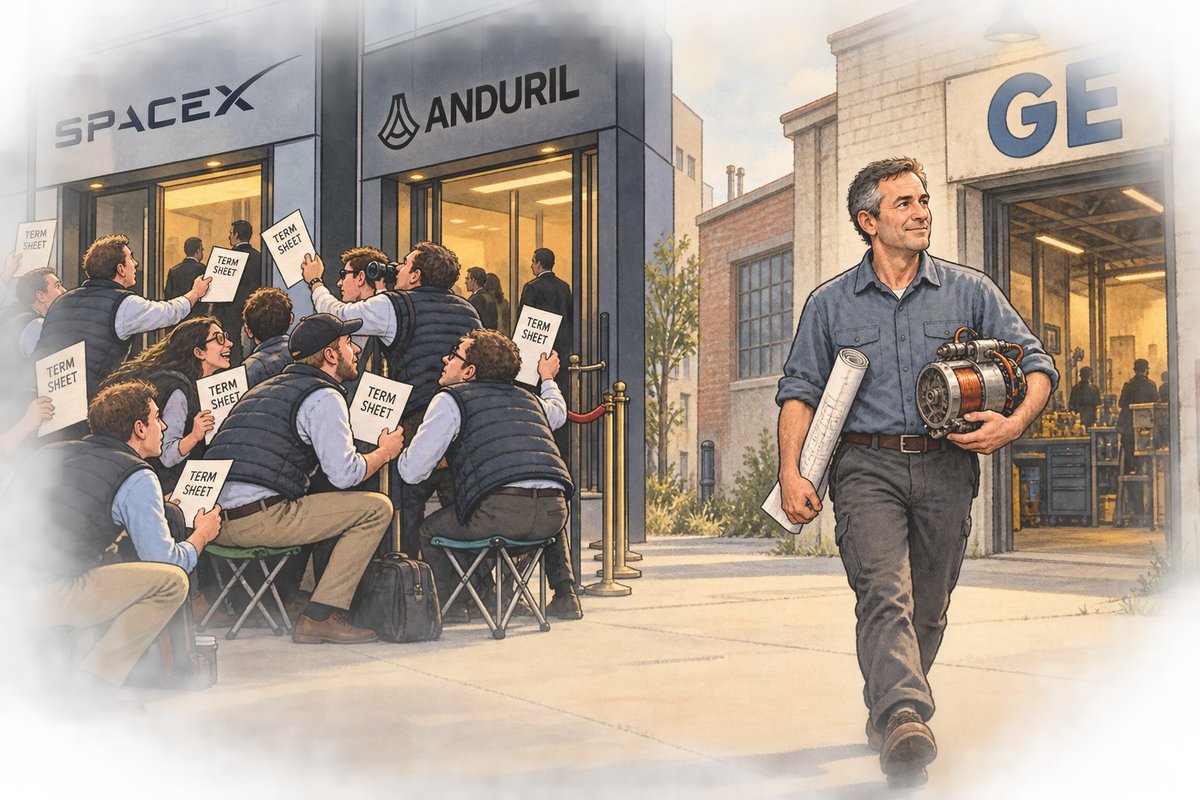
every hard tech investor is staking out SpaceX and Anduril alumni (us included).
but the underrated founder is 48, works at GE, knows exactly what to build, and is done asking permission.