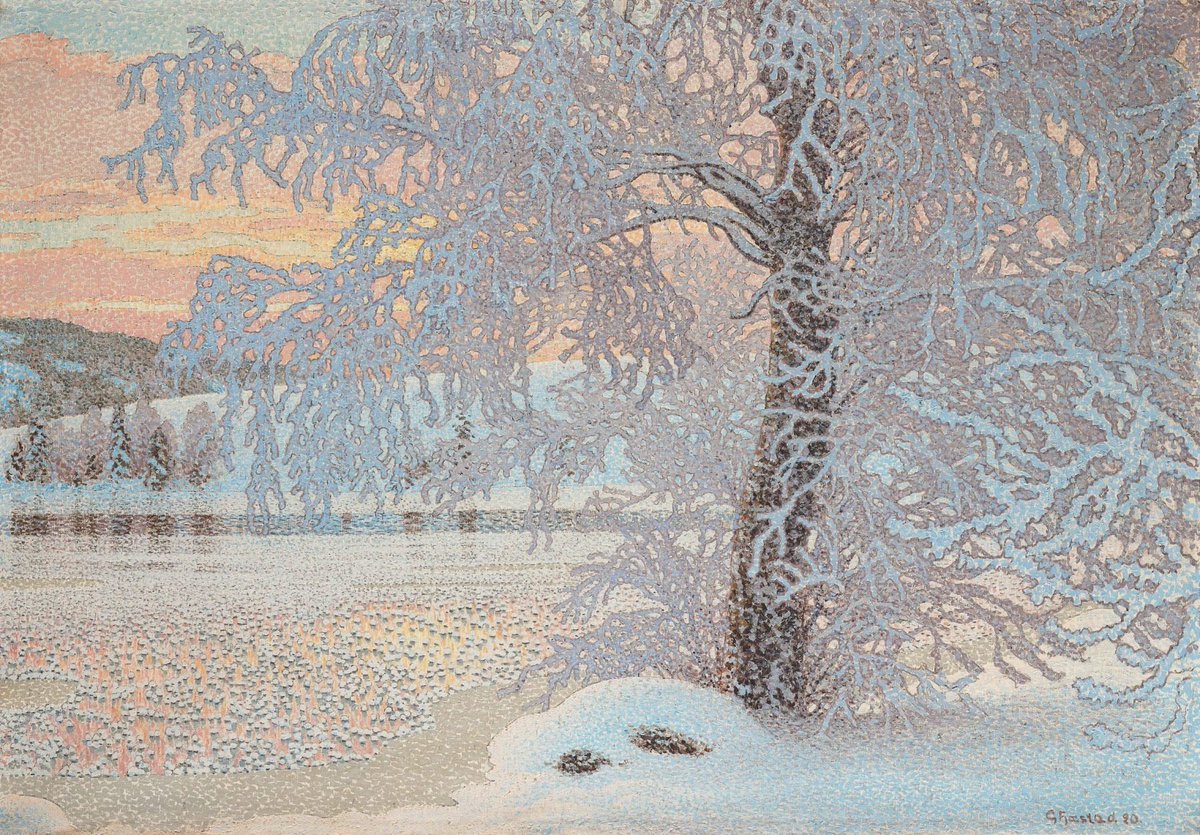
The walls that confine us are real, but they’re not necessarily hostile. Frustration, finitude, embodiment, consequences, other people, mortality... all the things that make material life feel confining are also the exact constraints through which we are shaped.
Verse 4, the climax, pivots from 3rd person to talking directly to God. "The valley of the shadow of death" is an immense primal threat, yet in the very next breath, it's subverted with "I will fear no evil." Even the cadence shifts from long, dark vowels to sharp sibilant sounds
No matter how many times I read it, Psalm 23 never fails to give me intense frisson. It is a masterfully crafted sacred text. It takes you from absolute peace straight into the ultimate symbol of human dread only to immediately subvert that dread into an unshakable safety.
Shame is not the opposite of love. It is a social signal: "Something about me/something I have done threatens my belonging, reputation, or value."
Sometimes the signal is distorted. Sometimes it's telling you something important. Love lets you examine it without becoming it.
Shame is the lowest vibrational emotion because it is the denial of your own personhood. It is the opposite of love, yet it too must be met with love. When we recognize shame as fleeting rather than a truth about who we are, we can begin to accept the parts of ourselves that we have most deeply rejected.
The ADHD brain explained.
A guide to understanding:
-What it really is
-How it develops
-Its neurochemistry
-The key environmental factors that impact these mechanisms
-How to rewire key pathways in order to be able to focus and crave hard tasks
-Alternative tools that can help repair the underlying biology of the disorder
-Why most treatments fail or have serious side effects -What actually moves the needle to get it under control
and more.
Here's what you need to know.
Thread🧵
transhumanism seeks to address fundamentally spiritual issues through material technology, inevitably leading to a whole lot of dissatisfaction and confusion
@Thomasdelvasto_ Was thinking about this the other day. A lot has to do with how orthodoxy is apophatic. The goal in prayer is communion with the other — a force outside of your own mind. They also have centuries of experience with prelest, so I can sorta recognize why there is an aversion to it.
There’s something in vasocomputation I’ve been calling a “stance” or way of feeling — stances are essentially discrete patterns of muscle tension (primarily vascular tension) that we can jump into and which offer specific affordances. The girl in this video is a great example: she goes from her default stance, to professional-calm, back to default (with a big release of tension)
Vasocomputation’s basic thesis is “vascular clenches stabilize neural patterns” — patterns of muscle tension will set certain aspects of phenomenology as constants and others as variables. I.e. every stance has a certain internal feeling that defines the stance and as long as you hold this feeling, you “hold frame” — if you lose the feeling (i.e. if this core pattern of stabilizing tension shifts), you break frame.
This would predict method actors will exhibit distinct patterns of muscle tension (especially vascular tension) across different roles; to take on a role is to take on a specific pattern of tension. Jung’s work on archetypes involve enumerating particularly natural and functional stances for us to fall into; subtle checkerboard patterns of tension & absence of tension we can inhabit that have useful affordances
We’re sort of fish-in-water in that we all have a default stance, i.e. a pattern of tension we habitually hold to feel like ourselves. Some of this tension is likely latched, and some isn’t; unlatched tension can be relaxed on the order of seconds-to-minutes if we find the right prompt, whereas latched tension will be constant across all situations until it’s explicitly released. What Buddhism calls the “self” will be a combination of latched tension (vascular muscle that is physically glued into a contracted state) and tension that is merely habitually clenched (i.e. *not* physically latched)
Vasocomputation suggests that every pattern of muscle tension is also a prediction, often held until some specific perception becomes true. Everybody has muscle tension; it’s worth thinking about what your particular pattern of muscle tension is predicting. Often it’ll be that a hidden list of very specific bad things will not happen; to know someone is to know their list
I think a really important part of childhood is learning the feeling of being loved & being safe, and incorporating these feelings into our default stance, the way we habitually hold our smooth muscle
The girl in this video has a very pleasant default stance — it is a pleasant thing to be her. But her default stance doesn’t seem to offer a wide range of social affordances, so she’s learned how to jump into a more professional mode (defined by a specific pattern of tension). But stress builds up when she inhabits it and uses its affordances; perhaps it feels transgressive to ask for room service
I'd like to imagine that some part of us exists beyond the reach of measurement. I would even go so far as to say I believe it. And yet, if you offered to show me the telemetry, I'd look.