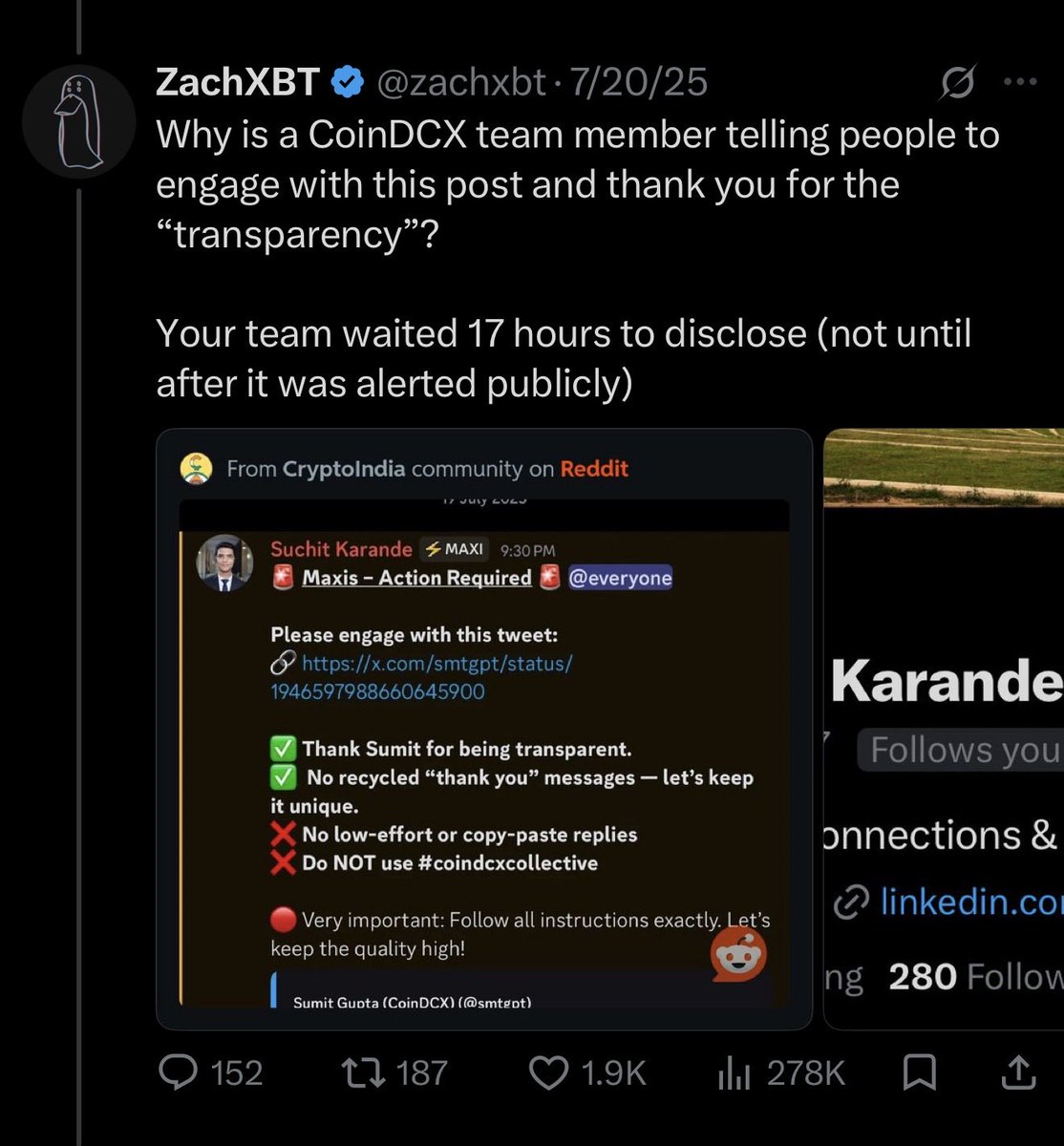
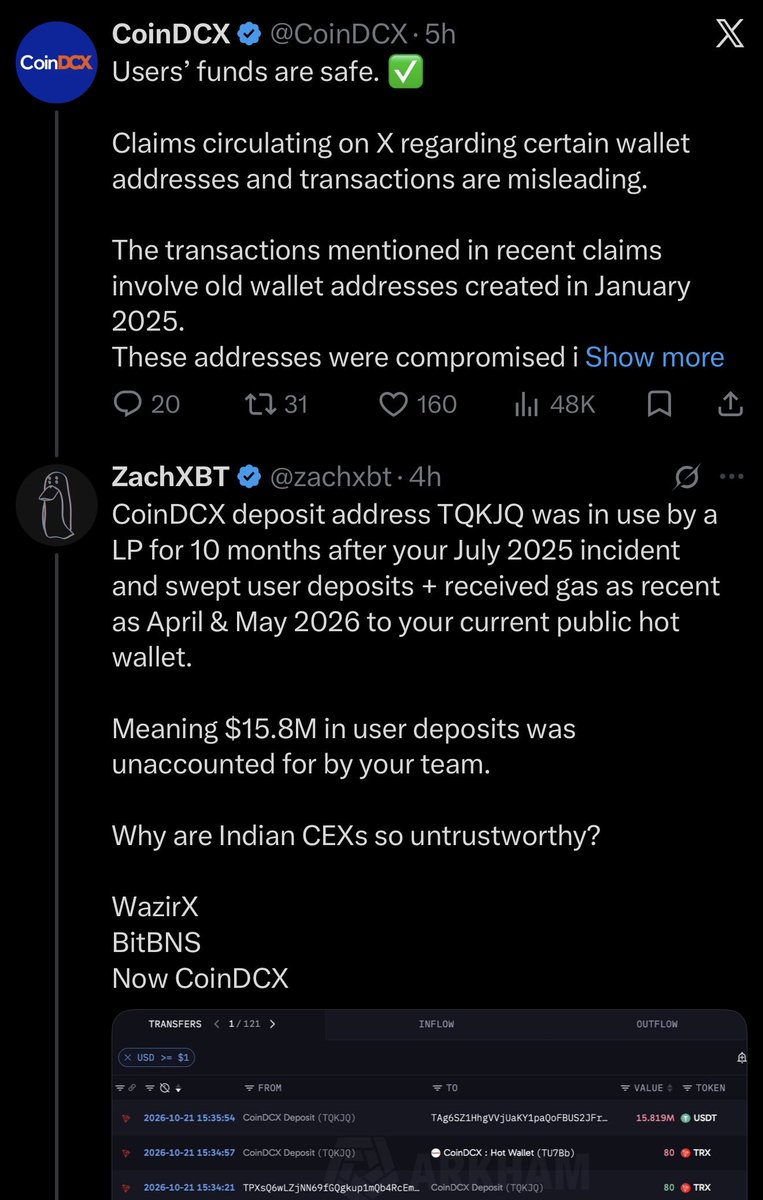
Withdraw all funds from CoinDCX if you value your assets.
Its co-founders are clowns running a circus.
They publicly and privately denied a theft of its assets occurred meaning they straight up lied or are negligently incompetent.
Later they disclosed the $16M theft and wasted everyone’s time instead of being transparent with the public initially.
Not the first time CoinDCX has done it.
Indian CEXs like CoinDCX, WazirX, BitBNS are all the same.
(I still helped freeze 6 figures for CoinDCX)
If you learn AI Security Engineering, you will never be unemployed again.
Stage 1: Threat Modeling & Foundations
- Learn: OWASP Top 10 for LLMs, MITRE ATLAS, STRIDE, trust boundaries.
- Practice: Threat model a RAG chatbot and map every place untrusted text enters the system.
Stage 2: Prompt Injection & Jailbreaks
- Learn: Direct vs indirect injection, instruction hierarchy, multi-turn attacks.
- Practice: Hijack a sandboxed agent with a poisoned webpage, then patch it.
Stage 3: Insecure Output Handling
- Learn: LLM-driven XSS, SQLi, SSRF, command injection, excessive agency.
- Practice: Exploit an app that pipes model output into a shell, then fix it with strict validation.
Stage 4: RAG & Vector DB Security
- Learn: Embedding poisoning, tenant isolation, ACL-aware retrieval.
- Practice: Plant a malicious document in a knowledge base and make the bot leak another user's data.
Stage 5: Agent & Tool Security
- Learn: Least privilege, confused deputy attacks, sandboxing, scoped credentials.
- Practice: Give an agent shell and email tools, then build a permission layer that blocks dangerous chains.
Stage 6: MCP Security
- Learn: Tool poisoning, rug pulls, tool shadowing, OAuth scopes, server authentication.
- Practice: Build a malicious MCP server that exfiltrates data, then write a scanner that catches it.
Stage 7: Data Leakage & Privacy
- Learn: PII exposure, training data extraction, membership inference, DLP.
- Practice: Extract memorized strings from a fine-tuned model and measure the leakage rate.
Stage 8: Model Supply Chain
- Learn: Pickle deserialization, safetensors, model signing, AI-BOM, typosquatting.
- Practice: Craft a malicious model file that executes code on load, then build a pipeline that refuses it.
Stage 9: Adversarial ML
- Learn: Evasion, data poisoning, backdoors, model extraction.
- Practice: Backdoor a small classifier with 1% poisoned data and detect it afterward.
Stage 10: Guardrails & Runtime Enforcement
- Learn: Input/output classifiers, policy engines, deterministic checks, human-in-the-loop.
- Practice: Put a policy gateway in front of an agent that blocks risky actions before they execute.
Stage 11: Red Teaming & Evals
- Learn: garak, PyRIT, promptfoo, attack success rate, regression suites.
- Practice: Automate a red-team pipeline in CI that fails the build when a new jailbreak lands.
Stage 12: Detection, IR & Governance
- Learn: Audit logging, anomaly detection, NIST AI RMF, ISO 42001, EU AI Act.
- Practice: Write an incident response playbook for a compromised agent, then run a tabletop exercise.
Chatbots are a commodity. AI Security is the physics of trust.
The modern AI Security Engineer builds the immune system for autonomous intelligence.
Bookmark and Repost!
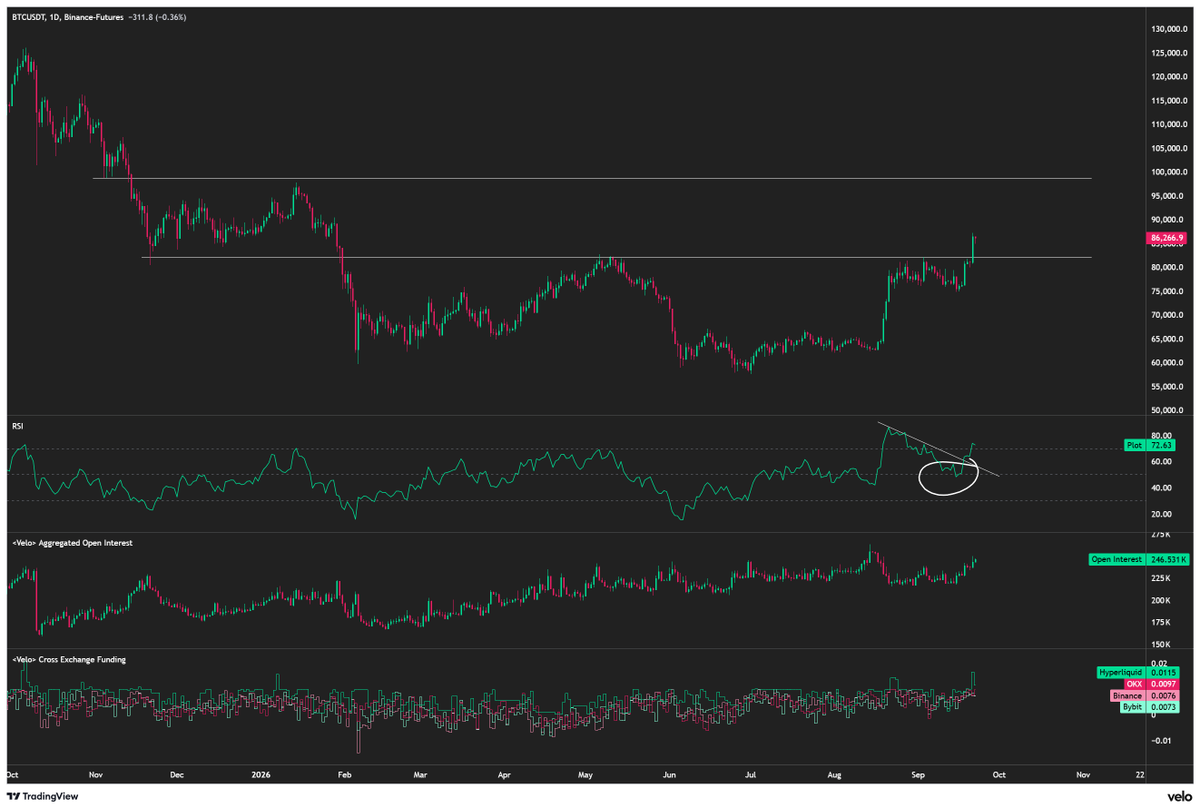
How to play the current meta.
As a trader:
1a. You think memecoins keep running but you have no edge -> buy the infra that earns on the volume: $UNI, solana:4k3Dyjzvzp8eMZWUXbBCjEvwSkkk59S5iCNLY3QrkX6R, solana:JUPyiwrYJFskUPiHa7hkeR8VUtAeFoSYbKedZNsDvCN.
If the mania is on Robinhood Chain, $ARB gets 10% share of that since it's an Orbit chain, and if Solana memes dominate then $SOL
1b. Could bet on tokenization platforms like $BP by Backpack or even Robinhood stock $HOOD
2. You believe in memes but want more exposure -> the launchpads, since every new token pays them first: $PONS, solana:6GmAFSYs4gk3FDao5FzzySQpPZaWsa4rUJHacpMpUNgx, solana:4k3Dyjzvzp8eMZWUXbBCjEvwSkkk59S5iCNLY3QrkX6R (LaunchLab) and $PUMP
3. More degen -> the main meme on whichever chain is winning: $AI, $CASHCAT, solana:HcRLc9VDgjLeK154xDawfb1dmVJ98DoSqcwTHGqiDeJR
4. You're in the trenches 24/7 -> you don't need this tweet and you already know your edge, the tg groups, the bots, the snipers.
5. You're an insider -> you launched the token last week and you're together with KOLs shilling or others simply followed your FOMO account.
As an LP:
1. Tokenized stock/USD pairs are the easy play.
IL stays small while fees stay high because arb bots keep the onchain price pinned to Nasdaq and every meme-to-stock rotation swaps through the pair.
Long tail yields without the long tail drawdown.
2. More degen -> LP the meme itself and accept the IL if it dumps.
Set and forget is also getting easier, Beefy and the other aggregators are adding more vaults for most of these pairs.
It feels strange to look at myself in this interview video by EO. What am I showing? I am showing my original "C++ by Hand" notes in my intro programming course many years ago, that eventually led to AI by Hand. ✍️
What else did I say? Here are some of my favorite self-quotes:
"I can only write at humanly possible speed by hand because students also learn at humanly possible speed"
"AI can't change who you are, but you can change AI"
"Tools can become obsolete but foundation will always stay"
Thanks Jiyoon Lim and the team for conducting the interview and producing this wonderful video. I can really see they understand me and keep these in the cut that speaks my heart. ❤️
Watch on YouTube: https://t.co/bv8D7mXOsV
New blackboard lecture w @reinerpope
How do chips actually work – starting with basic logic gates, and working up to why GPUs, TPUs, FPGAs, and the human brain each look the way they do.
0:00:00 – Building a multiply-accumulate from logic gates
0:16:20 – Muxes and the cost of data movement
0:25:59 – How systolic arrays work
0:39:00 – Clock cycles and pipeline registers
0:51:40 – FPGAs vs ASICs
1:03:14 – Cache vs scratchpad
1:07:16 – Why CPU cores are much bigger than GPU cores
1:11:49 – Brains vs chips
1:15:22 – A GPU is just a bunch of tiny TPUs
Look up Dwarkesh Podcast on YouTube/Spotify/etc to watch. Enjoy!
A friend of mine was on a sabbatical and he's just back to work, so he basically lost the whole AI revolution
I shared the most important learning materials
- auto research by @karpathy
- harness engineering by @OpenAI
That's it. All the rest is ephemeral
"Open Data Structures" is another very useful free resource for anyone interested in data structures and algorithms.
The book covers the implementation and analysis of fundamental structures such as array-based lists, linked lists, hash tables, binary trees, red-black trees, heaps, sorting algorithms, graphs, and data structures for integers.
It is a serious open textbook for studying one of the foundations of computer science, and a resource worth keeping close at hand as a reference.
https://t.co/bPDobBHhX1
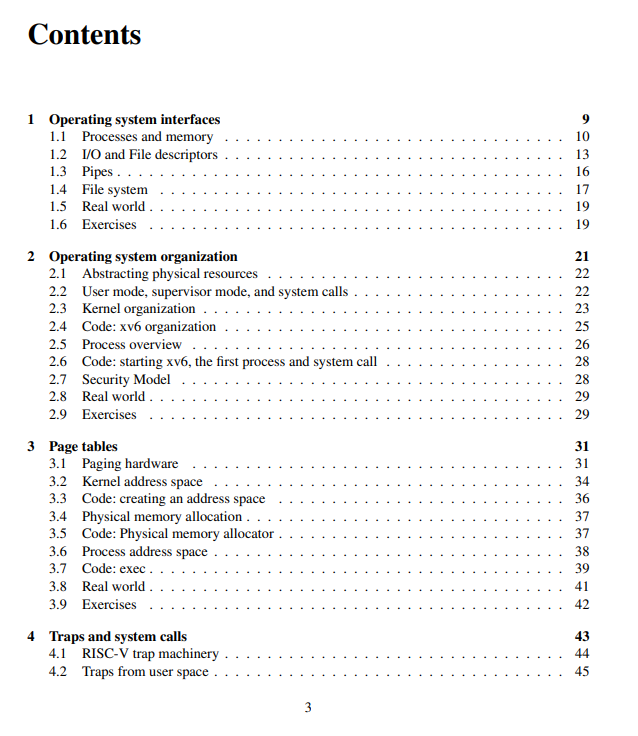
MIT teaches operating systems by giving students a complete Unix like kernel and asking them to modify it
it is called xv6 and is about 6000 lines of C a reimplementation inspired by Unix Version 6 from 1975 rewritten in modern C for x86 multiprocessor
processes system calls virtual memory and filesystem are all there and small enough to read end to end in a weekend
this is what you study to understand how operating systems actually work not just how they are described
He built it over a weekend. For himself. Today every developer on the planet uses it.
Meet Abhinav Asthana ,the IIT kid who built a $5.6B company from a Chrome extension.
> Born in Kanpur. IIT Bombay. Computer Science.
> Interned at Yahoo Bangalore in 2010.
> One frustration kept following him.
> Testing APIs was a nightmare. No clean tool existed.
> So he built one.
> In 2012 - A Chrome extension. Built on weekends. Named it Postman. Put it on the Chrome Web Store and forgot about it.
> Downloads started trickling in.
> Then flooding.
> His manager had no idea.
> The "side project" was quietly becoming the most downloaded developer tool in the Chrome store.
> Half a million developers. Zero marketing spend.
> In 2014 — quit his job.
> Team of 3. Office in Bangalore.
> Before Bangalore startups were cool.
> Growth strategy? None.
> Just a tool so good — developers told other developers.
> In 2016 → 1M users.
> In 2019 → 7M users. $500M valuation.
> In 2021 → 30M users. $5.6B valuation.
> No cold outreach. No sales team. No ads.
> Pure product-led growth — before anyone called it that.
> Today 98% of Fortune 500 companies use Postman.
> Every API in the world — tested, built, documented — runs through something he built over a weekend in 2012.
From Kanpur to the global developer stack.
Absolute legend.
simple iOS games are so underrated
there are dozens of sudoku apps doing $10k+/mo
it’s such a simple idea:
- huge audience
- works across multiple age groups
- easy to make more appealing with features, themes or progression systems
and the best part is
you don’t even need a paywall
you can literally ship something like this with Anything and monetize it with subtle ads for hints or extra features
You should tell Claude, ChatGPT, etc to talk to you like a caveman.
I'm being dead serious.
I stole a caveman prompt from @mattpocockuk and it cuts token usage by 75% (read: saves you/your company a boatload of $$$). It does so by turning your chat into an ultra-compressed communication mode that removes filler, articles, and pleasantries while keeping full technical accuracy.
Here's how to set it up:
• Step 1: Copy this prompt
Respond terse like smart caveman. All technical substance stay. Only fluff die.
## Persistence
ACTIVE EVERY RESPONSE once triggered. No revert after many turns. No filler drift. Still active if unsure. Off only when user says "stop caveman" or "normal mode".
## Rules
Drop: articles (a/an/the), filler (just/really/basically/actually/simply), pleasantries (sure/certainly/of course/happy to), hedging. Fragments OK. Short synonyms (big not extensive, fix not "implement a solution for"). Abbreviate common terms (DB/auth/config/req/res/fn/impl). Strip conjunctions. Use arrows for causality (X -> Y). One word when one word enough.
Technical terms stay exact. Code blocks unchanged. Errors quoted exact.
Pattern: `[thing] [action] [reason]. [next step].`
Not: "Sure! I'd be happy to help you with that. The issue you're experiencing is likely caused by..."
Yes: "Bug in auth middleware. Token expiry check use `<` not `<=`. Fix:"
### Examples
**"Why React component re-render?"**
> Inline obj prop -> new ref -> re-render. `useMemo`.
**"Explain database connection pooling."**
> Pool = reuse DB conn. Skip handshake -> fast under load.
## Auto-Clarity Exception
Drop caveman temporarily for: security warnings, irreversible action confirmations, multi-step sequences where fragment order risks misread, user asks to clarify or repeats question. Resume caveman after clear part done.
Example -- destructive op:
> **Warning:** This will permanently delete all rows in the `users` table and cannot be undone.
>
> ```sql
> DROP TABLE users;
> ```
>
> Caveman resume. Verify backup exist first.
• Step 2: Create a new skill
- In Codex: click plugins --> create --> create skill
- In Claude: click customize --> create new skills --> + create skill --> write skill instructions
• Step 3: Paste the prompt
• Step 4: anytime you work with an LLM now (and want to save tokens), invoke the caveman skill by starting your prompt with /caveman.
P.S. i want to keep sharing helpful skills/prompts/plugins, so feel free to share your favorites and i may feature yours in the future!
Been reading Rust AI infra codebases lately and half the engineering is basically:
“how do we move absurd amounts of tokens around without copying memory 14 times”
Arc, Cow, mmap, batching, lock-free queues, pinned buffers, cache locality.
Rust doesn’t magically make these systems faster, It just exposes bad architecture immediately.
Which is probably why serious infra teams keep reaching for it?