One person will win a Wacom One every day! Just follow & repost this post to enter. Open to all! Today is day 4! 3 more chances! Plus, get up to 60% off on Clip Studio Paint! Ends November 28, 2023, 8:00 a.m. UTC/GMT. Details: https://t.co/SmT4Ozjqhq
12 Reasons Why Cities Need More Trees:
1. Temperature Control
One large tree is equivalent to 10 air conditioning units, and the shade they provide can reduce street temperature by more than 30%.
2. Noise Reduction
Trees can reduce loudness by up to 50%. In urban areas filled with the sound of cars, construction, sirens, aeroplanes, and music, trees are essentially the best way to block noise and keep cities — along with the homes and workplaces in them — quieter.
3. Air Purity
Trees remove an astonishing amount of harmful pollutants and toxins from the air. In urban areas air quality is often disastrously bad — with severe consequences for our health. Trees make the air we breathe much cleaner.
4. Oxygen
And, while absorbing all those pollutants, trees also put more oxygen back into the urban environment. Oxygen levels are significantly lower in cities compared to the countryside; trees help to solve that problem.
5. Water Management
Trees do more than just shelter us and our buildings from rain — which is, in fact, extremely important. They also absorb huge quantities of water, reduce run-off, neutralise the severity of flooding, and make flooding more unlikely altogether. Not to forget that their roots absorb pollutants and prevent them from feeding back into a city's water supply.
6. Psychological Health
Studies have proven what we instinctively know to be true: that human beings are significantly happier when surrounded by nature rather than sterile urban environments. Our emotions, behaviour, and thoughts are shaped by the places we spend time — and trees have a profoundly positive effect on our psychology. The consequential benefits of being happier and more peaceful — as individuals and as a society — are immense.
7. Physical Health
Beyond all the other ways in which trees improve air quality and the urban environment, much to the benefit of our health, they also encourage people to go outside. Cycling, running, and walking are all more common in urban areas with plenty of trees. A knock-on effect of people spending more time outdoors is also social integration and stronger communities.
8. Privacy
A simple point, but not inconsequential, is that trees provide privacy.
9. Economics
The total economic benefit of urban trees is hard to calculate. There are costs, of course, including the repair of infrastructure damaged by roots and maintaining the trees themselves. But the total economic benefit — a consequence of everything else in this list and more — far outweighs the expenditure. Trees make cities wealthier.
10. Wildlife
Trees are miniature cities all of their own, serving as a habitat for hundreds of different species, including birds and mammals and insects.
11. Light Pollution
Trees don't only block the light shining down, therefore keeping us and our cities cooler — they also disrupt light shining up, from street lighting, cars, houses, and billboards. Skies are clearer in cities with more trees.
12. Aesthetics
And, finally, trees are beautiful. They break up the potential monotony of urban environments — the sharp geometry, the greyscale roads and buildings, the endless rows of cars — with their trunks, boughs, canopies, and flowers.
Just think: the gold and red of falling leaves in autumn, the white and pink blossom of spring, the vast green canopies of summer, and the branches lined with hoar-frost in winter. Every single tree is a myriad of intricacy and texture, of colour and scent, of dappled light on the pavement, mottled bark, knotted roots, of clustered leaves and delicate petals and stern boughs.
Few streets would not be improved by the kaleidoscopic aesthetic delights of a tree, not to mention the many different species of tree, all over the world, whether willow, oak, lime, cherry, aspen, maple, birch, horse chestnut, dogwood, hornbeam, ash, sycamore... the list goes on.
There are some drawbacks to urban trees, most of them context-specific, and they are not — of course — universally appropriate. But it seems fair to say that many cities would benefit from at least a few more trees here and there.
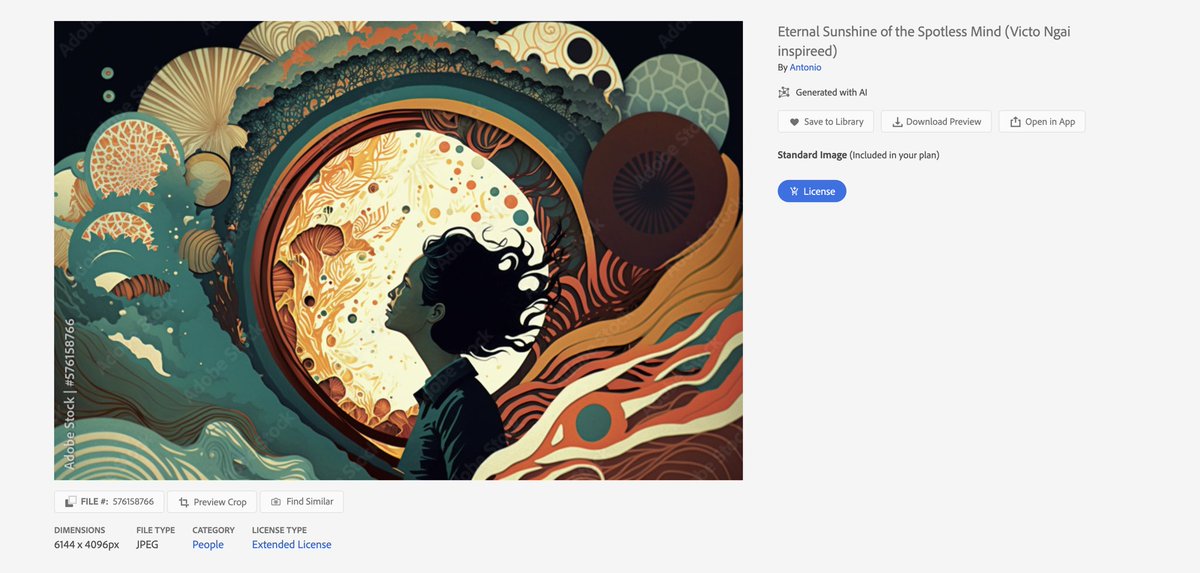
Dear @Adobe You mentioned your AI images uses the Adobe stock library only and guarantees the artist gets a royalty.
Then can you explain why my name is in your library and there are a bunch of AI generated images with my name without my consent or prior knowledge?
Please RT
Today I’m hearing all of the good old boys and girls saying if you don’t like Jason Aldean you don’t have to listen to him. Gotcha. And if you don’t like certain library books you don’t have to ban them ‘cause you ain’t going to read them.
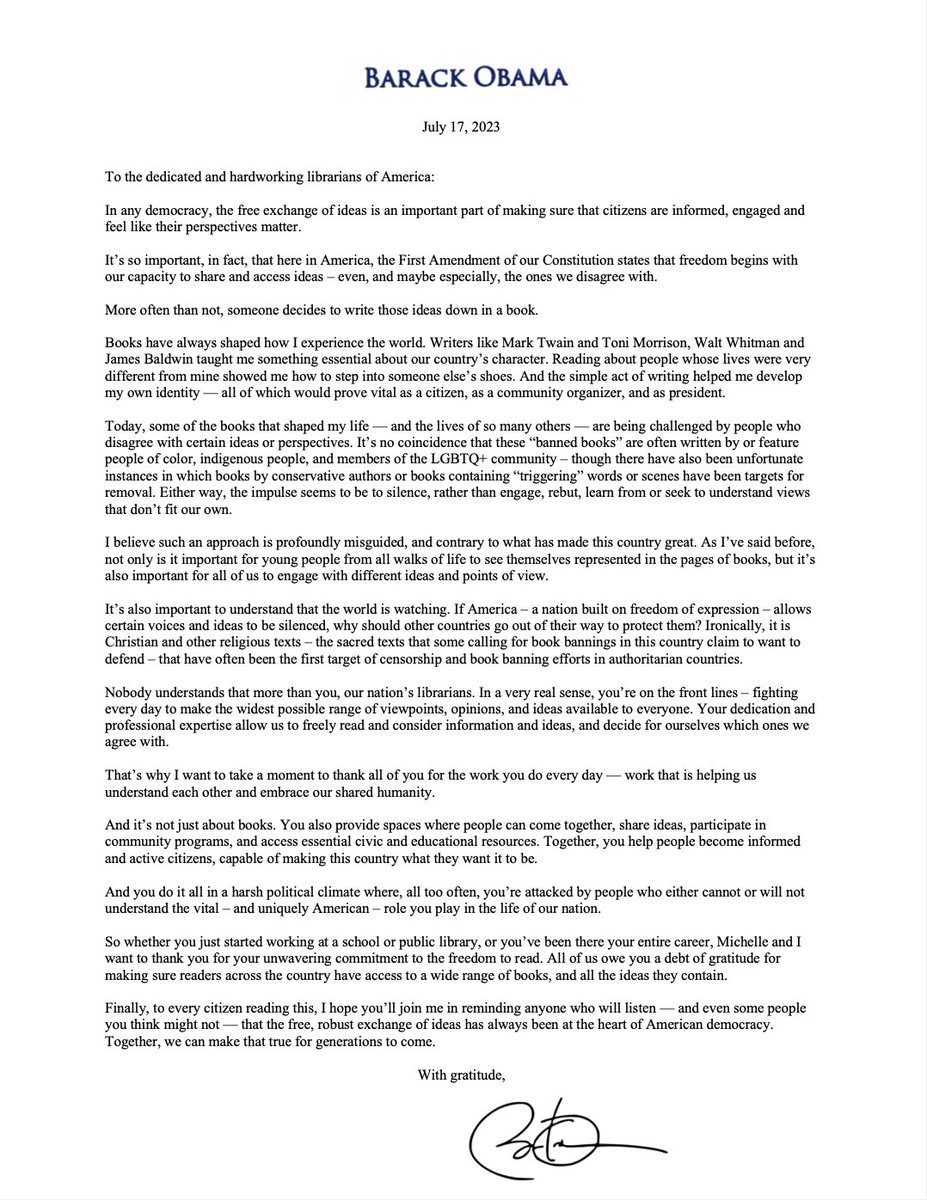
Today, some of the books that shaped my life—and the lives of so many others—are being challenged by people who disagree with certain ideas or perspectives. And librarians are on the front lines, fighting every day to make the widest possible range of viewpoints, opinions, and ideas available to everyone.
I LITERALLY stopped working on my memo so I could read this indictment.
I am on page 24 and JESUS LUPITA NYONG'O CHRIST.
HOW this man still has the capacity to shock me after everything that's happened, i'll never know.
but I am sitting here *STUNNED*.
James Cameron has written & directed 3 of the top 4 highest-grossing movies of all time (Avatar, Avatar: The Way of Water, and Titanic).
Before he made movies, Cameron was a truck driver.
He didn't go to film school.
Instead, on the weekends, he would go to the library and..
"I'd pull any thesis that [University of Southern California] graduate students had written [on] anything that related to film technology," Cameron explained.
"And for the cost of xeroxing (photocopying), I [got] all these doctoral dissertations [and] build up these big binders on how everything was done."
"So I literally gave myself a full graduate course on film technology for about $120.
I didn’t have to enroll in school because it was all there in the library. I’d set it up to go in like I was on a tactical mission, find out what I needed to know, and take it all home."
Takeaway 1:
When asked what motivated him to read those big binders full of information on filmmaking, Cameron said he was just following what excited him.
"People seek out the information and knowledge they need," he said. "It's like a divining rod."
The mythologist Joseph Campbell similarly talked about how reading is like "a divining rod," a way to find what you are uniquely attracted to and meant to do.
"You’ve got to read," Campbell said. "Find [what] excites you. And if it doesn’t excite you…It’s not yours.”
Takeaway 2:
Of course, at some point, Cameron had to put the binders down and pick up a camera.
When he eventually attempted to make his first movie, Cameron said, “It was a bit like a doctor doing his first appendectomy after having only read about it."
The bestselling author and learning expert, Scott Young, has a great article with a great title, "Do The Real Thing."
"When you examine case studies of people who have had major accomplishments," Scott writes, "you expect there to be some trick or shortcut...More often, however, the strategy used is dead simple: doing the real thing."
Takeaway 3:
Leonardo da Vinci used to sign off his letters, “Leonardo da Vinci, disscepolo della sperientia” ("disciple of experience").
He used to believe that one learns best by solely "doing the real thing."
Over time, however, he evolved out of this belief and, biographer Walter Isaacson writes, "became a disciple of both experience and received wisdom."
When you examine case studies of people who have mastered their craft, you usually find they are "disciples of both experience and received wisdom."
Like Cameron, they read the library and they do the real thing.
- - -
“Those who are in love with practice without theoretical knowledge are like the sailor who goes onto a ship without rudder or compass and who never can be certain whither he is going.” — Leonardo da Vinci
Follow @bpoppenheimer for more content like this!
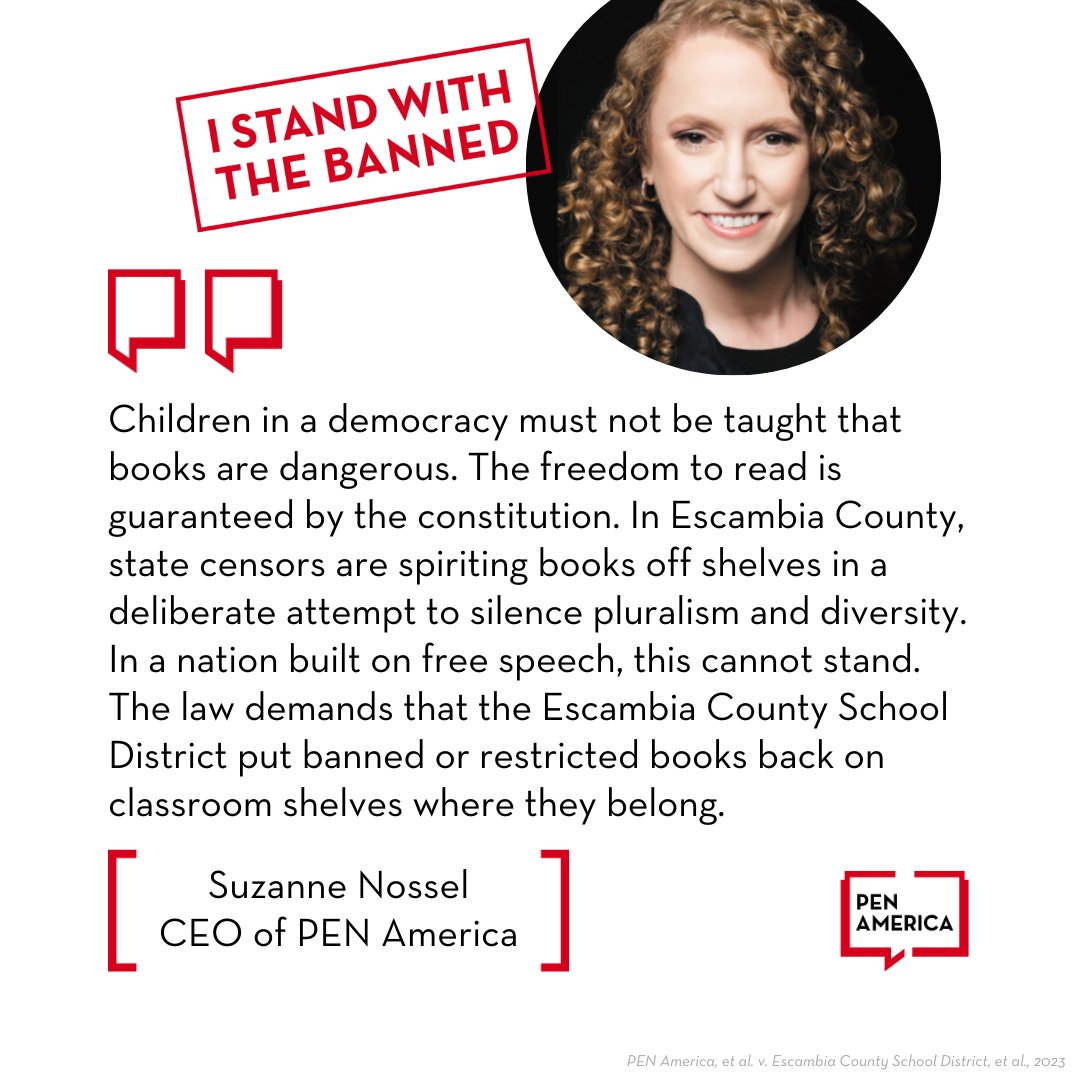
PEN America v. Book Bans:
Our lawsuit brings together authors whose books have been removed or restricted and parents and students in the district who cannot access the books, in a first-of-its-kind challenge to unlawful censorship. Today's press release: https://t.co/yyAqx8BtH4




![bpoppenheimer's tweet photo. James Cameron has written & directed 3 of the top 4 highest-grossing movies of all time (Avatar, Avatar: The Way of Water, and Titanic).
Before he made movies, Cameron was a truck driver.
He didn't go to film school.
Instead, on the weekends, he would go to the library and..
"I'd pull any thesis that [University of Southern California] graduate students had written [on] anything that related to film technology," Cameron explained.
"And for the cost of xeroxing (photocopying), I [got] all these doctoral dissertations [and] build up these big binders on how everything was done."
"So I literally gave myself a full graduate course on film technology for about $120.
I didn’t have to enroll in school because it was all there in the library. I’d set it up to go in like I was on a tactical mission, find out what I needed to know, and take it all home."
Takeaway 1:
When asked what motivated him to read those big binders full of information on filmmaking, Cameron said he was just following what excited him.
"People seek out the information and knowledge they need," he said. "It's like a divining rod."
The mythologist Joseph Campbell similarly talked about how reading is like "a divining rod," a way to find what you are uniquely attracted to and meant to do.
"You’ve got to read," Campbell said. "Find [what] excites you. And if it doesn’t excite you…It’s not yours.”
Takeaway 2:
Of course, at some point, Cameron had to put the binders down and pick up a camera.
When he eventually attempted to make his first movie, Cameron said, “It was a bit like a doctor doing his first appendectomy after having only read about it."
The bestselling author and learning expert, Scott Young, has a great article with a great title, "Do The Real Thing."
"When you examine case studies of people who have had major accomplishments," Scott writes, "you expect there to be some trick or shortcut...More often, however, the strategy used is dead simple: doing the real thing."
Takeaway 3:
Leonardo da Vinci used to sign off his letters, “Leonardo da Vinci, disscepolo della sperientia” ("disciple of experience").
He used to believe that one learns best by solely "doing the real thing."
Over time, however, he evolved out of this belief and, biographer Walter Isaacson writes, "became a disciple of both experience and received wisdom."
When you examine case studies of people who have mastered their craft, you usually find they are "disciples of both experience and received wisdom."
Like Cameron, they read the library and they do the real thing.
- - -
“Those who are in love with practice without theoretical knowledge are like the sailor who goes onto a ship without rudder or compass and who never can be certain whither he is going.” — Leonardo da Vinci
Follow @bpoppenheimer for more content like this!](https://pbs.twimg.com/media/FyDsJLPXsAIX5UE.jpg)