PRESIDENT RAMAPHOSA GRANTS FINAL EXTENSION OF MADLANGA COMMISSION REPORT DEADLINE
President @CyrilRamaphosa has extended - to Monday, 25 January 2027 - the deadline for the submission of the final report of the Madlanga Commission of Inquiry into Criminality, Political Interference, and Corruption in the Criminal Justice System.
The new deadline allows the Commission to process additional evidence, including the testimony of various experts who have made recommendations relating to the Commission’s terms of reference.
President Ramaphosa once again expresses his deepest appreciation for the work conducted by Commission as well as for the manner in which law enforcement agencies are following up testimony emerging from Commission hearings.
ISSUED BY THE PRESIDENCY OF THE REPUBLIC OF SOUTH AFRICA
Incredible, every African countries needs to emulate Ghana in this by embracing their languages as a medium of instruction while English can serve as a subject.
The National Treasury has rung the alarm bells over municipalities’ sluggish expenditure on infrastructure grants in the second quarter of the 2023/24 fiscal year, pinpointing potential repercussions for community service delivery.
https://t.co/EUvWeM2OEG
"All roads must be travelled,
I pray for Afrika to Unite...
Let's put our food in one plate and let us eat together.
Let us share the calabash of palm wine and warm our bodies on one fire. If you harvest we have harvested.
Let us dance together to the sound of the drum and assemble together to the call of the kudu horn.
Let's eat the soil when we get to new places and pour water to the ground before we drink it."
~Maponga Joshua III FoT
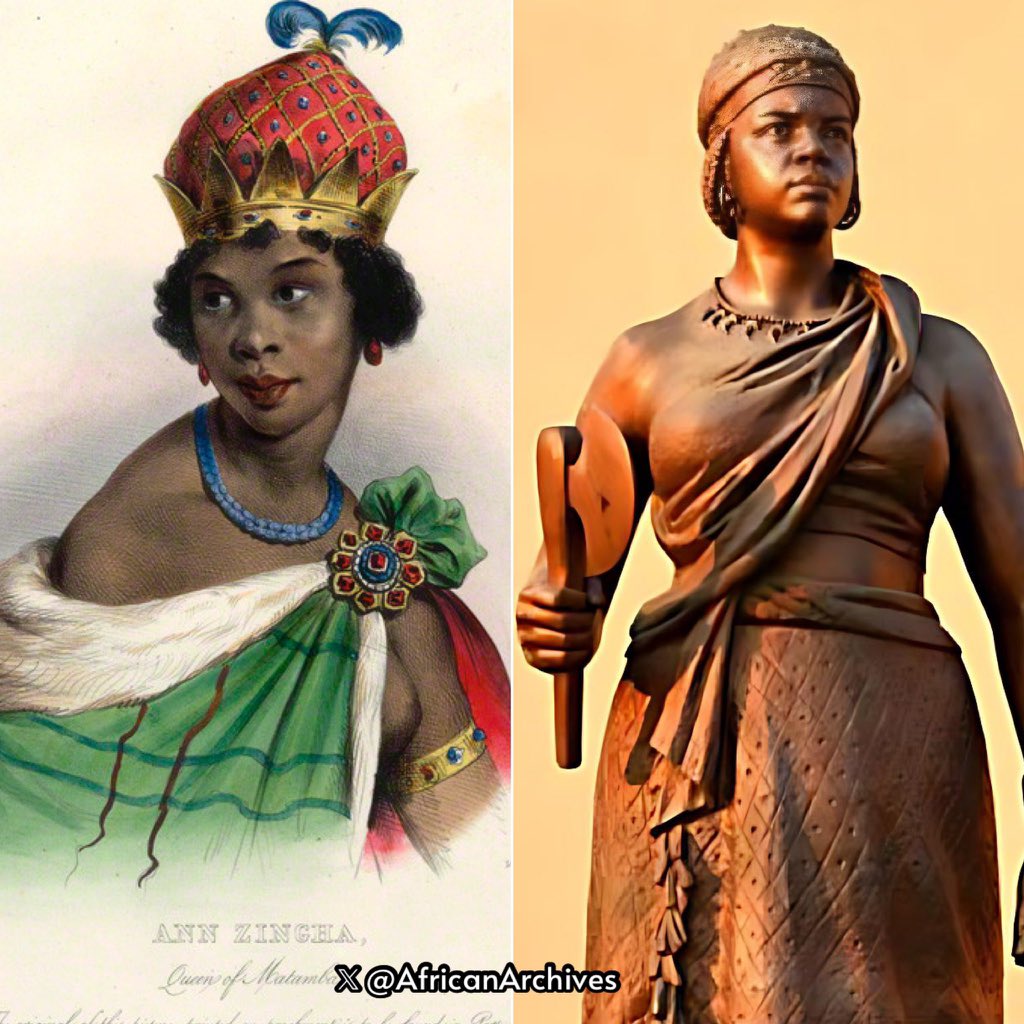
Queen Nzinga Mbande, a warrior queen of the Nzinga and Matamba and one of the greatest female African rulers. She led the stiffest opposition to European dominaion in Africa's interior, winning battle after battle against the Portuguese. #WomenHistoryMonth
Nzingha, also known as Ana de Sousa Nzingha Mbande, was a 17th century Queen of the Ndongo and Matamba Kingdoms of the Mbundu people in southwestern Africa (Ngola was both a name and a title in Ndongo).
Nzinga was a powerful monarch who successfully kept the Portuguese out of her land for 35 years. In order to fight off Portugal, (who wanted to conquer the area to further the slave trade) she conquered neighboring kingdoms to expand her territory and aligned herself with the Dutch.
During the late 16th Century, the French and the English threatened the Portuguese near monopoly on the sources of slaves along the West African coast, forcing it to seek new areas for exploitation. By 1580 they had already established a trading relationship with Afonso I in the nearby Kongo Kingdom. They then turned to Angola, south of the Kongo.
The Portuguese established a fort and settlement at Luanda in 1617, encroaching on Mbundu land. In 1622 they invited Ngola (King) Mbande to attend a peace conference there to end the hostilities with the Mbundu. Mbande sent his sister Nzinga to represent him in a meeting with Portuguese Governor Joao Corria de Sousa. Nzinga was aware of her diplomatically awkward position.
She knew of events in the Kongo which had led to Portuguese domination of the nominally independent nation. She also recognized, however, that to refuse to trade with the Portuguese would remove a potential ally and the major source of guns for her own state.
In the first of a series of meetings Nzinga sought to establish her equality with the representative of the Portugal crown. She converted to Christianity and adopted the name Dona Anna de Souza. Shortly afterwards Nzinga ordered the conversion of his people to Christianity.
In 1626 Nzinga became Queen of the Mbundu when her brother committed suicide in the face of rising Portuguese demands for slave trade concessions. Nzinga, however, refused to allow them to control her nation. In 1627, after forming alliances with former rival states, she led her army against the Portuguese, initiating a thirty-year war against them. She exploited European rivalry by forging an alliance with the Dutch who had conquered Luanda in 1641. With their help, Nzinga defeated a Portuguese army in 1647. When the Dutch were in turn defeated by the Portuguese the following year and withdrew from Central Africa, Nzinga continued her struggle against the Portuguese. Now in her 60s she still personally led troops in battle.
She also orchestrated guerilla attacks on the Portuguese which would continue long after her death and inspire the ultimately successful 20th Century armed resistance against the Portuguese that resulted in independent Angola in 1975.
Despite repeated attempts by the Portuguese and their allies to capture or kill Queen Nzinga, she died peacefully in her eighties on December 17, 1663.
🖊️As the only admin behind this page, I try to research to educate. If you appreciate this effort, you can support to help the page thrive on https://t.co/vf5SMSPu4z. Your support is deeply appreciated! (Or just the ko-fi page for articles/posts roundup)