Out now in Nanoscale (@nanoscale_rsc): presenting "CoffeeBots," a low-cost solution for eliminating various pollutants from water using spent coffee grounds as a base material. Or, as we put it in the title, "eliminating waste with waste."
https://t.co/BAvVmupK7b
We published a pair of modeling papers on electrocatalytic self-pumping membranes. Flow in such pores is heavily influenced by pore radius and pH, and less so by porosity, pore length, tortuosity, and pore defects. https://t.co/leyfmDQzSe https://t.co/PahCfLcTBk
@NSF@Space_Station This work is a collaboration with @WarsingerLab and @ISS_CASIS. More information can be found in this piece written earlier this year by @GeorgeMasonU news:
https://t.co/s0nOWaczyv
8-year-old me (obsessed with space) is flipping out with excitement.
Thrilled to report that we've received @NSF funds to send an experiment to the Int'l @Space_Station in 2025! The experiment will quantify aerosols' migration in response to temperature gradients. Aerosols in atmosphere affect climate, so we hope this work informs climate models.
I am in awe of the work being done in this @GeorgeMasonU lab.
It was an honor to tell the story of how we can make clean water more accessible with these brilliant scientists.
https://t.co/PJQKr8V9Oh
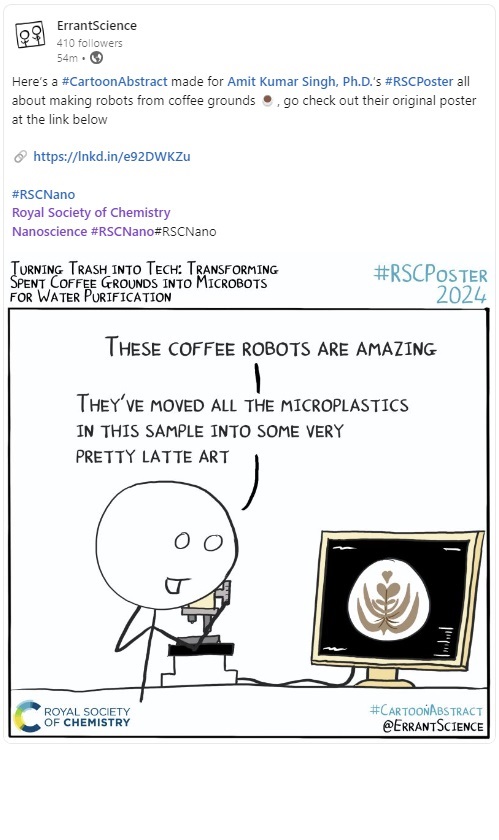
Thank you @ErrantScience for this cute #CartoonArt on our #RSCPoster. Do check our team's @MoranLabGMU
poster on LinkedIn - "Turning Trash to Tech: Transforming Spent Coffee Grounds into Microbots for Water Purification" from @GeorgeMasonU
Link: https://t.co/5ALMY2XvpP
Thanks to Teresa @Mason_CEC for the nice article (linked in Amit's post below) describing our paper on using CoffeeBots to remove various water pollutants.
Link to paper, out now in @nanoscale_rsc: https://t.co/BAvVmupK7b
As a part of @GeorgeMasonU 's research updates, we @MoranLabGMU were featured for our work on spent coffee grounds-derived magnetic microswimmers for removing emerging water pollutants.
https://t.co/cViv1EpzWj
Cheers to Amit and Tarini for all their hard work on this project. You both have bright futures ahead of you. Thanks also to @TJHSST_Official (esp. Dr. Armond Bass) for facilitating Tarini's internship in my lab that led to this collaboration, and for facilities help.
Out now in Nanoscale (@nanoscale_rsc): presenting "CoffeeBots," a low-cost solution for eliminating various pollutants from water using spent coffee grounds as a base material. Or, as we put it in the title, "eliminating waste with waste."
https://t.co/BAvVmupK7b
This technology could be used today anywhere in the world, but could be especially useful in parts of the world where (1) there's an urgent need for clean water; (2) coffee is grown and/or consumed in large quantities.
Myself, Dr. Jeff @MoranLabGMU and Dr. Shrishti @wellfedscienti1 are Guest Editors for special thematic issue of Micromachines (I. F. 3.4) @micromach_mdpi - "Active Particles for Drug Delivery and Theranostics" ..If you are interested to submit do contact us!
Deadline: 31st March 2024.
https://t.co/085NOYrA3f
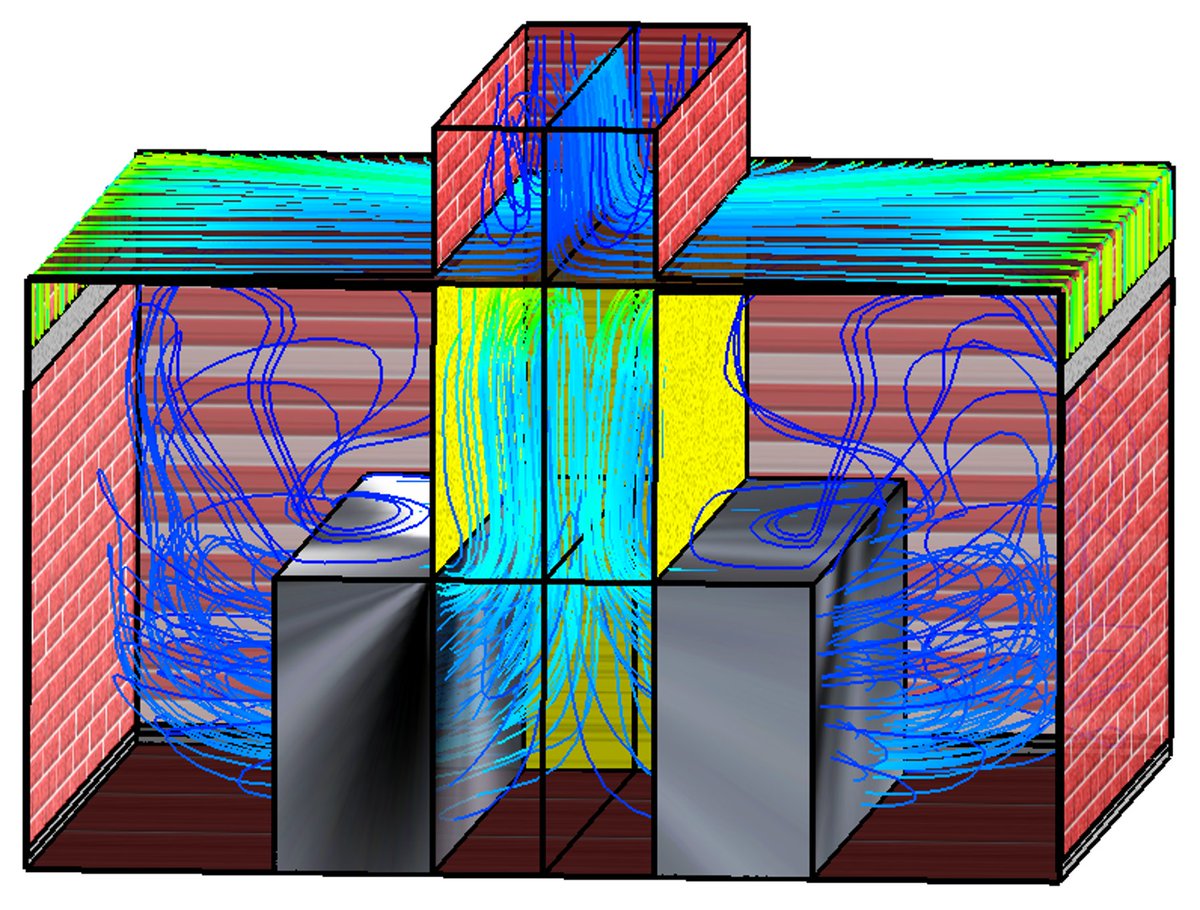
Next, stop by Sajad's poster presenting his vision for lowering the carbon footprint of large #DataCenters via advanced coolants and structural redesign. Poster S01.156 (it's listed in the program as 158). The poster session is from 3:34 to 4:25 this afternoon in Hall D.
Great to be at #apsdfd2023, where our group has both a talk and a poster today. First, come see Jacob discuss our work on enhancing thermal mixing with artificial #microswimmers! Showtime is 2:03p, room 154AB.
This project first started in 2020, and it's great to see another fun collaboration with @HitszWang's group come to fruition. Big thanks to all my coauthors, especially @Xianglong_Lyu, for all the hard work!
Hot off the presses in @acsnano: a comprehensive review, >3 years in the making, of autonomous microrotors: particles that convert ambient energy into rotation. A rich subject full of fascinating physics and promise for applications. Hop along for a 🧵
https://t.co/NKHZJXC8M3
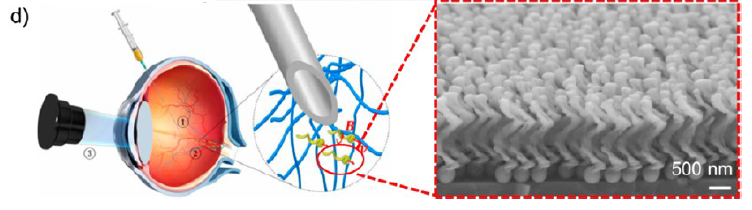
@acsnano Microrotors also have many potential applications. Their rotation can break up blood clots or mix fluids efficiently (big challenge in microfluidics). Wu et al. (Sci. Adv. 4, 11, 2018) magnetically actuated microhelices to move in the eye, offering a new way to deliver drugs.