What's Actually Inside a mump2p Node
We talk about mump2p as one thing, but under the hood, it's really three separate parts working together. Here's what each one actually does.
The Part That Finds and Talks to Other Nodes
This is the libp2p host. Before a node can send or receive any data, it needs to find other nodes on the network and establish a secure connection with them.
That's the job here, peer discovery, network transport, and making sure the connection between two nodes is secure. Nothing about coding or data compression happens at this layer, it's purely about finding people to talk to and opening a reliable line of communication.
The Part That Decides Who to Stay Connected To
Once a node knows who's out there, it doesn't connect to everyone. It maintains a mesh, a set of peer connections it actively keeps and uses.
This works a lot like Gossipsub's own mesh setup, the same general idea Ethereum already uses. The mesh size is actually tunable, which is exactly what we covered before with OPTIMUM_MESH_TARGET, how many peers a node keeps active connections with at once.
The Part That Actually Makes mump2p Different
This is the RLNC layer, the piece responsible for encoding, decoding, and recoding shards.
This is where the real speed advantage comes from. The libp2p host gets the connections, the mesh decides who to talk to, but this layer is what allows a node to take partial data, mix it into new shards, and forward it along, before it even has the full picture itself.
Why Splitting It Up Like This Matters
Each of these three parts does one job, and only one job. The libp2p host isn't trying to be smart about data. The mesh isn't trying to encode anything. The RLNC layer isn't worrying about peer discovery.
That separation is actually the point. It means Optimum could plug a faster coding method into an already-proven networking foundation, instead of having to rebuild peer-to-peer networking from scratch just to get RLNC's benefits.
The Simple Way to Think About It
Libp2p host: how a node finds and talks to others.
Mesh topology: who a node actually stays connected to.
RLNC layer: what makes the data moving between them faster.
Three separate jobs, one faster network.
@get_optimum | @cryptooflashh | @ada_pegasus | @JimmyHope_
Why a 0.8% Gap in Ethereum Is Worth Up to 2,000 ETH a Year
Every time a validator proposes a block, thousands of other validators have to attest to it, essentially confirming they saw it and it's valid. For that vote to count as accurate, the validator has to receive the block in time. This measure is called head vote accuracy, and right now, it's quietly leaving real money on the table.
The Current Numbers
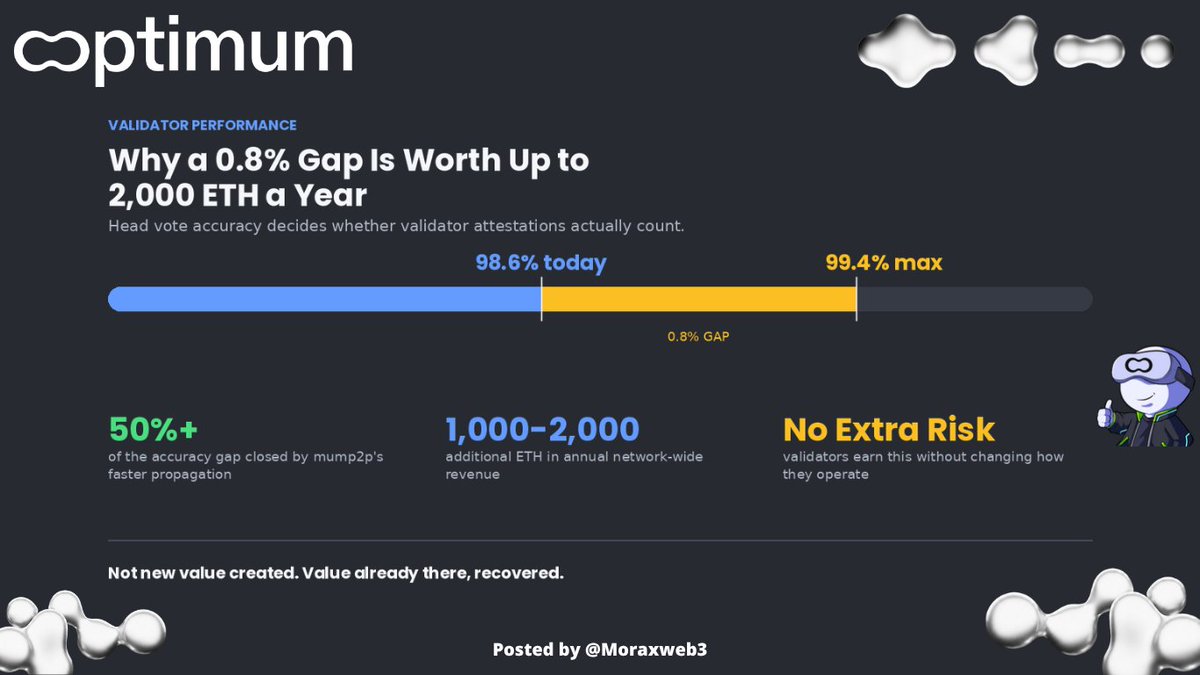
Ethereum's head vote accuracy currently sits at 98.6%. The theoretical maximum, if block data reached every validator instantly, would be 99.4%. That 0.8% gap doesn't sound like much, but at Ethereum's scale, it adds up fast.
Why Validators Miss It
Most validators that miss an accurate attestation aren't doing anything wrong. They simply don't receive the block "head" fast enough to vote correctly in time. It's not a performance issue on their end, it's a propagation issue on the network's end.
What Optimum's Research Found
According to analysis cited in Blocmates' breakdown of Optimum, mump2p can close more than half of that 0.8% gap just by getting block data to validators faster and more consistently. That translates to an estimated 1,000 to 2,000 additional ETH in annual network-wide revenue.
Why This Actually Matters
This isn't a hypothetical improvement. It's value that already exists but is currently lost simply because data doesn't move fast enough. Optimum isn't manufacturing new value, it's recovering value that's already there, just slipping through the cracks of a slower network.
@cryptooflashh | @blockchainjeff | @ada_pegasus | @JimmyHope_
Why a 0.8% Gap in Ethereum Is Worth Up to 2,000 ETH a Year
Every time a validator proposes a block, thousands of other validators have to attest to it, essentially confirming they saw it and it's valid. For that vote to count as accurate, the validator has to receive the block in time. This measure is called head vote accuracy, and right now, it's quietly leaving real money on the table.
The Current Numbers
Ethereum's head vote accuracy currently sits at 98.6%. The theoretical maximum, if block data reached every validator instantly, would be 99.4%. That 0.8% gap doesn't sound like much, but at Ethereum's scale, it adds up fast.
Why Validators Miss It
Most validators that miss an accurate attestation aren't doing anything wrong. They simply don't receive the block "head" fast enough to vote correctly in time. It's not a performance issue on their end, it's a propagation issue on the network's end.
What Optimum's Research Found
According to analysis cited in Blocmates' breakdown of Optimum, mump2p can close more than half of that 0.8% gap just by getting block data to validators faster and more consistently. That translates to an estimated 1,000 to 2,000 additional ETH in annual network-wide revenue.
Why This Actually Matters
This isn't a hypothetical improvement. It's value that already exists but is currently lost simply because data doesn't move fast enough. Optimum isn't manufacturing new value, it's recovering value that's already there, just slipping through the cracks of a slower network.
@cryptooflashh | @blockchainjeff | @ada_pegasus | @JimmyHope_
FP Validated just started testing mump2p
They're the validator arm under @FourPillarsFP , a team that's earned real respect for its research in this space. Four Pillars recently moved into ETH staking to serve institutional clients in Korea, so this isn't a side project for them, it's core infrastructure.
Here's what makes it interesting.
Ethereum's validator set isn't evenly distributed. Certain regions sit closer to the network's center of gravity, others don't, and Asia has historically been on the wrong side of that gap. Validators operating there deal with weaker peering and slower propagation, not because of anything they're doing wrong, just geography.
That's the exact problem mump2p is built to solve. Faster, more consistent data delivery means distance from the network's core stops being something a validator has to just live with.
What stands out here is who made this call. Teams in well-connected regions testing new infra is expected. A research-driven team serving institutional clients, based somewhere that actually feels this problem, choosing to run mump2p, that's a much stronger signal.
Good to have @FPvalidated on board.
@get_optimum | @cryptooflashh | @ada_pegasus | @JimmyHope_
@legendary54321@fermah_xyz Fermah is helping turn ZK proofs from complex infrastructure into a more accessible foundation for secure and trust minimized Web3