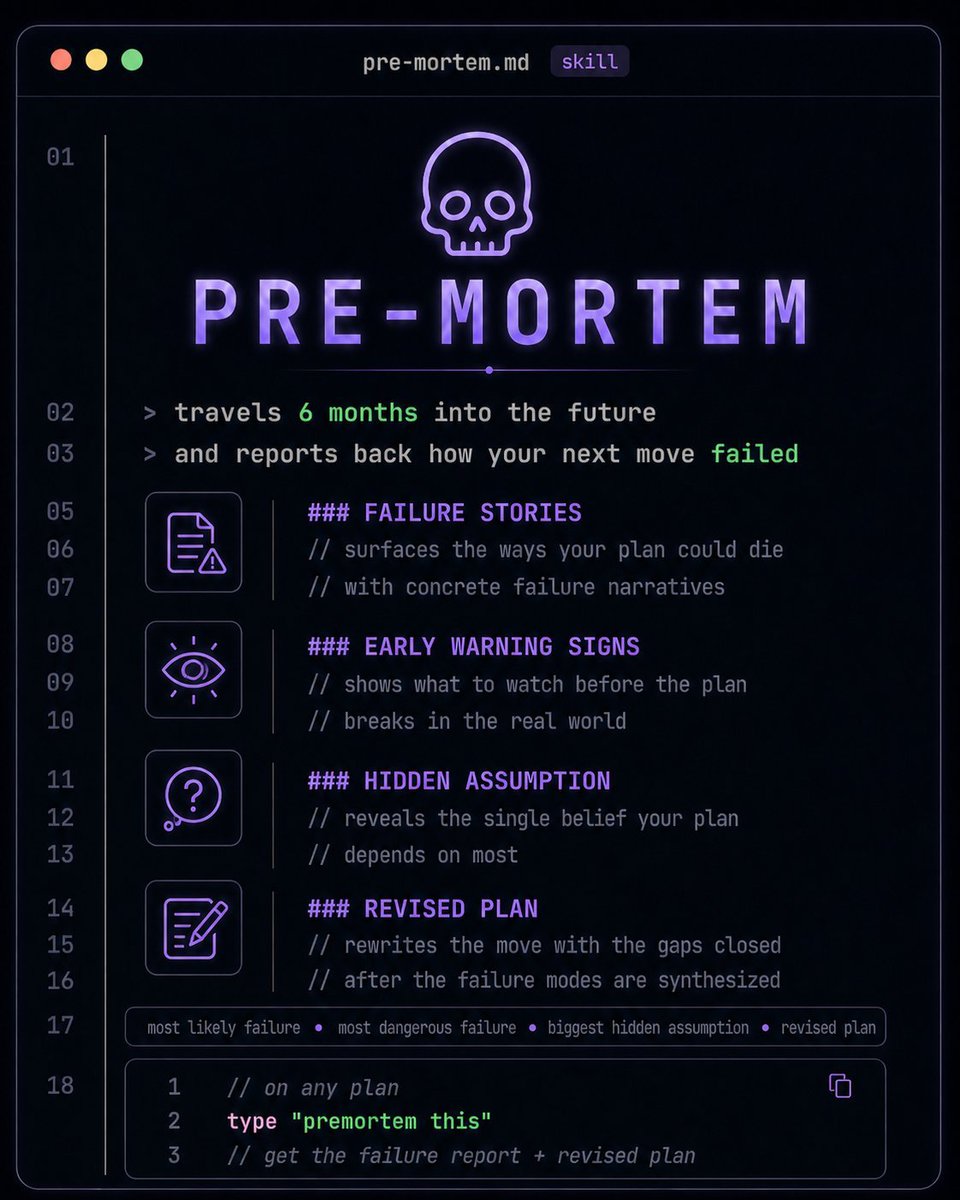
POV: claude traveled 6 months into the future and told you exactly how your next move failed.
it's called a premortem.
daniel kahneman (nobel prize-winning psychologist behind "thinking fast and slow") called it his single most valuable decision-making technique.
when you ask claude "is this a good plan?" it finds all the reasons to say yes.
that's what it was trained to do (to be helpful and agreeable). so you walk away feeling confident.
you execute, and spend weeks / months building on top of that plan.
then it blows up.
and you realize the problem was obvious in hindsight, you just never stress-tested it because claude told you it was solid.
a premortem fixes this by flipping the frame.
instead of asking "what could go wrong?" you tell claude "it's 6 months from now and this is already dead. tell me how it died."
that shift turns off claude's optimism because there's nothing to be optimistic about. the premise already says it failed.
so claude stops looking for reasons your plan will work and starts explaining how it fell apart.
claude comes back with every way your plan could die, each one with a full failure story and the early warning signs to watch for.
then a synthesis pulls it all together:
> which failure is most likely
> which failure is most dangerous
> the single biggest hidden assumption you're making (often the most valuable part)
> a revised version of your plan with the gaps closed
you say "premortem this" and give it your plan. the skill handles the rest.
🚨 BREAKING: Someone just built the exact tool Andrej Karpathy said someone should build.
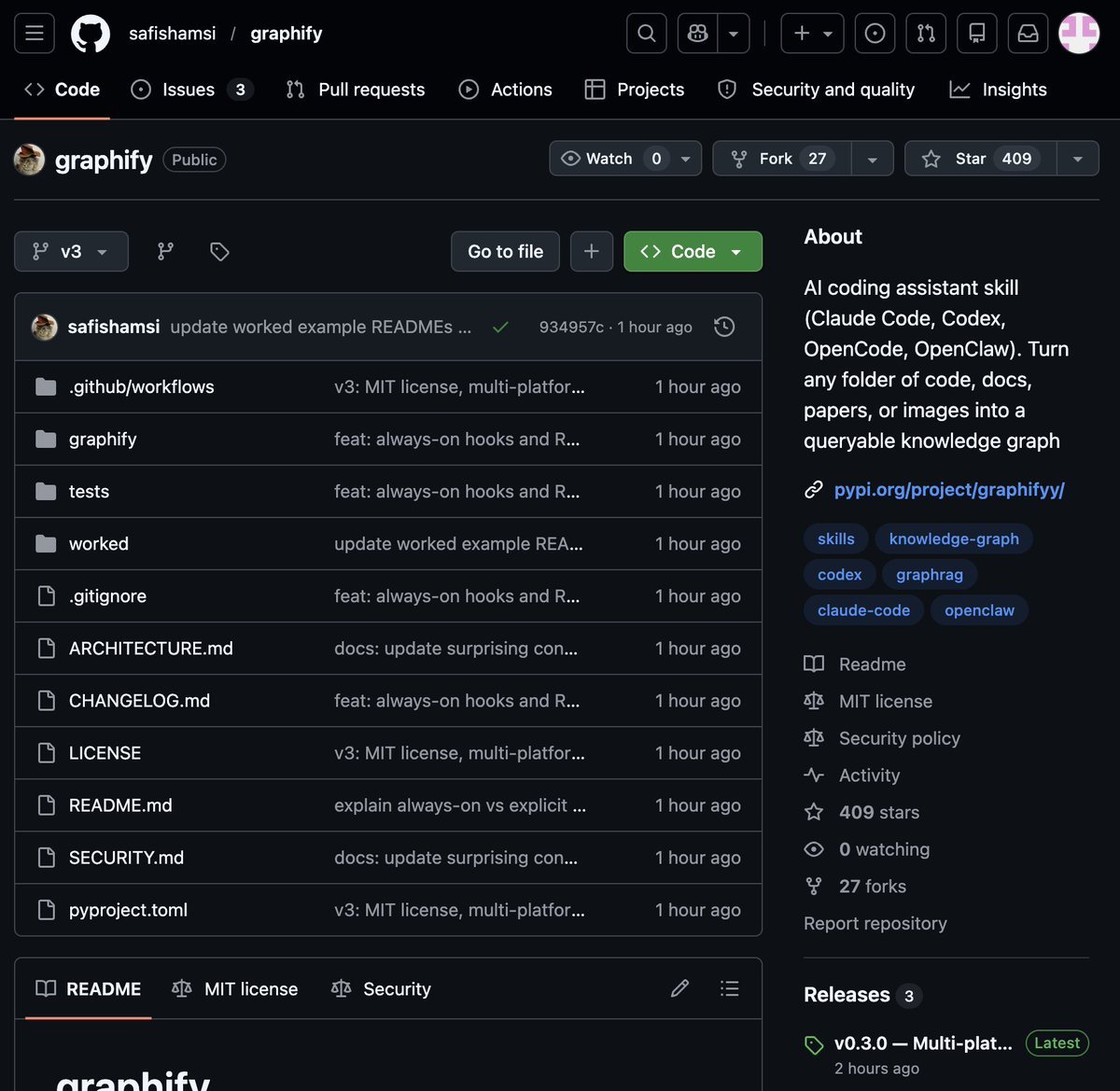
48 hours after Karpathy posted his LLM Knowledge Bases workflow, this showed up on GitHub.
It's called Graphify. One command. Any folder. Full knowledge graph.
Point it at any folder. Run /graphify inside Claude Code. Walk away.
Here is what comes out the other side:
-> A navigable knowledge graph of everything in that folder
-> An Obsidian vault with backlinked articles
-> A wiki that starts at index. md and maps every concept cluster
-> Plain English Q&A over your entire codebase or research folder
You can ask it things like:
"What calls this function?"
"What connects these two concepts?"
"What are the most important nodes in this project?"
No vector database. No setup. No config files.
The token efficiency number is what got me:
71.5x fewer tokens per query compared to reading raw files.
That is not a small improvement. That is a completely different paradigm for how AI agents reason over large codebases.
What it supports:
-> Code in 13 programming languages
-> PDFs
-> Images via Claude Vision
-> Markdown files
Install in one line:
pip install graphify && graphify install
Then type /graphify in Claude Code and point it at anything.
Karpathy asked. Someone delivered in 48 hours.
That is the pace of 2026.
Open Source. Free.
The person who built Claude Code just showed exactly how to use it.
30 minutes. Free. Straight from Boris Cherny himself.
Most people using Claude daily are missing 40+ features hiding in plain sight.
This single session is worth more than any $500 course.
Bookmark this before you forget. 👇
Brian Armstrong posted this today:
"Very soon there are going to be more AI agents than humans making transactions."
"They can't open a bank account, but they can own a crypto wallet. Think about it."
Here's what he's getting at:
Banks require KYC. Know Your Customer. You provide a name, an ID, a face, a physical address...
AI agents have none of those things.
It's not that banks are hostile to AI agents. It's that banks were architecturally designed around one assumption:
Every economic participant is a human being, or a business backed by humans.
That assumption is now wrong.
Coinbase launched Agentic Wallets in February. A crypto wallet spins up with a private key. No identity check. No address on file. No human required.
An AI agent can be operational and transacting in seconds.
A bank account for the same agent would be impossible.
Brian's point isn't that crypto is better than banking. It's that banking literally cannot serve this market.
Earlier today, CZ made the same prediction:
AI agents will make 1 million times more payments than humans. He pointed to BNB Chain's EIP-3009 upgrade, which lets agents transact without holding gas tokens.
Two of the most prominent CEOs in crypto made the same call on the same day.
Both are pointing at the same gap in the financial system.
The banks built for humans. Crypto built for anyone with a private key.
Soon, most of those private keys will belong to machines.
Der gefährlichste Ort für starres Denken?
✈️ Ein Flugzeug.
Reisen zeigt deinem Gehirn etwas, das Systeme nicht mögen:
Dass ihre Regeln nicht universell sind.
🧠 Ein 2-Wochen-All-Inclusive-Urlaub resettet dein Stresslevel.
🗺️ Drei Monate Perpetual Traveling resetten dein ganzes Leben (und das deiner Kinder).
Die meisten checken nie, wie sehr das Schulsystem + 9-to-5 ihre Familie in mentale Ketten legt.
Langzeitreisen brechen das auf. Neurologisch, emotional, für immer. Das ist wissenschaftlich erwiesen.
Speichere und teile diesen 8-Punkt-Plan.
Er könnte dein Leben für immer verändern. 👇
1. Neue Umgebungen zerstören alte Denkroutinen.
Dein Alltag ist ein ewiger Loop: gleiche Wege, gleiche Regeln, gleiche Perspektiven. Langzeit-Reisen zwingen den Hippocampus in Dauer-Turbo-Navigation, Lernen, Neukartierung.
- Kurze Trips geben nur einen Kick.
- Monate bauen echte neue Synapsen.
- Alte Pfade verkümmern.
➡️ Dein Gehirn schaltet von Autopilot auf Souveränität.
2. Du übernimmst wieder das Steuer.
Im System entscheiden Vorschriften und Gewohnheit für dich.
Auf Reisen musst du täglich selbst denken:
Wohin? Wie lösen wir das? Was gilt hier?
Präfrontaler Cortex feuert wieder. Kritisches Denken, Planung, echte Entscheidungen.
➡️ Du wirst zum Captain deines Lebens, nicht zum Passagier.
3. Realität ist relativ. Dein Gehirn checkt es endlich!
Eine andere Kultur zeigt in Wochen: Das „Normale“ bei dir ist woanders lächerlich.
Default-Mode-Netzwerk (Selbstreflexion) geht hoch.
Du siehst: Viele Ketten sind nur kulturelle Erfindungen.
➡️ Das „So macht man das“-Gefängnis bröckelt für immer.
4. Unsicherheit wird zur Superkraft.
Verpasste Busse, fremde Sprachen, keine klaren Regeln.
Erst Stress (Amygdala). Nach Monaten lernt dein Gehirn: Unsicherheit = Chance, nicht Gefahr.
Resilienz explodiert. Autonomie wächst.
➡️ Du brauchst kein 100%-sicheres System mehr, um zu atmen.
5. Dopamin-Reset: Exploration statt Konsum.
Neue Orte, Gerüche, Menschen. Echter Dopamin, der Neugier und Lernen antreibt.
Nicht der Scroll-Kick. Langzeit macht das zur neuen Default-Einstellung.
➡️ Dein Gehirn hungert wieder nach Entdeckung, nicht nach Anpassung.
6. Für Kinder gilt das 10x stärker.
In den ersten 15 Jahren sind ihre Gehirne am plastischsten. Jede neue Erfahrung baut Milliarden Synapsen.
Worldschooling-Familien sehen: Bessere Problemlösung, höhere Neugier, stärkere Empathie, weniger Angst vor Unsicherheit.
Real-World-Learning schlägt Klassenzimmer oft um Längen.
➡️ Dein Kind lernt in 6 Monaten mehr über die Welt als in 6 Schuljahren und du bist live dabei.
7. Familien-Bonus: Gemeinsam Probleme lösen schweißt zusammen.
Verlorenes Gepäck, fremder Bus, neue Freunde finden. Das trainiert Resilienz, die kein Spielzeug ersetzt.
Kinder werden selbstständig, anpassungsfähig, kreativ. Später brauchen sie kein „sicheres“ Hamsterrad.
➡️ Sie haben gelernt: Es gibt immer Wege.
8. Der Eltern-Moment, der alles ändert.
Viele kommen von der ersten langen Reise zurück und fragen sich brutal ehrlich:
Warum opfere ich die prägendsten Jahre meiner Kids für Überstunden und Gehaltserhöhungen, die wir eh nicht brauchen?
Deine Kinder werden nicht fragen, wie viel du verdient hast. Sie erinnern sich, ob du da warst, als sie zum ersten Mal allein eine Stadt navigierten oder eine neue Sprache sprachen.
Langzeitreisen geben keine fertigen Antworten. Sie nehmen dir die Scheuklappen und zeigen: Es gibt mehr als ein „richtiges“ Leben.
Zeit mit deinen Kindern, echte Freiheit, ein Gehirn, das für Abenteuer gemacht ist, statt fürs System.
An die Eltern hier: Welchen Moment mit deinen Kids auf Reisen würdest du nie gegen ein Jahresgehalt eintauschen?
An alle: Was hält dich wirklich davon ab, die besten Jahre nicht im Hamsterrad zu verschwenden?
🧠✈️ Speicher das, wenn du den Exit für deine Familie planst.
🚨 ChatGPT looks like a toy in 2026.
This is the real thing.
People building with Claude workflows are quietly automating entire businesses.
Most people are still using AI like a chatbot...
While others are using it like a co-worker.
So I’m giving away a Claude Prompt + Workflow Pack that can save you $5,500+ in tools, time, and productivity.
Inside the pack:
• Powerful Claude prompts used by founders
• Automation workflows for coding, research & content
• Copy-paste prompt frameworks that produce better results
• AI systems that replace multiple paid tools
• Real examples you can start using today
This is the stuff most people charge hundreds of dollars for.
But I’ll send it FREE to the first 2,500 people.
To enter:
1️⃣ Follow me
2️⃣ Like + Repost
3️⃣ Comment “CLAUDE”
I’ll DM the pack.
Once you see these workflows…
You’ll never use AI the same way again.
Optus 4.6, Claude Code and its Browser Extension are superior than ChatGPT. Most importantly the leadership has integrity and this will lead to more progress and future potential. I want my data in the hands of responsible leadership. #SwitchtoClaude#QuitGPT
The gym rewires your pain tolerance.
Marriage rewires your egocentrism.
Children rewire your priorities.
Responsibility rewires your character.
No rewiring, no upgrade.
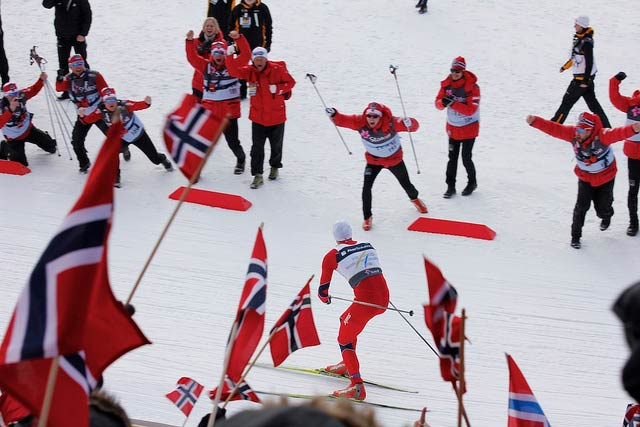
Norway consistently wins the most medals at the Winter Olympic Games, with a population of just 5.6 million people.
A big part of their success is how they treat youth sports—and it’s the opposite of what we do in the US. Here’s what we can learn from Norway:
1. Scorekeeping:
In the US: Youth sports tend to be hyper competitive even at early ages. Leagues almost always keep score.
In Norway: Scorekeeping isn’t even allowed until age 13.
Removing winners and losers keeps the focus on the process not outcomes. It keeps kids engaged longer because it minimizes pressure (and tears) and maximizes fun, learning, and growth. The goal isn’t to win a third grade championship. It’s to love sport and keep playing.
2. Trophies:
In the US: If you give everyone a trophy, you’re creating snowflakes who will never gain a competitive edge.
In Norway: Whenever trophies are awarded, they are handed out to everyone.
If getting a trophy makes young kids feel good, we should give them trophies. Maybe they’ll come back and play again next year!!
As for the creation of snowflakes with no competitive edge—Norway’s athletes are tough as nails and all they do is win.
3. Prioritizing Fun:
In the US: Far too often, the goal is to win.
In Norway: The national philosophy is “joy of sport.”
Youth sports in the US are driven by adults, ego, and money. Youth sports in Norway are driven by fun.
Only half of kids in the US participate in sports. The number one reason they drop out: because they aren’t having fun anymore. In Norway, 93% of kids participate in youth sports. Fun is the foremost goal.
4. Playing Multiple Sports:
In the US: There’s pressure to specialize early and play your best sport year round.
In Norway: Try as many sports as you can before specializing as late as college.
Norway encourages kids to try all types of sport. This reduces injury and burnout and increases all-around athleticism. It also helps promotes match quality, or finding the sport you are best suited for as your body develops, which is impossible if you commit to a single sport too early.
5. Affordability
In the US: There is increasingly a pay-to-play model with high fees for leagues, equipment, and travel. This excludes many kids from playing.
In Norway: It’s a national priority to keep youth sports affordable and therefore accessible for all.
Kids aren’t priced out, which creates opportunities for everyone to participate (and develop into athletes), regardless of their parents’ income level.
We could learn a lot from Norway:
In the US, 70% of kids drop out of youth sports by age 13. This not only diminishes an elite-athlete pipeline, but it also destroys an opportunity for healthy habits and all the character lessons kids can learn from sport.
In Norway, lifelong participation in sport is the norm. The goal isn’t to have the best 9U team. It’s to develop the best athletes. Those are two very different things. And Norway has the gold medals to prove it.