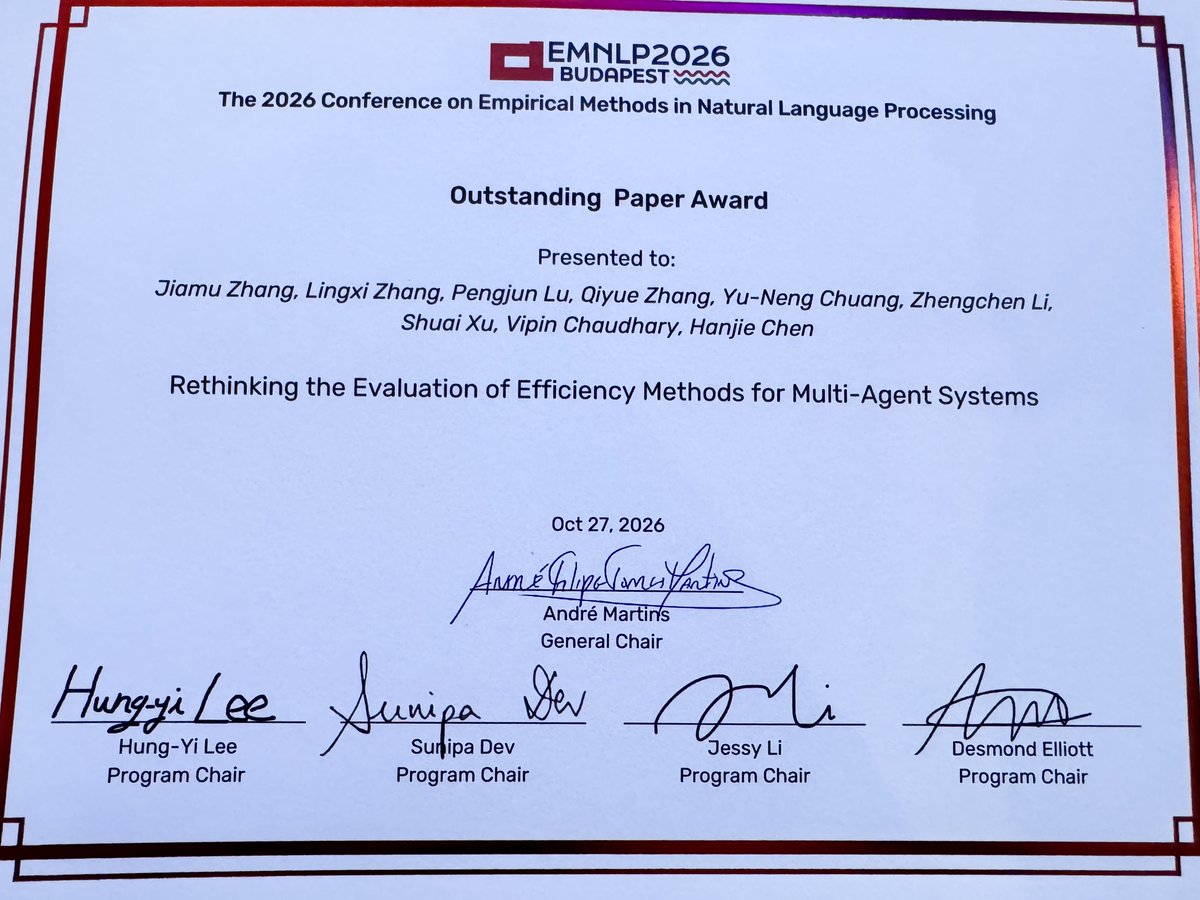
@burkov Thanks for sharing our paper! The one-line version: neighboring layers' KV caches look unrelated, but the hidden states that produce them share one low-rank subspace, so we cache that once per block of layers. Training-free; near-lossless at 4x, close to dense at 16x.
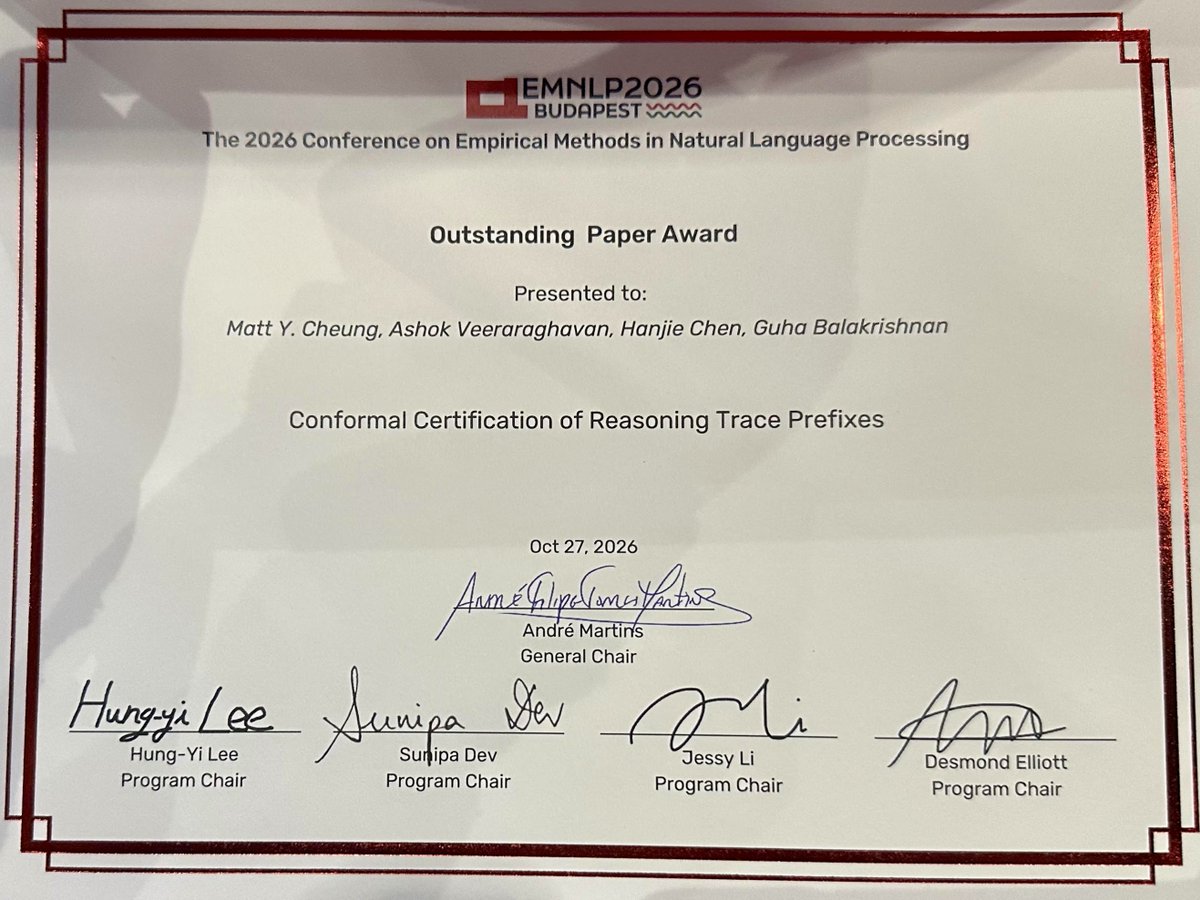
Excited to share that we received two Outstanding Paper Awards at #EMNLP2026🔥
Congratulations to the student leads and the teams!🎉
Many thanks to the program chairs and committee for this recognition!💙
AnyJev author here. Thanks for the write-up, the level breakdown is accurate and clearer than most summaries we have seen.
One thing worth adding on L0: besides rotating the options, it also removes the model's label prior, meaning the pull toward "yes", or toward one particular option, that is there regardless of the input. On our benchmarks that correction carries as much of the gain as the rotation does.
One caveat on L2: it is still a preview. A head fitted on a single option order is not order-invariant yet, so we would not put it in production at this point.
And a small clarification on model access: L0 and L1 only need next-token log-probabilities, so any endpoint that exposes logprobs over the label tokens can run them. Hidden states are only required for L2.
Issues and PRs are very welcome, especially on new backends.
Excited to share AnyJev, a project I've been leading with @wuliang211 and the team at Nokia.
Your LLM already knows a lot. AnyJev turns that into calibrated, typed decisions, without training a separate model.
I maintain the repo, so issues, PRs, and new benchmarks are very welcome 🙌
Your LLM already reasons. Why train another model just to make decisions?
AnyJev keeps decision-making in the LLM you already run: a calibration layer plus a closed-form head.
New question? Write a prompt. Zero labels.
Have 100–300 labels? One closed-form solve, seconds on a CPU.
Better LLM? Swap it in.
📊 JevBench public set, 231 typed decisions, Qwen3-8B, zero labels:
• 0.727 accuracy (easy 1.000, hard 0.523)
• Every answer schema-valid, 57 ms median
• One temperature: ECE 0.246 → 0.079, accuracy unchanged
With labels, the head costs 0.68–0.84× a forward pass.
Serves on vLLM: an embed server plus a ~100 KB head.
Keep the reasoning in your LLM.
Calibrate the probabilities, not another model.
pip install anyjev
🔗https://t.co/5qBrRMAMx4
AnyJev author here. Thanks for putting this together, and for including AnyJev in it. : )
The latency is real. We went correctness first and have not tuned the serving path at all yet. That work is starting now on vllm/sglang, and it will be landed pretty soon.
One thing worth saying though🧐: AnyJev is not another Jev model. It is a method for turning a model you already serve into a Jev-style decision layer, so a team can have its own Jev, on its own domain, inside its own stack. That is the part we care about, and it is also why the first version is slow.
It is all Apache-2.0 and still early, so tests like yours are exactly what we need. Comments, issues and PRs are very welcome!!! and we would rather hear where it breaks now than later. 😀
@andrewgwils Grad student here. Ideas: every paper ships a script that reproduces its main table, auto-run at submission; claimed gains must beat your own seed variance, else it's a tie; swap some review load for reproducing another paper. Can't fake that with an LLM lol.
📢I'm recruiting a postdoc at Rice University! Looking for someone with a PhD in CS (or a related field) and expertise in LLMs and Trustworthy & Responsible AI.
I'll be at #COLM2025 from 10/8-10/10. Happy to chat in person!
Feel free to email or DM me if you're interested.😀
A survey on efficient reasoning for LLMs.
That was quick!
I have been featuring papers on the topic of efficient reasoning and I see a few familiar papers in this survey.
Good read overall!