“Why didn’t you submit your homework on time?”
“Corner solutions are rarely optimal.”
“It says here you attended less than half of the lectures. Why?”
“Corner solutions are rarely optimal.”
“You did not appear for your maths final. Why?”
“Corner solutions are rarely optimal.”
“Why didn’t you submit your homework on time?”
“Corner solutions are rarely optimal.”
“It says here you attended less than half of the lectures. Why?”
“Corner solutions are rarely optimal.”
“You did not appear for your maths final. Why?”
“Corner solutions are rarely optimal.”
Excited to FINALLY release toughest+most rewarding paper I've worked on...
….we attack a 150 year old Walras question that's gone unanswered, not for lack of trying (Hicks, Samuelson, Arrow; our chances?😱)...
Q: Is the market equilibrium stable or unstable?¯\_(ツ)_/¯
🧵
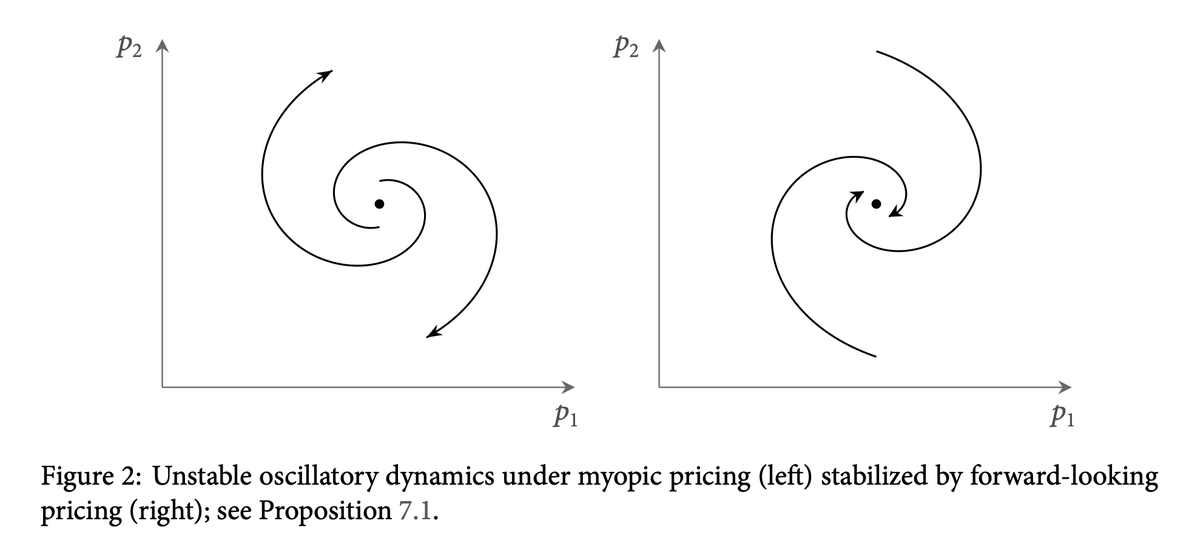
2nd strong force for stability from...
… forward looking price setting!
Result 1: more forward looking
—> grows set stable economies!
Result 2: in fully forward looking pricing
—> all oscillatory instability
—> becomes stabilized!
… this shocked us 😱… unexpected
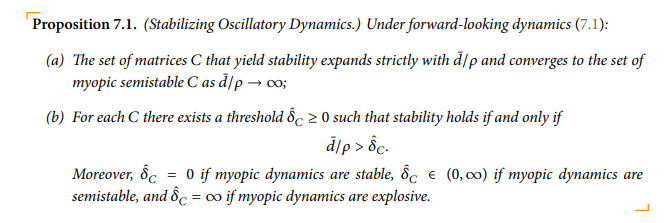
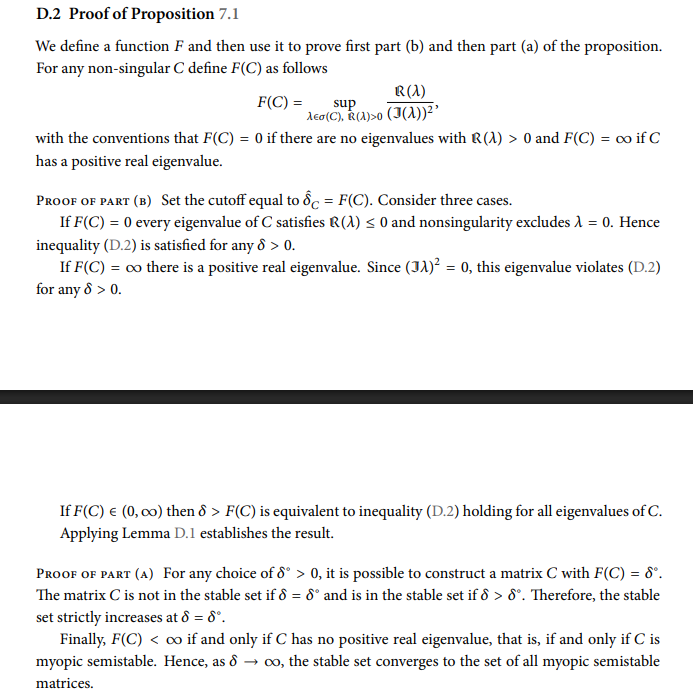
@tumacius When I am digging through the proof of proposition 7.1 its a bit terse. Seems less to do with preferences directly and more to with whatever C and D are.
Maybe I need to sit on this a bit more. I appreciate the picture, but independently reading the proof is strange.
Out of respect for the efficiency of writing and sacred nature of economic theory. I propose putting the main text of the abstract in the middle and then surround this by comments.
I also suggest reading one page of this paper a day.
@tumacius When I am digging through the proof of proposition 7.1 its a bit terse. Seems less to do with preferences directly and more to with whatever C and D are.
Maybe I need to sit on this a bit more. I appreciate the picture, but independently reading the proof is strange.
I do want to say, if Frisch Demands really do pick up- we are going to see much more rinky dinky applied work where people dont even pretend to proxy for income.
The marginal utility of money is vague. No kitchen sink of demographic variables will ever pass the sniff test.
econ version:
An assistant professor of microeconomic theory at a university failed his tenure review after years of struggling to publish in Econometrica or the QJE.
He was cast out into the brutal academic job market, but that year, the market completely collapsed.
He couldn't even land a lecturer position at a third-tier state school, and corporate recruiters rejected him for corporate strategy roles, calling his work "hopelessly theoretical."
Eventually, he swallowed his pride and reached out to his old grad school classmate. This friend had seen the writing on the wall during their second year of the PhD program, mastered the art of "quitting with a Master's," and started a plumbing contracting business. He was now the biggest plumbing boss in the tri-state area.The friend looked at the exhausted, broken academic and sighed. "I get it, man. You’re a high-level micro theorist. You used to spend all day on mechanism design and game theory. Why don't you come work for my company as a plumber? You’ll earn half your old professor salary, but with overtime, union benefits, and blue-collar health insurance, you'll be way better off than you ever were as an academic peasant. But remember: when you apply, tell them you only completed seven elementary classes. These plumbers hate high-and-mighty academics, especially the theory guys."So it happened. The former economics professor became a plumber, and his life significantly improved. He just had to tighten a bolt or clear a pipe occasionally, his cash flow was robust, he no longer suffered the torture of Revise & Resubmit, and his mental fatigue completely vanished.
One day, the board of the plumbing company issued a new mandate: to improve grassroots operational efficiency, every plumber had to attend evening classes to earn a "Basic Cost & Material Allocation" certification. So, our ex-professor had to go there too.
It just so happened that the very first class was about "Plumbing Inventory Procurement under a Finite Budget."The evening instructor, looking to gauge the students' background knowledge, casually asked the room: "If you have a fixed budget and need to buy two types of pipes, and their unit prices and drainage efficiencies are fixed, how do you allocate your budget to maximize total efficiency?"The person asked was the ex-professor.He habitually adjusted his glasses and walked up to the whiteboard. In that instant, he realized he had been dealing with abstract topological spaces for so long that he had forgotten how to solve a dummy-proof, high-school-level arithmetic question. His occupational disease flared up instantly. He decided he had to derive it from first principles.He filled the whiteboard with symbols.He first defined a consumption set $X \subset \mathbb{R}^2_+$ and posited that the plumber’s preferences satisfied strict monotonicity, strict convexity, and continuity. To guarantee an interior solution, he solemnly scribbled the Inada Conditions in the corner.
Next, he constructed a continuously differentiable, quasi-concave utility function $U(x_1, x_2)$ subject to a strict budget constraint $p_1 x_1 + p_2 x_2 \le I$. He set up the Lagrangian, listed the first-order conditions (FOCs), and filled three pages of the board with Kuhn-Tucker Conditions just in case a boundary solution arose.But because the instructor had asked about "maximizing efficiency under a fixed budget," he suddenly became paralyzed by a dilemma: was this a Utility Maximization Problem (UMP) or an Expenditure Minimization Problem (EMP)?He invoked Duality Theory to map one into the other. He frantically scratched out proofs, deriving Marshallian Demand, switching to Hicksian Demand, applying Roy’s Identity to take partial derivatives, and using Shephard’s Lemma to verify the expenditure function.
To prove the allocation was socially optimal, he even sketched a small Edgeworth Box in the corner, deriving Pareto Efficiency and invoking the First Fundamental Theorem of Welfare Economics to demonstrate that the plumber's individual choice would lead to a General Equilibrium.
Finally, exhausted, covered in chalk dust, his eyes wild with academic mania, he deployed the Envelope Theorem, substituted the Marginal Rate of Substitution (MRS) to equal the price ratio, and arrived at the final, special-case linear answer:$$\frac{MU_1}{p_1} = \frac{MU_2}{p_2}$$He took a deep breath, dropped the chalk, and turned around, habitually expecting the adoring gaze of undergraduate students.
Instead, forty plumbers, in perfect unison, slammed their heavy pipe wrenches onto the desks and roared:
“DRAINAGE PIPES ARE PERFECT SUBSTITUTES! YOU DIDN'T ACCOUNT FOR THE CORNER SOLUTION UNDER QUASI-LINEAR PREFERENCES, YOU UNTENURED FUCKING TOURIST!!”
@tumacius When I am digging through the proof of proposition 7.1 its a bit terse. Seems less to do with preferences directly and more to with whatever C and D are.
Maybe I need to sit on this a bit more. I appreciate the picture, but independently reading the proof is strange.
@e_moracci I think the familiar phase diagram pictures+ the connection between myopic preferences vs forward looking preferences is whats doing the work.