@Keir_Starmer What he meant to say was, "Those responsible will be held accountable unless they are an immigrant of color. But seriously, since the government did this, nothing will happen to those who are actually responsible."
@ConstitustionX A nonchalant attitude towards wasting the people's money should be grounds for termination. But apparently, it is rampant, and few seem to care.
Has there ever been a time in history when the good guys were for restricting speech?
No, there has never been a clear, unambiguous case in history where the side widely regarded today as the unambiguous "good guys" (in the sense of advancing liberty, truth-seeking, human flourishing, or moral progress without major caveats) were the primary advocates for broad restrictions on speech. The historical pattern shows the opposite: those pushing for systematic censorship, licensing, or suppression of dissenting ideas have overwhelmingly been authorities, majorities, or entrenched powers seeking to maintain control, enforce orthodoxy, or silence challengers—often later viewed as regressive, tyrannical, or mistaken.
@SenWarren I have yet to hear what is a "fair share" of the government forcibly taking someone else's money. Especially when that government is such a hideously bad steward of that siezed money.
@BreitbartNews@DanielBaldwin People filled with hate are the same people who plant hate, and the same type are those who encourage more of the same.
They attack outwardly when the real problem is internal.
Does this seem wise?
Here is a partial list of professions with strict eligibility requirements.
Medical Doctor
Lawyer
Certified Public Accountant
Commercial Pilot
Registered Nurse
Professional Engineer
Pharmacist
Public School Teacher
Dentist
Real Estate Broker
Veterinarian
Architect
Physical Therapist
Psychologist (Clinical)
Optometrist
Certified Financial Planner
Air Traffic Controller
Occupational Therapist
Chiropractor
Speech-Language Pathologist
Commercial Truck Driver
Electrician
Plumber
HVAC Technician
Carpenter (Union/Commercial)
Welder (Certified)
Heavy Equipment Operator
Elevator Mechanic
Pipefitter
Ironworker
Here are the eligibility requirements to be a member of Congress.
Other than age and residency, there are no formal education, professional experience, or other qualifications that are constitutionally required.
Our words are a direct reflection, or mirror, of our inner self, particularly the heart.
What we say reveals what truly fills us, whether good or evil, because speech flows from our deepest thoughts, treasures, and character.
In essence, words are like fruit from a tree or overflow from a storehouse: they expose the quality of what's inside.
You can't consistently produce good words from a corrupt heart or vice versa.
People will give account for every word, for by your words you will be justified, or by your words you will be condemned.
Words aren't neutral; they testify to the soul’s condition.
Listening to your own words (or others') is a diagnostic tool for the soul, much like a mirror reveals your appearance.
Guarding and renewing the heart is essential because out of it spring the issues of life.
Pure speech flows from a heart filled with goodness; corrupt speech reveals what needs cleansing.
Seek heart-level transformation.
Has there ever been a time in history when the good guys were for restricting speech?
No, there has never been a clear, unambiguous case in history where the side widely regarded today as the unambiguous "good guys" (in the sense of advancing liberty, truth-seeking, human flourishing, or moral progress without major caveats) were the primary advocates for broad restrictions on speech.
The historical pattern shows the opposite: those pushing for systematic censorship, licensing, or suppression of dissenting ideas have overwhelmingly been authorities, majorities, or entrenched powers seeking to maintain control, enforce orthodoxy, or silence challengers—often later viewed as regressive, tyrannical, or mistaken.
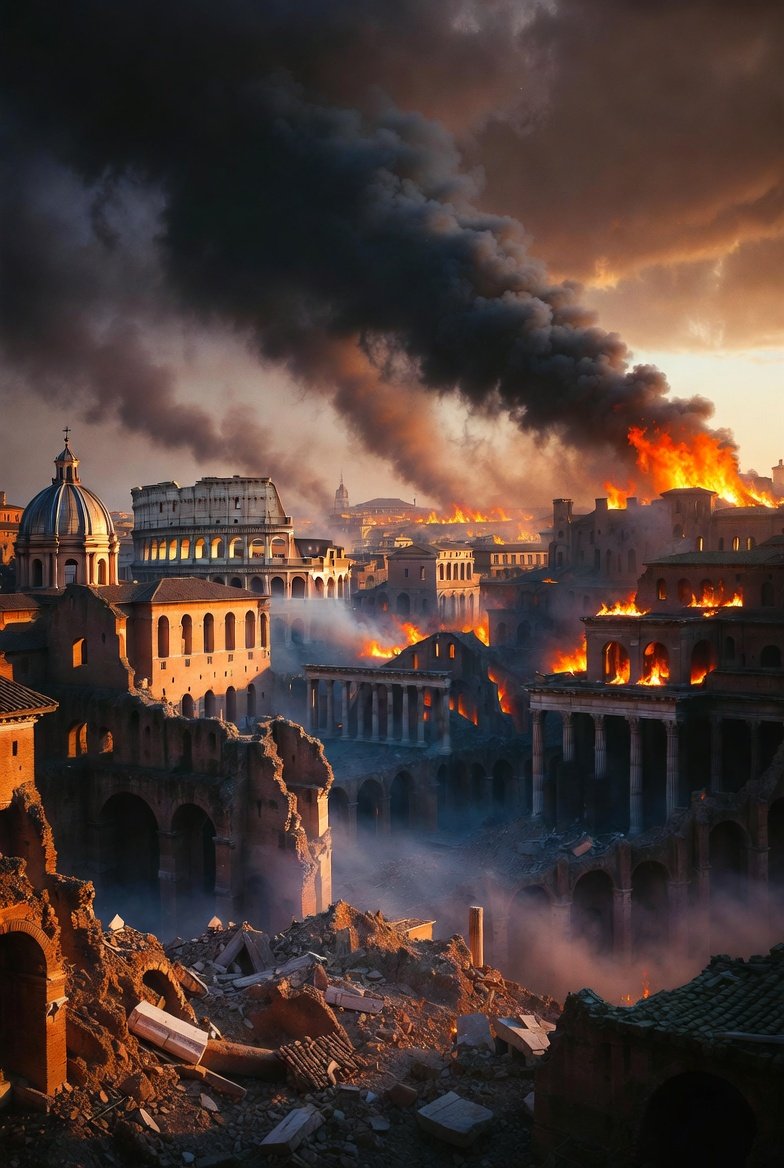
The fall of great empires throughout history rarely stems from a single cause but from a combination of interconnected factors that compound over time.
The most common recurring conditions include:
1-Internal Decay & Institutional Weakness
Bureaucracies become corrupt, inefficient, or parasitic. Tax systems collapse or become unbearably oppressive. The ruling elite grows detached from the population.
2-Economic Decline & Overextension
Empires overexpand militarily, creating unsustainable defense costs. Currency debasement (inflation), chronic trade deficits, loss of productive capacity, and reliance on import labor erode economic vitality. Wealth concentrates in fewer hands while the middle and working classes stagnate or decline.
3-Military Stagnation
Professional standing armies become expensive and politically powerful (leading to coups) or are replaced by cheaper foreign mercenaries/barbarian foederati who eventually turn on the empire (Rome, late Han China, Byzantium).
4-Demographic Decline & Loss of Civic Virtue
Falling birth rates, urban decadence, mass immigration without assimilation, or the replacement of citizen-soldiers with hired foreigners all weaken social cohesion and the will to defend the state.
5-External Pressures Exploiting Internal Weakness
Rival powers rarely destroy a healthy empire; they overwhelm one that is already rotting. Examples: the Goths vs. Rome, the Manchus vs. Ming China, the Arabs vs. Sassanid Persia and Visigothic Spain.
6-Ideological & Cultural Erosion
Loss of the founding ethos or religion that once unified the empire. Cynicism, hedonism, or fatalism replaces confidence and duty (Gibbon’s famous diagnosis of Rome: “The decline of Rome was the natural and inevitable effect of immoderate greatness… the stupendous fabric yielded to the pressure of its own weight”).
7-Succession Crises & Civil War
Weak, incompetent, or rapidly rotating leadership (often via assassination or capital intrigue) prevents long-term planning and invites constant internal conflict (Roman 3rd-century crisis, late Han warlords, Ottoman sultanate murders).
7-Technological or Environmental Shifts
Climate change (e.g., the 535–536 volcanic winter, Medieval Warm Period → Little Ice Age transitions), epidemics (Antonine Plague, Justinian Plague, Black Death), or the empire’s failure to adapt to new military technologies (stirrup, gunpowder, naval innovations) can act as triggers or accelerators.
In almost every case (Rome, Han China, Abbasid Caliphate, Spain, Ottoman, British, etc.), the empire is already hollowed out internally when the final blows land.
The dramatic “fall” moment, sack of the capital, last emperor deposed—is usually just the visible culmination of centuries of decay.
Strong empires can survive enormous external shocks; weak ones collapse under comparatively minor ones.
@BigBrainPhiloso This was mentioned by some guy named Jesus.
"For whoever wants to save their life will lose it, but whoever loses their life for me will find it."
— Matthew 16:25 (NIV)
Has there ever been a time in history when the good guys were for restricting speech?
No, there has never been a clear, unambiguous case in history where the side widely regarded today as the unambiguous "good guys" (in the sense of advancing liberty, truth-seeking, human flourishing, or moral progress without major caveats) were the primary advocates for broad restrictions on speech. The historical pattern shows the opposite: those pushing for systematic censorship, licensing, or suppression of dissenting ideas have overwhelmingly been authorities, majorities, or entrenched powers seeking to maintain control, enforce orthodoxy, or silence challengers—often later viewed as regressive, tyrannical, or mistaken.