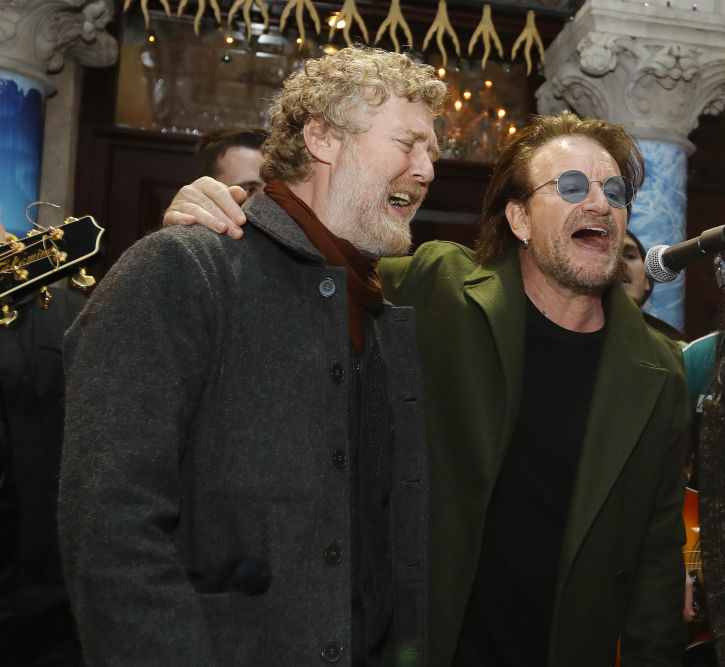
U2’s Bono pens a moving tribute to Glen Hansard:
“A smiling rascal if you needed him to be… this most musical and mischievous archangel of Ballymun… no airs, plenty of graces. He really was who you thought he was. He could never walk by a person living rough without checking they were OK… and more than that, he worked very hard so that less people had to live on the streets in the first place...”
More tributes: https://t.co/0vWSvfpyUO
"This morning, Mass was offered for the repose of the soul of Ann Widdecombe at Westminster Cathedral, where she was sometimes the Lector at the Sunday evening mass. We pray for her family and friends at this time. May she rest in peace."
~ Archbishop Richard Moth
Archival footage of Dublin in 1915, capturing the city's streets, trams, horse drawn carriages and people going about their daily lives before the Easter Rising.
Footage: J. Gordon Lewis for British Pathe
Another picture for the Lopes scrapbook. If you think we are overdoing the Pico v Messi aspect, FIFA pick out a standout player from each team for a pre game head to head on the screen
He could have been playing away in Sligo tonight
England v Croatia is the World Cup’s only group-stage match where both countries have a UNESCO World Heritage Site named after a Roman emperor.
England has Hadrian’s Wall. Croatia has Diocletian’s Palace in Split.
Stay tuned for more cutting-edge, geography(ish)-based World Cup analysis.
📰 New paper on https://t.co/ydXEFK7BuY by Dr. Muhammad Maladoh Bah (SEAI & UCD Energy Institute) & Prof Andrew Keane (UCD Energy Institute) “Could Ireland Go Nuclear? Regulatory frameworks, technology choice, and infrastructure issues”. Ireland would need deep, long‑term legislative, regulatory, infrastructural and system reforms before nuclear could credibly contribute to its power mix, making deployment before 2050 unlikely and economically unattractive versus renewables. In the interim, policymakers should prioritise detailed techno‑economic feasibility work on nuclear while focusing on proven decarbonisation options, including expanded interconnection to import nuclear‑generated power without assuming the costs and risks of a domestic programme.
https://t.co/lZnqKBKstu
#Nuclear #Ireland #Energy
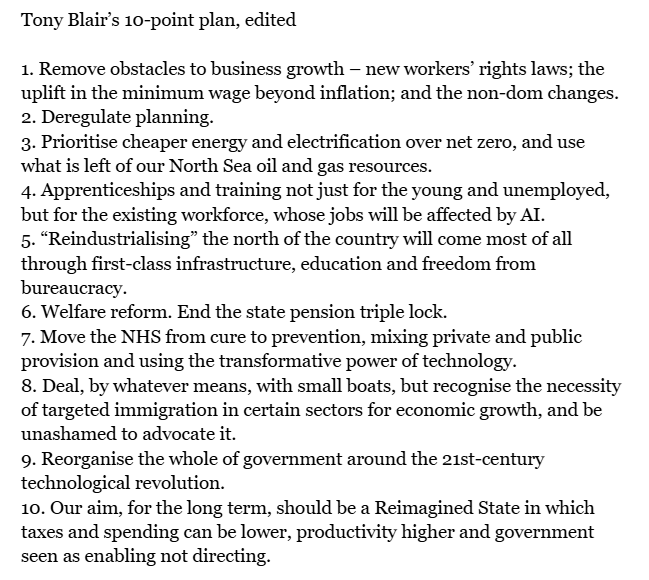
Blair, Burnham, Streeting and Starmer all wrote essays this week. Here’s a summary of what they said for those who can’t be bothered to spend an hour reading about Labour’s favourite pastime: fighting about what it means to be Labour.
Blair's thesis is that Labour lost its nerve after 2007 and needs to rediscover the radical centre. Markets work, the private sector is your friend, competent technocratic government is still the answer, and the biggest transformative force on the horizon is AI, which he sees as a positive revolution that a serious centre-left government should embrace. Miss that wave and you miss everything. TLDR; the model isn't broken. Labour just needs to run it properly and stop indulging the perennial delusion that losing votes to the right means the country secretly wants you to go left.
Burnham, Streeting and Starmer think this misses the point. And they broadly agree on the diagnosis but disagree on the cure.
All three locate the origin of Britain's political unravelling in 2008, not 2007. The financial crisis broke the implicit bargain of modern capitalism: work hard, things get better. When that bargain collapsed and the banks got bailed out while wages stagnated for a decade, people got poorer – but also angry in a deeper, harder-to-satisfy way. And then austerity poured petrol on everything.
The more philosophically interesting disagreement is about what the crisis was actually a crisis of. Blair frames it as a delivery failure: the wrong policies and the wrong positioning. Starmer and Burnham both reach for ‘dignity’. The idea that whole communities (post-industrial, working class, people who didn't go to university) were made to feel invisible. That implies a fundamentally different kind of politics.
Burnham argues that New Labour never actually took Britain off the Thatcherite track. He blames deregulation, privatisation, leaving things to the market for the cost of living crisis. The centre failed people. You can't win them back by reasserting it more confidently. On AI, Burnham calls for tougher regulation of big tech and signals that an active, interventionist state would govern how AI develops rather than leaving it to the market. For Burnham, ungoverned AI is just the latest mechanism by which powerful interests extract value from everyone else.
Streeting is more moderate but lands in similar territory. Inequality is the organising fact of contemporary politics, and treating it as secondary is what produced the crisis in the first place. When the rules stop rewarding effort fairly, resentment grows.
Starmer agrees Britain should be an AI superpower, but where Blair frames AI as an opportunity to be seized, Starmer frames it as a force to be governed. The question isn't just whether AI grows the economy but whether Britain is a rule-maker or a rule-taker, and whether the gains flow to Blyth and Castleford or just to London.
The deepest difference, underneath all of this, is a question about whether the post-war and post-Thatcher economic settlement is fixable or finished. Blair thinks it needs better management and AI is the tool that makes better management possible. The others think the settlement itself was the problem, and are open to the possibility that AI (if ungoverned) compounds it by concentrating power further.
Further to Blair. Literally every honest sensible person in all the main parties privately agrees with all these propositions:
- welfare spending is too high and is throwing good people on the scrapheap
- defence spending is too low
- the triple lock is unsustainable
- without cheap energy we cannot exploit the AI revolution
- we should be investing in EVERY form of energy: renewables, nuclear and the North Sea
- migration needs to be controlled to boost social cohesion and because the boats look like a huge failure of the state
- any new relationship with the EU will be imposed on us until we are stronger and cannot involve the closeness some desire without freedom of movement
- we are deeply embedded with America in ways which the public does not understand and cannot be told and however joyous it makes us feel to hate Trump, disengagement at the deep state level is not only wholly unrealistic but also undesirable
- Whitehall needs a total overhaul so specific project expertise and political appointees can be brought in quickly
Blair basically says all that.
The one thing he doesn’t say and which the same group of people agree on is this and it’s something Blair left behind:
- judges and quangos have too much power, are unaccountable and without redressing the balance in favour of parliament it is very difficult to do anything big fast
- the bare minimum that needs to change in this regard is to reform judicial review and planning law so we can put building and economic growth ahead of newts and NIMBYs
None of that above really ought to be up for discussion. It is all common sense but not one of our politicians will publicly say all of it
Whatever you think of Blair, engage with what he’s saying not how he makes you feel. The bare minimum we should expect from any leader is that they have an analysis of the current situation and a plan to deal with it which is as coherent and realistic as his intervention. Pretty well every critique I’ve read so far has failed to meet this requirement.
Over to Andy and Keir and Kemi and Nigel and Zack and all the others
It’s interesting how many aspects of modern political commentary hold up the 1945-1971 postwar period as the natural state of things that was broken by our weird new modernity, when instead maybe it’s more accurate to see this period as profoundly unusual.
I think about this with media commentary all the time: “Why can’t we get back to Walter Cronkite, shared sense of reality, etc”
A brief and strange information oligopoly created a scarce number of radio/TV stations, which enforced a news monoculture on radio/TV audiences. Whether that was altogether good or bad, it was extremely weird! Look at the 19th century. A zillion newspapers, many of them insane and terrible and partisan. The chaos is what’s normal.
I wonder whose idea it was to put these rather elegantly carved lines from Larkin on the wall at King’s Cross railway station? Well, I’m glad they did.
Twas ever thus! There may be only a very brief period really, c.1700-1900, when this wasn’t the case. And that period only began because of deflation making many of the caps still on the statute books irrelevant.
Please Repost:
The Irish Cancer Society
Daffodil Day 2026
@IrishCancerSoc
"Let us not look for you only in memory,
where we would grow lonely without you.
You would want us
to find you in presence,
beside us when beauty brightens."
~ John O'Donohue
The last 6 wins for @Scotlandteam against England have been collected over a span of 8 years from 2018-2026:
2026
2024
2023
2022
2021
2018
Their previous 6 wins prior to that were collected over a span of 34 years from 1984-2018:
2008
2006
2000
1990
1986
1984
WARNING
Massive AI hype being built in a sudden burst
(and most of it fake)
1) A scary article: I was surprised to read a long article on Twitter (X) claiming it's just 6-12 months before a Covid-like event changes this world. It claims this will be the AI-event, where most white-collar jobs worldwide would be gone, because AI is that good now. That article got 100 M plus views. Clearly, people are spooked (naturally). So the psy-op has worked.
(and I saw other similar dark articles too)
2) Suddenly many influencers are pushing the same narrative, and it so turns out that media reported many are being paid heavy sums by AI firms to push their story (that AI singularity is arriving). But if AI is "revolutionary", does it need an influencer push? No. This should be a clear signal it's hyped.
3) A correction in IT stocks' and SaaS stock's prices is suddenly creating a doom scenario about these companies dying any moment now, with second- and third-order effects on entire economy. Stock investors who haven't studied AI technicals are automatically assuming it's all over, dead, gone, finished. WRONG. NO.
4) What is the truth, and what's most likely to happen?
In my opinion, based on years of observing AI trends, reading and learning AI technology, and doing AI at various levels, my take is as follows. I urge you to read this, and preserve your sanity. Please don't panic, nothing catastrophic is happening anytime soon.
A) IPO pressure: AI firms are going crazy pushing their God-narrative, as many giant IPOs are lined up soon. They need public to buy their paid subscriptions or else the story goes kaput. So they are creating a false hype. It's shameful, anti-social and deeply hurtful.
(Almost all AI firms released doom-scenarios just before their next funding rounds; investors who haven't learnt technology fall for it; pure FOMO. This playbook is so repetitive it's comical)
B) OpenAI is spooked: Sam Altman has lost the lead he temporarily managed to build against Google and others, and now his loss-making enterprise isn't the darling of any investor any more. He's terrified.
C) Elon Musk's Grok does not have the traction in consumer space anyway near what's needed to make it a profit-making entity. So with many other capex-heavy AI firms. But the GPU / TPU hungry AI ops need more capex each day, not less. It's a dead-end for most except cash rich Googles.
D) Enterprise AI is patchy, lagging, slow, choppy: Anyone who has ever built a company, or run a large department, or consulted a business enterprise knows how random, undefined, tacit, and unstructured most of the real world work actually is. No way is AI ever going to replace humans doing those very complex things on a daily basis. No way. Not tomorrow, not in 10 years. NO.
(I am not even beginning to get into 'regulated' industries' needs)
E) Consumer AI is cool, but has limits: The more AI regular humans (of all ages) use, the more the artificiality of it becomes apparent to anyone. The novelty cannot sustain the commercial numbers needed to make AI (foundation models) profitable. OpenAI and Perplexity would never have given free tiers for most Indians otherwise. They desperately need folks to stick to this opium.
F) LLMs aren't solved, Hallucinations aren't zero: The structure of any LLM is such that it will ALWAYS hallucinate, no matter how much fine-tuning humans do. In most sensitive business operations, you cannot allow LLMs to control the core data at all. Can you run an airline with a Generative AI system (LLM-based) that's 98% accurate? Can you run a precision-mfg. operation at 97% accuracy? Can you run a financial services firm with 95% accuracy? NO. NEVER. So the deterministic, old-fashioned computer software ERP will go nowhere. Nowhere at all. LLMs will be good as a top layer on those ERPs to glean insights, nothing more.
[ None can 'train away' hallucinations in a probabilistic LLM model, using larger datasets. You are actually claiming I'll build a dice that lands a 4, or a 6, each time ]
G) Agents aren't magical, humans aren't going anywhere: Multi-step agentic AI is being touted as the final solution where one founder sitting alone can run 100 agents and build an empire. Try doing that once, experience the frequent breakdowns, see the regular edges and new complexities, and you will realize that other than the most mundane of tasks, nothing else will be seamless. Yes, Voice AI agents are good, and many in the developing world are now deploying those, but that's hardly a cutting-edge technology that'll replace all humans.
H) IT and SaaS firms are going nowhere: Ironically, the more AI happens in enterprises, the more will be the need for humans to supervised and orchestrate those bits and pieces of AI, to ensure nothing flies off the rails. The complex software code that Claude and Codex can write only changes the nature of work for the human coders who now have to check the AI code thoroughly for the many edge cases in real world. The nature of IT and SaaS work will change, some companies that can't innovate and adapt will vanish, but many new ones will emerge in their place. (Yes, there'll will be some much-deserved disruption in short-term, and the non-innovating IT firms will have deserved every bit of it)
I) If IT and SaaS are dead, why are AI firms hyping: Ask this simple question - if AI is indeed killing IT and SaaS, then why are AI firms spending massive sums hyping their wares? They need spend nothing and still earn the spoils. But they know the truth.
J) The China angle: Models from China - many of them open-sourced - are getting better and more competitive. Many of them are cheaper, or free (for now). OpenAI complained recently that they are stealing from American models (via "distillation"). Imagine, just imagine - OpenAI that stole entire internet work of creative work is complaining the Chinese are stealing from it. A dacoit crying that thieves broke into his house. Rich. You think these are signs of singularity? Ha! The judicial backlash on stolen content and profiteering off of it hasn't even begun in most jurisdictions.
(now imagine what happens to American LLM-makers when Chinese models gain traction everywhere)
K) Downside of mindless AI already visible: Take just one example: In education everywhere, students, parents and teachers are all realizing that mindless AI use is harming the process of learning, not aiding it. The sensible, guarded and limited way AI should be brought into pedagogy hasn't even been given a proper thought. Students are just doing "cognitive offloading", and turning into non-thinking beings. This is bound to collapse sooner than later. Humans as species don't learn this way - it's a long, tortuous and slow process, always.
L) AI is normal technology: Serious researchers from the AI field have for years argued that AI is being hyped unnecessarily out of proportion, turned into Snake Oil like propositions, and most of AI's predictive powers are anyway not better than that of astrology. AI's ability to talk to use like humans has totally stumped normal people, and anthropomorphism has kicked in. Since no ERP talked to use like a human would, the computer revolution came about without the singularity fears.
M) AI in law and judiciary: The impact will be on the grunt work. It will be cut down substantially. But no judge will outsource their cognition to AI, now will any lawyer. The fact that an LLM can read a complex document fast and summarise it means nothing if it hallucinates. And LLMs will forever hallucinate; that's their structure. (so you'll need humans to sign off on LLM outputs)
N) Enterprise AI's lessons: Every company that has mindlessly gone in on AI has learnt that employees just stopped using it if it didn't adapt to the existing workflows. AI cannot magically alter anything: it can speed things up (with hallucinations), it can generate beautiful stuff (needed or not) and it can help save some time, but the company-to-company needs are so different, it cannot be force-fit on all in one shot. (that is what foundation LLM firms are trying to do). Remember: Enterprise work is not just code. It’s messy data, old legacy systems, compliance needs, multiple integrations, business context, human complexities, and more. Services firms are going nowhere.
O) AI has no solutions for the human situation: Fertility rates everywhere are dropping. Humans are being converted into permanently marketable selves. Consumption comfort has made us soft, and our morality is totally adrift. AI doesn't solve any of this, it just force-multiplies most of it. We built it. It reflects what we are.
5) So what should you do?
a) Read up on AI. Its technical side. How LLMs are created. What they just cannot do. What they can. Why they aren't superhuman at all. Why AI is a good but normal set of technologies.
b) Think why regulated industries (at least 25) cannot hand over their future to AI, LLMs, and GenAI.
c) Check the history of Indian IT and how it kept rebooting itself to suit a new era (from Y2K, to outsourcing, to SaaS backend support, to much more).
d) Check how human societies eventually revolt when artificiality starts overpowering natural human interactions.
e) Be prepared for more hype and nonsense. Sadly, the AI firms won't stop at it at all. They need more humans to subscribe to their paid tiers, and fear seems to be the chosen weapon. Tragic.
[I am subscribed to more than 10 such paid AI tools currently, and know exactly what's good and what's not, and why no singularity is arriving]
f) Adapt your work, and bits of it, to AI tools that can adjust to the workflow well. Let your discretion be supreme.
g) If AI is the shiny new tap, IT is the plumbing behind it.
Remember:
Elon Musk's predictions have mostly gone wrong
Geoffrey Hinton's predictions have gone wrong
Mustafa Suleyman's predictions have gone bust
Yet they keep predicting.
Sad part:
We are living in an age of bullshit. And LLMs are excellent bullshitting machines. The reason the AI Bros are continuing doing so is no one is holding them accountable for their nonstop lies.
But what about AGI:
If AGI is ever built, it won't be by any one company. The technology diffuses rapidly each day. So multiple AGIs in multiple hands. Goes without saying governments will capture (claim) that technology almost immediately. If that day ever arrives, UBI is happening too.
Finally:
Your brain, running on just 20 watts, continues to outthink LLMs fueled by the energy of an entire planet. Never underestimate yourself. And stop falling prey to AI hype.