@elonmusk Funny how the picture changes when you see Absolute births vs rates.
1. India made 2.5x more babies than China .
2. Both Bihar and UP made more babies that USA.
3. Bihar + UP made as many babies as China.
Problem for India is not the pop implosion but lower 50th %ile HDI.
were corrected in the next few days. That prompt help saved the applications of all the affected students. Dr. Satish Shetye was removed from his position shortly thereafter due to some petty politics in the government. Good deeds never go unpunished! More so in India .
I remember when I requested my transcripts from Goa University in 2012 for my MS applications and received completely erroneous documents. The same issue affected many of my fellow students. Thanks to the prompt intervention of then Chancellor Satish Shetye, the errors 1/2
This is an unbelievable piece of work by Sarthak and something that requires amplification.
Let me explain what he found, in simple terms.
Sarthak is a Class 12 student from the 2025-26 batch, one of the 17 lakh students whose answer sheets went through CBSE's new On-Screen Marking system.
He spent days reading through CBSE's evaluation tenders, scraped all 576 tenders CBSE has issued, and tracked how the rules changed across three versions of the same tender.
The core finding is that the company that won the contract to scan and grade 17 lakh students' answer sheets is Coempt Eduteck.
Coempt used to be called Globarena Technologies. Globarena was the company behind the 2019 Telangana intermediate exam disaster, where software failures led to 3.8 lakh students getting wrong or missing marks, and 23 students died by suicide.
A government committee found systemic failure and negligence. Six months later, Globarena rebranded to Coempt Eduteck.
So a company with that track record won a contract to handle 17 lakh CBSE students. Sarthak's investigation is about how the rules were rewritten to let that happen.
The tender was issued three times.
> First tender, February 2025. It existed, then disappeared from the public GeM portal. Sarthak scraped all 576 CBSE tenders and this one was missing from the archive entirely.
> Second tender, May 2025. Four companies applied including TCS and Coempt. All four failed the technical evaluation. Cancelled.
> Third tender, August 2025. Coempt won. Between the second and third tender, a series of rule changes happened, and every single one made it easier for Coempt to qualify.
Here is what changed, one by one.
01. The old rules disqualified any company with a history of abandoning work, failing to complete contracts, or financial weakness. The new rules deleted this clause entirely. Coempt's Telangana history stopped being a barrier.
02. The old rules disqualified any company that was "blacklisted earlier." The new rules changed this to "currently blacklisted." Because Globarena rebranded after Telangana, removing the word "earlier" effectively erased their past.
03. The rules required Rs 50 crore average turnover over three years. Coempt's exact average came to Rs 50.86 crore. They cleared the bar by less than 1%. Earlier, a smaller company had asked CBSE to lower the bar to Rs 30 crore for fairer competition. CBSE refused. So the bar was kept high enough to block small players, but sat exactly low enough for Coempt to scrape through.
04. Software maturity is measured on the CMMI scale, 1 to 5. The old rules required Level 5. The new rules dropped it to Level 3. Coempt is a Level 3 company.
05. The cooling-off period for engaging retired CBSE officials was cut from two years to one. This makes it easier to use recently retired insiders to influence the process.
06. The old rules required experience with large projects of at least 5 lakh students each. The new rules removed the student count and counted cumulative answer-book volume across small projects instead. Coempt has many small fragmented university contracts. This helped Coempt and hurt TCS.
07. The old rules required bidders to own their own data centre and disaster recovery centre on Indian soil. The new rules allowed third-party MeitY-empanelled cloud hosting. Coempt runs on AWS and Azure. This helped Coempt and hurt TCS, which owns its own data centres. It also means student data is no longer on sovereign, Indian infrastructure.
08. The old rules required the bidder to own or control the complete source code of its software. The new rules deleted this. Coempt's platform runs on Microsoft's proprietary IIS, which they don't own.
09. A last-minute corrigendum, issued right before bid submission, removed CBSE's own power to blacklist the firm if its software failed catastrophically. So even a Telangana-scale failure couldn't get Coempt banned from future government tenders.
10. The penalty structure shifted from punishing mistakes to punishing delays. The old rules fined the vendor for wrong scanning, merged pages, and unscanned books. The new rules dropped those and instead levied Rs 50,000 per day for delays. This incentivises rushed scanning over accurate scanning.
11. The old rules had a hard accuracy threshold, error rate not to exceed 0.5%. The new rules removed this number entirely.
12. The old rules specified proper book and robotics scanners. The new rules just say "sufficient scanners." The definition was vague enough that, as Sarthak notes, the scanning could be done with a phone on a stand.
13. On the security side, the contract required a VAPT (vulnerability and penetration test) certified by CERT-In before go-live, and a restricted beta phase before launch. The system clearly wasn't restricted, because the other researcher, Nisarga, was able to access it and find vulnerabilities four days before go-live. So the mandatory security audit appears to have been bypassed.
These are more than a dozen rule changes, all between the failed tender and the winning tender, all pushing in the same direction, all benefiting the one company with the worst track record in the field.
The security holes Nisarga found last week now have an explanation. The system was built by a vendor that was specifically allowed to skip the security certification, the source code ownership, the data sovereignty, and the quality thresholds the original rules demanded.
Following things need to happen immediately;
1. An immediate CAG audit of the tender process.
2. A parliamentary debate on the topic.
3. An independent investigation into
> Why the first tender vanished?
> Why the disqualification clauses were deleted?
> Why the turnover bar was held exactly where it was?
> Why the security level was dropped?
> Why the blacklisting power was removed at the last moment?
Sarthak, this is genuinely exceptional investigative work. Far better than most journalists with full resources ever manage. Take a bow. :)
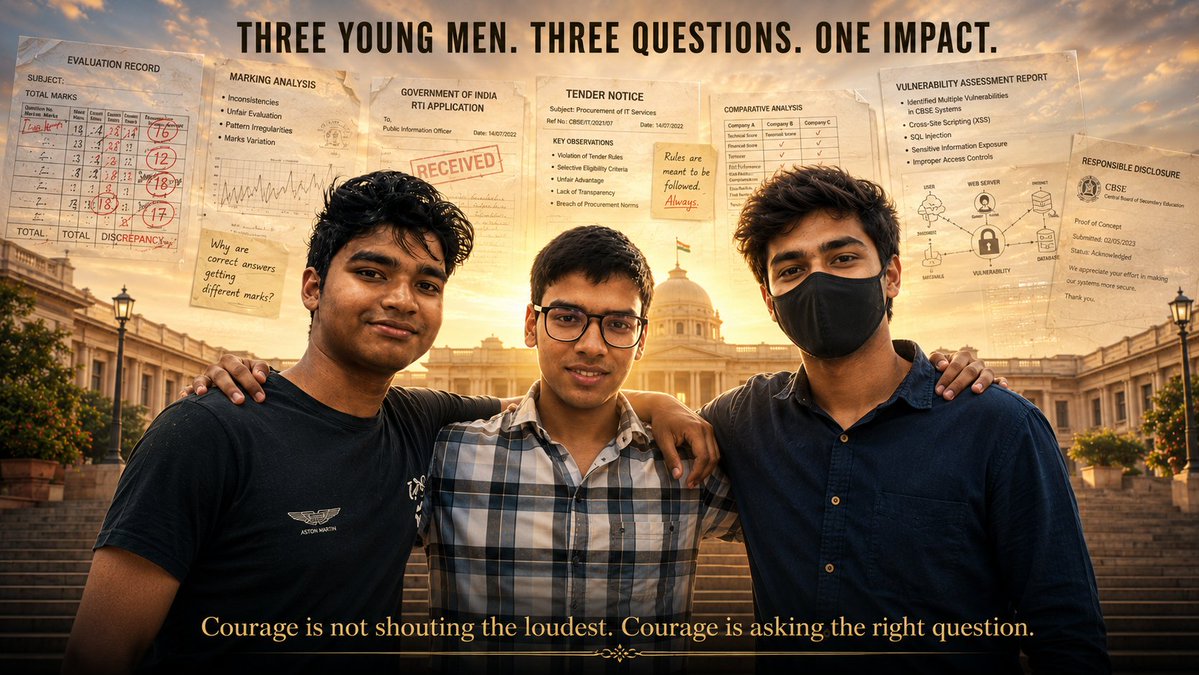
Vedant Srivastava - 17 yrs old
Took to social media and exposed discrepancies in CBSE's OSM marking system.
Nisarga Adhikary- 19 yrs old
Hacked CBSE website and informed them (and us) that it is vulnerable and can be hacked.
Sarthak Sidhant- 17 yrs old
Exposed how CBSE bent rules to award the OSM tender to COEMPT.
These 3 kids need to be lauded. They have given us a glimmer of hope. They have shown us, not all is lost.
We still have a future to salvage.
Most people don’t understand that the Indian bigco CEO phenomenon is mostly an immigration story. Indians are FAR more likely to be tied to employment visas than other nationalities, so they couldn’t easily start companies.
The 1990 Immigration Act created the modern H-1B/EB green card system. As Indian demand exploded, the 7% per-country cap turned into decades-long backlogs for Indians. Indian tech workers stayed tethered to sponsoring employers in a way Europeans, Russians, Taiwanese never had to. Founding a company means risking your status, resetting a green card path, or finding another workaround (now usually O-1 or EB-1).
European/ Russian /Taiwanese immigrants don’t face the same trap. Their countries don’t hit the 7% per-country cap, so demand stays under the limit. A German or Russian engineer on H-1B can get a green card in 1-2 years and leave to found a company. An Indian engineer doing the same job has to wait 20+ years.
The 1965-1989 Indian cohort was much smaller but not yet trapped by today’s H-1B lottery and India backlog machine. That’s why you see so many Indian founders from that era: Vinod Khosla (Sun Microsystems), Sanjay Mehrotra (SanDisk, before becoming CEO of Micron), Kanwal Rekhi (Excelan), Suhas Patil (Cirrus Logic), Desh Deshpande (Sycamore Networks), Pradeep Sindhu (Juniper Networks), etc.
My dad is a 1972 IIT grad who came to America for a PhD. Most of his IIT friends are successful entrepreneurs. My cousin took the same exact path (IIT>CMU) in the 1990s and most of his friends worked their way up corporate jobs because they needed employment sponsorship.
IMO this is bad for America. We took the highest-conviction risk-takers on earth, people who crossed an ocean and left their families behind, and forced them into the lowest-risk career path.
Fortunately this has been loosened in the 2010s with O-1 and EB-1A workarounds but it’s still much more challenging for Indian or Chinese founders.
Tesla has reportedly scrapped plans for a vehicle production factory in India.
India’s Minister of Heavy Industries, K. N. Balagopa, stated that Tesla has decided against building a manufacturing plant in India.
Tesla’s decision weighed several factors, including major shortcomings in the country’s local supply chain and industrial base, a stalemate in talks with the government over the sequencing of tariff cuts versus factory construction, insufficient infrastructure, the limited purchasing power of Indian consumers relative to Tesla’s premium vehicles, and broader uncertainties stemming from policy and regulatory risks in the Indian business environment.
Primeminister of India, Narendra Modi, would not take my question, I was not expecting him to.
Norway has the number one spot on the World Press Freedom Index, India is at 157th, competing with Palestine, Emirates & Cuba.
It is our job to question the powers we cooperate with.
@protosphinx The concept of "win-win" is yet to arrive to the broad indian cultural mindset. We're still a super scarcity society. Someone's loss is still seen as one's metric for success.
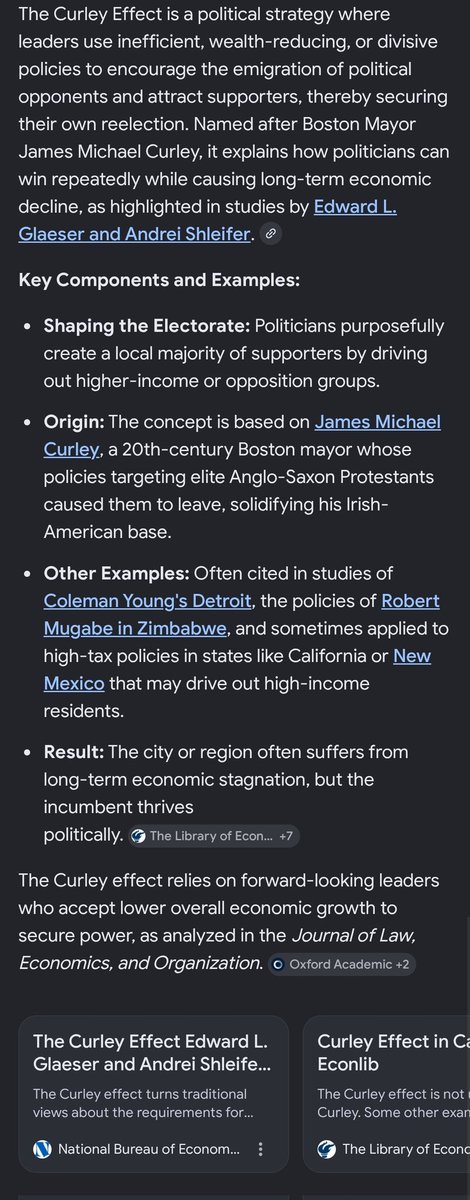
What we're seeing in the blue cities has a name, its the Curley Effect.
"The Curley Effect is a political strategy where leaders use inefficient, wealth-reducing, or divisive policies to encourage the emigration of political opponents and attract supporters, thereby securing their own reelection. Named after Boston Mayor James Michael Curley, it explains how politicians can win repeatedly while causing long-term economic decline, as highlighted in studies by Edward L. Glaeser and Andrei Shleifer."