New update complete: Validator-Based Ownership & Staking
This update introduces validators as the primary identity layer under the entire Hypertensor umbrella.
Previously, subnet nodes were independently registered, and users' stakes were delegated to them on a per-subnet basis.
Now, node operators first register a validator identity that can own and operate nodes across multiple subnets. This makes validators easily identifiable participants to whom users can directly delegate stake.
Previously, if a validator operated across multiple subnets, delegators had to discover and stake to each node separately.
Now, delegators stake directly to validators and receive emissions generated from all subnet activity associated with that validator.
The reputation system also benefits from this change. Instead of reputation being isolated to individual subnet nodes, reputation is now accumulated at the validator level. Validators build a track record across all of the networks they participate in, allowing delegation, rewards, penalties, and consensus performance to contribute to a single reputation profile.
Why this matters:
• Establishes validators as first-class network participants
• Creates a foundation for validators to operate across multiple decentralized AI networks
• Aggregates validator reputation, rewards, penalties, and consensus participation
• Aligns validator incentives across all subnets they participate in
• Enables delegation at the validator level and subnet level, making the data structure more coherent and staking decisions easier for users
This update represents a significant optimization of the validator and delegator architecture and its scalability, creating a unified reputation, delegation, and rewards system.
The $DRAM ETF from @roundhill is an index of memory companies benefitting from the AI buildout. It sits at $9.6B in assets less than two months after launch, and it’s up 85% in value that time.
This is so cool! So far we’ve mainly seen private hedge funds and their LPs enjoying the gains from this sector, but now retail investors have *public* fund access (in addition to the option of picking stocks manually, though most don’t have the time and expertise for that).
The famous AI thesis hedge fund Situational Awareness is sitting on $13.6B in assets – not all that much more than $DRAM’s $9.6B, meaning retail is starting to enjoy a similar level of exposure.
But $DRAM is a US-listed ETF, so you can only buy it in countries that are plugged into the US brokerage network. Fund access has progressed from private to public, but still leaves much of the world out.
We can do better. By creating funds onchain with tokenized US stocks that are backed 1:1 with underlying equities and accessible outside of the US, we can extend access to most of the globe. That’s what we’re cooking right now, alongside the leading tokenizer of US equities.
Stay tuned for globally accessible AI supply chain funds in the coming weeks, freely accessible in about 145 countries to about 6 billion people.
If you are in the trenches on this trade, you can guess which vertical we’ll lead with.
In Reserve’s pursuit of asset-backed currency, we’ve always had RWA support on our roadmap. We believe this is the perfect time to launch support for tokenized equities because we can address a real market gap: right now the economic benefit of the AI buildout is uneven based on where you live and what you can invest in, and we can make meaningful headway in fixing that with a product line we believe will bring usage to our platform and propel us forward as a project.
Our endgame remains the construction of DTFs that protect your purchasing power whether we go through World War 3, the decline of the US and the dollar, or a true technological singularity. The next step in our journey is incorporating exposure to the AI buildout.
We’re curious:
Are you invested in the AI sector yet?
Where are you from, and what has been your experience trying to get access?
Which companies or sectors are you most interested in, or do you not know where to start?
This is an email I sent earlier today to all employees at Coinbase:
Team,
Today I’ve made the difficult decision to reduce the size of Coinbase by ~14%. I want to walk you through why we're doing this now, what it means for those affected, and how this positions us for the future.
Why now
Two forces are converging at the same time. We need to be front footed to respond to both.
First, the market. Coinbase is well-capitalized, has diversified revenue streams, and is well-positioned to weather any storm. Crypto is also on the verge of the next wave of adoption, with stablecoins, prediction markets, tokenization, and more taking off. However, our business is still volatile from quarter to quarter. While we've managed through that cyclicality many times before and come out stronger on the other side, we’re currently in a down market and need to adjust our cost structure now so that we emerge from this period leaner, faster, and more efficient for our next phase of growth.
Second, AI is changing how we work. Over the past year, I’ve watched engineers use AI to ship in days what used to take a team weeks. Non-technical teams are now shipping production code and many of our workflows are being automated. The pace of what's possible with a small, focused team has changed dramatically, and it's accelerating every day.
All of this has led us to an inflection point, not just for Coinbase, but for every company. The biggest risk now is not taking action. We are adjusting early and deliberately to rebuild Coinbase to be lean, fast, and AI-native. We need to return to the speed and focus of our startup founding, with AI at our core.
What this means
To get there, we are not just reducing headcount and cutting costs, we’re fundamentally changing how we operate: rebuilding Coinbase as an intelligence, with humans around the edge aligning it. What does this mean in practice?
- Fewer layers, faster decisions: We are flattening our org structure to 5 layers max below CEO/COO. Layers slow things down and create coordination tax. The future is small, high context teams that can move quickly. Leaders will own much more, with as many as 15+ direct reports. Fewer layers also means a leaner cost structure that is built to perform through all market cycles.
- No pure managers: Every leader at Coinbase must also be a strong and active individual contributor. Managers should be like player-coaches, getting their hands dirty alongside their teams.
- AI-native pods: We’ll be concentrating around AI-native talent who can manage fleets of agents to drive outsized impact. We’ll also be experimenting with reduced pod sizes, including “one person teams” with engineers, designers, and product managers all in one role.
In short: AI is bringing a profound shift in how companies operate, and we’re reshaping Coinbase to lead in this new era. This is a new way of working, and we need to leverage AI across every facet of our jobs.
To those who are affected
I know there are real people behind these decisions — talented colleagues who have poured themselves into this company and our mission. To those of you who will be leaving: thank you. You’ve helped build Coinbase into what it is today, and I am sincerely grateful for everything you've done.
All impacted team members will receive an email to their personal account in the next hour with more information, and an invitation to meet with an HRBP and a senior leader in your organization. Coinbase system access has been removed today. I know this feels sudden and harsh, but it is the only responsible choice given our duty to protect customer information.
To those affected, we will be providing a comprehensive package to support you through this transition. US employees will receive a minimum of 16 weeks base pay (plus 2 weeks per year worked), their next equity vest, and 6 months of COBRA. Employees on a work visa will get extra transition support. Those outside of the US will receive similar support, based on local factors and subject to any consultation requirements.
Coinbase prides itself on talent density. Our employees are among the most talented people in the world, and I have no doubt that your skills and experience will be highly sought after as you pursue your next chapters.
How we move forward
To the team that is staying, I know this is a difficult day. We’re saying goodbye to colleagues and friends you've been in the trenches with. But here’s what I want you to know as we move forward together:
Over the past 13 years, we have weathered four crypto winters, gone public, and built the most trusted platform in our industry. We’ve made it this far by making hard decisions and by always staying focused on our mission. This time will be no different – nothing has changed about the long term outlook of our company or industry. And most importantly, our mission has never been more important for the world. Increasing economic freedom requires a new financial system, and we’re building it.
The Coinbase that emerges from this will be more capable than ever to achieve our mission.
Brian
We've been building the decentralized AI economy, the coordination layer for the future of AI. The system has been purposefully iterated in stages. Feature by feature. Here's what we've done:
Testnet Vitalik→
Focused on the fundamental consensus mechanism where peers formed consensus based on the LLM transformer blocks they hosted, not a state, but actual AI computation.
Testnet Gavin→
Introduced economic mechanisms and refined consensus logic, turning early experiments into an economic system that can coordinate real participants.
Overwatch Agents→
We introduced Overwatch Agents, an evolving set of decentralized, staked participants who serve as agents that join each AI network at the P2P level, validate consensus, validate on-chain vs. in-subnet state, and score networks based on decentralization, consensus accuracy, and benchmarking. They act as an evaluation mechanism, benchmarking each AI network.
Testnet Tensor→
Focused on testing the full-featured blockchain, including the final consensus mechanism, delegate node staking, and many other iterations of features.
P2P AI Template→
A decentralized AI framework for deploying deAI networks using DHTs, gossip, noise encryption, PoS, and more features.
This is a blockchain tech stack for building AI networks, but it's purposefully built for AI with no computational limitations, unlike blockchains. This ensures the future of AI is decentralized, reproducible, verifiable, and scalable.
This is the development backbone that makes it easy for devs to deploy decentralized AI networks.
Testnet Hoskinson→
Testnet Hoskinsons' main purpose was to test the P2P AI template in public with multiple teams and partners running nodes to ensure it was ready for production.
All of this leads to one point:
We are entering the final phases.
We're now actively working with external teams and developers to build the first set of AI networks that will be deployed to the ecosystem.
People wonder, what makes an AI network decentralized?:
- verifiable decentralization
- peer-to-peer execution
- trustless coordination
Built on the P2P AI Template. Secured by the network. Real deAI.
The subnet template will soon have a DAG feature built in for decentralized AI workloads!
WOWZEERS
What's a DAG and who uses them?
A Merkle DAG is basically a content-addressed graph of hashed objects, enabling trustless, parallel, and mergeable state replication, unlike linear blockchains.
Used by Kaspa, Hedera, IPFS, etc.
I've said since the beginning, each subnet will eventually become a blockchain purposefully built for decentralized and trustless AI.
DAG is the perfect system for AI as it allows for non-time based data (blocks)
Testnet Hoskinson is complete! 🎇
All core blockchain infrastructure and decentralized AI networking layer testing have been completed!
This milestone marks the transition from foundation-building to ecosystem expansion.
What we accomplished:
• Over 1,000,000 blocks validated
• Over 2,000,000 pubsub heartbeats processed
• Over 5,000,000 messages successfully gossiped across the network
• Fault-tolerant P2P connectivity validated under real conditions
• End-to-end decentralized AI network coordination confirmed
The future is decentralized, trustless, and P2P AI, and we've unlocked that.
⇾ Production-grade experimentation for agent swarms and model coordination
⇾ Scalable on-chain incentives for AI infrastructure
⇾ Composable decentralized AI services pooled together across a single network
We now move from proving the network… to building on it.
The future of AI starts now.
The future of AI is trustless.
The future of AI is peer-to-peer.
The future of AI is private.
1/ crvUSD is now easier to move from L2s back to Ethereum.
FastBridge removes the 7-day withdrawal delay from native bridges using @LayerZero_Core messaging, enabling crvUSD transfers from @arbitrum, @Optimism, and @fraxfinance's Fraxtal to Ethereum in ~15 minutes.
https://t.co/NhQUjV4ONs
Here's how it works 🧵
Testnet Hoskinson is approaching its final stages.
Our primary focus during this phase has been testing the decentralized AI subnetwork template and framework. This included validating peer coordination, gossip propagation, and fault tolerance under continuous operation.
We are now transitioning into the next stage of development: deeper blockchain testing. This phase will focus on validator incentives, smart contract deployment, and precompile functionality.
One of the key properties we tested in the subnet framework was fault tolerance. Because each subnet uses a technology stack similar to modern blockchain networks, it must meet enterprise-grade reliability standards.
During live testing, the subnet has been running uninterrupted with:
- 1,900,800+ pubsub heartbeats
- 4,561,920+ messages gossiped between peers
With subnet template testing nearing completion, development is expanding into additional areas of the protocol, including:
- Blockchain validator rewards
- Smart contract deployment
- Precompile smart contracts
This marks the transition from infrastructure validation toward preparing the ecosystem for the first real subnets to deploy.
In parallel, we are preparing for the stage that follows testnet, building the first subnets alongside other great teams in the AI space that will launch on mainnet.
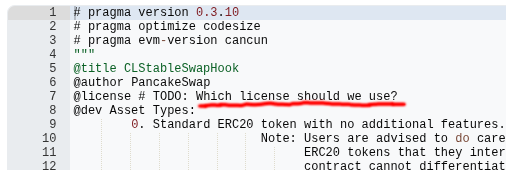
Dear @PancakeSwap. Looks like you copied our code without asking. It is violation of its license. Not only it is illegal: historically it showed to be unwise for those who did it this way in other regards.
In any case. If you want to enjoy using stableswap without legal problems and to borrow some of our expertise to keep users SAFU - you still can contact us for licensing and collaboration.
@NoLimitGains HPS Corporate Lending Fund (HLEND) was hit with it.. but the fund’s rules allow only 5% of assets to be redeemed per quarter…so now some investors must wait for a later redemption window, not that their money is permanently locked.
$QNT
Bring your own app coming soon. Developers willl be able to code a service against a specification and hav it displayed directly inside Quant Connect.
The blockchain App Store is finally coming
This is huge news and will help enable the mass adoption of blockchain + Overledger
Canton does over $300 billion in daily repo volume.
Over $6 trillion in tokenized real world assets sit on the network with firms like DTCC and Broadridge building on it.
Transactions stay private between counterparties because that's the only way banks can legally operate onchain.
Canton enforces this at the smart contract level through Daml, meaning two firms can settle a trade without the rest of the network seeing a thing.
Institutions are paying attention.
When users shield assets in RAILGUN, it creates a larger anonymity set, and a larger anonymity set means stronger privacy for everyone participating in the system. Every transaction that goes through RAILGUN permanently improves privacy for all users, not just the person making that transaction.
The network effects here work in your favor instead of against you.
The updated Aztec Product Roadmap is live.
All the code is complete to build privacy-preserving smart contracts on Ethereum.
The past 8 years of work are now converging.
https://t.co/4jQFlhgLRf