Something I’ve found helpful for reducing low-level disruption during transitions is to frontload the expectations, followed by a short, firm countdown for when the transition must be complete.
For example:
“Silently, without talking to anyone nearby, you have 30 seconds to put your whiteboards away and have your case study packet and pencil on your table in front of you. 3-2-1, go.”
20 seconds: “Still silent. Whiteboards are away. Packets are out.”
10 seconds: “Waiting patiently and silently for the next direction.”
“3-2-1. Eyes and ears on me.”
The key is that students know exactly what they should be doing, what ‘done’ looks like, and when they need to be done. The countdown makes the transition a defined task rather than an open-ended period of dead time.
Tell your boss that I gave you the rest of the week off so you can explore this amazing interactive map showing the road network of the Roman Empire. This is so much fun to explore you can compare the Ancient and Modern road network for example. Great stuff. Your boss will understand... Source: https://t.co/Y8vig00PWY
You can't Rosenshine your way out of a Curriculum problem*
But you also can't Curriculum your way out of a Rosenshine problem**
And you can't ANYTHING your way out of a behaviour problem.
Exactly what today’s episode of Operation Education is about. 3 things to avoid when seating a new class:
❌1. Do not display seating plan on board.
❌2. Do not have a ‘do now’.
❌3. Do not line them up outside!
Look at Iran on a map and one thing becomes pretty obvious: its geostrategic importance.
There’s a reason Zbigniew Brzeziński singled it out in his book "The Grand Chessboard". Here’s what makes Iran so geographically important (and annoying) to the West.
1/n
Try teaching one repeatable study cycle:
READ → CLOSE → RETRIEVE → CHECK → CORRECT → SCHEDULE A RETURN
Model it with actual course content. Practise it in class. Then ask pupils to use the same cycle independently.
Study habits need teaching too.
Nobody develops their thinking alone.
Much of what I believe about teaching has been shaped by reading, listening, testing ideas in the classroom and returning to the people who keep making me think.
Six influences have shaped my practice more than most. 🧵
Many classroom problems begin with an instruction that made sense to the teacher but not to the pupils.
Be sensible.
Get started.
Work quietly.
Each sounds clear until we ask what pupils must actually do.
Strong instructions make action visible.
Some flags are simple, easy-to-understand affairs. Others are more complex, with several layers of meaning.
And then there’s Mongolia.
I had often looked at it and thought, 'I wonder what all that stuff means'. So I looked it up, and it's tremendous.
1/n
I’ve subscribed to Teacher Toolkit, listened to Ross McGill for years and had the privilege of interviewing him.
Today, @TeacherToolkit delivered a keynote on feedback at my school and I still came away with a genuinely new way to think about it.
Three takeaways 🧵
A worked example can make a difficult task look easy.
That is not the same as making the learning easy.
Used well, examples reveal the decisions an expert makes but a novice cannot yet see. A thread on getting modelling right.
1/10
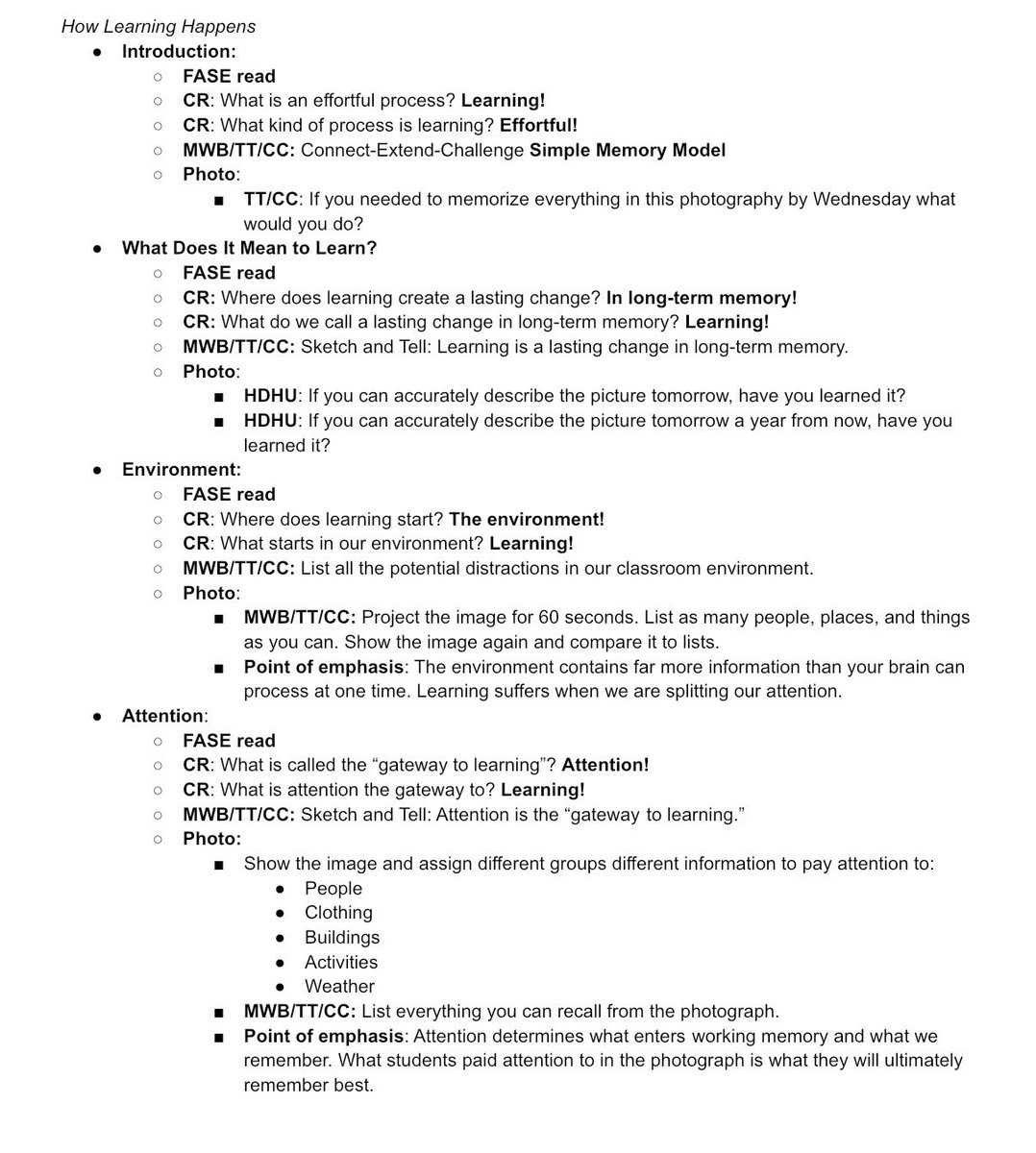
Working on the scripting for my How Learning Happens crash course to start the school year.
I think what I love most about planning lessons this way is the opportunity to explicitly and intentionally incorporate the principles of learning I’ve come to know over the last few years. It gives me the chance to finally take those ideas from theory to practice and from books, podcasts, and blog posts into the classroom.
There’s something incredibly rewarding about designing instruction that aligns with what we know about attention, working memory, retrieval, and long-term learning. The science becomes more than something I read about. It becomes something my students experience every day.
I've just discovered that I never posted a series of 5 videos of talks that I gave as part of Scotland's Attainment Challenge on March 24th, 2016. The first is here: https://t.co/Vj4JR96e0e.
The Powerpoint slides for all five presentations are here: https://t.co/g8wvSwFkJj
The choreography of teaching 30 children at the same time > quite a long read but dare I say I think it's worth it. Nail this, you've nailed it! https://t.co/R9fxgXRcgK via @teacherhead
A community college professor named Marty Lobdell taught the same study skills lecture for 30 years. The video quietly became one of the most watched educational recordings online, with over 10 million views.
He spent his career watching students fail not because they were lazy, but because no one had taught them how their brain actually works when learning something difficult.
The lecture, “Study Less Study Smart,” contains a powerful framework.
Your brain cannot sustain focus the way most people believe. Studies show the average learner hits a wall between 25 and 30 minutes. After that, efficiency collapses. You’re still sitting there, but almost nothing is being absorbed.
Lobdell told the story of a student who planned to study 6 hours a night, 5 nights a week. Thirty hours total. She failed every class. She was not lacking effort. She was confusing time near books with actual learning. The fix is simple: when focus drops, stop, take a 5 minute rewarding break, then return. That reset makes a massive difference.
He also destroyed the myth of highlighting and re reading. Recognition is not the same as recall. To prove it, he read 13 random letters. Almost no one remembered them. Then he turned them into “Happy Thursday.” The entire room recalled them instantly. The brain stores meaning, not repetition.
This is why elaborative encoding works so well.
Finally, he shared the most important principle: 80 percent of study time should be active recitation. Close the book and explain the material in your own words. Teach it to someone else or an empty chair. Retrieval is where real learning happens.
His closing line stuck with me: If this information does not change your
behaviour, you have not actually learned it.
The best students do not study more hours. They stop confusing the feeling of studying with the reality of learning.
I had never taught using white boards until this year and now it is pretty much all I use. What I appreciated about this conversation that while we discussed the benefits of teaching using white boards we also discussed when not to use them and the danger of overusing them (I am guilty here).
@AmberBHaven@AndrewWatsonTTB@SoLInTheWild@bamradionetwork https://t.co/tWU40sQQ8g
Mini whiteboards (MWB) are great for formative assessment. But I always struggled with getting students to actually apply the feedback I gave them on their MWB responses.
Tick-Trick took care of that! I explain more in my new Substack post. You can find the link below ⬇️
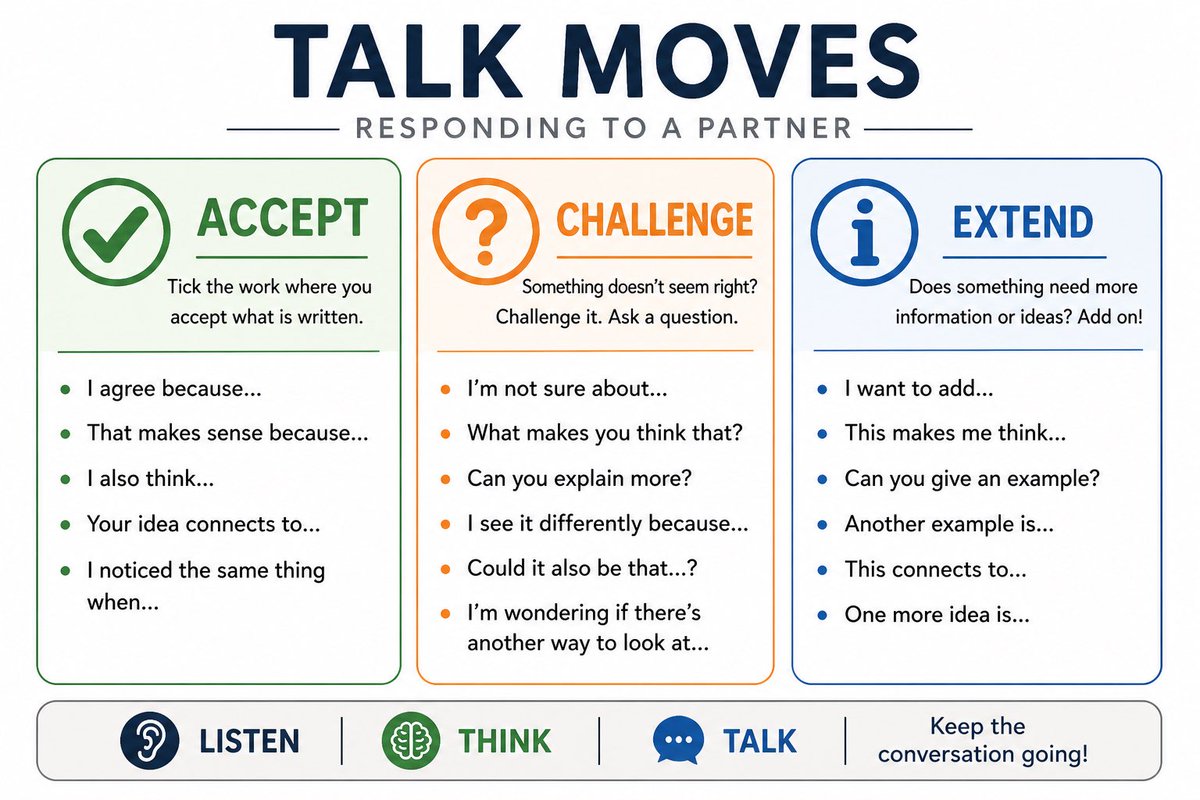
Over the past couple of days, I’ve embedded the Accept–Challenge–Extend routine into our existing turn-and-talk and cold-call procedures. It has led to some of the strongest partner discussions and whole-class responses we’ve had all year. One key reason is that it sustains students’ attention on what their partner is saying, and on what the student being cold-called is saying, because they know they may need to respond in one way or another. It also gives students additional opportunities to think about the learning objective in diverse contexts.
This is also an ideal time of year to field-test new techniques and routines you’re considering for next year. Think of it as a soft launch before the official rollout.