Boston and the Birth of British India
Far too often, we imagine Britain's first and second empires in America and India as two separate stories. Yet colonial India and America were deeply entangled.
Around 30 robots demonstrated outside Poland's Digital Affairs Ministry in Warsaw, chanting 'we want law, we want rules' to demand stronger AI oversight
I join the @iaeaorg in raising the alarm again over the safety of nuclear facilities in #Iran.
The latest incident involving the Bushehr nuclear power plant is a stark reminder: a strike could trigger a nuclear accident, with health impacts that would devastate generations.
With every passing day of this escalating conflict, the stakes and threats are raised higher and higher. We must de-escalate now. Peace is the best medicine.
An unarmed Iranian ship was invited to take part in an Indian naval exercise alongside the United States.
Its sailors were welcomed on land and paraded before the president as a gesture of cooperation.
Then, at the last moment, the United States abruptly withdrew from the exercise,only to turn around and torpedo the very ship it had just stood beside.
What followed was even more grotesque.
After attacking an unarmed vessel, the US refused to rescue the sailors it had thrown into the sea, abandoning them to drown.
The grim work of recovering bodies was left to the Sri Lankan Navy.
This wasn’t warfare,it was treachery of the most disgraceful kind: an ambush carried out under the pretense of diplomacy, followed by a cold refusal to show even the most basic human decency to the dying.
It would represent a collapse of every norm that supposedly governs civilized conduct at sea.
And yet, instead of outrage, much of the American media response has been indifference or rationalization.
The bombing of a girls’ school is brushed aside; talk of carpet-bombing Tehran is floated as if it were just another policy option.
When atrocities are normalized and cruelty is laundered into “strategy,” the line between reporting and complicity begins to disappear.
this is not good, not good at all. India, along with its regional partners such as Sri Lanka, must ensure that the subcontinent and its waters do not become a theatre for other countries' wars.
https://t.co/ChXR9zYGgf
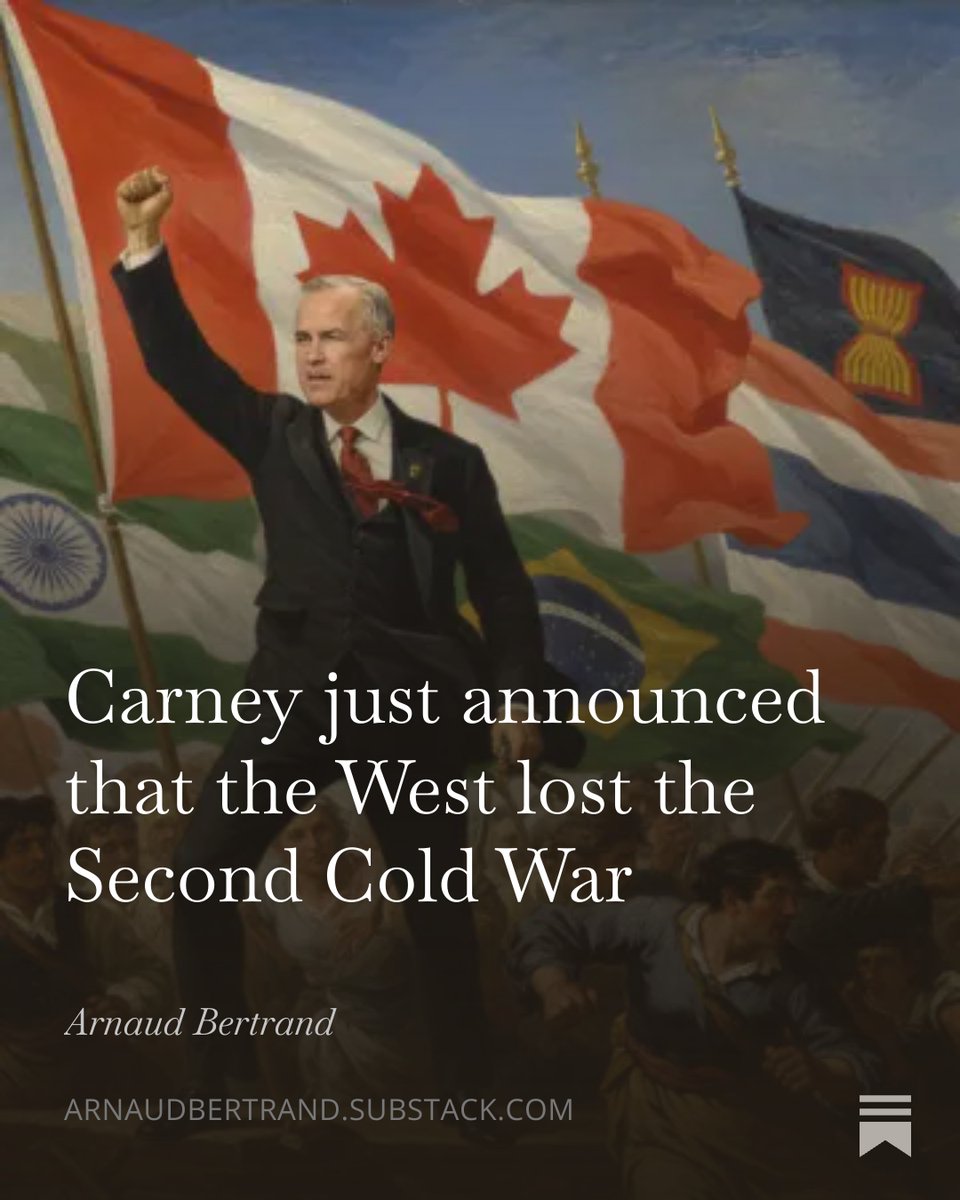
Who could have expected Mark Carney, a liberal establishment figure if there ever was one, to be the flag-bearer for the end of the US-led order? And from a podium at Davos, of all places?
The more you think about it, though, the more it makes sense.
Carney is, at heart, a central banker. As such he understands the power of words and beliefs better than anyone: when you strip things down to their core, a world order - like trust in a currency or a financial system - fundamentally relies on the maintenance of belief. Systems of power exist because participants act as if they exist. That's pretty much it: perception is reality.
Once participants acknowledge the fiction as Carney just did (he literally started his speech announcing he'd "end the pleasant fiction" of the US-led order), the system itself unravels. This is incidentally a formal concept in game theory: the shift from private knowledge to common knowledge is what triggers cascades.
Carney, with his background, ought to have known this was his most potent weapon facing Trump's America: "Trump has the economic and military might. But I have something his power rests upon: I can shatter the collective belief that sustains it."
He's even explicit about this being his thinking: his entire speech revolves around Vaclav Havel’s famous shopkeeper analogy and the fact that the power of the Soviet Union rested on "everyone’s willingness to perform as if it were true," on "living within a lie."
As Carney puts it, "when even one person stops performing, the illusion begins to crack" and the entire "system’s power" starts to crumble.
Today, that "one person" was him.
Make no mistake, Carney’s speech at Davos may prove to be one of THE most important speeches made by any global leader over the past 30 years. This is genuinely epochal stuff.
More than anything, what it means is that, to the extent it even existed at all, the West irremediably lost the Second Cold War: a Cold War requires two competing systems. Carney just announced that one of them simply no longer exists.
This is the topic of my latest article: an in-depth analysis of Carney's speech and its immensely consequential implications for what comes next.
Enjoy the read here: https://t.co/Vf5heHU1OV
“When I entered Gaza the Israeli military had a rule: I was only allowed to bring in three kilos of food. As I was weighing out protein bars, trying to get under the limit, I said to my husband: ‘How sinister is this?’ I’m a humanitarian aid worker. Why would there even be a limit on food? I’ve worked in many places with extreme hunger, but what’s so jarring in this context is how cruel it is, how deliberate. I was in Gaza for two months; there’s no way to describe the horror of what’s happening. And I say this as a pediatric ICU doctor who sees children die as part of my work. Among our own staff we have doctors and nurses who are trying to treat patients while hungry, exhausted. They’re living in tents. Some of them have lost fifteen, twenty members of their families. In the hospital there are kids maimed by airstrikes: missing arms, missing legs, third degree burns. Often there’s not enough pain medication. But the children are not screaming about the pain, they’re screaming: ‘I’m hungry! I’m hungry!” I hate to only focus on the kids, because nobody should be starving. But the kids, it just haunts you in a different way. When my two months were finished, I didn’t want to leave. It’s a feeling I haven’t experienced in nearly twenty years of humanitarian assignments. But I felt ashamed. Ashamed to leave my Palestinian colleagues, who were some of the most beautiful and compassionate people that I’ve ever met. I was ashamed as an American, as a human being, that we’ve been unable to stop something that is so clearly a genocide. I remember when our bus pulled out of the buffer zone. Out the window on one side I could see Rafah, which was nothing but rubble. On the other side was lush, green Israel. When we exited the gate, the first thing I saw was a group of Israeli soldiers, sitting at a table, eating lunch. I’ve never felt so nauseous seeing a table full of food.”
-------------------------------------------------------
Aqsa Durrani is a pediatric doctor and board member of Doctors Without Borders USA, with nearly twenty years of experience in humanitarian projects. During our interview Aqsa repeatedly expressed a desire to center the voices of her Palestinian colleagues. To this end I’ve spent the past week collecting stories from the Palestinian staff of Doctors Without Borders in Gaza. I will be sharing these stories over the next several days. I’m so grateful for the time that these people gave me; they were sleepless, hungry, traumatized, and often working 24-hour shifts. Because of the unreliable internet connection their images are sometimes grainy. Their words, however, will be crystal clear.
Mark Carney and I were in school together. If I had said to him, “Mark, someday Donald Trump will be President of the United States, and he is single-handedly going to make you Prime Minister of Canada”, he would have called campus security to take me home.
Jessica to Musk: you've been making cuts to a lot of the agencies that have open investigations and regulatory battles with your companies. At the same time you continue to get billions in government contracts. How do you explain that to the American people?
Canada has built an economy where the best way to get rich isn’t to invent, create, or build anything
It’s to own houses and wait for prices to rise
If we want a more dynamic, prosperous economy
We need a system that channels investment into productive sectors—innovation, entrepreneurship, and industry
Rather than unproductive, extractive investments like owning houses
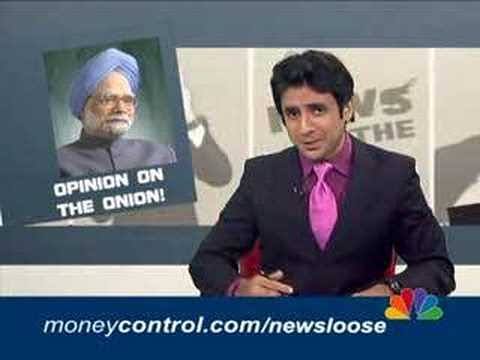
Dr. Manmohan Singh said that history would remember him kindly. I’m happy to see that’s the case on social media today. He had a sense of humour. Leaders mean different things to different people, I can only speak to my experience. Personally, I remember being in my 20s and doing jokes about him on prime time bulletins at CNBC with our team having been made fully aware his office was watching and we’re okay with it. He was the most powerful man in the country and we were doing jokes about him five nights a week on a mainstream news channel, that weren’t even that great because we were utterly immature. Mind you this wasn’t even on a comedy show but as a part of a 9pm news bulletin that every businessperson in the country watched. Think about how far fetched that seems today. The mark of a truly great, secure, and humble leader, to my profession, is the ability to take a joke. Great leaders understand that’s part of the job, that powerful politicians and jest have always been historically intertwined for centuries, and that taking humour within grace makes them so much greater. A politician who can take a joke is truly powerful, and a politician who can make a joke about themselves is admirable, and invincible. In that respect, he stood tall above any Indian leader in my lifespan. Rest in peace sir 🙏