☎️ Who do I call when I want to speak to Europe? The Silence of the Shenzhen Triumvirate means the EU must join NATO – ⚓️🚀🏭🇪🇺 Bringing Europe’s economic, industrial, and civilian capabilities into a binding Euro-Atlantic defence framework:
Attributed to a supposedly more frustrated than usual Henry Kissinger, the mocking moniker ‘Who do I call when I want to speak to Europe?’ has been used often enough by rightfully scornful politicians and leaders on the Potomac to put pesky Europeans in their place. Von der Leyen, Costa, Kallas: the Europeans have clamoured, with diminishing assertiveness, in the past months.
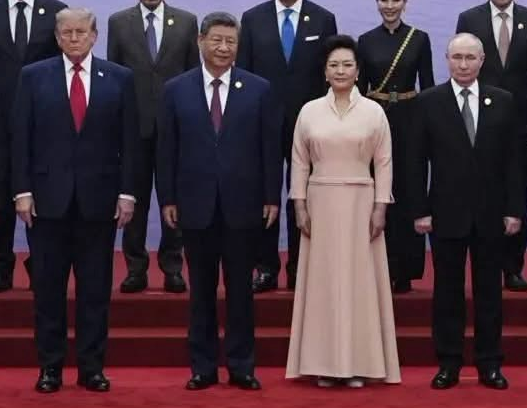
🇺🇸🇨🇳🇷🇺 Still, three men sat down in a room in Shenzhen to settle the world’s security and, thus far, settled nothing. The stage merely showed a frenzied media who had been asked: Presidents Xi and Trump shoulder to shoulder, Xi’s wife as garland, and Putin beyond her, without female companion, as an appendix. The latter may have been apoplectic at the distinctive, if not pernicious, Chinese protocol, but the Russian dictator, primus inter oligarchs, was at least on stage and in the room.
Xi set the stage at the APEC venue and Trump took the opportunity: no European. No European. Not even a hint. And in the joint declaration, silence: not a word on Europe, and none on the two wars that shake the globe. In Ukraine Russia is the aggressor waging a genocidal war of extermination. In Iran it stands behind the terrorist regime of the mullahs and the IRGC. In both China is banker and supplier.
At Yalta the other three men at the table were at least temporary allies; in Shenzhen the American President sat down with the aggressor in one war and the patrons of his enemy in the other. He also called them friends.
🇺🇸🇪🇺 Days earlier an amateurish American envoy, echoing Kissinger, had told the Europeans that finding one person to speak for them would be a greater feat than persuading Moscow to admit them. It is not sufficient to decry loudly, out of anxiety, hapless fear, and impotent incapacity, yet another brutal, roughshod ride over sovereign nations: a performative and, given the fragility of its members, unearned but still violent echo of a triumvirate à la Yalta. European politicians must act; their populations deserve leadership and decisive action, symbolism with relevant action. One large step in this, to show strength and gather a strong joint foothold, is our purpose and central thesis:
💥 After the Silence of Shenzhen, the EU should immediately take all necessary steps to join NATO as an institution and formalise the symbiotic relationship which protects Europe and serves the US and Canada equally. NATO should admit the European Union by treaty-defined institutional accession, so that the Union’s existing economic, financial, industrial, regulatory, infrastructural, and civilian capacities become an integrated and accountable component of Euro-Atlantic collective defence.
Ours is, of course, not a proposal for a European army, a replacement for NATO, or the compulsory federalisation of Europe. It is not primarily an attempt to extend a new security guarantee. The purpose is to introduce a distinct institutional pillar into NATO: a Union-level contributor with the legal, financial, and administrative means to strengthen the Alliance’s capacity to deter, mobilise, reinforce, produce, and sustain defence over time.
The military structure remains NATO, its sovereign Allies, integrated command arrangements, and national armed forces. The EU contributes the extensive economic, industrial, and civil structure upon which sustained military effectiveness depends. Membership, rather than occasional consultation, supplies a permanent seat in the North Atlantic Council and creates treaty-defined duties and reciprocal accountability. A compact between the two institutions would deliver the industrial plumbing; only a seat answers Kissinger’s question.
A treaty amendment and careful EU constitutional settlement will be needed. Those issues are genuine legal work and hard to negotiate; we are making an institutional-economic proposal but certainly not a demand for a supranational military state.
The Alliance and the Union face the same principal adversary and defend one political order with different instruments. Russia wages conquest in Europe, mobilises its economy for attrition, and conducts sabotage and cyber attacks against its neighbours. In June 2025 NATO’s Secretary General warned that Russia produced in three months the ammunition that the whole Alliance produced in a year. A brigade fights only while ammunition, transport, energy, repair, communications, and civil government permit. The Alliance holds the military half of that system. The Union holds much of the public authority over the industrial, financial, infrastructural, and civilian half, exercised alongside its Member States. These inputs cross borders and outlast budgets; no institution is yet answerable for bringing the two halves together. Membership gives that responsibility a seat, a mandate, and a duty.
The Treaty of 1949 anticipated the need: Article 2 provides for economic collaboration, Article 3 for the capacity to resist, and Article 9 for the Council in which Parties act together. At The Hague in 2025 the Allies undertook to account for up to 1.5 per cent of GDP in wider defence- and security-related investment, expressly including critical infrastructure, industry, communications, and civilian resilience. The EU’s 27 Member States spent €418 billion on defence in 2025; yet national expenditure, Union investment, and NATO requirements follow separate authorities and timetables. A bridge on a reinforcement route, a reserve of explosives precursors, or spare transformers for a threatened grid benefits several Allies, whilst the immediate bill falls on one. The result is underinvestment in shared capacity and orders that arrive too late to sustain production.
Civilian defence is the clearest case for accession. In the integrated economies of the EU and EEA, an attack on an electricity interconnector, port, railway-signalling system, communications network, hospital, water supply, or payment service can cripple military reinforcement without striking a single soldier. Russia’s sabotage, drone incursions, and cyber operations exploit these dependencies, often below the threshold of open war. The European Council said as much in October 2026, citing intensifying hybrid attacks, sabotage among them, and calling for urgent work on resilience, preparedness, and the protection of critical infrastructure. NATO’s revised resilience requirements of September 2026 identify the services, national essential functions, and host-nation support that must survive attack. The Union can translate many into binding operator standards, investment in redundancy, stockpiles, and cross-border recovery. National governments retain policing, intelligence, emergency command, and defence. NATO says what must remain operational; the Union can help ensure that it does. Finland, which by law shelters 4.8 million of its 5.6 million people, shows what a prepared society looks like. Civilian continuity is not a rear-area luxury. It is a condition of military endurance and of the survival of the societies being defended.
Across the fifteen domains we analysed the same finding runs like a red thread: NATO clearly specifies the need whereas the Union can finance capacity, remove bottlenecks, protect supply chains, and connect infrastructure. It is national authorities and industry which then deliver.
Ukraine adds the lesson of rapid adaptation under fire and extreme scarcity: a weapon that cannot be manufactured, replaced, and improved at the pace of the war soon ceases to confer advantage. A standing schedule would connect requirements to authorised expenditure, production, readiness, and audited delivery, counting no euro twice. It would give the Alliance not merely more spending, but a more dependable ability to turn European resources into usable strength. An EU of proper preppers.
The remedy proposed here is full institutional membership of NATO, expressly qualified by the Union’s competences. It is no European army, no rival military command, and no federation by stealth. National forces, nuclear deterrence, and operational command remain sovereign. The Union takes its seat in the North Atlantic Council, not in the Military Committee or the Nuclear Planning Group. It accepts Article 5 as written, acting through its lawful economic, financial, industrial, transport, and civil-protection instruments, prepared in advance. Article 42(7) continues to bind the Member States in their own right. The Union’s undertaking is distinct, but complementary. An aggressor would confront an organised economic and civilian response within the Alliance itself.
The legal objections are serious, but they have identifiable negotiating paths. Article 10 must be amended to admit the Union; the 1951 accession protocol for Greece and Turkey already shows that accession instruments can amend the Treaty.
Our proposed ten-article protocol leaves Article 6 unchanged, limits the Union’s role in consensus to its competences, and safeguards EU budgetary authority and Allied sovereignty.
Notably, Austria, Cyprus, Ireland, and Malta obtain no Article 5 guarantee by indirection. The Cyprus–Turkey dispute requires a reciprocal, staged settlement.
Non-EU Allies must have a fair means of participating in programmes upon which their forces depend.
Further, precedent and experiences from FAO and WTO practice rebut the supposed impossibility of institutional membership alongside constituent states. It may not replace Allied consent, EU authorisation, and judicial scrutiny but it can be made to work. We have set out a simplified, negotiable architecture which should suit the key parties. Obviously, there is no pretence that process, decision-making, and ratification will be easy. Given what we experience in the ongoing disassembly of the rules-based order, this will require some hard-nosed leadership, especially on the European side, both within NATO and the EU.
A key element for success is that the United States and Canada would gain a European pillar better able to finance and sustain its own industrial depth, reinforce its eastern flank, and withstand attack upon its civilian economy. The US especially would be relieved of commitments. Their authority in NATO would remain undiminished, whilst greater European capacity would relieve pressure on North American forces, production, and stocks. The transatlantic bargain would be measured by capabilities delivered, not merely expenditure percentages.
For the sceptics of full membership: a binding compact is a useful first stage, but cannot supply the constitutional fact of belonging. The oft-cited compact merely joins two institutions in co-operation; only membership makes the Union a Party to the Alliance whose defence it helps sustain, come hell or high water. It gives Europe an institutional address, an occupant answerable to its fellow Allies, and a public commitment whose symbolism follows from its substance.
In our article on #Substack we make the case, test it across fifteen domains, and derive a proposed accession protocol.
📜 Ceterum censeo: The plumbing can be bought.
The seat must be taken.
1/2🧵
@ChuckPfarrer@NTenzer@John_ForemanCBE@SchullerKonrad
#NATO #EU #Accession #Shenzhen #Ukraine
Russland versucht die Niederlande gezielt anzugehen mit einem Drohnenschlag gegen die Botschaft in Kyjiw, weil Russland behauptet, die Niederlande hätten zu den erfolgreichen ukrainischen Schlägen gegen die Krimbrücke beigetragen. Alle Europäer sollten sofort die Reihen mit den Niederlanden fest schließen.
SLOVIANSK-KONSTIAINTYNIVKA: UKR forces have stabilized the front east of Sloviansk. No confirmed operational breakthroughs or full seizure of Kostiantynivka have occurred. Fighting remains highly attritional, drone-dominated, and characterized by Russian small-group infiltration into gray zones.
🇫🇷⚡️🇪🇺 When you have a moment, @afneil—always worth examining what the 🇷🇺 enemy’s minions publish, while discounting their obfuscation and any attempt to inflate their own role in the mayhem.
The Rybar propaganda map is revealing in its presentation of European unrest. Its founder, Zvinchuk, is already back in Moscow after his expulsion from Montenegro, claiming help from Russian state bodies in securing his release.
Capitalising on existing popular frustration, despair and upheaval, adding kerosene to the casseurs’ fires, sponsoring and exploiting organised criminal elements - then amplifying the spectacle through the media: this is quite a good show of an Active Measure.
The political opportunity is plain enough: pit hard-left aggression against Madame Putinesca, allowing her to present herself as the saviour who will “restore order” and rescue “la vieille France”. With all these October surprises, we cannot be startled, shocked or distracted, that is what our adversaries want. We need shake it off and swiftly get to work to save Europe and beloved Blighty. Keep setting out the principles and agenda on your Report.
@KeirGiles@John_ForemanCBE@ChuckPfarrer@RidT@NTenzer@Peter_Conradi@TheNeilReport
🇺🇦🇧🇪🇺🇲 Solid piece by @NRO's finest and #ThreeMartiniLunch legend @jimgeraghty on how dithering, sloth & being simply slow in wartime costs lives not just time & money. #Belgium nos chers amis, get to work on F-16s rather than into the streets.
Ceterum censeo: whilst you are at it, Monsieur De Wever, box your fears, stop the wavering, release the frozen Russian assets at Euroclear for Europe to fund Ukraine's defence. There is no excuse anymore. We need to arm #Ukraine to the teeth. @MooreUSA@KeirGiles@John_ForemanCBE@DrChrisParry@SchullerKonrad@gregbagwell@ChuckPfarrer
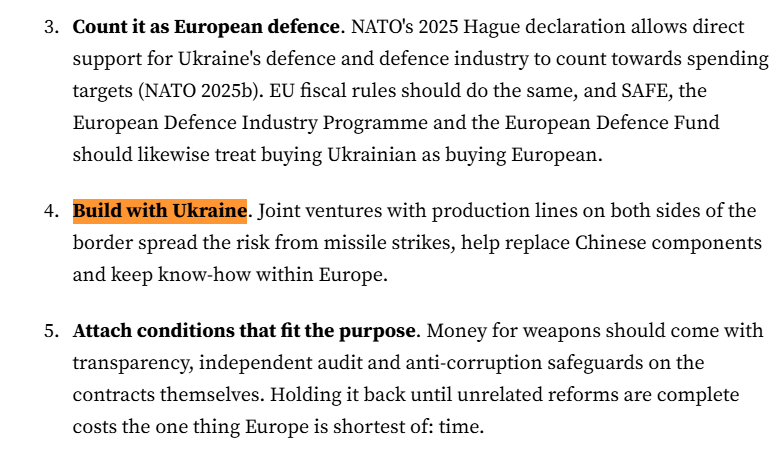
Finally, someone else is LITERALLY saying it: #BuildWithUkraine 😀
@cepr_org finds that €1 buys 3-5x more defence in Ukraine than in Germany, while $25-40B of Ukrainian capacity sits idle without orders.
Seems like a pretty good deal for Europe.
https://t.co/oayRTUrWtN
270 Ukrainian service members have returned home from Russian captivity, President Volodymyr Zelensky said. Most had been held since 2022, and many defended Mariupol.
Five of those released had been believed killed in the July 2022 Russian attack on the Olenivka prison.