Tried & liked it on https://t.co/7gOqjtmSJ3.
Fugu Ultra pairs well as a advisor & planner with Composer 2.5.
For scope/architecture, it’s on par with Fable orchestration.
Advisor doesn’t slow the loop if the driver stays fast & https://t.co/9cL4HqvqSf can split it from worker.
Introducing Sakana Fugu: A full multi-agent orchestration system accessible via a single model API.
Our ‘Fugu Ultra’ model matches the performance of Fable and Mythos, delivering frontier capability without the risk of export controls.
Try it: https://t.co/hhO6qTawgb 🐡
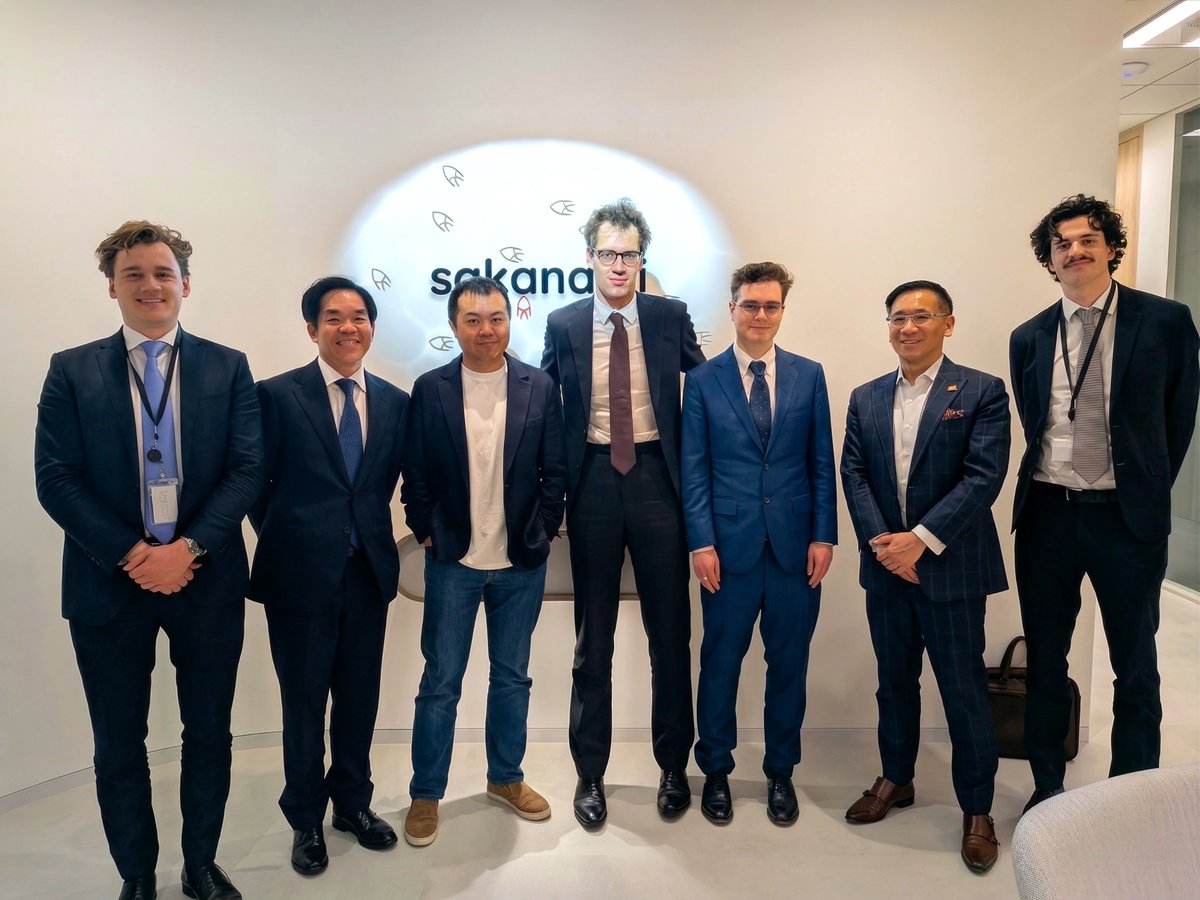
Great collab with @SakanaAILabs on an #ICML26 paper about sparse transformer kernels + formats optimized for modern NVIDIA GPU execution.
• TwELL sparse packing
• Fused CUDA kernels
• 20%+ inference/training speedups at scale
Paper + code below 👇
We’re launching the beta for our new commercial AI product: Sakana Fugu 🐡, a multi-agent orchestration system!
Blog: https://t.co/36Ud311KCP
Fugu hits SOTA on SWE-Pro, GPQA-D, and ALE-Bench, and has been our internal secret weapon. It dynamically coordinates frontier models, autonomously selecting the optimal agent combinations and roles for each task.
Available as an OpenAI-compatible API, you can seamlessly integrate Fugu into your existing workflows with minimal changes.
🐟 Fugu Mini: High-speed orchestration optimized for latency
🐡 Fugu Ultra: Full model pool utilization for deep, complex reasoning
Apply for the beta test here: https://t.co/1fjuAha7ci
What happens when you put competing neural networks in a Petri Dish and start changing the rules while they adapt?
Last year we released Petri Dish NCA, where neural nets are the organisms that learn during simulation. Today we're releasing Digital Ecosystems: a browser-based platform for interactive artificial life research.
The setup: several small CNNs share a 2D grid, each seeing only a 3x3 neighborhood. No global plan. They compete for territory by attacking neighbours and defending against incoming attacks, learning via gradient descent online while the simulation runs.
What we didn't expect was the role of the learning itself. Gradient descent isn't just optimising each species' strategy. Instead, it acts to stabilize the whole system during simulation. Species that overextend get pushed back by the loss. Species that stagnate get nudged to grow. This means you can push parameters toward edge-of-chaos regimes: a zone characterised by emergent complexity. Letting the neural networks learn acts to hold the complex system together while you explore and interact.
The platform lets you steer all of this interactively. You can draw walls to create niches, erase parts of the system online, and tune 40+ system parameters to explore the most interesting configurations. We find it mesmerizing to watch species carve out territories and reorganise when you perturb them.
Everything runs client-side in your browser, no install needed.
Blog: https://t.co/qOuelxmd6l
Code: https://t.co/pz7ktDCRZS
Still remember the experiment grind over New Year's break--really great to see this out in Nature today!
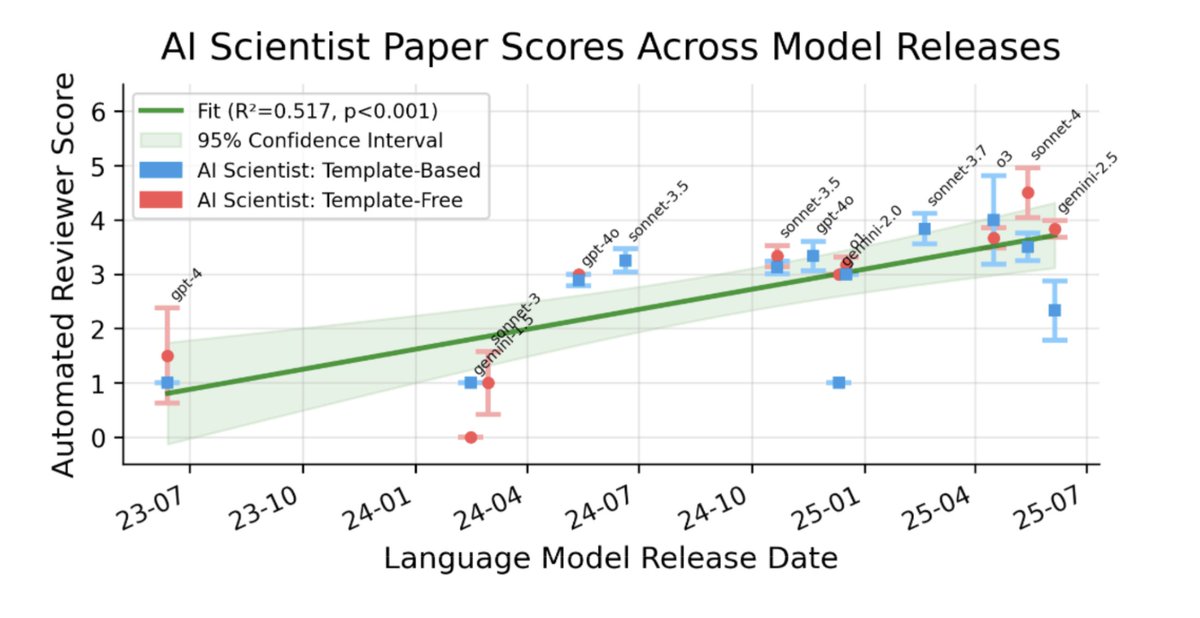
AI automation of AI research is heating up fast, and I'm excited to see what becomes possible as models keep improving (see the figure below!)
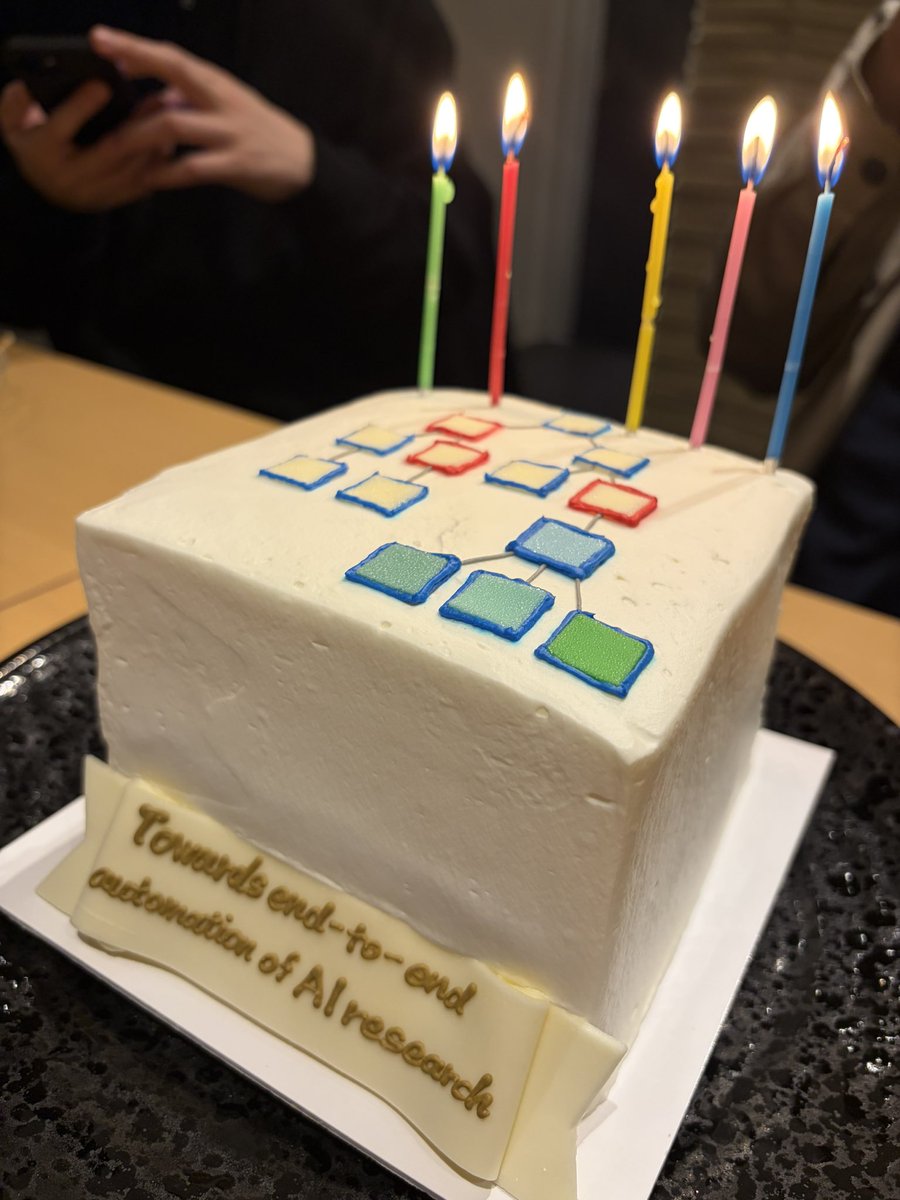
The AI Scientist: Towards Fully Automated AI Research, Now Published in Nature
Nature: https://t.co/nNfpSV5e5I
Blog: https://t.co/i6h8LVQOdl
When we first introduced The AI Scientist, we shared an ambitious vision of an agent powered by foundation models capable of executing the entire machine learning research lifecycle.
From inventing ideas and writing code to executing experiments and drafting the manuscript, the system demonstrated that end-to-end automation of the scientific process is possible.
Soon after, we shared a historic update: the improved AI Scientist-v2 produced the first fully AI-generated paper to pass a rigorous human peer-review process.
Today, we are happy to announce that “The AI Scientist: Towards Fully Automated AI Research,” our paper describing all of this work, along with fresh new insights, has been published in @Nature!
This Nature publication consolidates these milestones and details the underlying foundation model orchestration. It also introduces our Automated Reviewer, which matches human review judgments and actually exceeds standard inter-human agreement.
Crucially, by using this reviewer to grade papers generated by different foundation models, we discovered a clear scaling law of science. As the underlying foundation models improve, the quality of the generated scientific papers increases correspondingly. This implies that as compute costs decrease and model capabilities continue to exponentially increase, future versions of The AI Scientist will be substantially more capable.
Building upon our previous open-source releases (https://t.co/H1tBT14Yx8), this open-access Nature publication comprehensively details our system's architecture, outlines several new scaling results, and discusses the promise and challenges of AI-generated science.
This substantial milestone is the result of a close and fruitful collaboration between researchers at Sakana AI, the University of British Columbia (UBC) and the Vector Institute, and the University of Oxford. Congrats to the team!
@_chris_lu_@cong_ml@RobertTLange@_yutaroyamada@shengranhu@j_foerst@hardmaru@jeffclune
The way @OpenAI and @AnthropicAI account for revenue / ARR is apples to oranges.
Should Anthropic treat their revenue from AWS and other hyperscalers the same as OAI, they would be a materially lower in rev…
If they both IPO in the coming quarters, not sure how the SEC is going to let these two companies have different accounting treatment for essentially the same type of revenue.
OpenAI TAKES OUT the 80% revenue share that goes to @Microsoft Azure and others so reports this 3rd party revenue on a NET basis in their total revenue.
Anthropic INCLUDES the revenue share that goes to @amazon AWS and others in their revenue so reports this 3rd party revenue on a GROSS basis in their total revenue.
IMO, OpenAI taking more conservative approach that reflects the reality of the economics of these hyperscaler partnerships.