This is a very thorough breakdown of the $STRATO ecosystem.
The focus on HardFi and connecting real-world assets to onchain markets is particularly compelling.
I appreciate the detailed look beyond just trading.
A token becomes more interesting when there's an ecosystem being built around it.
That's what I wanted to understand about $STRATO.
@strato_net is building a Layer 1 blockchain focused on HardFi, where real-world assets and onchain financial activities connect.
But there's more to the ecosystem than just trading.
Here's what makes it worth exploring:
1. Trading
You can explore $STRATO trading through the platform and experience its onchain trading environment.
2. Network Utility
$STRATO is designed to play a role in the network's economy, including transaction fees and network participation. Some token utilities are still being rolled out.
3. Staking
Staking is part of $STRATO network security model. Token holders can explore delegation and validator participation as these features become available.
4. Real-World Finance
$STRATO connects tokenized assets like gold and silver with borrowing, savings, liquidity and other DeFi activities.
The bigger idea is to connect real-world financial assets with onchain markets instead of keeping them in separate worlds.
If you want to explore the platform yourself, start with the trading side:
→ Open my referral link: https://t.co/73avTHGizK
→ Connect your wallet.
→ Deposit supported funds if needed.
→ Explore and trade $STRATO.
→ Discover staking and other available features.
Don't just follow the ticker. Understand the ecosystem behind it.
DYOR, check the live trading details and make your own decisions.
This sounds like a truly unique and engaging event.
I'm looking forward to seeing how Arab navigates the challenge and how Kem's innovative approach to payments enhances the experience.
.......
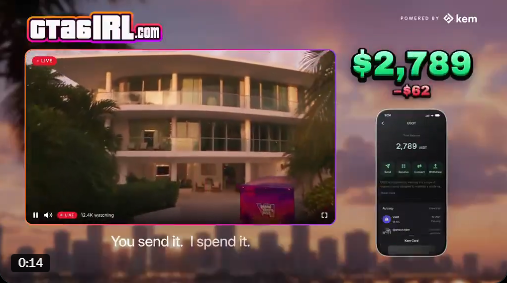
Most livestreams are built around watching. This takes a different approach.
When viewers can send money that directly affects what the streamer can afford, they become part of the experience rather than just spectators.
It also shows how digital payments can create new forms of audience participation beyond simply sending tips.
One thing I find Mind-blowing about $RNT is how differently it has performed across these market conditions.
@rntprotocol token stayed flat over the last 7 days, while the broader crypto market dropped 11% and RWA tokens lost 5.4%.
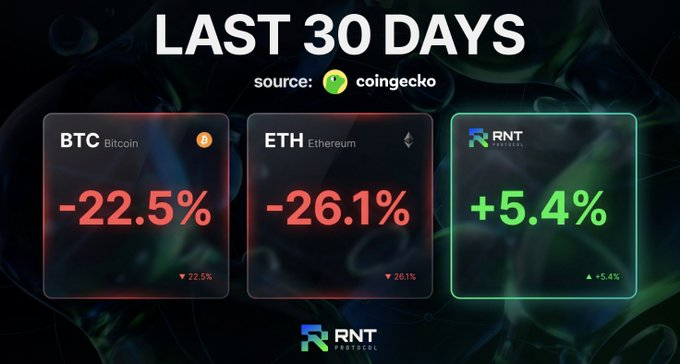
The 30-day comparison makes that contrast even harder to ignore. $BTC is down 22.5%, $ETH is down 26.1%, while $RNT is up 5.4%.
Looking at the 12-month picture, $RNT is up 106%.
I wouldn't call this proof that $RNT is immune to market conditions. No token is. But holding up across these different timeframes is worth paying attention to.
Now the question is whether this relative strength can be supported by real demand and continued activity across the ecosystem.
This is a compelling analysis of $RNT 's performance.
It's certainly impressive how it has navigated various market conditions. I look forward to seeing how sustained demand supports its continued strength.
Smooth
One thing I find Mind-blowing about $RNT is how differently it has performed across these market conditions.
@rntprotocol token stayed flat over the last 7 days, while the broader crypto market dropped 11% and RWA tokens lost 5.4%.
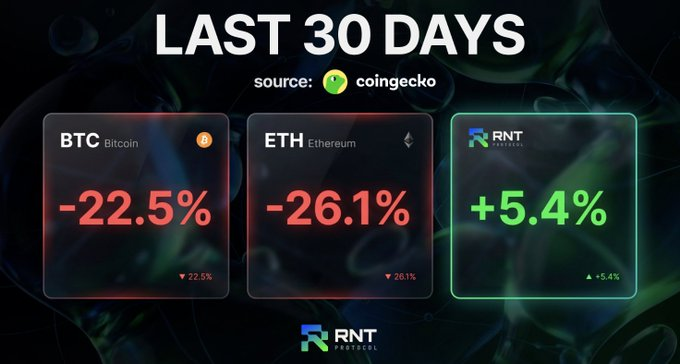
The 30-day comparison makes that contrast even harder to ignore. $BTC is down 22.5%, $ETH is down 26.1%, while $RNT is up 5.4%.
Looking at the 12-month picture, $RNT is up 106%.
I wouldn't call this proof that $RNT is immune to market conditions. No token is. But holding up across these different timeframes is worth paying attention to.
Now the question is whether this relative strength can be supported by real demand and continued activity across the ecosystem.
This is a very insightful breakdown of crucial trading strategy components.
Your emphasis on boundaries and defined limits is particularly important for risk management.
tnx
A trading strategy needs more than an entry signal. It needs boundaries.
When a trade is placed, position size, leverage and exit conditions all matter.
I explored @FensoryApp BTC/USD trading interface, and I like having the chart, order book and key order settings visible together.
You can see controls for position size, leverage, cross or isolated margin, reduce-only orders and TP/SL before placing a trade.
But there's a bigger point here.
If a trading agent is going to place orders on your behalf, it shouldn't have unlimited room to act.
It needs a real trading account, clearly defined limits and checks before orders go out.
That's one of the ideas behind @FensoryApp approach to trading on @HyperliquidX markets.
Trading carries risk, and losses are possible.
Explore: https://t.co/TQeR4yVDJC
This is a comprehensive overview of Strato's ecosystem.
It's impressive how they're integrating diverse financial functions onto a single Layer 1 blockchain.
Tnx for sharing
Most DeFi platforms focus on one part of finance. $STRATO is taking a broader approach.
It's building a Layer 1 blockchain around HardFi, bringing real-world assets and financial applications together onchain.
So, what can you actually explore on @strato_net ?
🔹 Real-world assets: Explore tokenized assets such as gold and silver.
🔸 Trading: Trade $STRATO and explore onchain markets.
🔹 Borrowing: Access borrowing features within the ecosystem.
🔸 Savings: Explore savings opportunities.
🔹 Staking: Participate in the network's staking ecosystem.
What I find interesting is how these pieces fit together.
Instead of treating trading, borrowing, savings and real-world assets as completely separate experiences, $STRATO is bringing them into one financial ecosystem.
Want to explore it yourself? Here's how to get started:
Open my $STRATO referral link.
Connect your wallet.
Deposit funds if needed.
Start exploring and trading $STRATO.
Check out staking and other available features.
If you're exploring what the next generation of onchain finance could look like, $STRATO is worth checking out.
Start here: https://t.co/73avTHGizK
Explore the platform, understand the risks and make your own decisions.
This is a thorough explanation of the XStable CP system.
It's helpful to see how different actions contribute to earning points.
Thank you for the clear breakdown.
Not every activity on a trading platform contributes to its points system in the same way.
That's something worth understanding before getting started with XStable's Contribution Points (CP).
@XStableAI has introduced three main ways to earn CP: eligible trading activity, referrals and additional points from qualifying losing trades.
Here's how they work.
1. Trading CP
Eligible trading activity generates CP. Both opening and closing trades can contribute to your eligible trading volume.
The important thing is that points are calculated under the platform's rules, not simply based on how much money you deposit or keep in your wallet.
2. Referral Bonuses
@XStableAI has benefits for both sides of a referral.
An invited user receives a 5% boost on their base trading CP, while the referrer earns 10% of the invitee's base trading CP.
For example, if an invited user generates 100 base trading CP:
The user receives 105 CP, while the referrer earns an additional 10 CP.
These are calculated from different bases, so the two bonuses shouldn't be confused.
3. Extra CP from Eligible Losing Trades
This part needs a little more attention.
XStable offers additional CP for qualifying losing trades, based on the loss as a percentage of margin.
The published bonus tiers are:
🔹 Below 10% loss: +20% CP
🔸 10%–30% loss: +50% CP
🔹 30%–60% loss: +80% CP
🔸 60% or more: +100% CP
For example, a qualifying trade with 100 base CP and a 20% loss-to-margin ratio can receive an additional 50 CP.
But this is an extra points incentive, not compensation for the financial loss.
How do you track your contribution?
The basic process is straightforward:
Connect your wallet, complete eligible trading activity under the platform rules, and visit the Points page to check your CP balance and activity history.
One thing I would keep in mind: understanding the rules matters more than chasing a higher number. Trading still carries financial risk, and extra points should never be a reason to take a loss deliberately.
@XStableAI CP system connects trading activity and community referrals with its contribution program. Knowing how each part is calculated helps users understand what they're actually earning.
Check the official rules here:
https://t.co/NBpvGu19RF
Trading page:
https://t.co/XvUSirTvdq
This is a very insightful breakdown of Nym's approach to privacy.
It's great to see such a focus on true decentralization and user trust.
This is a really insightful breakdown of VPN decentralization and trust.
Having more VPN servers doesn't automatically make a VPN decentralized.
What matters is who operates those servers.
With a traditional VPN, your traffic usually passes through infrastructure controlled by one provider.
Even when the connection is encrypted, you're still trusting that company with the routing of your internet traffic.
@nym approaches this differently.
Its network is powered by 800+ independently operated nodes across 70+ countries. Instead of relying on one provider-controlled server, it distributes traffic across independent operators.
But there's another detail worth understanding: having two servers doesn't automatically mean having two independent operators.
If the same entity controls both ends of a connection, the benefit of distributing trust becomes weaker.
That's why @nym introduced Server Families.
This feature helps identify servers operated by the same entity, so users can make more informed choices when selecting their entry and exit servers.
NymVPN also offers two different routing modes.
Fast Mode uses two independent hops and is designed for everyday browsing, streaming and downloads.
Anonymous Mode takes a different approach. It uses five hops, including three mix nodes that shuffle packets, introduce random delays and generate cover traffic to make communication patterns harder to analyze.
There is a trade-off: stronger mixing comes with additional latency.
For me, understanding the operators behind a VPN's infrastructure is just as important as knowing how many servers it has.
Privacy isn't only about encrypting traffic. It's also about how much trust you have to place in a single provider.
Want to explore NymVPN? Try it here:
https://t.co/hvseZaG1qA
People might discover SELF because of its Prize Draw, but I think the privacy side is what makes the app worth exploring.
@SELF_HQ has three ongoing draws:
• Daily: 5,000 $SELF
• Weekly: 50,000 $SELF
• Monthly: 200,000 $SELF
You can enter by keeping the app connected, with one entry per minute for each draw. Even the free plan qualifies. More time connected means more entries, but winning is never guaranteed.
What makes it more interesting is what's behind the app.
Your AI chats, messages, and files are encrypted using keys derived from a 12-word recovery phrase on your own device. SELF cannot read your private content.
One important thing: if you lose that recovery phrase, your content cannot be restored, not even by SELF.
So there's more to explore here than just a token or a prize draw.
If you're curious about private AI and encrypted communication, take a look at SELF.
Explore it now : https://t.co/LKsjfhBYg1
$SELF is for users aged 18+