The research on afternoon naps is more compelling than most people realize.
A 26-minute nap improves cognitive performance by 34% and alertness by 100% according to NASA research on military pilots.
The key is staying under 30 minutes to avoid entering slow-wave sleep and waking up groggy.
If you cannot nap, 10 minutes of slow nasal breathing in a dim room restores alertness significantly.
@LynAldenContact@WalkerAmerica@carlabitcoin Agreed! I loved every bit of the book and the voice acting. SO well done!
PS. My Audible book collection is now 289 titles, so I have a pretty good idea of what a GOOD audiobook is.
Bravo! 👏
@OrevaZSN What you are blaming on capitalism are actually flaws of the fiat monetary system, whereby central banks devalue your savings and increase the price of everything by printing money out of thin air, enriching the wealthy (asset holders), and increasing the wealth divide.
@phongle@Strategy@phongle. MSTR shareholder here. Huge fan of everything you guys are doing. One small suggestion to improve videos like these:
A Teleprompter.
Cheers!
Rick Rubin’s House on the Mountain test:
Create according to your own taste, not for applause, critics, algorithms, or market demand.
“Imagine going to live on a mountaintop by yourself, forever. You build a home that no one will ever visit. Still, you invest the time and effort to shape the space in which you’ll spend your days. The wood, the plates, the pillows—all magnificent. Curated to your taste.”
“This is the essence of great art. We create our art so we may inhabit it ourselves.”
“I'm willing to go to extremes to make the thing that I want to inhabit and it's not for anyone else. it's just for me.”
Winston Churchill never hid the fact that he suffered from depression. He called it his “black dog” — a dark shadow that could follow him even when he stood at the height of power.
But Churchill had his own way of keeping that darkness from completely taking over. It was not grand speeches or political victories. It was a simple physical act — laying bricks.
At his estate, Chartwell, he personally laid around 200 bricks a day. Row by row, wall by wall. He built garden walls, utility buildings, sometimes entire structures. What mattered was not only the result, but the process itself.
His principle was simple: keep the hands busy so the mind can rest. When heavy thoughts overwhelmed him, he picked up a trowel. When anxiety tightened its grip, he laid one brick. Then another. And another.
They say Churchill took this craft so seriously that he even joined a bricklayers’ union. Imagine that: the British prime minister carrying a builder’s union card.
There is a phrase often associated with his experience: depression does not like a person who keeps moving.
Sometimes the path through darkness begins not with a great decision, but with one small action. Take a step. Complete a simple task. Lay your own “brick” today.
And tomorrow — lay another one.
@zaidlikesmstr As a fellow Canadian Bitcoiner, I echo all of this. Self-custody BTC as the foundation, and MSTR in a TFSA for outsized, tax-free gains.
At the end of 2023 I met the person who ran GreenpeaceUSA's campaign against Bitcoin. I expected it to be tense.
But it wasn't.
He told me he'd read almost all of my responses to the posts they'd made on Twitter.
"I wish we'd engaged with you and people like you from the outset," he said.
Two months later he left Greenpeace.
A few months after that they ended the campaign entirely.
It was the most well-funded, yet the worst result in their history. I keep coming back to that phrase.
"People like you." Not me, but a whole group: Troy Cross, Margot Paez, Elliot David, Susie Violet Ward and many others.
We were working independently, with no budget and no coordination.
We just shared data and conviction. It is a great story of a decentralized response beating a multi-million dollar centralized campaign, by a combination of having the truth behind us, and expressing that truth in such a way that reasonable people could see.
That recipe has two parts, and it's like giving a glass of water to someone dying of thirst.
The first part is truth, there must be water in the glass.
The second part is the container, how you hold and deliver that truth matters just as much.
You can have perfect data and still lose people if the glass doesn't reach them, or if the energy behind it makes them flinch instead of drink.
We won because the data was right AND because enough people delivered it with the kind of energy that made opponents think rather than react.
And this recipe, we can use again and again throughout Bitcoin's adoption journey, and each time a Bitcoiner builds a new Bitcoin project that involves outreach to non-Bitcoiners.
The victim mentality almost destroyed my ability to lead, love, and grow.
Here is how I broke free from it:
For years, I unconsciously played the blame game (the way most people do).
By the time I understood what it was costing me, I had already wasted years of emotional energy, damaged relationships, and handed over the steering wheel of my life to people and circumstances that had no business driving.
It nearly became a permanent way of operating.
Others I've watched do the same thing never came back from it.
They aged into their resentments. Became bitter. Isolated. Stuck.
We had the same capacity for freedom – they just never chose it.
So here is how I found my way out:
1. The first turning point was realizing blame is a transaction.
Blame buys you innocence, sympathy, and the right to stay exactly where you are.
Once you see you're collecting a payoff, you can no longer pretend it's something happening to you.
By reframing adversity as something happening for you rather than to you, you can transform your habit of blaming into spiritual growth.
2. The second turning point was Viktor Frankl.
A man who lost his family, his freedom, and everything he owned inside a N*zi concentration camp... and still chose to respond from a place of love.
He called it the final human freedom (the space between what happens to you and how you respond, the one place no external circumstance can reach).
When I really sat with that, I stopped being able to justify my own smaller grievances the way I had been.
If he could exercise that freedom there, I had no excuse not to exercise it everywhere.
It felt uncomfortable (the way responsibility always does) but also like reclaiming something that had always been mine.
3. The third turning point was the daily practice.
Understanding something intellectually and living it are two completely different things.
What I did every day was simple:
Whenever I noticed the urge to blame, to tell myself a story of what someone did to me or what circumstance derailed me, I stopped and asked myself – what is the payoff I'm collecting right now?
Self-pity.
Sympathy.
Innocence.
The right to stay small.
I started letting these things go rather than using them to write my story.
The result was simple.
I stopped being a victim of my circumstances and started being the author of them.
That's what personal sovereignty actually feels like.
I'm not special and I'm not better than anyone who's struggled with the blame game.
I just got honest with myself about what I was actually doing and chose to walk a new path in life.
If you find yourself pointing the finger outward more than inward right now, this is your sign.
Blame has never solved a single problem in the history of the world.
But personal responsibility has solved every problem that has ever been solved.
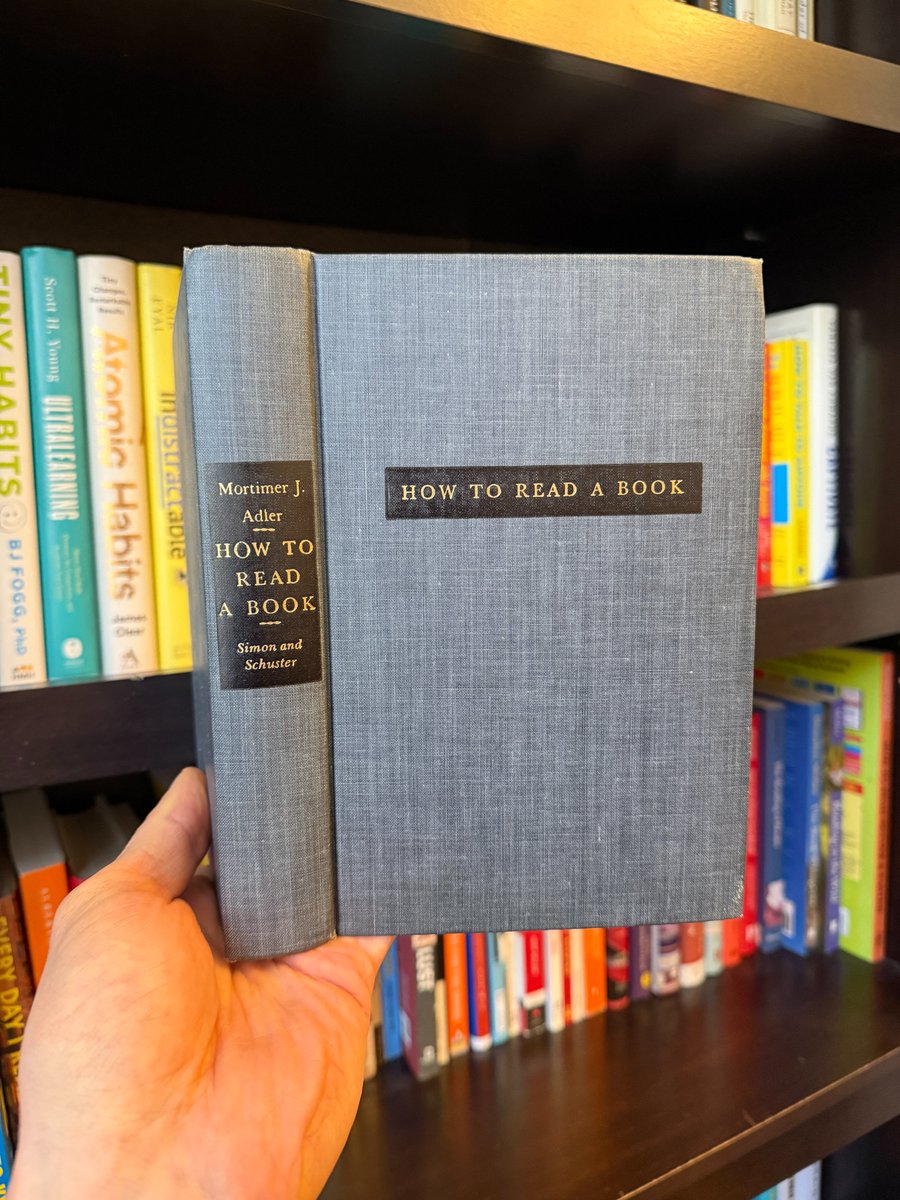
This book is the ultimate guide to becoming a better reader.
It was first published in 1940 and became an instant bestseller.
It will teach you how to get more value out of every book you read.
Here are 12 key lessons from "How To Read A Book":
I lost my mother a year and a half ago and grief taught me something I wasn't expecting.
Here's the Stoic technique that turned it into gratitude (from Letting Go by David R. Hawkins):
All grief comes from attachment combined with the refusal to accept that everything is temporary.
The more you depend on external things and people to feel whole, the more vulnerable you become to losing them.
The Stoics had a practice for this called negative visualization (the primary other name for the Stoic practice of negative visualization is ''premeditatio malorum'', a Latin phrase translating to "the premeditation of evils" or "pre-studying a bad future")
In any moment, hugging someone you love or drinking a glass of water, imagine this is the last time you ever do it (the goal is to wake up to what you already have before it’s gone).
Because there will be a last time and it won't announce itself.
I lost my mother a year and a half ago.
There was a moment where I hugged her for the final time without knowing it.
Sitting with that reality is one of the most powerful ways to activate genuine gratitude – gratitude that clears the mental clutter and puts you in a state where you can actually move forward.
The book draws a line between the smaller self and the higher self:
The ego is the illusion of separateness.
Although this illusion can be useful at times, it distorts the underlying reality that everything is interconnected.
Marcus Aurelius believed we are hardwired for service and connection & that living in that truth is where real fulfillment comes from.
Here's the paradox that changed how I show up in relationships:
Chasing love makes it harder to find. Your vibe attracts your tribe.
I used to highlight my strengths, hide my weaknesses, and perform but it never worked.
When I committed to showing up in radical truth I stopped dating entirely for over 2.5 years and met my wife 8 to 9 months after I started again – we built something real from the very first conversation.
The energy you put into yourself is what gets reflected back to you by the world.
The choice to live from love shapes everything – your relationships, your character, and the legacy you leave behind.
I love you, mom.
Thanks for all the wisdom you shared with me that I was too naive to understand.
You gave me many lessons that continue to unfold even unto this day.
Thank you for giving me a love for wisdom, and an ambition to learn to love wisely.
I spent 7+ years studying money full time to understand how the financial system was designed to keep you poor forever.
Here are the top 10 brutal truths no one will ever teach you (THREAD):
1. Every dollar is your life compressed into a token.