This is a fantastic pick!! When I attended Weijie's job talk at Princeton as a student, I was shocked by how beautiful and elegant the solution is. Congratulations to Weijie!
Econometrica is pleased to announce the 2026 Arrow Prize for the best economic theory paper, awarded to Weijie Zhong for “Optimal Dynamic Information Acquisition.”
https://t.co/ym2R5Lqisz
This November, I sent a note to John, expressing my gratitude to all his help and support during the last three years and wishing him all the best on the new era of the career. I was still looking forward to meeting him soon, just as the numerous times in Lorch. John, RIP!
@BorgersTilman I always thought the lab was a more recent thing... It is interesting that the sign survived for so long. Maybe we should keep (a version of) it in the renovation.
@AEACSWEP
announces Mira Frick as the 2025 Elaine Bennett Research Prize winner! Visit https://t.co/JZ0Bv0HH70 for the full announcement. Congratulations Mira!
Great post! Really like the discussion and, of course, the wonderful paper by Simone, @UncertainLars, Fabio, and Massimo. I also want to shout out to Alfonso Maselli https://t.co/tQDpvB2o0B. He is on the market. Please look at his file and HIRE HIM!
Let me explain why I believe modern economics is such a powerful tool for understanding the world. I’ll do this by discussing a great paper by Simone Cerreia-Vioglio, @UncertainLars, Fabio Maccheroni, and Massimo Marinacci, “Making Decisions Under Model Misspecification,” published in the Review of Economic Studies a few months ago.
Imagine I want to drive from UC San Diego to UCLA, but I’ve never driven that route before. I need to build a “model of the world” to guide me, which we usually call a map. Maps are simplified representations of reality. They can’t include every detail if they’re to be useful. Borges, in his short story On Exactitude in Science, makes this point beautifully. (In practice, I don’t draw the map myself—I use an app—but someone still had to make it.)
Because maps simplify, I can’t fully rely on them. Maybe last night’s storm knocked down a tree and closed a street, or there’s construction and the ramp off the highway in LA is shut down.
This uncertainty matters. Suppose I’m driving to UCLA for an important talk at 11 a.m. If the ramp is closed, I might need 15 extra minutes. When should I set my alarm to arrive on time, while still getting enough sleep to give a good talk?
The problem is that I can’t assign precise probabilities to all these contingencies. How likely is the fallen tree? Or new roadwork? Even the best traffic apps can’t capture every disruption, and some might happen after I’ve already left.
In economic terms, my “model of the world” (the map) is misspecified—and no matter how hard I try, I can’t fully fix that.
But sitting down and crying about misspecification doesn’t answer my basic question: when do I set the alarm? Too early, and I’m exhausted. Too late, and I’m late.
Simone and his co-authors offer a way to think about this. They start from the idea that we often hold several structured models of an economic phenomenon, grounded in theory. For example, a central bank might use a standard New Keynesian model and a search-and-matching model of money.
Yet, aware that each model is misspecified by design, the bank adds a protective belt of unstructured models—statistical constructs that help it gauge the consequences of misspecification.
The beauty of the paper is that it provides an axiomatic foundation for this protective belt (and even generalizes it to include a Bayesian approach). It shows that if a decision-maker’s preferences meet certain conditions —reflecting both rational and behavioral features— then those preferences can be represented by an augmented utility function that formally accounts for misspecification.
Crucially, we don’t assume that augmented utility function; we derive it. We start with general, plausible properties of preferences and prove that they imply such a representation.
That’s real progress. Instead of writing endless critiques of expected utility or rational expectations (as many have done for decades, with little to show), we now have a formal way to reason about misspecification—precise definitions, clear boundaries of validity, and awareness of what we still don’t know.
Take, for instance, a brilliant Penn graduate student on the market, Alfonso Maselli
https://t.co/rl2gu95V7t
His job-market paper pushes this frontier further. He studies cases where a decision-maker not only faces model misspecification but is also unsure which model best fits the data and can’t assign probabilities to them—what we call model ambiguity. In my example, the central bank is unsure whether the New Keynesian or the search-and-matching model fits better, and it worries that both might be incorrect.
If you read Simone et al. or Alfonso’s paper, you’ll see how misguided—and, frankly, cartoonish—many of the recent criticisms of economics on X have been.
First: the idea that economists don’t understand math or have “physics envy.” The math in these papers is subtle and advanced—utterly different from what physicists do (neither better nor worse, just distinct). An engineer transitioning into economics would find these tools unfamiliar.
Second: claims of ideological bias are unfounded. I have no idea about the political views of the authors, and I’d be surprised if anyone could infer them from the analysis—beyond vague guesses about typical academics.
Third: This has almost nothing to do with what one learns as an undergraduate, or even in first-year graduate school. If your knowledge of economics stops at an intro textbook, it’s best not to pontificate on the field’s frontiers.
Fourth: Is this science? Debating that word’s boundaries is pointless; every definition of “science” breaks down somewhere.
The Germans solved this long ago with the idea of Wissenschaft—the systematic pursuit of knowledge, whether of nature, society, or the humanities. By that measure, modern mainstream economics is clearly a Wissenschaft: a disciplined, cumulative, and highly useful effort to understand how the world works. Simone and his co-authors have demonstrated that beyond any reasonable doubt.
Proud that my student got the very first publication!! I'm only a cognate member on his dissertation committee (he is not in Econ) and I have little credit in the process, but it still feels sooo great. His message certainly makes my day!😊
AI-generated text is everywhere: hard for orgs to assess human performance. Can we detect it while min false accusations?
Yes! With @alexolegimas we audit detectors, show incredible accuracy ~0 (!!) false pos & neg; and we offer a policy framework for evaluating trade-offs.
🧵
I'm excited to share my job market paper (for the 2025-26 market)!
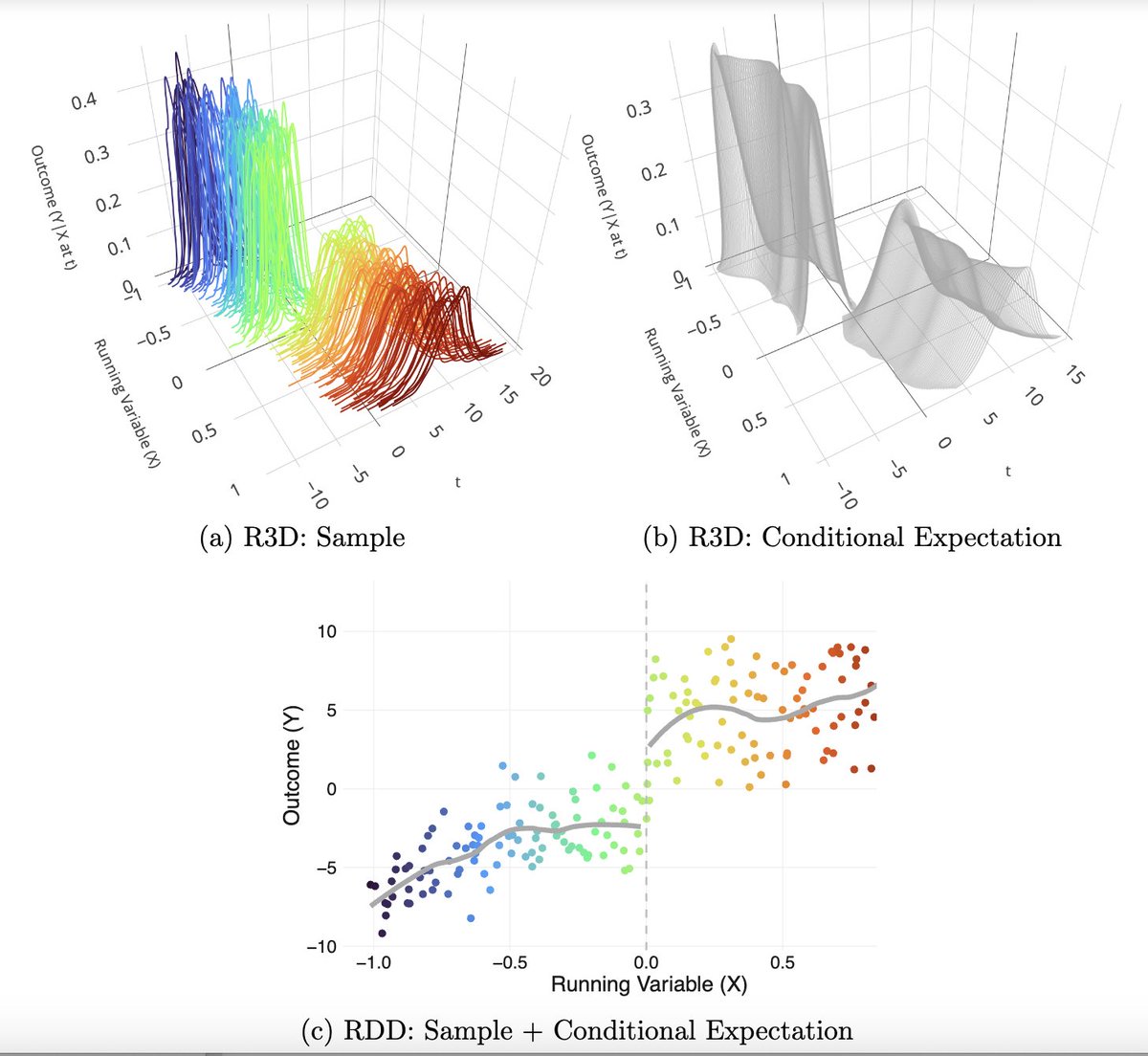
It introduces a new extension of RDD where outcomes are entire distributions: Regression Discontinuity Design with Distributions (R3D).
Thread below 👇 (1/)