1/
What could we discover if we had a binder for every protein in the human proteome?
We are excited to introduce the Bindome, an open and free resource of over 300,000 designed protein binder candidates against over 8,000 human target proteins.
🧵
The Human Bindome: A Proteome-scale Atlas of Designed Binder Candidates
1. The paper introduces the Human Bindome: 306,146 designed, genetically encodable protein binder candidates (fixed length 90 aa) spanning 8,296 human proteins, each with an explicit sequence, a predicted binder–target complex structure, and in silico confidence metrics.
2. Core motivation: conventional antibody reagents are often expensive, variably characterized, and frequently lack disclosed sequences, contributing to reproducibility issues; the Bindome aims to provide openly specified alternatives at proteome scale.
3. Methodologically, they scale the experimentally benchmarked BindCraft pipeline (reported prior success rates 10–100% depending on target) by adding automated domain-level target selection and an accelerated parallel implementation suitable for proteome-scale execution.
4. Target selection is driven by AlphaFold DB full-length models plus PAE matrices: proteins are segmented into domains via PAE-based clustering, and “targetable domains” are filtered for confident folding, compactness, contact density, acceptable length, and exclusion of membrane-embedded regions.
5. A key engineering detail: designing against cropped domains makes computation cheaper and enables multiple distinct sites per protein, but can create clashes with other parts of the full-length protein; they address this by superimposing each complex onto the full-length model and rejecting sterically clashing designs unless the clash is in low-confidence regions (high PAE / low pLDDT).
6. All candidates pass unchanged BindCraft stringency thresholds, including binder monomer fold confidence (pLDDT > 0.8) and interaction placement confidence (normalized iPAE < 0.35); distributions are not piled up at cutoffs (medians pLDDT 0.92, iPAE 0.23), enabling within-target prioritization.
7. Coverage numbers: the “targetable proteome” is 10,664 of 20,279 proteins; Bindome covers 77.8% of that targetable set and 40.9% of the full human proteome, with ~37 candidates per target protein on average.
8. Structural breadth: mapping domains to CATH superfamilies suggests 78.2% of superfamilies represented in the human target-domain set have at least one binder candidate; uncovered regions are largely outside the current scope (notably integral membrane proteins).
9. Epitope biology: binder epitopes show convergence within domain families (e.g., grooves/pockets in WD40 and bromodomains; broad kinase-domain surfaces), and epitope residues are significantly more evolutionarily conserved than matched surface controls—more consensus across binders corresponds to higher conservation.
10. Functional relevance and perturbation potential: epitopes often overlap annotated functional sites (PTMs, protein–protein interfaces, ligand-binding sites, DNA-binding regions), and 26% of ASD-annotated allosteric targets have at least one binder overlapping an allosteric site; examples include candidates positioned to occlude TP53 DNA-binding or disrupt SOD1 interaction interfaces.
11. Interface properties vs native PPIs: binder interfaces are native-like in mean area and slightly more polar, but show a strong bias toward helix-mediated contacts on the designed binder side; binder folds are often not globally novel, yet interfaces appear largely novel by interface similarity comparisons.
12. Accessibility is treated as a first-class output: a free web interface supports ranking/inspection and bulk downloads; a standardized 3D-Beacons API enables programmatic retrieval; and an MCP server allows natural-language “agentic” querying via LLM tools.
13. ML utility: the dataset is released with leakage-controlled train/val/test splits based on interface clustering (205,553 train; 21,205 val; 21,955 test), designed to support development/evaluation of next-generation binder design models.
💻Code: https://t.co/uRVLQb0khr
📜Paper: https://t.co/S9FMaBlseD
#ProteinDesign #ComputationalBiology #StructuralBioinformatics #AlphaFold #ProteinBinders #Reproducibility #FunctionalGenomics #DrugDiscovery #MachineLearning
A Generalizable Interface-Seeded Framework for De Novo Design of Functional Oligomers
1. The paper introduces an “interface-seeded” generative design strategy: instead of docking existing protein building blocks into a target symmetry, it uses a previously validated protein–protein interface (PPI) as the seed and generates new symmetry-compatible protomers around it.
2. Key implementation detail: a new symmetric motif-scaffolding module in RFdiffusion that preserves the interface motifs while sampling seed orientations and radial placements, then “drags” the motif radially during denoising to bias toward compact, well-packed cyclic oligomers.
3. This directly addresses a practical bottleneck in symmetric assembly design: dock-and-design success is often limited by geometric incompatibility between chosen protomers and target symmetries (C3/C4/C5), producing strong biases and low hit rates.
4. Benchmarking with LHD heterodimer seeds (LHD101, LHD29), the framework produced many expressible designs (63/64 expressed), with a substantial fraction matching the intended oligomeric states by SEC (33/63) and SEC-MALS (18/63).
5. Structural accuracy was validated by crystallography for multiple designs: C3 trimers (PI25, PI31) and a C4 tetramer (PI57) closely matched design models (Cα RMSD < 1.6 Å), including accurate interface side-chain placement; the resulting folds were also “new-to-nature” by Foldseek comparisons.
6. The approach generalizes to chemical triggers by reusing ligand/metal-dependent PPIs as seeds (often fragmented into many discontinuous segments), enabling conditional C3 assembly for Cu2+ (MC11), cholic acid (CHD04), and venetoclax (LBM10). Measured effective assembly affinities were in the ~100 nM range (e.g., MC11 Kd,eff 137 nM; LBM10 Kd,eff 130 nM).
7. Crystal structures of CHD04 and LBM10 matched their design models and showed ligand occupancy in the engineered pockets, demonstrating that the seeded responsive interface can be transplanted into entirely new oligomer topologies while retaining chemical control.
8. A major functional advance is reversible phosphorylation-controlled oligomerization using a dynamic “phosphoswitch” interface seed: phosphorylation by PKA shifts monomer→oligomer, and λ-phosphatase reverses it back. Single interface-weakening mutations reduced unwanted basal oligomerization while preserving phospho-dependent assembly (PO5s, PO18s).
9. The work also demonstrates multi-input control: introducing a disulfide lock created a system that requires both reducing conditions and phosphorylation to oligomerize, enabling dual-gated assembly behavior in a de novo designed oligomer.
10. Applications go beyond in vitro biophysics: (i) ligand-triggered membrane binding via MinD membrane-targeting sequence fusions (Cu2+ or CHD induces oligomerization-driven avidity on supported lipid bilayers), and (ii) phosphorylation-inducible transcription in HEK293T cells by coupling PO18s trimerization to an HSF1-based reporter, yielding ~6-fold induction (and >14-fold with combined endogenous + engineered PKA activation).
💻Code: https://t.co/XfOyrQXTCQ ; https://t.co/L7pDzceKN7
📜Paper: https://t.co/Oy61XIA0Dl
#ProteinDesign #RFdiffusion #AlphaFold3 #SyntheticBiology #ComputationalBiology #ProteinEngineering #DeNovoDesign #SignalTransduction #Phosphorylation #Nanobiotechnology
De novo designed oligomers that respond to copper, small molecules, and phosphorylation...
Using a single design strategy? 🧬⚙️
🎉
Excited to share our new bioRxiv preprint—a collaboration between the Khmelinskaia, Correia, Schoeder and a Tinnefeld labs!
https://t.co/8Hdfs52L0E
Check our new preprint, effort led by Stephen Buckley and @befcorreia, on the de novo design of phosphorylation-activated protein switches for synthetic signaling.
In it, NMR unveiled how complex molecular mechanics actually make the designs work.
👉 https://t.co/MD5YkK2cbs
De novo design of phosphorylation-induced protein switches for synthetic signaling in cells
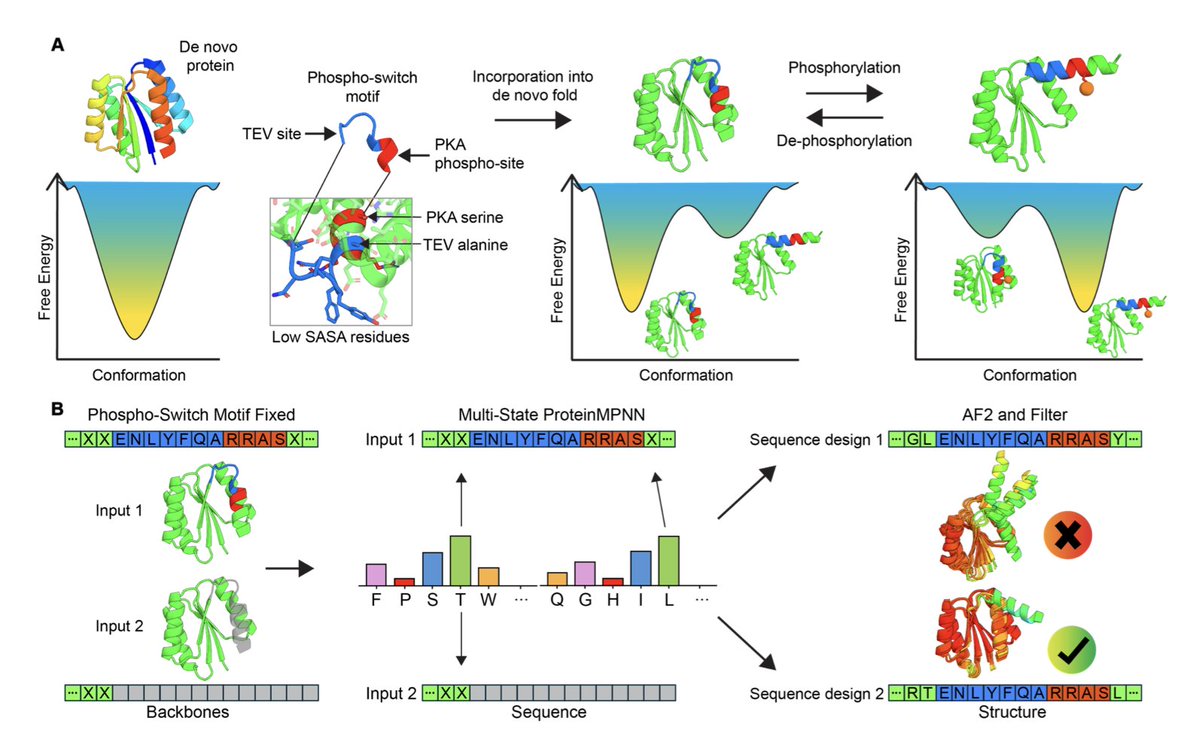
1. Researchers have developed a method to design synthetic proteins that can switch states in response to phosphorylation, mimicking natural cellular signaling mechanisms. This breakthrough could enhance our understanding of cellular signaling and has potential applications in synthetic biology.
2. The study introduces a novel approach to create minimal signaling networks using de novo protein components. These proteins can regulate transcription in a phosphorylation-dependent manner, demonstrating their functionality in cell-based systems.
3. The designed proteins were characterized biochemically and structurally, showing stability in both non-phosphorylated and phosphorylated states. This stability is crucial for their potential use in synthetic signaling cascades.
4. The researchers used multi-state ProteinMPNN and AlphaFold2 to design sequences compatible with both closed and open states. This computational approach allowed them to generate proteins that can dynamically switch states in response to phosphorylation.
5. The study also includes the design of conformation-specific binders that interact with the phosphorylated state of the proteins, enabling the creation of synthetic signaling pathways that can regulate gene expression.
6. The designed proteins were tested in a split transcription factor system, where phosphorylation-induced interactions drove the expression of a reporter protein. This demonstrates the potential for creating more complex synthetic signaling networks.
7. The researchers explored the generalizability of their approach by applying it to four different de novo folds, including a novel fold. This shows the potential for expanding this method to other protein topologies.
@befcorreia@SebastianMaerkl@Scheller123@leepaowan@YoungyoungdumbB
📜Paper: https://t.co/FPu0p4R9M3
#ProteinDesign #SyntheticBiology #CellularSignaling #Phosphorylation #DeNovoProteins
🏆 Mubarak Idris received the #SNEChemBio Prize for the Best Master’s Thesis 2025 in Chemical Biology! 🎉
Find out more about his interdisciplinary research conducted at the laboratory of Prof. Bruno Correia (@befcorreia@EPFL_en):
👉 https://t.co/QMndnq0EjV
#ChemicalBiology
🎉👏 Huge congratulations to Mubarak Idris for winning the 2025 Best Master Thesis Award #SNEChemBio! 🏆🎓 His work on “Computational Design of Functional Protein Switches with Therapeutic Potential” sets a new bar for innovation!
@sciences_UNIGE@EPFL_en
🌟#SNEretreat Two days full of great talks, a scenic hike and a poster session with very interesting discussions!
🙌Big thanks to Prof. Angela Steinauer @AngelaSteinauer@EPFL_en & Prof. Pablo Rivera Fuentes @RiveraChemLab@UZH_en, who led the scientific program.
📷Ming&Luis