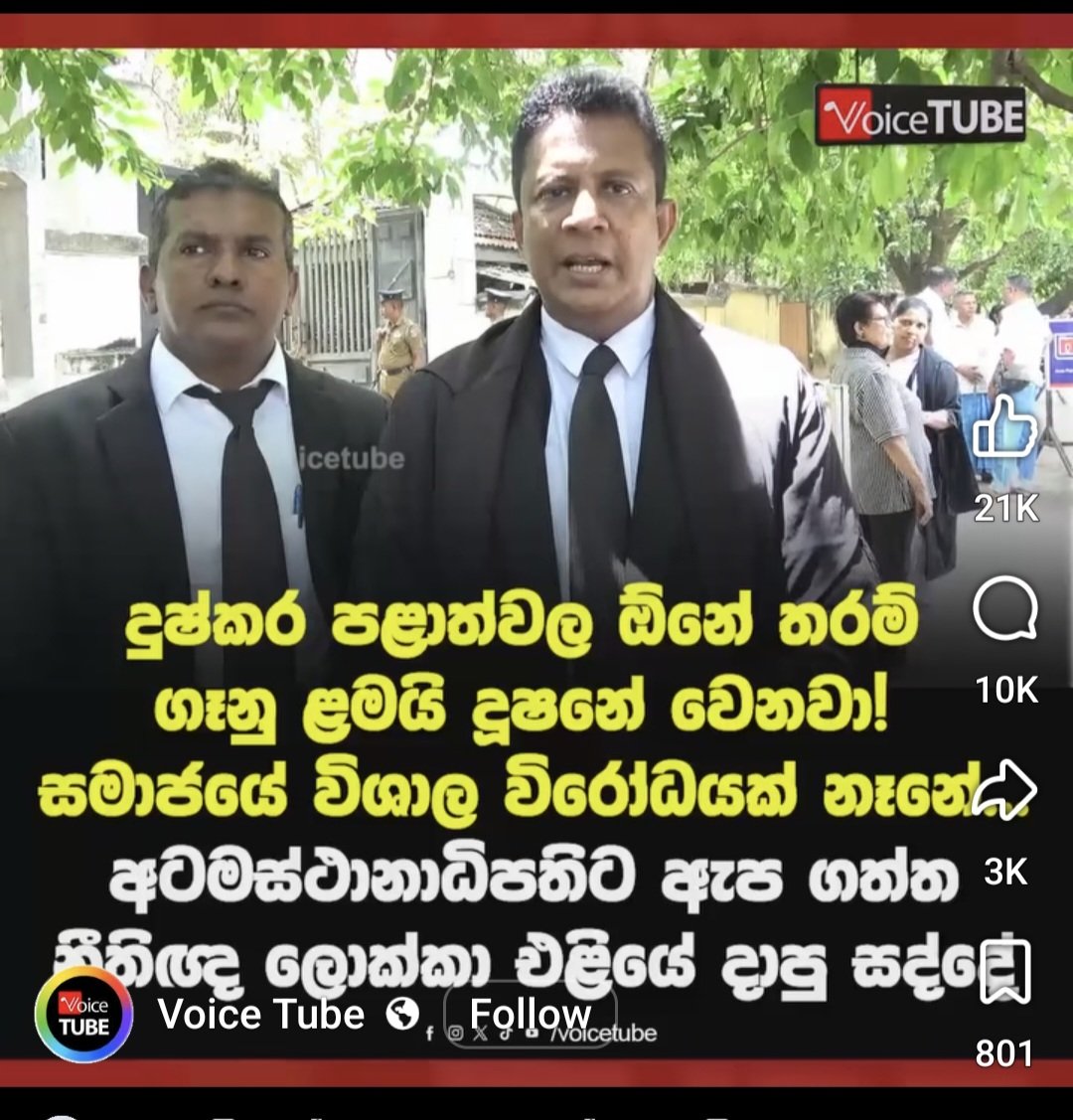
Are we so blinded by religion that we justify and normalize the rape of children?
I am speechless at the audacity of these "professional men" to come in front of cameras and speak like this.
We have really failed as a country...
Shameful.
Sri Lanka’s economic growth slowed in the fourth quarter due to the impact of Cyclone Ditwah, while the near-term outlook remains clouded by the Iran war https://t.co/GUSoOxDLgI
The world, Europe, and Spain have faced this critical moment before. In 2003, a few irresponsible leaders dragged us into an illegal war in the Middle East that brought nothing but insecurity and pain.
Our response then must be our response now:
NO to violations of international law.
NO to the illusion that we can solve the world’s problems with bombs.
NO to repeating the mistakes of the past.
NO TO WAR.
https://t.co/KpRjBfwY4B
Trump’s statement that everyone who seeks to lead Iran “ends up dead” made from a position of demonstrated military and covert capability, cannot be reasonably classified as mere political commentary.
By any consistent application of international human rights law and democratic principles, principles the United States itself claims to champion. This statement is ethically indefensible and legally irresponsible.
A regime and its people are not the same. Threatening or normalizing the death of anyone who aspires to lead a nation does not liberate that nation’s people, it holds them hostage.
@sumedhbhagwat96 The incident occurred beyond Sri Lanka’s 12-nautical-mile territorial waters. This means the sinking of IRIS Dena took place in Sri Lanka’s EEZ or possibly in international waters, depending on the exact distance.
THE FIRST CLOUD INFRASTRUCTURE CASUALTY OF WAR
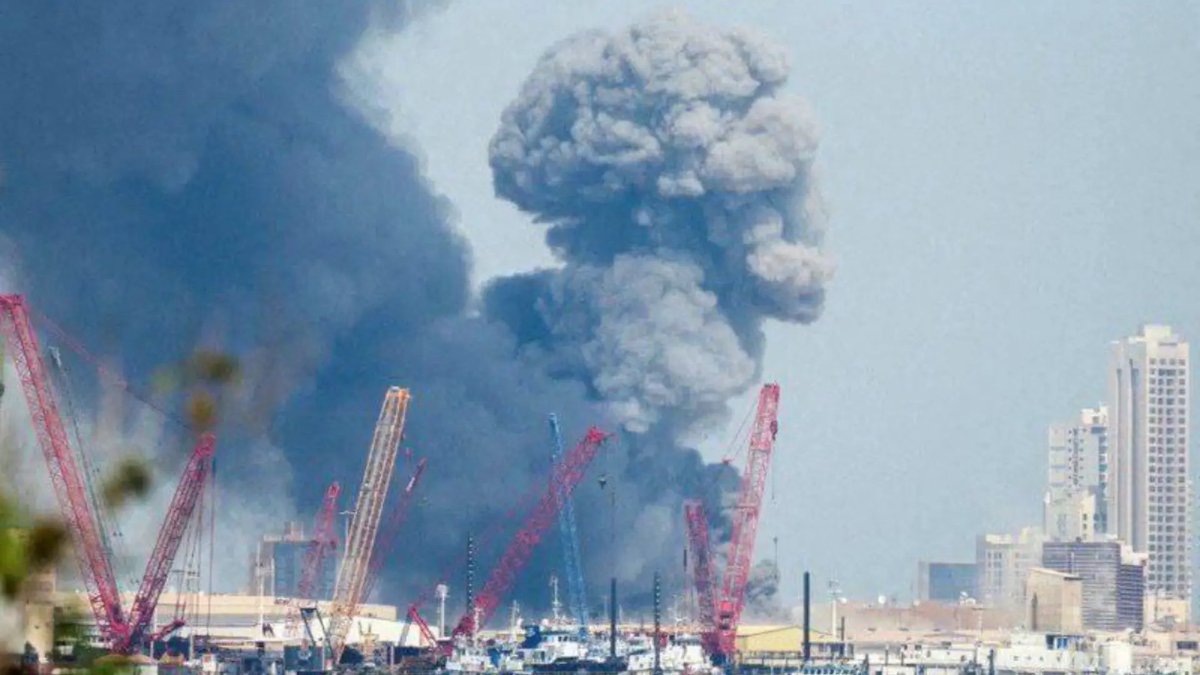
An Amazon Web Services data center in the UAE just got hit.
AWS confirmed that at approximately 4:30 AM PST on March 1, “objects struck” the facility in availability zone mec1-az2, creating sparks and igniting a fire. The UAE fire department cut power to the building. The zone went dark. AWS says other zones remain operational and restoration will take several hours.
Read that sentence again. “Objects struck.”
The most valuable corporate infrastructure on earth is now absorbing kinetic damage from a state-level military conflict, and the world’s largest cloud provider is describing missile or drone debris as “objects” because no corporate communications playbook exists for this scenario.
This is the first time in history that a major hyperscaler data center has been physically struck during a war.
Every cloud architecture slide deck in every boardroom on earth assumes physical security means perimeter fences and biometric locks. Not ballistic missile defense. Not drone intercept capability. Not wartime fire suppression while the building next door absorbs ordnance.
The Jerusalem Post reported the facility was used by Israel’s military. If confirmed, Iranian targeting of dual-use cloud infrastructure transforms every data center in a conflict-adjacent geography from civilian asset to military target. The distinction between cloud infrastructure and defense infrastructure just collapsed.
And the geography matters enormously. AWS chose the UAE for its Middle East region precisely because Dubai and Abu Dhabi offered stability, connectivity, and proximity to enterprise clients across the Gulf. That thesis died on a Saturday morning when Iranian drones struck the Burj Al Arab, hit Jebel Ali port, and set fire to a data center running workloads for governments, banks, and military operations simultaneously.
The concentration risk is staggering. AWS, Microsoft Azure, and Google Cloud all operate Middle East regions clustered in the same geographic corridor that just became an active theater of war. Oracle has infrastructure in Dubai. Every enterprise running production workloads in these regions is now calculating disaster recovery scenarios that were categorized as “theoretical” 72 hours ago.
The insurance implications alone will restructure cloud pricing for a decade. Lloyd’s of London was already reassessing war-risk exclusions after Ukraine. Now a drone has physically damaged a data center belonging to a $2 trillion company in a country that markets itself as the safest business hub in the region.
AWS built multi-availability-zone redundancy for earthquakes, power failures, and network partitions. Not for Iranian retaliation against a joint US-Israeli military campaign. The architecture held because one zone went down while others stayed up. But the premise broke: that geography selection for cloud regions is a business decision, not a wartime calculation.
Cybersecurity expert Lukasz Olejnik flagged the euphemistic language immediately. AWS did not say “bombed.” AWS said “objects struck.” That linguistic gap is the entire story. The world’s cloud infrastructure just entered the theater of war and the industry has no vocabulary for it yet.
The vocabulary will be priced in by Monday.
https://t.co/BrzGRrU3VW
Story of SupremeSAT 🛰️ and PM Harini
⭕ May of 2012, SupremeSAT registered with the BOI with a stated investment of Rs 1.828 billion.
⭕ Ownership: Supreme Global Holdings (80%) and Supreme SL Investment (20%). The project was led by R. M. Manivannan, who owns Supreme Global Holdings, along with Jaya Sudhir and Alberto de Simone.
⭕ Manivannan appointed Rohitha Rajapaksa (youngest son of former President Mahinda Rajapaksa) as chief technical director and issued him shares through Dycer International, a company 100% owned by Rohitha.
⭕ Jaya Sudhir Jayaram, a Malaysian national reportedly linked in media and UN reporting to fraud and money laundering, was alleged to have paid $10 million in bribes to Saddam Hussein’s regime in the Iraq Oil-for-Food scandal. He was also reportedly stopped at Sri Lanka’s airport with USD 50,000 in undeclared cash and released without penalty, reportedly due to political influence.
⭕ Supreme SL Investment has almost no public footprint, no visible active operations, and is known mainly for holding shares in SupremeSAT typical of a shell or special-purpose vehicle (SPV).
⭕ Publicly available information shows no clear link from Supreme Global Holdings to credible revenue-generating operations, satellite or otherwise. They have been involved in crypto and other ventures, with little evidence of a conventional operating business or about their clients.
⭕ The same group behind SupremeSAT launched another large real estate project - Horton Square using the same offshore setup, the same principals, and additional political links. Horton Square brought back Manivannan, Jayaram, and de Simone. The BOI rejected the project due to concerns over these directors, but the UDA still approved it.
⭕ The company used an offshore firm Paradise Island Holdings Ltd., based in the UAE and nominee directors, obscuring the ultimate owners. One director was Renuka Shanmuganathan, whose sister-in-law is Nirupama Rajapaksa, a cousin of Mahinda Rajapaksa.
⭕ The land for Horton Square was bought from Purni Edwards, wife of Rienzie Edwards, who was indicted by the U.S. government in 2016 in connection with an alleged $50 million international fraud scheme using shell companies and offshore bank accounts, including transfers to Sri Lanka.
⭕ SupremeSAT-1” wasn’t a separate Sri Lankan spacecraft. It was capacity leased on ChinaSat-12 (which had earlier been ordered as Apstar-7B). The leased capacity was then co-branded/marketed as “SupremeSAT-1."
⭕ In Parliament, Prime Minister Harini stated the revenue as Rs 343.9 billion, but Minister Wasantha Samarasinghe corrected the figure to Rs 343.9 million later. Regardless of the figure, it reflects the company’s revenue, not the revenue for Sri Lanka.
⭕ The government should not blindly accept documents submitted to or from the BOI. PM Harini should have realized, even while reading, that these numbers are questionable. This raises real concerns about the PM's financial literacy.
⭕ BOI companies do not pay income tax in Sri Lanka during their concession periods. This private company used BOI tax-holiday status to extract profits while contributing nothing to the national treasury.
⭕ Having companies like these under the BOI is solely to get income-tax concessions, with little to no oversight, and the government has granted their associates BOI company status while the BOI is not doing due diligence on commitments.
⭕ The pattern: Foreign or politically connected entities register with the BOI, claim massive “investments,” generate tax-free revenue and legal cover to operate under the shadow, transfer profits offshore, and leave Sri Lanka with zero benefit.
⭕ There are genuine companies under the BOI, yes but many others abuse tax concessions, misreport finances, and operate with zero oversight.
At least something good may come of this: the government might audit the BOI, review every agreement and commitment, and clean house...
#SriLanka #BOI