I’m a lawyer writing about how AI is changing legal work, how regulation is shaping crypto and digital assets, and what policy shifts mean for Pakistan’s markets. Practical analysis from the intersection of law, technology and finance. Based in Lahore.
AI clauses are entering contracts faster than many businesses understand them. The practical questions: What data enters the model? Can it be used for training? Who owns the output? What if the provider changes its terms? Cross-border deals need answers before deployment.
@Clevy_Law Exactly. A model can surface patterns and draft options, but judgment comes from context: the client’s risk tolerance, commercial leverage, regulatory exposure and the consequences of being wrong. The lawyer remains responsible for connecting those pieces.
@heyitsalexsu AI can reduce review time, but it does not absorb negotiation risk, manage stakeholders or own the final judgment. Treating software as a substitute for legal capacity confuses task automation with responsibility, especially when contract volume keeps growing.
@taimurabdaal Celebrity marketing can create awareness, but legal AI earns trust through less glamorous work: transparent limitations, reliable citations, secure data handling and clear human accountability. Lawyers will remember the workflow that helps them deliver, not the campaign.
For years, my focus was simply on doing the legal work well. But while building a law firm, I realised how much time lawyers lose to intake forms, follow-ups, reminders, and moving information between different systems.
That led me to n8n. I am now experimenting with automations that can handle some of these repetitive workflows while keeping legal judgment and final approval with the lawyer.
Building a modern law firm, I am learning, is not only about practising law. It is also about building better systems around the lawyers who practise it.
#n8n #LegalAutomation #LegalTech #LawFirmManagement
@MeherJazibAli The discipline of saying “good company, wrong price” matters more than keeping a permanent buy list. For banks, the rate cycle, asset quality and policy exposure can change the valuation case quickly even when headline earnings remain attractive.
@loganbrown799 The opportunity is real, especially for niche and cross-border practices. AI reduces the infrastructure needed for research, drafting and knowledge work, but independence still depends on client trust, supervision and a clearly defined service model.
@iabdullah278 The hybrid structure is the interesting part. Combining contracts can broaden the asset base and investor appeal, but it also makes disclosure and Shariah-governance clarity more important. Investors need to understand which risks sit in each underlying contract.
@ZachAbramowitz Agreed. In legal work, a well-framed prompt plus disciplined verification often beats an elaborate workflow no one fully understands. The real dividing line is not prompts versus agents; it is whether the lawyer can test, explain and take responsibility for the output.
@rohasnagpal This is useful because legal AI discovery is becoming fragmented. From a cross-border practice perspective, jurisdiction and data-handling filters would be especially valuable: which law the tool covers, where its sources sit, and whether client material is used for training.
@WilsonElser Great point. The real privilege risk isn't just input logging, it's that pasting client facts into a public model can arguably waive confidentiality when a third party controls the data. Most firms need a use policy before a use case. Enterprise/on-prem tools change the calculus.
Building legal services online keeps reminding me that clients usually judge clarity before they judge legal skill.
They want to know what you do, what is included, how long it takes, and whether their documents will be handled carefully.
For lawyers, online trust is built before the first call.
#LegalFreelancing #Upwork #LegalServices #FreelanceLawyer
@WillManidis This is where AI policy gets difficult: protecting national capability without turning regulation into a moat for incumbents. The line has to be drawn carefully.
@synthwavedd If model outputs are being harvested for distillation, the legal issue is not just competition. It is terms of use, evidence, attribution, and whether providers can actually enforce model-access rules.
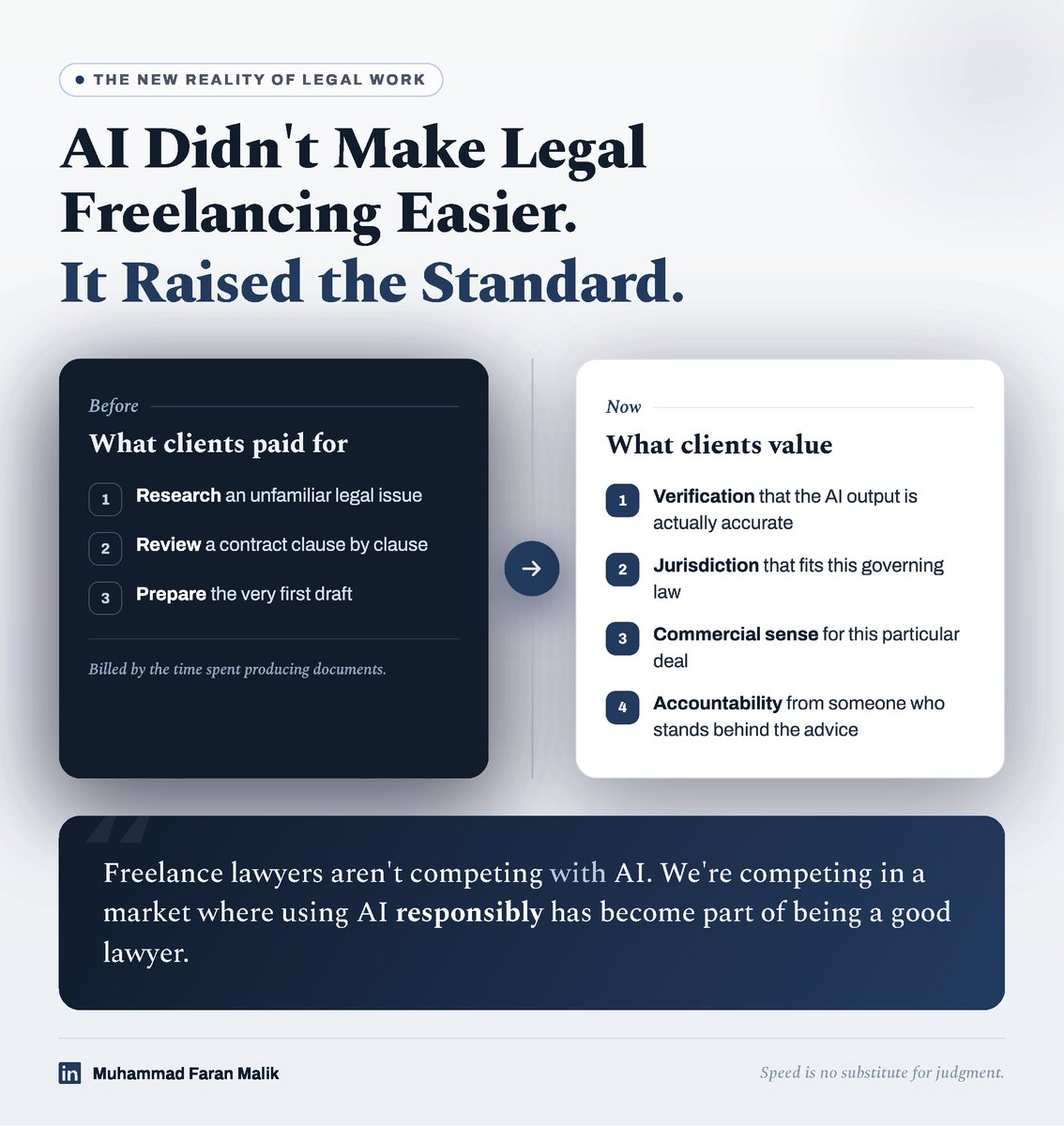
𝗔𝗜 𝗱𝗶𝗱 𝗻𝗼𝘁 𝗺𝗮𝗸𝗲 𝗹𝗲𝗴𝗮𝗹 𝗳𝗿𝗲𝗲𝗹𝗮𝗻𝗰𝗶𝗻𝗴 𝗲𝗮𝘀𝗶𝗲𝗿. 𝗜𝘁 𝗿𝗮𝗶𝘀𝗲𝗱 𝘁𝗵𝗲 𝘀𝘁𝗮𝗻𝗱𝗮𝗿𝗱.
When I started providing freelance legal services through Upwork, clients generally approached lawyers because they needed someone to research an issue, review a contract, or prepare the first draft.
𝗧𝗵𝗮𝘁 𝗶𝘀 𝗰𝗵𝗮𝗻𝗴𝗶𝗻𝗴.
Many clients now arrive with an AI-generated agreement, a summary of the relevant law or even a list of supposed contractual risks. The problem is that they still do not know whether the output is accurate, suitable for their jurisdiction or commercially sensible.
As I have started building legal AI agents, one thing has become increasingly clear to me: AI can complete the first layer of legal work remarkably quickly, but speed is no substitute for judgment.
A tool may identify an indemnity clause. A lawyer must determine whether the clause is acceptable for this client, in this transaction, under this governing law. It may produce a contract in seconds, but someone still has to stand behind the advice when that contract is negotiated or disputed.
This is also changing legal freelancing. Clients are no longer paying only for the time spent producing documents. They increasingly value verification, strategy, commercial context and accountability.
Freelance lawyers are not competing with AI. We are competing in a market where knowing how to use AI responsibly is becoming part of being a good lawyer.
𝗛𝗮𝘀 𝗔𝗜 𝗿𝗲𝗱𝘂𝗰𝗲𝗱 𝘁𝗵𝗲 𝗹𝗲𝗴𝗮𝗹 𝘄𝗼𝗿𝗸𝗹𝗼𝗮𝗱, 𝗼𝗿 𝗵𝗮𝘀 𝗶𝘁 𝘀𝗶𝗺𝗽𝗹𝘆 𝗰𝗵𝗮𝗻𝗴𝗲𝗱 𝘄𝗵𝗮𝘁 𝗰𝗹𝗶𝗲𝗻𝘁𝘀 𝗲𝘅𝗽𝗲𝗰𝘁 𝗳𝗿𝗼𝗺 𝗹𝗮𝘄𝘆𝗲𝗿𝘀?
#LegalAI #LegalFreelancing #Upwork #LegalOutsourcing #AIAgents #LegalTech #FutureOfLaw
There was a point in my career when I almost quit litigation.
It was not because I had stopped enjoying the law. It was the constant uncertainty around hearings, adjournments, delays, and outcomes that often had little connection with the amount of preparation involved. You could spend days preparing a matter, only to leave court without the case moving forward. After a while, that becomes exhausting.
Around the same time, I began taking on more corporate, contract, and cross-border work through legal freelancing. Working with clients on Upwork showed me a different side of practice: clearly defined problems, measurable progress and the ability to deliver value without spending an entire day waiting for a matter to be called.
For a while, I thought I had to choose between the two. Eventually, I realised that litigation had already taught me skills that made me better at everything else. It taught me to work under pressure, question assumptions, anticipate the other side’s arguments and understand what contractual language looks like when a relationship actually breaks down.
That journey has now taken me into another area I never expected: building legal AI agents. I am exploring how agents can support work such as contract review, legal research, document organisation and issue identification. The goal is not to remove the lawyer from the process, but to reduce repetitive work so that more time can be spent on strategy, judgment and the client’s actual problem.
I did not quit litigation. I simply stopped allowing it to define the limits of my legal career. Litigation gave me judgment, freelancing gave me a global perspective, and building legal AI agents is helping me rethink how legal services can be delivered.
Sometimes, the answer is not to leave the profession. It is to build a different way of practising within it.
#Litigation #LegalAI #AIAgents #LegalTech #LegalFreelancing #Upwork #LegalOutsourcing #FutureOfLaw
@MarioNawfal An AI regulator only works if it has technical capacity, independence and fast update cycles. A slow agency supervising fast models will always be behind.