In many of our African universities, which are largely imitators of Western universities, when you are applying for promotion, you simply give them what they want, not what you consider to be more relevant to your community. When it comes to their most important requirements, I look for the minimum, and I use the rest of my time to do what I think a scholar should be doing in their community. I hope we shall get to a time when our universities will prioritise and incentivise local relevance above marathons of publications in foreign spaces without regard to local absorption.
Africa’s unique problems need African ingenuity. Yet our governments kill local talent by denying it opportunities while paying foreigners to solve the same problems. It’s time to fund our innovators, buy their solutions, and give them a chance.
Gervais Koffi Djondo, fondateur de la banque panafricaine Ecobank.
« J'ai reçu toutes sortes de menaces lorsque j'ai lancé le projet de création d'Ecobank, dans les années 1980.
À cette époque, il y avait très peu de banques privées en Afrique et les banques françaises dominaient le marché ouest-africain. Les Français m'ont d'abord dit que les Africains n'étaient pas suffisamment mûrs pour gérer une banque.
Ensuite, lorsque j'ai présenté le projet à l'ancien président ivoirien Félix Houphouët-Boigny, il l'a beaucoup apprécié. Et bim ! La nouvelle a fait écho jusqu'en France. Les banques françaises ont appelé Paris, qui a envoyé un avion spécial en Côte d'Ivoire. Des responsables sont alors allés raconter toutes sortes d'histoires à Félix Houphouët-Boigny.
Le même soir, à 2 heures du matin, Félix Houphouët-Boigny m'appelle et me demande de venir à Abidjan à 6 heures du matin. Je n'ai pas pu fermer l'œil de toute la nuit.
Je suis donc retourné en Côte d'Ivoire pour le rencontrer. À mon arrivée, il me demande : “Pourquoi voulez-vous absolument associer les anglophones, notamment les Nigérians, à ce projet ?”
Je lui ai répondu qu'il s'agissait d'un projet privé visant à soutenir la CEDEAO et à favoriser l'intégration africaine.
Il m'a alors demandé de réaliser le projet sans associer les Nigérians.
Nous nous sommes quittés sur ces mots. Ce jour-là, j'étais découragé, démoralisé et profondément abattu.
Mais j'ai ensuite pris le temps de réfléchir et j'ai décidé de ne pas me laisser abattre.
Finalement, Ecobank a vu le jour, contre vents et marées.
Aujourd'hui, la banque est présente dans 34 pays africains et compte plus de 20 000 employés. Elle a réalisé plus 1400 milliards de fcfa de chiffre d'affaire en 2025.
Captain Ibrahim Traore of Burkina Faso 🇧🇫 is the focus, blueprint, and model every African leader needs to emulate. He sees the problem of Africa through the eyes of Africans while trying to use an African solution to solve it.
Kwame Ture: White Supremacy Reigns Until Africans Seize Power
Kwame Ture (1941-98) co-founder of the All-African People's Revolutionary Party (@AAPRP ), argues here that we need not be offended by white supremacy. Our only job is to organise Africans to seize power. Then we won't have to worry about what Europeans can do to us.
How can we build on the organisations that already exist?
Video credit: Cheyney University
American military spending is only possible because the dollar is the reserve currency.
This is not an opinion. It is arithmetic.
The United States runs persistent deficits that would be unsustainable for any other country.
It finances those deficits by issuing Treasury bonds.
Foreign central banks buy those bonds because they need dollar-denominated assets for their reserves.
They need dollar-denominated reserves because the dollar is the currency of global trade.
The circle is closed.
Military spending → deficit → Treasury bonds → foreign purchase → dollar demand → reserve currency status → military spending.
Break any link in that chain and the whole logic shifts.
This is why dedollarization is not just an economic story.
It is the foundational strategic threat to American military primacy.
Not Russian missiles. Not Chinese carriers.
Foreign central banks deciding to hold a more diversified reserve portfolio.
The most important battlefield of this century looks like a spreadsheet.
The side that understands this is already fighting.
Very right, see Part 1.
I wonder what our X Village Academics @Wordslinger__ and @wmnjoya have to day about her points - because we are pointing in the wrong direction and at scare speeds.
At the Africa-Russia Summit in Moscow, something truly surreal happened. A young Russian woman approached me, visibly excited, and asked, “Oh my goodness, are you Wode Maya?” When I said yes, she could hardly contain her excitement. She told me that MGIMO University, one of Russia’s most prestigious universities, had published a book titled 100 African Leaders and Influencers, and I was among those featured in it.
Honestly, I was overwhelmed. Imagine travelling all the way to Russia and discovering that a university had recognised your work enough to include you in a book celebrating 100 African leaders and influencers. I initially thought it was a joke until she showed me a digital copy.
But the story didn’t end there. The following day, one of the university professors personally brought an English-language copy of the book to my hotel.
Sometimes, you get so caught up in the journey that you forget how far you’ve come and how many lives your work might be touching beyond the places you have travelled.
I started this journey simply wanting to tell Africa’s stories differently and change the negative narrative about our continent. I never imagined that one day, my work would find its way into a book published in Russia.
I’m genuinely humbled, grateful and overwhelmed. This is bigger than me. ❤️🌍
Every time an African country elects a government that tries to keep more of its own resources, Western media discovers a "democracy deficit."
Every time an Asian nation builds technology that competes with Western products, Western governments discover a "security threat."
Every time a Latin American country charts an economic path outside the Washington Consensus, Western financial institutions discover a "stability risk."
The pattern is precise and it has been precise for two centuries.
The West is not afraid of authoritarian governments.
It has funded dozens of them.
The West is not afraid of economic mismanagement.
It has imposed structural adjustment programs that produced exactly that.
What produces the alarm, the specific, urgent, editorial-board-meeting alarm, is independence.
A poor country making its own choices with its own resources for its own people without asking permission.
That is the danger.
That has always been the danger.
Everything else is the vocabulary chosen to describe it in ways that don’t require honesty.
The lie about Africa was not a small lie carelessly told.
It was a structural lie, deliberately constructed, institutionally maintained, academically defended.
It required the renaming of things. Egypt became, in the Western imagination, not quite African. The pyramids became a "mystery," because the alternative was crediting Africans with their construction, which the framework could not accept.
It required the discrediting of Arab and African scholarship about African history.
It required the dismissal of oral traditions as legend rather than history.
It required deciding that writing on paper counted as "civilization" and other forms of knowledge transmission did not.
It required, essentially, redesigning the criteria for what counted as "civilization" so that the places being colonized would fail the test.
The test was not neutral.
The test was written to produce a specific result.
And that result was: "Africa has no history worth the name."
Therefore what colonialism destroyed was not civilization. Therefore what colonialism did was not destruction.
This is not an accusation of individual ignorance.
This is a description of institutional architecture, built over centuries, maintained by people who understood exactly what it was for.
What they called "tribes" were, frequently, nations.
The word choice was precise and deliberate.
"Tribe" suggests pre-political. Primitive. Blood-based. Pre-rational. The kind of social organization that exists before real civilization begins.
"Nation" suggests sovereignty. History. Law. The kind of social organization that has rights.
You cannot colonize a nation without committing a crime that demands accounting.
You can "pacify" a tribe. You can "administer" a tribe. You can "protect" a tribe from itself.
The same Zulu Kingdom that had its own legal tradition, its own military strategy sophisticated enough to defeat British forces at Isandlwana, its own diplomatic history, was a "tribe."
The same Asante Empire that controlled extensive gold trade networks, developed complex political institutions, and produced remarkable artistic traditions was dismissed as a mere "tribe."
The word did the work before the soldiers arrived.
Call it a "tribe" first.
Then the conquest is "administration."
Then the destruction of its institutions is "modernization."
Then the theft of its resources is "development."
Language is the first colonial tool.
It was used here with full awareness of what it was doing.
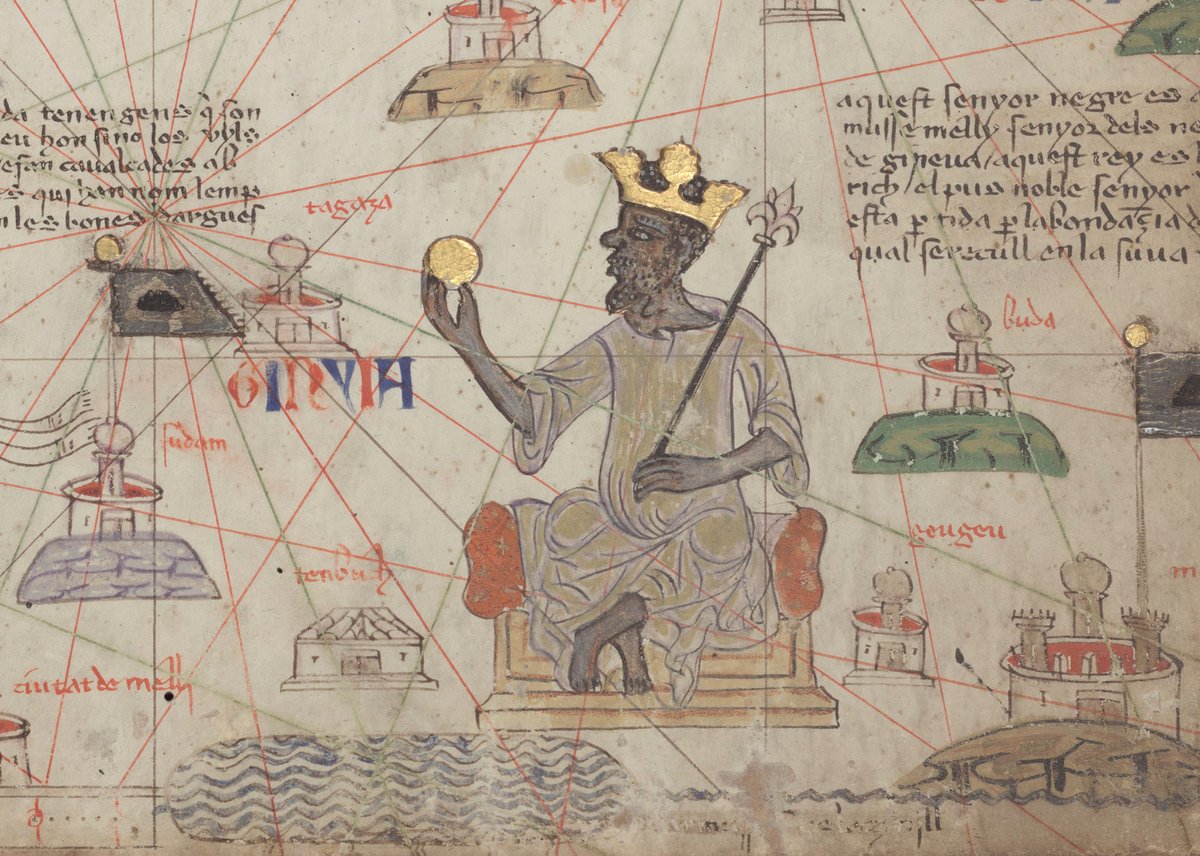
In 1324, Mansa Musa of Mali made a pilgrimage to Mecca.
He traveled with 60,000 people and 100 camel-loads of gold.
He gave away so much gold in Cairo that he collapsed the regional gold market for a decade.
A decade. From generosity on a journey.
His empire covered more territory than Western Europe. His capital, Niani, was a center of scholarship, trade, and governance sophisticated enough that visiting Arab historians wrote about it with undisguised admiration.
This was not a primitive society waiting for civilization to arrive.
This was a civilization.
One of the great ones. By any measure that wasn’t specifically designed to exclude it.
The colonizers who arrived in West Africa centuries later did not bring civilization to a void.
They dismantled something that was already there.
The textbooks that don’t mention Mansa Musa at all, not once, not a paragraph, are not gaps in education.
They are a decision. Made deliberately. Maintained consistently.
Because his existence changes the sentence.