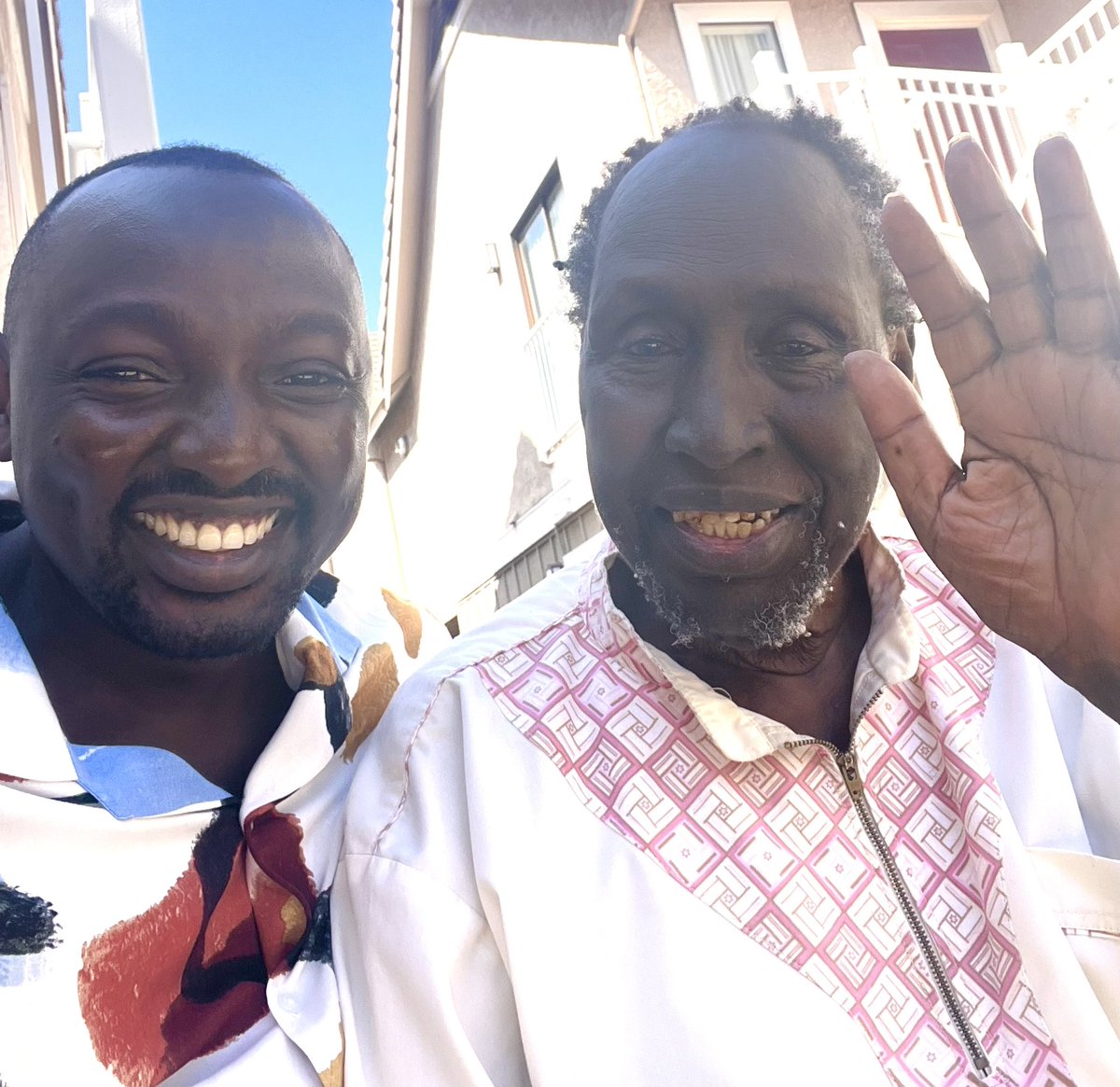
Professor Ngugi wa Thiong’o teaches at UC Irvine in Southern California. He is very sharp, articulate, and his sense of humor is out of this world. Spent time with him on the 13th, and here are my 13 takeaways.
1. He pointed out remarkable attributes of Professor Micere Mugo, portraying her as a combination of beauty, intelligence, and eloquence. She truly encompassed a well-rounded persona. And when she stood on stage to dramatize the play “Trial of Dedan Kimathi,” she was simply marvelous.
2. He laughed at "colonialism embedded in Patriarchy. He explained, for example, how some (married) women hide their given names and adopt foreign names along with their husband's surname. For instance, Eunice W. Mwangi might opt to be known only as Eunice (the colonial name) or Mwangi (the husband's name with patriarchal connotations) and hide Waitherero (W). This act, in a way, reflects a submission to the husband's authority and the traditional role he envisions for women. “Nikiii marakunîkîra rîtwa ithaka” he wondered.
3. He expressed the notion that a society is as great as the prevailing music and religion. Sadly, today’s church is no longer interested in welfare of the masses like “Kanitha wa Karing’a” of yesteryears. We reminisced on good ol’ music, listening to Kamaru and also explored Makibi James' music.
4. He emphasized the universal truth that no matter the extent of one's education, there will always be gaps in knowledge. Even if you hold ten degrees, encountering a broken lock would require seeking help from someone who possesses the necessary skills, often without any formal degrees.
5. His face lit up remembering Professor Micere Mugo. He highlighted her quick thinking, recounting how she declined an offer of about 30 acres of land from Moi. This created an ideological schism between her and her brother in law.
6. He touched on the concept he referred to as "normalizing the abnormality." It's that situation where what is weird in normal circumstances is mainstreamed and considered “woke.” For example, someone transitions from their rural roots (Assume Kîamûtûgû) to Nairobi, secures a job, and as soon as
they don a suit and polish their English, they disconnect from their mother tongue and soon start thinking their grandparents are less knowledgeable because they don’t speak that kind of English. Another example is where less qualified or tainted people are given the mandate to lead, which is actually an abnormality. But we have normalized it.
7. He wondered how in the name of Kaimosi I got the name “Mukurima” in a society that glorifies foreign names. îî weee
8. The professor got some dance moves. I told him we have to go head to head soon. He laughed. I laughed. Man, I have to represent the Njaangai warriors who could move like contortionists.
9. He expressed his admiration for Carey Baraka's recent article in The Guardian. He wants readers, especially men, to prioritize their health and undergo regular check-ups: He appreciated how the article shed light on his prostate cancer, a hidden disease affecting many African men and misattributed to supernatural causes by society. “nîararogiro” people say, yet it’s prostrate cancer doing a number on the body.
10. The professor maintains a stance of not harboring personal hatred or disdain for anyone, including figures like Moi. His strong aversion is directed towards ideologies that dehumanize individuals.
Isitoshe,
12. From Makibi’s lyrics in the song “Ngûhe Kîrîra,” Mîciî nî ndogo..
13. We both share a love for “kamûkimo ka minji”.
May the day break.
Near the end of Terminator 3: Rise of the Machines, Arnold Schwarzenegger crashes a helicopter into the entrance of a mountain bunker. He steps out of the wreckage, looks straight ahead and says, “I am back.”
That is the scene I thought of earlier today when Nvidia announced that its board had unanimously voted to bring Jensen Huang back as CEO, president and a board member
May the day break
#NVIDIA #JensenHuang
HPE reports earnings after market close today. Dell reports later this week.
First two tech companies to report after the Jensen reinstatement news.
And they are way oversold. Decent bounce?
If 37 year old @HEBabuOwino was to tour USA, I would strongly urge him to prioritise seeking 35 year old Mayor Zohran Kwame Mamdani of New York City for one-on-one mentoring. Then the icing on the cake should be a visit with former celebrated President Barack Obama.
ANTHROPIC, AI, BILLIONS AND INVESTMENTS: Anthropic went public yesterday through an IPO on NASDAQ in the largest IPO ever, with a market cap topping $ 1.7 trillion.
Here are some interesting facts; Share Price is based on the opening day.
The company that was founded in 2021 is now worth more than $1.7 Trillion (KSh 221 Trillion) on fully diluted basis. Enough money to fund the Kenyan budget for 50 years without collecting taxes, fees, or levies. And without borrowing.
The AI Safety company was started by employees who worked at OpenAI, including siblings Dario Amodei and Daniela Amodei. All seven founders are now billionaires, with an individual average net worth of over $ 23 billion (approximately KSh 3 trillion each).
Through employee stock ownership, almost all of the 5,300 employees are now either billionaires or millionaires in Dollar terms. Over 600 employees have a net worth of over $100 million each ( Ksh 13 billion), over 2,800 staff have a net worth of $ 10 M each (Ksh 1.3 billion), and 5,100, including the centimillionaires, have a net worth of over $1M (Ksh 130 million).
This model of giving opportunities for staff to own stocks in the company they work for is a model that must be cultivated in Kenya. Part of the reason why Dr Mwangi of Equity Bank produces the kind of results he does is because he is also a part owner of the Bank. It benefits both the founders and employees to have a robust Employee Stock Ownership Plan.
On investments, there is an investor called Jaan Tallin who invested $60 M in the company in 2021 within the initial rounds of funding. His stake has gone up 305 times to $18 billion by yesterday.
In the US, tech stocks are usually based on future expectations. Anthropic has a market cap of over $1.7 Trillion yet it is making losses. It has a negative PE ratio. SpaceX, with a valuation of over $1.8 Trillion has a PE ratio of over 600. Meaning if it were flat, it would take you 600 years to recover your money through rent. This sounds absurd. Investors are not buying past performance but future expectations.
The world is a global interconnected economy, and anyone can participate in investing anywhere in the world.
We are African, and Africa is our Business.
We are not in any fight with any opposition political party.
We enjoy a cordial working relationship, particularly on identifying one presidential candidate.
However, we shall compete in all other positions to enhance voter turnout and strengthen vote protection.
I do not know whether it is by design or coincidence, but Edwin Sifuna’s itinerary to the United States is rather interesting. Almost every state he is scheduled to visit has a history that speaks to some of the very issues he has been raising back home in Kenya.
His trip begins in New Jersey, where the Linda Mwananchi Movement plans to open an office in Hackettstown.
New Jersey has an important place in American history. It was the third state to ratify the Constitution, but even before that, it had witnessed one of the defining moments of America’s struggle for independence.
On Christmas night in 1776, George Washington led his army across the icy Delaware River from Pennsylvania into New Jersey. The following morning, his troops surprised British-allied Hessian forces at Trenton and secured a victory that revived a revolution many feared was collapsing.
From New Jersey, Sifuna heads to Pennsylvania for a town hall meeting. And this is where the itinerary becomes even more interesting.
Philadelphia, Pennsylvania, is where America’s Declaration of Independence was adopted in 1776. 11 years later, delegates gathered in the same city to draft the Constitution that would become the foundation of American government.
For a Kenyan politician who has made constitutionalism and the defence of democratic institutions central to his political message, that is quite a place to visit.
Next are Maryland and Washington, D.C.
Washington is, of course, the seat of American political power. It is where Congress makes laws, the Supreme Court interprets them, and the president exercises executive authority.
Maryland has its own story worth telling. In 1864, while America was fighting a civil war over slavery and the future of the Union, Maryland adopted a new constitution abolishing slavery within the state. It was a major political achievement, secured through a bitter struggle over who deserved freedom and the protection of the law.
On November 27, Sifuna travels to Dallas, Texas, for a Thanksgiving dinner. Two days later, he is scheduled to address a women’s caucus and town hall meeting in Houston.
Texas is another interesting stop. Before joining the United States in 1845, it had spent nearly a decade as an independent republic. Its history is full of arguments about independence, political identity and the relationship between citizens and their government.
But Houston offers another story, particularly relevant to the women’s caucus and this must have been some genius move by Sifuna’s team…
In 1966, a young Black lawyer named Barbara Jordan was elected to the Texas Senate, becoming the first Black woman to serve there. Six years later, she became the first Black woman from the American South elected to the U.S. House of Representatives.
Jordan had grown up in Houston at a time when segregation limited opportunities for Black Americans. Her political success was not handed to her. She had to build support, win elections and persuade people who had been excluded from political power that their voices mattered.
From Texas, Sifuna heads to Seattle, Washington, a city with a large Kenyan community. In fact, Washington state is increasingly mentioned alongside Texas whenever Kenyans discuss where their compatriots have settled in America.
There is another historical connection here.
In 1910, Washington became the fifth American state to grant women voting rights on equal terms with men. That was ten years before the Nineteenth Amendment prohibited denying women the vote on the basis of sex across the United States.
Think about that. Women in Washington were voting in state elections while millions of other American women were still fighting for the same right.
And finally, California.
Sifuna is expected to address a town hall meeting in San Francisco, attend a gala dinner in Oakland and, two days later, visit Silicon Valley.
California has a long history of political activism. San Francisco played an important role in the civil rights movement, while Oakland became the birthplace of the Black Panther Party in 1966. The party was founded by Huey Newton and Bobby Seale, who believed Black communities needed to organise politically and defend themselves against police brutality.
But there is something else about this California leg that caught my attention.
I do not know whether those organising Sifuna’s visit have arranged for him to stop in East Palo Alto. If they haven’t, they should consider it.
You see, in the late 1960s, when residents were discussing the future identity of East Palo Alto, one of the names proposed for the community was Nairobi.
Imagine that! Sifuna could find himself in Nairobi while thousands of miles away from the Nairobi he represents in the Kenyan Senate.
And just across the municipal boundary is Palo Alto, one of the best-known communities in Silicon Valley.
We often associate Silicon Valley with technology companies, billionaires and extraordinary wealth. But there is another side to its history that politicians understand very well. It is a place where people with money and influence have helped turn relatively unknown individuals and their ideas into national and sometimes global forces.
Which brings me to Barack Obama.
Years ago, I interviewed some Kenyans who told me about being invited to a political fundraising gathering in Silicon Valley. Among the politicians seeking support was a relatively unknown young man from Illinois named Barack Obama.
This was around 2000, long before Obama became a household name. At the time, he was a state senator trying to establish himself in American politics. He had not yet delivered the speeches that would fill stadiums, inspired millions of people or made history as America’s first Black president.
According to the Kenyans I interviewed, they did not think much of him. To them, Obama was just another politician looking for money and attention.
So they gave him a wide berth.
Four years later, that same man stood before the Democratic National Convention in Boston and delivered a speech that introduced him to millions of Americans.
By 2008, he was president-elect of the United States.
Now, I am not suggesting Edwin Sifuna is another Barack Obama, or that a visit to Silicon Valley will somehow change his political fortunes.
Sometimes the people who eventually shape a country’s political future are not the ones everyone is rushing to meet today. And sometimes those who have the opportunity to support them do not recognise what is standing right in front of them.
Isitoshe
May the day break
There's something so lovely about spotting talent early! ❤
Meet Natalie Chepkemoi Adhiambo. She's 16, and she's just written her first story for Sable Africa!
Through New Voices at @SableAfrica, we're giving young writers under 18 a chance to explore business journalism and get published.
Someone gave me a chance once. I love that we get to do the same!
Know a young writer? Send them our way; ask them to send a pitch to [email protected].
And yes, we give a little token of appreciation for every story we publish! ❤️
Read Natalie's debut:
https://t.co/6wWtixFNqd
Having put together networking events in LA, it is not cheap. A good location, good food and everything that goes into making a successful event cannot be $100 or $50. That’s just the reality.
It would make sense if Sue were to say people were charged $250 or $150 and the location was ghetto, food was terrible, and so on.
Diasporans are tired of being conned by opposition leaders, Rigathi was charging Sh250,000 per plate , Sifuna charging Sh150,000 after Rigathi’s flopped. They’re saying no way they’re paying all that only to be told ‘wantam!’ ‘Ruto must go!” & no agenda!
I believe the @nvidia board is not acting in the best interest of shareholders nor in a manner consistent with their fiduciary duties.
What we know is that the board fired Jensen or forced his resignation for violating company policy and/or in response to the accusation of an affair with a spy.
They did so without careful consideration of the impact on the company, its customers, its shareholders or other stakeholders.
They rushed to judgment without the benefit of careful due diligence or even with a basic understanding of the facts.
How do we know this?
We know this by how quickly Jensen was fired and how little was known at the time of his firing.
It takes time to convene a board meeting. There was time, maybe, for one Zoom.
And this is a decision that should have been made by a board sitting in person and carefully deliberating the facts once they are known.
And they should have slept on the decision and met again the day after to discuss the facts, the risks and the other implications of their decision.
The timing and lack of information did not allow for careful board deliberation.
While boards can fire a CEO for an inappropriate relationship with a subordinate, it should not be an automatic decision. That is why we have boards comprised of humans and not agents.
A board should consider whether or not such a relationship was consensual or whether it was an abuse of power dynamics. And a board has to consider what the impact of the firing is on all stakeholders.
If I were in this board, I would not have rushed to judgment based on articles in the media. I would have made sure the board had all of the facts so it could make a careful and informed decision.
Boards of Delaware companies have a duty of care which means they must make informed, prudent and good faith decisions. This clearly did not happen here.
What law firm is advising this board?
Or is the board even taken good legal advice?
It doesn’t look like it.
And now the board is compounding its failures by insisting that there is no possibility for Jensen’s return as CEO.
Why is it in the best interest of the company to foreclose the possibility of Jensen’s return and to do so before all of the facts are known? This is yet another breach of their duty of care.
Furthermore, the board has launched an investigation whose scope is unknown. Investigations can be extremely damaging to a company and should be carefully targeted to address whatever facts need to be known rather than be overly broad in scope.
In short, this looks like a series of major governance failures by directors that panicked due to headlines in the media. They likely felt compelled to do something because they were afraid of looking bad in the media, not because it was the right thing for them company.
They couldn’t stand the heat.
The board’s conduct here is shocking for a company of this scale and importance to our country and the world at large, particularly at this moment in history.