@ShippersUnbound Nuclear energy is the only flaw in the above analysis. Not clean, not cheap, no domestic supplies, not renewable , massive project development lead times, and longterm toxicity risks for multiple future generations
Further to Blair. Literally every honest sensible person in all the main parties privately agrees with all these propositions:
- welfare spending is too high and is throwing good people on the scrapheap
- defence spending is too low
- the triple lock is unsustainable
- without cheap energy we cannot exploit the AI revolution
- we should be investing in EVERY form of energy: renewables, nuclear and the North Sea
- migration needs to be controlled to boost social cohesion and because the boats look like a huge failure of the state
- any new relationship with the EU will be imposed on us until we are stronger and cannot involve the closeness some desire without freedom of movement
- we are deeply embedded with America in ways which the public does not understand and cannot be told and however joyous it makes us feel to hate Trump, disengagement at the deep state level is not only wholly unrealistic but also undesirable
- Whitehall needs a total overhaul so specific project expertise and political appointees can be brought in quickly
Blair basically says all that.
The one thing he doesn’t say and which the same group of people agree on is this and it’s something Blair left behind:
- judges and quangos have too much power, are unaccountable and without redressing the balance in favour of parliament it is very difficult to do anything big fast
- the bare minimum that needs to change in this regard is to reform judicial review and planning law so we can put building and economic growth ahead of newts and NIMBYs
None of that above really ought to be up for discussion. It is all common sense but not one of our politicians will publicly say all of it
Whatever you think of Blair, engage with what he’s saying not how he makes you feel. The bare minimum we should expect from any leader is that they have an analysis of the current situation and a plan to deal with it which is as coherent and realistic as his intervention. Pretty well every critique I’ve read so far has failed to meet this requirement.
Over to Andy and Keir and Kemi and Nigel and Zack and all the others
Finnish scientists trucked in real forest dirt and grass and laid it over the gravel at four daycare yards. They let the kids dig around in it for a month. The blood tests came back with changes the researchers hadn’t expected to see so fast or so clear.
The study ran at ten daycares in two Finnish cities with 75 kids aged three to five. Four of the yards got the forest treatment: about a tennis court worth of soil and grass laid over the gravel, plus planters and peat blocks the kids could dig and climb on. Three others stuck with their normal gravel yards. The last three were daycares where the kids were already visiting real forests every day.
After one month, the variety of bacteria living on the kids’ skin shot up, and the kind that helps train the skin’s immune defenses jumped the most. Their gut bacteria started to look like the gut bacteria of the forest-visiting kids. Their blood showed more of the immune cells whose job is to keep the body from freaking out at harmless stuff like pollen and peanuts, and overall inflammation dropped. The kids on the plain gravel yards showed none of this.
Childhood asthma in the US doubled between 1980 and 1995. Food allergies in kids jumped 50 percent between 1997 and 2011, then jumped another 50 percent between 2007 and 2021. And peanut allergies in one-year-olds tripled between 2001 and 2017.
The Finnish researchers think one of the reasons is simple: kids today don’t get dirty enough. 37 percent of American preschoolers now spend an hour or less outside on a normal weekday. Their immune systems are getting trained in environments stripped of the bacteria humans have always lived around.
Aki Sinkkonen, who led the study, put it in plain words: “It would be best if children could play in puddles and everyone could dig organic soil.” The Finnish government is now helping pay for daycares across the country to make the same changes.
Westminster may finally be about to have the argument it has spent 40 years avoiding.
If Andy Burnham returns to Parliament, the political class will know how to cover it. A leadership drama. Who is up, who is down, whether Keir Starmer can survive, whether Labour is once again turning inward. The familiar machinery of Westminster psychodrama will whirr into life.
That framing misses the larger point. Burnham’s possible return matters not because of what it says about Labour’s leadership, but because of what it reveals about the British state: what it can still do, what it has forgotten how to do, and what kind of country it must become if it is serious about resilience.
Britain is finally having a more serious conversation about national security. The Strategic Defence Review, the pivot back towards Europe, the recognition that hybrid warfare turns citizens, infrastructure and civic institutions into part of the front line: all of it marks a real shift in how the state thinks about its own survival.
But at the centre of that conversation lies a question that the defence establishment, and most of Westminster, still does not want to answer. What kind of society do you need to be before resilience is possible?
Finland is now the model everyone cites. Comprehensive security. Whole-of-society defence. Civilian preparedness woven into military planning. British strategists admire the Finnish system and ask how it might be copied. But the admiration stops short of the uncomfortable question: why does it work there?
The answer is not geography or history or some mysterious quality of Finnish national character. It is structural. Nearly 80% of Finns say they would defend their country if attacked. In Britain, the figure is closer to 33%. That gap is not an accident. It exists because Finland has spent decades building a society in which people have a genuine stake in what they are being asked to defend. Energy is affordable. Housing is available. Public services function. Institutions command trust. The Nordic welfare state is not a sentimental add-on to Finnish security policy. It is the foundation of it. You cannot ask people to defend a country that does not work for them.
Britain has spent 40 years building the opposite. The privatisation of essentials – energy, water, transport, housing – transferred wealth upwards from households to shareholders while making the basics of everyday life more expensive. The state, stripped of the tools to control costs at source, has been reduced to compensating after the fact.
Out of every pound the Government spends on housing, 88p goes to subsidising private rents. Just 12p goes to building homes. When energy prices spiked in 2022, the Government spent £40bn in a single winter cushioning the blow, not because it had a resilient energy system but because it lacked one. Debt interest now consumes more than £100bn a year. Britain has the highest debt servicing costs in the G7: the compounding price of financing failure rather than eliminating it at source.
This is what bond market dependency actually looks like. It is not an abstract fiscal condition. It is the consequence of a state that has been stripped of the supply-side tools that would let it cure the problems it now pays, indefinitely, to manage. And here is the paradox the Treasury refuses to confront. The countries that borrow most cheaply are often those that have retained the public investment model Britain abandoned. The spread between UK and Dutch borrowing costs has widened sharply not because markets fear public investment, but because they have lost confidence in a model that borrows to subsidise private failure while never addressing its causes.
This is the connection Britain’s defence debate is missing. The familiar framing, that social spending is what must be sacrificed to meet the NATO target, is not merely politically toxic. It is strategically illiterate. Cutting the foundations of social cohesion to fund the hardware of national defence is self-defeating. You end up with planes and no pilots, submarines and no crew, an army that cannot recruit because the society it is meant to protect has stopped believing in itself.
I think Burnham understands this. That is why his programme is more interesting than the leadership gossip suggests. What he has been building in Greater Manchester – public control of transport, expanded social housing, investment in the productive foundations of the city economy – is not a nostalgic rerun of postwar nationalisation. It is a proof of concept for a different kind of state.
The Bee Network is the most visible example, but the argument behind it travels. A state that can shape markets is not condemned to subsidise their failures. A state that produces affordable energy through public generation does not need to spend tens of billions cushioning every price shock. A state with a serious public housebuilding programme does not need housing benefit to rise endlessly in line with private rents. A state that builds institutions people can see, use and trust begins to restore the civic confidence on which resilience depends.
The real constraint on Britain is not money. It is capacity: the workers, institutions, supply chains and public purpose needed to turn national will into national renewal. Britain’s tragedy is not that it has run out of money. It is that after 40 years of hollowing out the state, it has made itself less able to act.
Burnham’s critics will reach for the familiar warning. Borrow more, spend more, spook the gilt markets, repeat the Truss disaster. But this misunderstands both the problem and the opportunity.
Bond markets do not have ideological preferences. They have functional ones. They prefer clarity, credible revenue streams, productive investment, and a state with a plan. What they punish is not public ambition but incoherence. A properly designed productive state programme would not be a leap into fiscal fantasy. It would be an attempt to end the much costlier fantasy that Britain can keep borrowing to compensate for broken markets while refusing to repair them.
The defence conversation and the economic conversation need to become the same conversation. Finland did not build national resilience by choosing between welfare and security. It built resilience by understanding that they are inseparable: that a country in which the basics work, where people trust one another and the institutions around them, is one that can face danger with something more than anxiety.
That is the deeper argument Burnham represents. Westminster will be tempted to treat him as a leadership story. It should resist the temptation. The question is not whether Burnham can return to parliament. It is whether Britain can return to the idea that the state should make life work. Because a country that cannot command the confidence of its people cannot truly defend itself.
The Iranian women’s national football team refused to sing the anthem of the Islamic Regime. Tonight. At the opening match of the Asian Cup. In front of the entire world.
So, to all liberal Western women:
Watch and learn.
THIS is what real feminism looks like.
Charlie Munger’s simple formula for success:
-Spend less than you earn
-Invest shrewdly
-Avoid toxic people and toxic activities
-Defer gratification
-Try to keep learning all your life
It is hard to think of other examples of security forces massacring at least 20,000 of their own citizens in the space of two or three days. That is political violence at the Stalin, Hitler and Mao level.
Member of the European Parliament Afroditi Latinopoulou absolutely obliterates the hypocrisy and total indifference of the left on Iran, and calls them the cancer of Europe.
Confident, smart, strong, and a superb delivery 💯
And then notice the pathetic, weak leftist idiot at the end. Her words hurt his feelings so much he immediately starts calling for an “investigation” and resorts to the same tired, lazy buzzword where “everything I disagree with is fascist.”
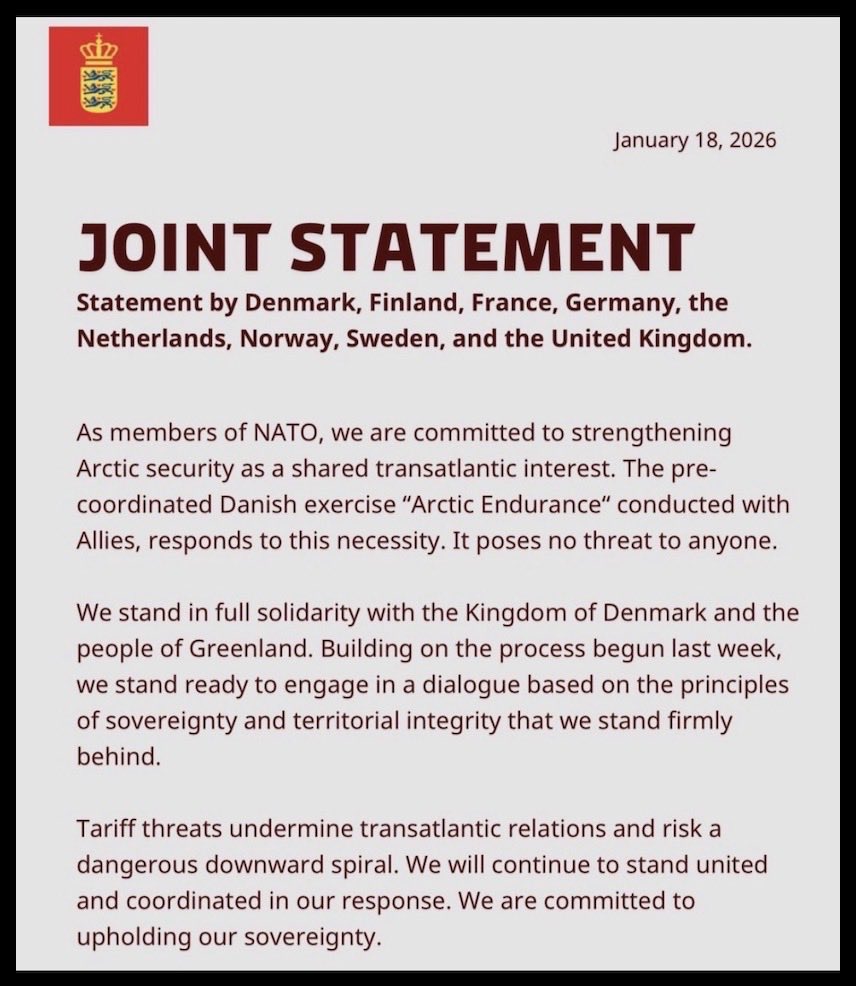
JOINT statement by Denmark, Finland, France, Germany, Netherlands, Norway, Sweden, and the United Kingdom! ✅
Wave a 🇬🇱 flag if you're with Greenland,
Denmark, and other NATO members! 🇬🇱
#HandsOFF#GreenlandNotForSale ⤵️
Yesterday, a number of Peers including Toby Young, Lord Hogan Howe and others promised to put in a welcome amendment to the Policing and Crime bill to abolish “Non Crime Hate Incidents”. My speech went further: I want to see Hate Crime abolished in its entirety. It doesn’t work, it distracts the police and opens them to ridicule. It’s become nothing but a weapon for the identitarians.
China again doubled down on solar in the first half of 2025, adding in 6 months more than America has built in its entire history.
They're literally growing at a rate of 2 United States a year.
Which raises an interesting question for the many people out there who, like Trump, believe that "renewables are a joke" and "green energy is a scam".
Year after year, China is doubling down on renewables, now reaching investment levels of an unimaginable scale, investing far more than the rest of the world combined. China isn't exactly "woke" or known as bleeding heart liberals. They're more famous as the world's most hardheaded economic planners.
If they're going all-in on renewables at this scale, investing in it like it's the winning bet of the century, maybe it's worth wondering if maybe the "joke" won't end up being on the ones laughing.
Two years after the genocidal rampage that happened on October 7, 2023, it's important to be reminded of the nature of the atrocity, even as Hamas's useful idiots continue their warped campaign to recast victims as perpetrators, perpetrators as victims.
Rest in peace, Patricia Routledge 🙏🏻
In memory of her, I encourage everyone to read these words of hers from February last year.
Whether young or old, you're bound to get something out of it.
*****
"I’ll be turning 95 this coming Monday. In my younger years, I was often filled with worry — worry that I wasn’t quite good enough, that no one would cast me again, that I wouldn’t live up to my mother’s hopes. But these days begin in peace, and end in gratitude.
My life didn’t quite take shape until my forties. I had worked steadily — on provincial stages, in radio plays, in West End productions — but I often felt adrift, as though I was searching for a home within myself that I hadn’t quite found.
At 50, I accepted a television role that many would later associate me with — Hyacinth Bucket, of Keeping Up Appearances. I thought it would be a small part in a little series. I never imagined that it would take me into people’s living rooms and hearts around the world. And truthfully, that role taught me to accept my own quirks. It healed something in me.
At 60, I began learning Italian — not for work, but so I could sing opera in its native language. I also learned how to live alone without feeling lonely. I read poetry aloud each evening, not to perfect my diction, but to quiet my soul.
At 70, I returned to the Shakespearean stage — something I once believed I had aged out of. But this time, I had nothing to prove. I stood on those boards with stillness, and audiences felt that. I was no longer performing. I was simply being.
At 80, I took up watercolour painting. I painted flowers from my garden, old hats from my youth, and faces I remembered from the London Underground. Each painting was a quiet memory made visible.
Now, at 95, I write letters by hand. I’m learning to bake rye bread. I still breathe deeply every morning. I still adore laughter — though I no longer try to make anyone laugh. I love the quiet more than ever.
I’m writing this to tell you something simple:
Growing older is not the closing act. It can be the most exquisite chapter — if you let yourself bloom again.
Let these years ahead be your TREASURE YEARS.
You don’t need to be famous. You don’t need to be flawless.
You only need to show up — fully — for the life that is still yours.
With love and gentleness,
Patricia Routledge
*****
Once more, rest in peace. 🤍
"Yes, Britain stands at a fork in the road. But the choice is not, as Keir Starmer claimed, between 'decency' and 'division.' It is between delusion and decision. It is between barbarism and civilization."
In the wake of the terrorist attack on the Heaton Park Hebrew Congregation, I urge you to read @Ayaan's searing essay.