Research and briefings on AI business, agents, operating models, intelligence economics, creator monetisation and AI opportunities hiding in plain sight.
🛰️ @elonmusk wants 10 gigawatts of compute by the end of 2027. @JensenHuang says Nvidia now counts @SpaceX alongside its cloud provider customers, and the two companies' engineers are designing a server for space:
"In the two parts of our chart, Elon used to be under enterprise. That's the way we reported the numbers. Now he's part of our CSPs... They're massive.
He's using our technology for his own AI in training models and such, deploying models, of course... And the demand for GrokBot, the consumption for GrokBot is really skyrocketing. And then, of course, he rents it. And so the combination of these three things, he's fairly unique in doing that...
He loves the intersection between computing and the physical build-outs... And nobody knows more about energy than he does.
And one particular new market that we're going to go explore together is putting data centers out in space. So our two engineering teams are working super closely together to create a new type of server, a new type of architecture that might be super good... in space and on Earth."
— @JensenHuang, CEO of @nvidia on @BG2Pod with @altcap
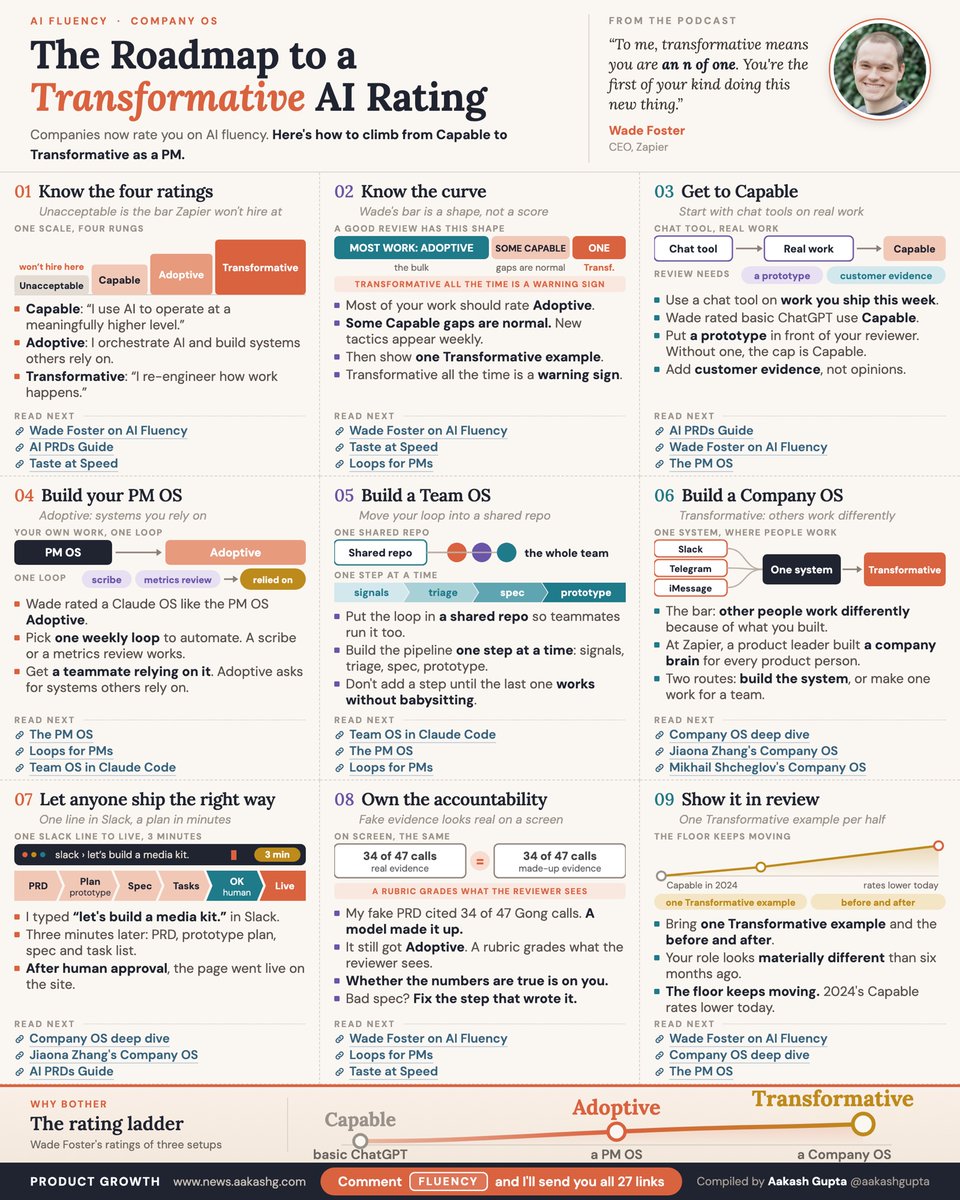
"Transformative means you are an n of one. You're the first of your kind doing this new thing." -Wade Foster, CEO at Zapier
That's the guy whose AI fluency rubric started the trend of rating everyone on AI.
If you want to achieve a Transformative rating, what's the roadmap?
1) Understand the scale
There are four grades in Zapier's AI fluency rubric: Unacceptable, Capable, Adoptive and Transformative.
Capable is when you use AI to operate at a higher level. Adoptive is when you orchestrate and build systems others rely on. Transformative is when you re-engineer how work happens.
2) Know the curve
What might surprise you is that what used to be Transformative in 2025 might only be Capable in 2026. Most of your work is going to be Adoptive. It's not actually a good idea to always be focused on Transformative work, because then are you actually doing your other job?
3) Get to Capable
This is the starting point. Make sure you're using LLMs to deliver real work, build prototypes and gather customer evidence.
4) Build your personal operating system
When I showed Wade my PM operating system, he called that Adoptive. Getting everything connected and going beyond the chat doesn't suddenly make you Transformative.
5) Upgrade to a Team OS
The frontier after individual productivity is team productivity, and you want to help others on your team get the context in your brain.
6) Build a Company OS
This is the work that actually becomes Transformative. You can do it on Claude Code, or you can even add Hermes and OpenClaw.
7) Build the system for anyone to ship
The real unlock with AI is when even CSMs can ship to production. If your company isn't doing that, it's because they haven't built the harness yet. Own that harness.
8) Own the accountability
AI is going to help you move faster, but every word, every line you send out, you are accountable for. So still spend more time on docs than the people reading them.
9) Show it in the review
A performance rating doesn't just mean you did the thing. It means you get credit for it in your review. So make sure you have one Transformative example if you want to hit that rating.
Companies are rating you on your AI usage. This is the roadmap to Transformative.
Just remember, you don't always want to be Transformative.
How have you been nailing your AI rating at work?
Imagine having this capability for authors, editors and publishers 👀
Ideation and cross chapter mapping.
Editing and auto highlighting relationships across sections
Edits and changes, with visible impact and conformations
Handling the old “let’s just add one more story arc” in, at the second drafting stage.
Weeks recovered. Better end product.
i’m building myself a little army of marketing bots. here’s some ideas, thinking out loud:
1. social listening intern
monitors brand mentions, product feedback, all kinds of FUD, competitor conversations, and emerging narratives. sends me a daily briefing with posts worth responding to, amplifying, or flagging internally.
2. the founder whisperer
studies how founders and executives communicate on X, esp competitors. identifies their strongest opinions, recurring themes, and best-performing posts
3. the main character detector
finds influential people engaging with our brand and industry. founders, investors, creators, potential customers, and people who are becoming important. basically tells me who’s worth getting to know.
4. the competitor’s biggest fan
tracks competitor launches, announcements, positioning, and content. figures out what they’re doing well, what people are responding to, and which conversations we’re missing
5. the narrative archaeologist
tracks how conversations around emerging technologies and industry trends evolve. identifies recurring questions, misconceptions, emerging narratives, and opportunities to have an opinion before everyone else does.
6. the distribution strategist
studies which hooks, formats, memes, and conversations are performing in our corner of X. suggests where to distribute content, which conversations to join, and who might amplify it.
7. the launch war room
monitors product announcements and campaigns. surfaces influential reactions, unanswered questions, sentiment shifts, and posts gaining unusual traction. basically an extra pair of eyes during launch week.
8. the community matchmaker
finds interesting people who should know each other. potential event guests, speakers, podcast hosts, collaborators, and future friends of the brand. bonus points for suggesting thoughtful introductions.
9. the content recycling department
digs through old posts, founder takes, community questions, and industry discussions to find ideas worth revisiting. turns them into new angles, threads, explainers, and content experiments.
10. the marketing chief of staff
takes everything the other nine find and gives me one morning briefing: what happened, what matters, who to engage, what to publish, and what actually deserves my attention today.
obviously, some of these will need additional data and tools beyond the X connection itself but i’m starting to believe that @bot is capable
my goal is simple: spend less time collecting information and more time having good ideas, building relationships, and making interesting things happen, because that is where my strengths lie
marketing is about to get a lot more fun!!
If you're looking to churn off of Miro (sorry) let know! We're getting a lot of inbound about this and have a product we're trialing to satisfy it https://t.co/1LO1KuAr4B
If you can get these 3 sorted, you’re absolutely flying 🙏
The 3 features are:
“Sidekicks”: AI assistants that analyse, discuss and create content on your canvas.
“Flows”: visual, multi-step AI workflows that turn canvas content into outputs.
“Talk Track”: The feature for recording video or audio walkthroughs of a board, so others can follow your explanation in their own time.
Rooting for you. 🏆
We just finished a 6-week course on Claude Code and Codex for marketers.
This GitHub repo includes every transcript and resource shared from over 18 hours of sessions.
Drop this into your Claude Code to become a better agentic marketer https://t.co/35PQb17x5N
A lot of companies who spent small fortunes on AI consulting and training are going to wake up in 2027 and realize they're only at 2025 era AI deployment.
There are some good AI consultants and trainers, but by and large they are just raising the floor not the ceiling.
2027 will be the year the masses start buying forward deployed engineers (FDEs).
They'll go from babysitting chat bots to:
- AI employees
- Background agents
- Knowledge work factories
@tldraw Wait until they pair with @ExaAILabs plugin, to pull data, and display it neatly onto a new @tldraw board. Automatically adding context, annotations and structure. Powerful ⚡️