Last week, we hosted the Agentic AI in Lending Webinar: Unlock Your Competitive Edge🚀
Huge thank you to everyone who joined live and especially to the incredible leaders who shared what real AI adoption looks like inside regulated lending teams ❤️
Key takeaways that hit hard:
1. Scale lending capacity without scaling headcount
FORUM Credit Union publicly shared: AI-driven underwriting lets them process up to 70% more loans, no extra staff needed. Pure operational leverage.
2. The real bottleneck is workflow friction, not demand
Manual doc review, endless back-and-forth, siloed systems → slow decisions. Agentic workflows orchestrate intake → analysis → validation → recommendations end-to-end.
3. Transparency is non-negotiable
In lending, you MUST see: what the agent reviewed, which rules applied, why it recommended X. Full traceability = trust.
4. Underwriters evolve into high-leverage decision-makers
AI handles ingestion + first-pass analysis. Humans focus on judgment, edge cases, and building member relationships.
If you're a credit union leader eyeing AI: the opportunity is massive → scale decisions, not headcount.
🥂 Comment “Multimodal Lending”below and we’ll DM you the full recording!
Follow @MultimodalAI to watch us tackle more financial services bottlenecks with agentic AI. Exciting builds incoming... 👀
#AgenticAI #Lending #CreditUnions #FinTech #AIinFinance
The finance ops problem nobody talks about:
Your best analyst isn't slow because they're bad.
They're slow because they spend 60% of their day pulling data from systems that don't talk to each other, formatting it into templates, and waiting for approval chains that haven't changed since 2004.
The bottleneck isn't intelligence. It's plumbing.
That's what we're fixing. @MultimodalAI
One of Europe's leading telecommunications companies processes thousands of payment orders and payment forms every month.
Until recently, every single one was handled manually.
Staff reviewed each document individually, extracted transaction details by hand, categorized payment types, and entered data into downstream systems. As volume grew, the team couldn't keep up without adding headcount. Errors accumulated. Rework was constant. Compliance exposure grew alongside it.
The technology to fix this existed. The infrastructure to connect it to their actual documents didn't.
That's where we came in.
We deployed Document AI and Decision AI on their existing infrastructure, no rip and replace, no migration project, no disruption to live operations.
The AI agents took over document classification, field extraction across transaction details, payer information, and payment amounts, and routing to downstream systems. Built around their document types. Integrated with their existing stack.
The results came immediately:
50%+ reduction in processing time across payment orders and payment forms.
93%+ classification accuracy significantly above the manual baseline.
Fewer errors, less rework, and a compliance posture that no longer depended on individual staff not having a bad day.
More importantly: the foundation is now in place to expand automation across additional document types as volume grows without expanding the team proportionally.
This is what scalable AI looks like in practice. Not a pilot that produces a dashboard. A deployed system that changes the economics of a core operation.
#DocumentAI #AgenticAI #PaymentAutomation #FinancialServices #AI
We moved away from @cursor_ai to @claudeai Code and Codex.
Not because Cursor isn't good it is. But if you're on the bleeding edge, you're moving toward coding agents that don't need an IDE at all.
Here's what that has actually changed at Multimodal:
The workflow used to be: engineer understands the requirement, engineers writes the code, engineer reviews the PR, repeat.
The workflow now is: agentic coding drafts the PRD from existing code and roadmap context, creates the Linear tickets, writes the implementation, generates the PR stack. The engineer reviews, redirects, architects. The ratio of human judgment to human execution has inverted.
We run Claude Code and Codex in tandem — they're not the same tool. One plans, the other reviews. One drafts, the other stress-tests. The ping-pong between them catches things neither would alone.
What this has meant in practice: we're hitting our product roadmap materially faster with the same team size. We measure it in two ways compression in time-to-release for product features, and PR volume normalized for headcount.
The honest framing: the constraint isn't gone, it's just shifted. You still need engineers who can think architecturally, who know when the agent is wrong, who can define what "done" actually means. Those people are now 5-10x more productive.
The engineers who can't operate at that level who still want to write every line themselves are increasingly misaligned with how software gets built now.
That's not a comfortable thing to say. But it's what's true.
#AgenticCoding #AI #Startups #Engineering #ClaudeCode
We've been building AI for financial institutions for three years, and getting our own organization to adopt it has still been one of the harder problems.
We say that not as a confession. We say it because we think it's the most honest and useful thing we can tell anyone who's trying to drive AI adoption inside their own company right now.
Two years ago, the bar was: is your team using ChatGPT? Fine. Adoption was uneven but the stakes were lower. Maybe some people were using it well, some weren't. It didn't break you.
Today the bar is completely different.
Agentic AI - coding agents, workflow automation, AI-assisted go-to-market isn't a productivity tool you opt into. It's an organizational capability you either have or you don't. And the gap between teams that have it and teams that don't compounds every quarter.
At Multimodal, that's meant being very deliberate about who the champions are, who the stewards are, and who the laggards are and being honest about what to do when someone isn't adapting fast enough.
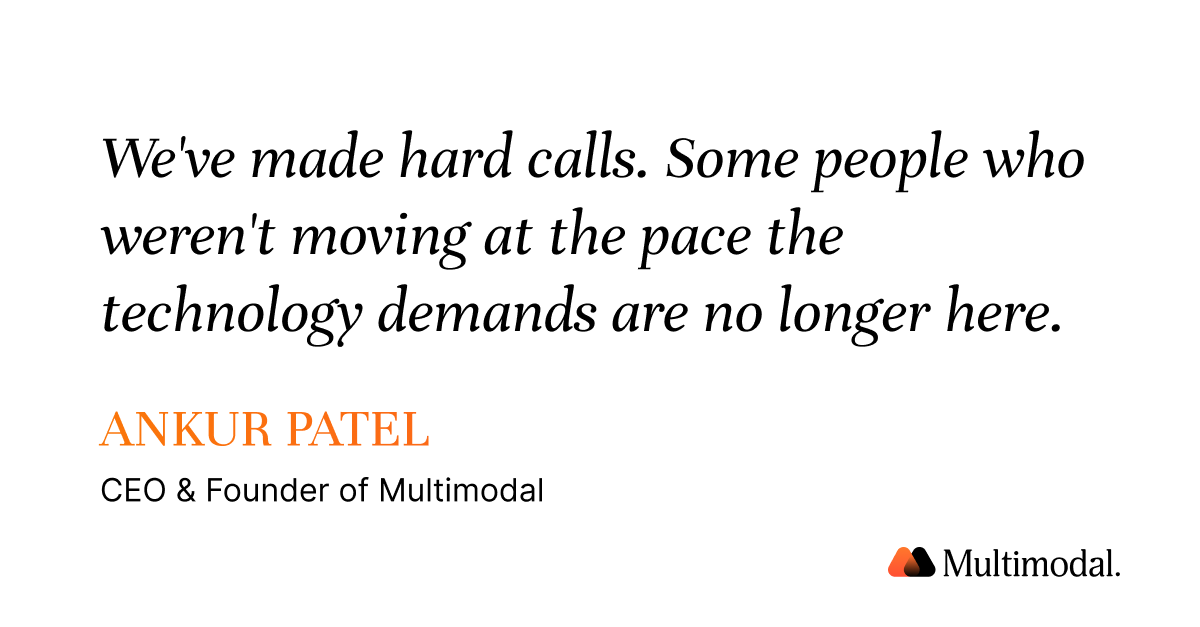
We've made hard calls. Some people who weren't moving at the pace the technology demands are no longer here.
That's not a comfortable thing to say. But we think it's the right frame.
The job of a leader right now isn't just strategy or product vision. It's getting every level of the organization to actually use the tooling — in the most optimal way — before your competitors do.
The pace of adoption inside your organization is a competitive variable. Most leaders haven't started treating it that way yet.
#AI #Leadership #AgenticAI #Startups #FintechNews
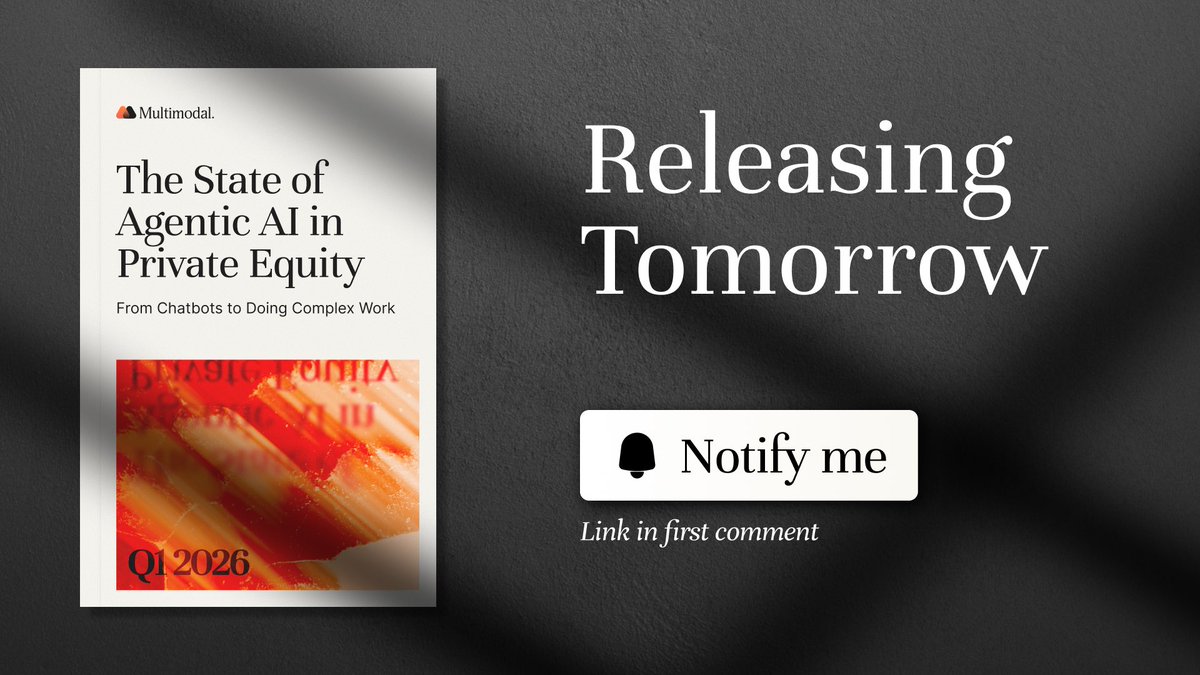
Tomorrow we publish the most comprehensive look at agentic AI in private equity that exists.
51 pages. 50+ sources. The honest answer to why 95% of PE AI fails and what the 5% that works actually looks like.
Free. 9am ET. Tomorrow.
People keep using the word "trust" without saying what they mean.
When a bank asks whether they can trust an AI system, they are not asking one question. They are asking at least five.
- Can I trust how the AI handles our customers' data?
- Can I trust that the AI can explain why it made a decision?
- Can I trust that the AI operates within proper governance frameworks?
- Can I trust that a human will step in when the AI is uncertain?
- Can I trust that the AI follows our compliance obligations?
Each one of those is a different problem with a different answer. You can have an AI that is completely secure from a data standpoint but has zero explainability built in. You can have an AI that is technically compliant but has no real governance framework around it.
Trust in agentic AI is a stack, not a switch.
The components: information security, explainability, governance, compliance, AI ethics, human oversight, and audit trails. Every one of them matters. We will go through each one in this series.
--> Follow this page and save this post. We are breaking down each pillar over the next 1 week.
#TheTrustSeries
Why compliance breaks in fragmented workflows? Regulated workflows fail in the seams, not in the steps.
Workflow tools can generate an audit trail for what they touched. The problem is that most financial services processes span multiple systems, teams, and decision points, so the audit record gets fragmented.
That is where inconsistency creeps in.
What breaks:
1. Policy drift. A rule enforced during origination does not automatically carry into servicing, reporting, or exception handling.
2. Missing context. Approvers review an output without a standardized record of inputs, thresholds, and prior decisions.
3. Unreconcilable audits. When logs live across multiple platforms, proving consistent control becomes a manual, narrative exercise.
Process orchestration makes compliance an architectural property. Rules live at the process level, approvals are triggered with full context, and every action is recorded in one continuous trail.
That is the difference between “we think we are compliant” and “we can prove it quickly.”
#workflowtool