Multimodal agent memory is on arXiv!
📈 From static retrieval, to dynamic update, to self evolving!
🤖 Across Image, audio, video, GUI, and Embodied agent.
📱Important for personal agent and RSI…
Explore our observatory and submit papers by website to contribute!
📝 https://t.co/tFJ4Lk1VRk
📄 https://t.co/PVVFgBK1KA
#AgenticAI #RSI #PersonalAgent
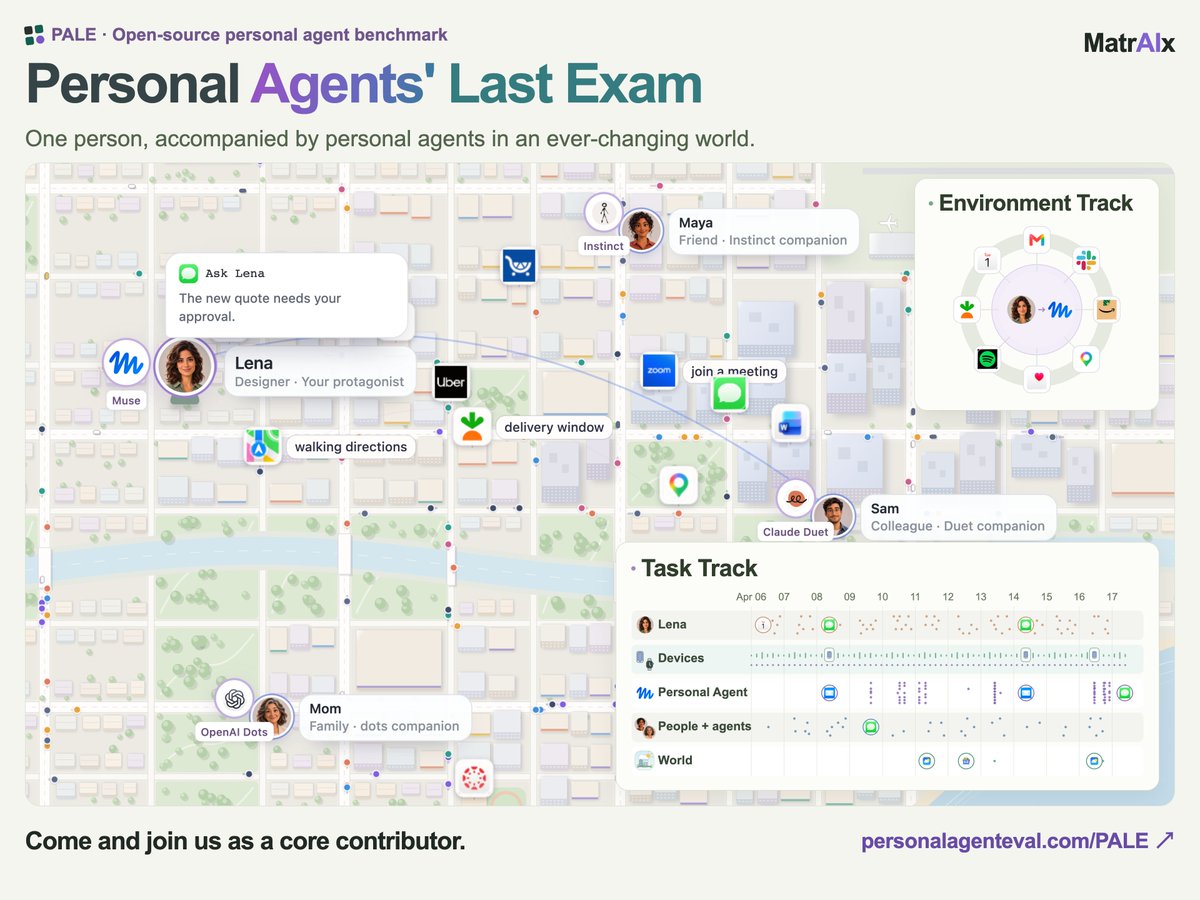
🚀 We’re building Personal Agents' Last Exam (PALE) and looking for contributors!
Following PersonalAgentEval, we’re building an open-source benchmark for personal agents. Best personal agents must reason and act across lifelong history, evolving preferences, and a complex changing world. 🎯PALE research collaborations bring together professors and researchers from @Stanford, @MIT, @Harvard, and other top institutions, including @NobelPrize and Fields laureates, as well as researchers at @OpenAI, @AnthropicAI, and @GoogleDeepMind. Come and join us!
Two tracks:
🌍 Environments: realistic apps and websites with full workflows, state, and interfaces
🧩 Tasks: challenging personal context with rubrics + reference solutions
Own a domain, and start to ship!
🌐 Join PALE: https://t.co/MD4PXROMjb
#MatrAIx #PALE #PersonalAgents #AIAgents #OpenSource #AgentEvaluation #MetaMuse #GrokBot #OpenAIDots #Hark #ManusCue #Instinct @YuexingHao@XiaominLi98
🚀 Can GPT-Astra simulate YOU better than Claude Opus 5.5?
We’ve updated the TwinVoice Leaderboard!
📊 5,687 samples
🧠 3 persona dimensions
🎯 6 evaluation capabilities
🤖 9 frontier models
GPT-Astra shows impressive performance!
But can LLMs truly capture who we are—not just how we talk?
📄 Paper (ACL 2026 Findings):
https://t.co/3cP8jtU63Q
🏆 Leaderboard:
https://t.co/5oplpLzsd4
💻 GitHub:
https://t.co/8wOgRpJEMD
#TwinVoice #LLM #DigitalTwin #PersonalAgent
We survey 297 agent memory systems, 82 benchmarks, across 5 modalities (image, video, audio, GUI, embodied & 3D) with an interactive observatory that traces how agents form, store, and evolve memory.
Explore: https://t.co/BCIkWWP9HG
📄 arXiv:2610.19366
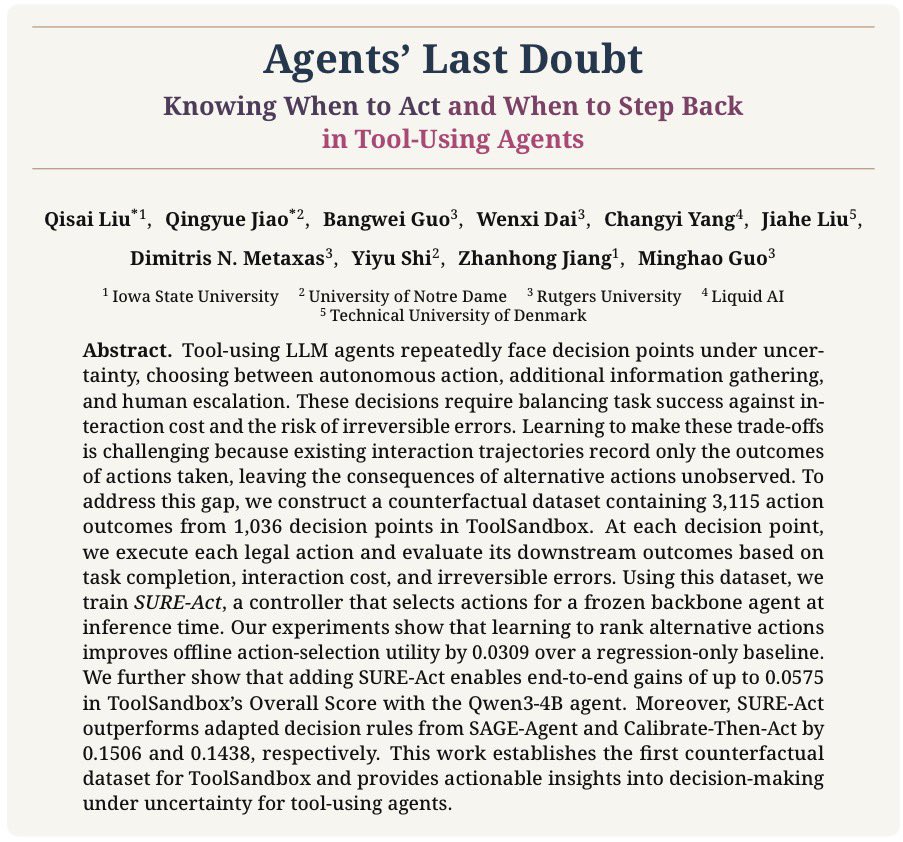
🚀 Excited to share our new paper, Agents’ Last Doubt (SURE-Act)!
Can AI agents learn when to act—and when to step back?
We explore counterfactual learning for better agent decisions, paving the way toward more reliable RSI.
#AIAgents#RSI
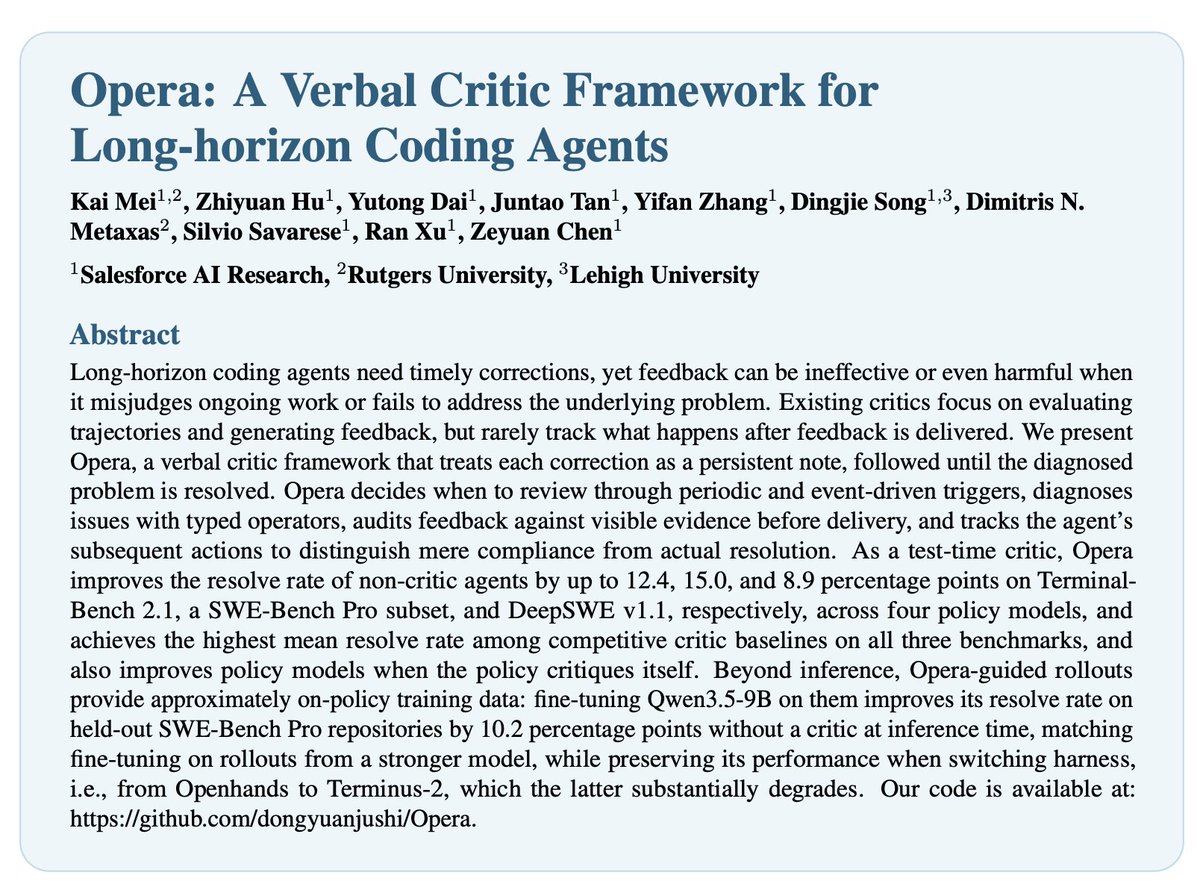
Excited to share Opera, our research from my internship at Salesforce AI Research!
If you’ve used coding agents, you’ve probably seen them repeat a failing command or say “done” while the bug is still there. How do we help them recover, and check that the correction actually worked? We propose a verbal critic framework: Opera, which decides when to intervene, checks feedback before delivering it, and tracks each correction as a persistent note until evidence supports closing the issue.Across three coding benchmarks, Opera improves task success by up to 15 percentage points. Its guided rollouts also provide training data: fine-tuning a 9B model improves performance on unseen repositories by 10.2 points, with no critic needed at inference.
Paper: https://t.co/rDjKYjos0F
Code: https://t.co/9K1ngoYzJW
Would love feedback from anyone building coding agents.
Excited to share our recent work, EmbodiedRSI 🤖 — enabling an Embodied Agent Harness to autonomously decide “what to try next and which direction to improve.”
EmbodiedRSI maintains hypotheses for improving code and skills, prioritizes experiments with high information value and low execution cost, and uses real-world execution outcomes to drive the co-evolution of code and skills. Meanwhile, reward-based learning helps identify which experiences are worth retaining and reusing, allowing each interaction to more effectively guide future improvements.
Without updating the underlying robot foundation model, EmbodiedRSI improves the success rate on unseen compositional tasks in RoboCasa365 from 40.1% (best baseline) to 71.3%. When transferred zero-shot to real-world robots, the success rate increases from 46.0% to 71.3%. Under the same budget of 50 interactions, EmbodiedRSI improves the success rate from 27.1% with random exploration to 72.9%.
📄 arXiv: https://t.co/RZj9d7IMqb
🌐 Webpage: https://t.co/roJ8MhcwsK
Self-evolving agents have recently attracted a lot of attention.
However, when people talk about “self-evolving” systems, are they always referring to the same thing? Many works describe themselves as self-evolving, self-improving, continually learning, or capable of test-time adaptation. But what exactly are they improving, and how are these ideas related?
In this blog post, we try to provide a simple taxonomy of current self-evolving systems.
We view such systems as consisting of three key components: the model, the harness, and the artifacts produced by the agent. This naturally leads to three types of self-evolving work: systems that optimize artifacts, systems that improve the agent harness, and systems that update the model itself.
For each category, we summarize its motivation, typical methods, and emerging trends. We then take a step back and discuss how these directions are connected, where their boundaries become blurry, and what this may suggest about the future development of self-evolving agents.
Excited to share that I’m joining Zoom in Seattle as an AI Intern this summer!
I’ll be working on enterprise AI, focusing on agent memory and agentic search systems.
If you’re in the Seattle/Bellevue area, feel free to reach out and chat! ☕️
#Zoom#Seattle
Most "agent memory" benchmarks just test whether a chatbot remembers your preferences. That tells you almost nothing about real agents. So we built MemGym: memory evaluation for deep research, coding, and GUI agents, with a clean memory-isolated score. 🧵
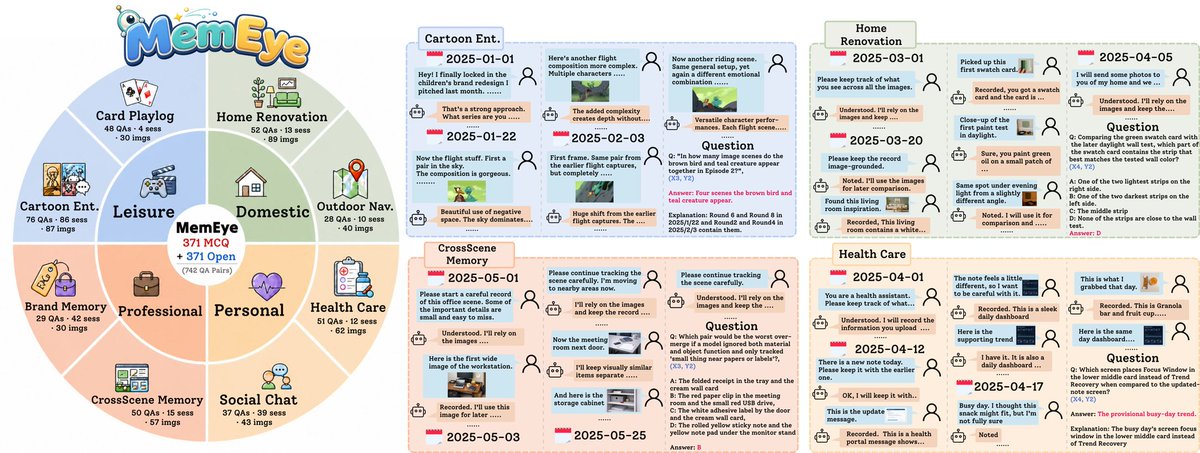
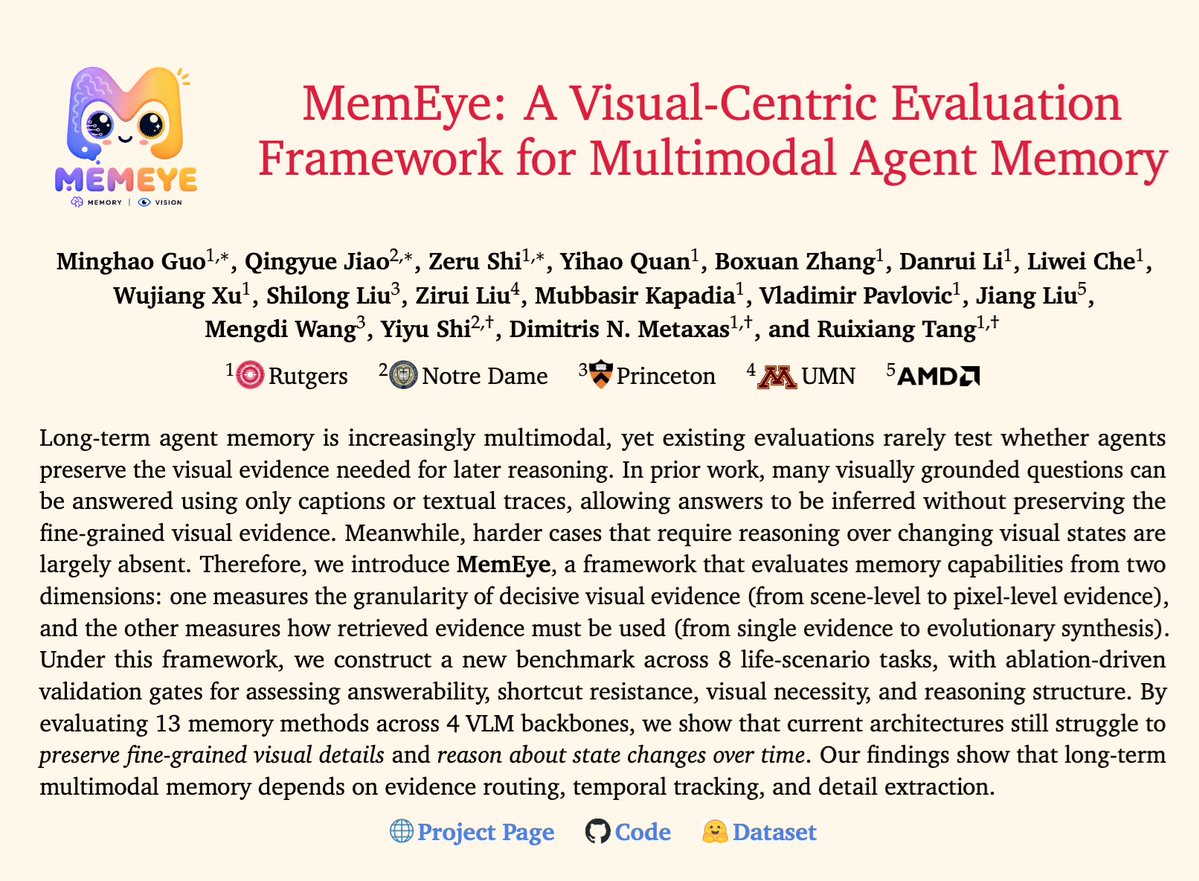
MemEye
A visual-centric benchmark evaluating how well multimodal agents preserve fine-grained visual details across long-running interactions, from scene-level to pixel-level evidence, across 8 life-scenario tasks.
👀 Can multimodal agents truly remember what they saw? Do they just rely on caption-level shortcuts?
MemEye: a visual-centric benchmark for multimodal agent memory, can test whether agents can preserve visual evidence and track evolving visual states.
📄 https://t.co/CMNbNxmunQ