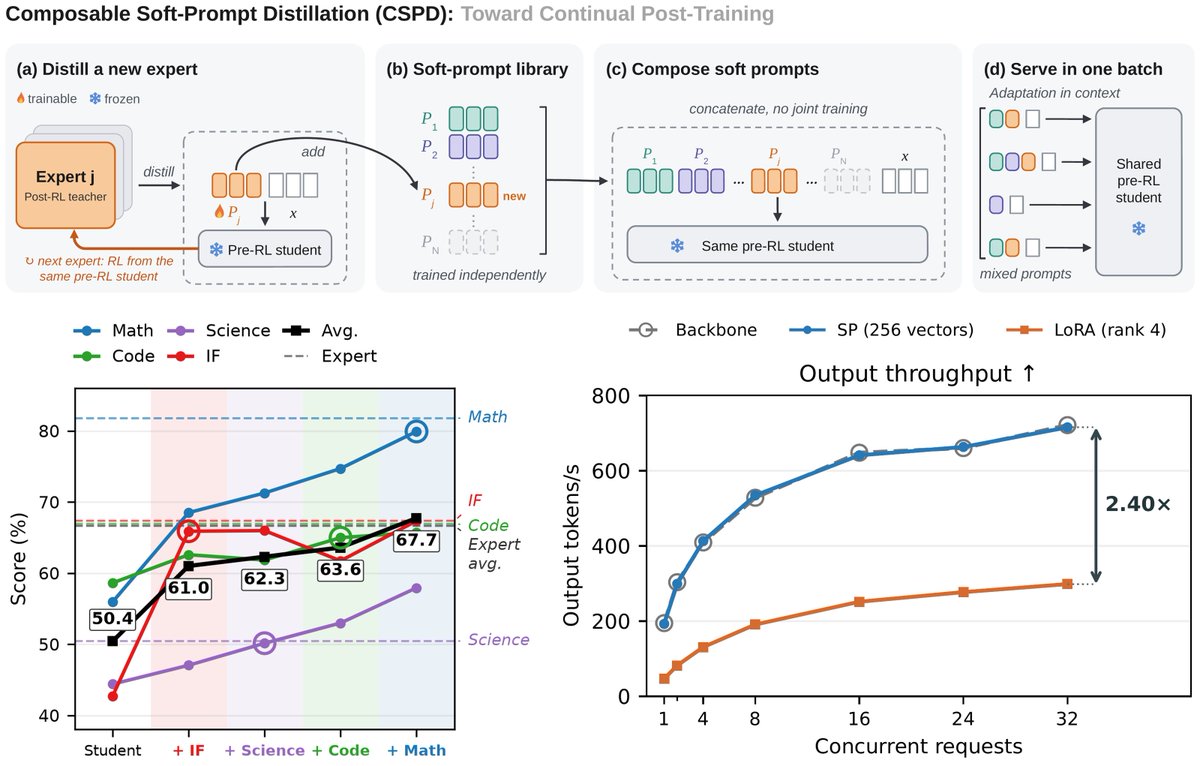
We think we’ve found a better path to continual post-training: merging models in input space.
🔹 A 256-token soft prompt (~0.01% of params) matches full-parameter RL
🔹 Plug-and-play composition: prompts trained separately just stack, with no joint training, and the combo beats the experts. No more MOPD!
🔹 Better OOD generalization, almost no forgetting
🔹 ~0 inference overhead, even with a different prompt per request. Built for personalization.
@p_fabrikantov We explore user interests with detailed instructions to better understand user intentions and filter out unrelated items. Breaking the recsys echo chamber is hard. We believe building memories from user intentions will help a lot.
This reminds me of iAgent, our work from 2024 on building a recommendation agent that acts on the user’s behalf. Traditional recommendation platforms optimize for metrics like time spent, CTR, and CVR, but these objectives don’t necessarily align with what users actually want to see. https://t.co/DVOq4wmWLP
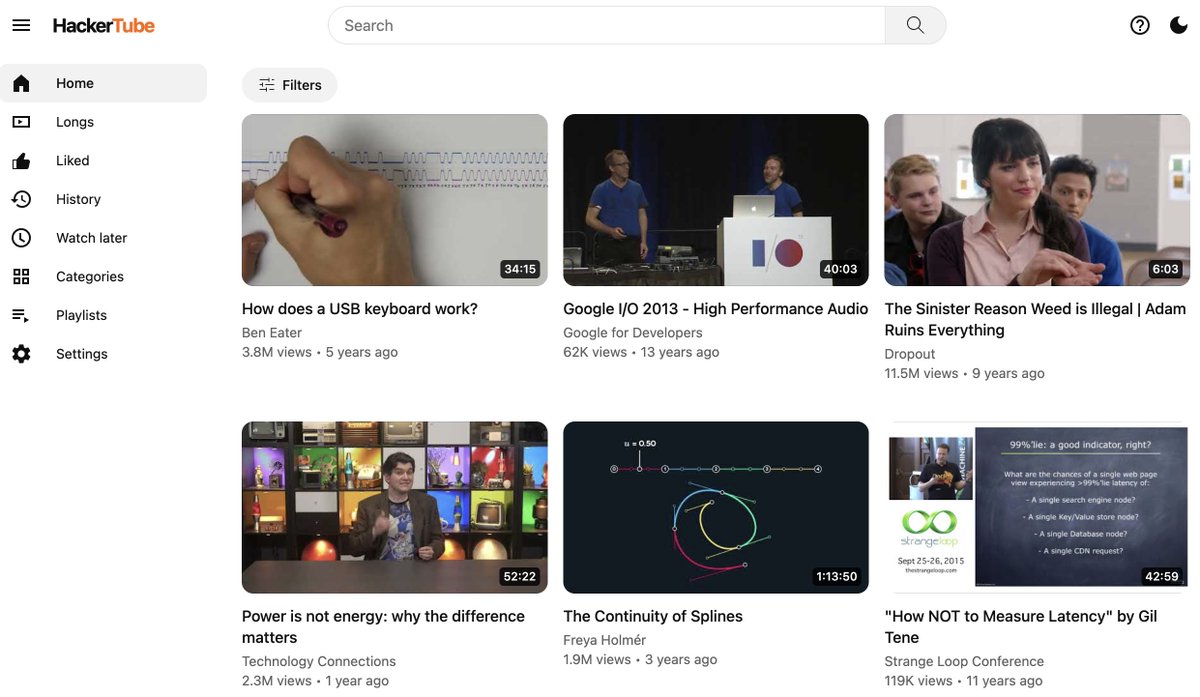
Weekend hack: HackerTube. I was annoyed with YouTube's recommendations so I had Claude filter down 43M comments over 20 years of HN to 6,454 videos that keep being recommended. *Significantly* better viewing experience, ~2 hours with Opus 5.5:
https://t.co/JIhXN7OSh1
- Excellent recs without any logins (state is kept in local browser session)
- Thumbnail is a representative frame from middle of the video instead of the super duper A/B test hyper-optimized user uploads
- Underlying data from the comment analysis as one zip file, point your Claude at it and ask for your own version
- HackerTube Longs ✊
A bit more on the process:
I use Claude Code (desktop app for Mac), Opus 5.5 on Medium effort as my default. I only talk to Claude and have it do everything, the only "manual work" I helped with in tandem was in the browser (reminiscent of MenuGen): 1) I had to create some kind of API key from Google Cloud UI to query YouTube for video metadata, 2) I booted up a VPS box for serving and 3) I bought the domain name. Once the box was up I gave Claude the IP and told it update, secure, harden, deploy and optimize the code, and it did the whole thing.
Many awesome projects that would have normally taken weeks/months even can now be few-shotted for breakfast. What else are we not thinking of.
What Happens Inside an AI Model When a Problem Becomes Too Difficult?
New research reveals a fascinating pattern: the harder the problem, the sparser the AI's internal representations become.
We know that large language models perform remarkably well on familiar questions but often struggle with complex reasoning, conflicting information, and unfamiliar problems.
But what actually changes inside a model when the difficulty increases?
A new research paper, Farther the Shift, Sparser the Representation: Analyzing OOD Mechanisms in LLMs, investigates exactly this question.
And the findings could change how we understand AI reasoning, model robustness, and the way we design more intelligent inference systems.
1. The surprising discovery: harder problems produce sparser representations
Researchers investigated how the internal activations of LLMs change when they encounter increasingly challenging inputs.
They examined models from the Qwen and Llama families across different reasoning tasks and model sizes.
The central finding was remarkably consistent.
As task difficulty increases, the model's final hidden-state representation becomes more sparse.
In simpler terms, more of the representation's activation energy becomes concentrated in a smaller subset of dimensions.
The researchers observed this pattern across four different types of difficulty:
Complex reasoning: Harder mathematical problems produce sparser representations.
More answer choices: Adding plausible incorrect answers increases representational sparsity.
Conflicting information: When provided context contradicts the model's learned knowledge, activations become more concentrated.
Longer contexts: Increasing the amount of information the model must process produces similar effects.
Importantly, this is a statistical pattern across groups of examples, not a guaranteed rule for every individual input.
The researchers summarize their discovery with a simple principle:
The farther the distribution shift, the sparser the representation.
2. Why does this happen?
One of the most interesting parts of the research is its explanation of how these patterns develop during training.
The researchers studied a smaller Transformer trained from scratch in a controlled environment.
They discovered two distinct phases of representation learning.
Phase 1: Feature selection
During the early stages of learning, the model increasingly concentrates its activations in a limited set of dimensions.
It appears to emphasize features that are useful for learning the task.
Representations become more concentrated while the model is still learning the underlying structure.
Phase 2: Feature consolidation
As training progresses and the model becomes more familiar with the data, the opposite pattern emerges.
Representations become more distributed across multiple dimensions.
The model develops broader internal representations for patterns it has successfully learned.
This leads to an intriguing interpretation.
Familiar problems can activate rich, distributed representations, while unfamiliar problems may rely on narrower activation patterns.
In other words, representation density may reflect how well a model has internalized particular patterns during training.
This is especially interesting because the model was not explicitly trained to produce the observed sparsity–difficulty relationship.
The pattern emerged through learning.
Final thoughts
The most interesting implication of this research is not simply that difficult questions produce sparser activations.
It is that the geometry of a model's internal representations may carry meaningful information about how familiar or challenging an input is.
That changes how we might investigate AI reasoning.
Rather than studying only the final answers generated by language models, we can also examine the internal structures that emerge while they process information.
Understanding these structures could help researchers build systems that adapt more intelligently to unfamiliar problems.
Perhaps one of the next breakthroughs in AI will come not only from making models larger, but from understanding their internal representations well enough to guide how they reason.
The future of AI may depend as much on understanding how models represent difficulty as on improving how they answer questions.
📄 Research paper: Farther the Shift, Sparser the Representation: Analyzing OOD Mechanisms in LLMs
https://t.co/5GPal2LDdT
💻 Code: https://t.co/9iWffVB1tz
#ArtificialIntelligence #LLM #AIResearch #MachineLearning #DeepLearning
Multimodal agent memory is on arXiv!
📈 From static retrieval, to dynamic update, to self evolving!
🤖 Across Image, audio, video, GUI, and Embodied agent.
📱Important for personal agent and RSI…
Explore our observatory and submit papers by website to contribute!
📝 https://t.co/tFJ4Lk1VRk
📄 https://t.co/PVVFgBK1KA
#AgenticAI #RSI #PersonalAgent
Want to know who's the most cited person in ICLR 2027, and which submissions cite your paper?
I downloaded all 43,013 public ICLR 2027 submissions through the OpenReview API and asked my good friends Codex and Claude to build a site that ranks the most-cited papers and authors.
#1 paper is not Attention Is All You Need 👀
Link: https://t.co/AD8Ye4uKNl
Self-evolving agents increasingly rely on human-designed harness scaffolds. But as the policy becomes more capable, should the external harness eventually disappear?
Introducing the full version of EvoHarness-RL (@Meta × UIUC): a shared Belief–Progress–Experience harness interface + RL that learns what to keep external, what to internalize, and when the harness is worth using.
• +10.0 pts plug-and-play on frontier models
• +8.5 pts over the strongest trainable baseline with Qwen3-8B
• 67% fewer harness calls and up to 2.9× fewer RL steps
• Harness annealing & internalization, with environment-dependent model–harness boundaries
📄 Paper: https://t.co/Ws12AF8DZl
🌐 Webpage: https://t.co/7smoY9wfKq
💻 Code: https://t.co/q5FjqYWGF5
Happy to share that the full version of EvoHarness-RL from @Meta, UIUC, and CMU is now out, together with our code and project page!
We substantially expanded the study across 3 long-horizon benchmarks: ALFWorld, WebShop, and WebArena. EvoHarness-RL consistently improves over strong trainable baselines, with +8.5 pts average success. Our unified BPE harness also improves frontier models by +10.0 pts on average, without any training.
One interesting insight is that as RL progresses, agents gradually internalize recurring harness-use patterns and learn to selectively retain the external state that is actually useful, resulting in different harness behaviors across environments.
Feel free to repost, and if you find the code useful, we’d really appreciate a GitHub star ⭐️
We’ll share more findings in follow-up posts soon!
We’re also presenting EvoHarness-RL at the @COLM2026 LLA Workshop this afternoon. Feel free to stop by and check out our poster!
🌐 Webpage: https://t.co/7smoY9wNzY
📄 Paper: https://t.co/OW8jUbe2ct
💻 GitHub: https://t.co/q5FjqYXeuD
On the eve of the #ICLR deadline, I swear AI has already taken over.
Vibe coding ✔️
Vibe writing ✔️
Vibe reviewing ✔️ And the final boss? AI reviews from GPT-6 Astra & Opus 5.5 dropping 100+ comments and errors or have we already lost control? 🤖😭#ICLR#AItookover
🚀 New paper alert: On-Policy Self-Distillation without Any Supervision !!
🧠 Can a model truly on-policy “self-distill"?
On-policy self-distillation removes the need for a stronger teacher, but still relies on an external ground-truth solution to make the self-teacher more capable.
Our new work asks: can we remove supervision altogether?
Can an LLM improve its reasoning entirely from its own generations—without ground-truth answers, verifiers, or a stronger teacher?
♻️ We introduce U-OPSD, a simple approach toward genuine self-distillation:
For each problem, the model samples multiple solutions from itself:
🗳️ Agreement identifies a likely solution through majority vote
🔀 Disagreement reveals trajectories where the model may be going wrong
🎓 The pseudo solution conditions the self-teacher, which provides dense token-level guidance along those disagreeing trajectories
U-OPSD turns self-consistency into supervision: agreement builds the teacher context, while disagreement determines where to distill.
🔓 No external supervision at all
📚 Unlabeled problems only:
🚫 GT solutions
🚫 Verifier
🚫 External strong teacher
🚫 Environment feedback
📊 Yet, across 5 math reasoning benchmarks and 6 Qwen3 settings, U-OPSD consistently improves the base model and matches or surpasses supervised SFT, GRPO, and OPSD.
🌙 Non-thinking mode:
📈 +8.5 / +10.7 over the 4B / 8B base models
🏆 +3.2 / +2.3 over GT-supervised OPSD
🚀 +7.0–11.3 over label-free self-rewarding RL methods including TTRL, RENT, and Intuitor
🧠 Thinking mode:
📈 +2.2 / +1.9 over the 4B / 8B base models
🤝 On par with GT-supervised OPSD and GRPO
🚀 +0.8–1.4 over label-free self-rewarding RL methods including TTRL, RENT, and Intuitor
Meet U-OPSD 👇
📄 ArXiv Paper: https://t.co/sGBO2uT8DQ
💻 GitHub: https://t.co/T5eZtbUlYJ
🌐 Project Page: https://t.co/7oDlOLCPK2
🤗 Hugging Face Paper: https://t.co/hWWVJoISOw
(Plz upvote if you can !!
Amazing collaboration with @ Bingyang @JoLiang17@tian_yunjie@Di Fu and Nuno !
Grateful for all the insightful discussions and exploration together!
#LLM #OPD #OPSD #Distillation
Today we're also opening the weights for Muse Glimmer, a great 30B parameter dense model that can run locally. Soon we'll also release the weights for Muse Spark 1.2, our latest foundation model. Meta is a strong supporter of open source and I'm proud of these releases. Congrats to @alexandr_wang and the MSL team for all your great work on these models.
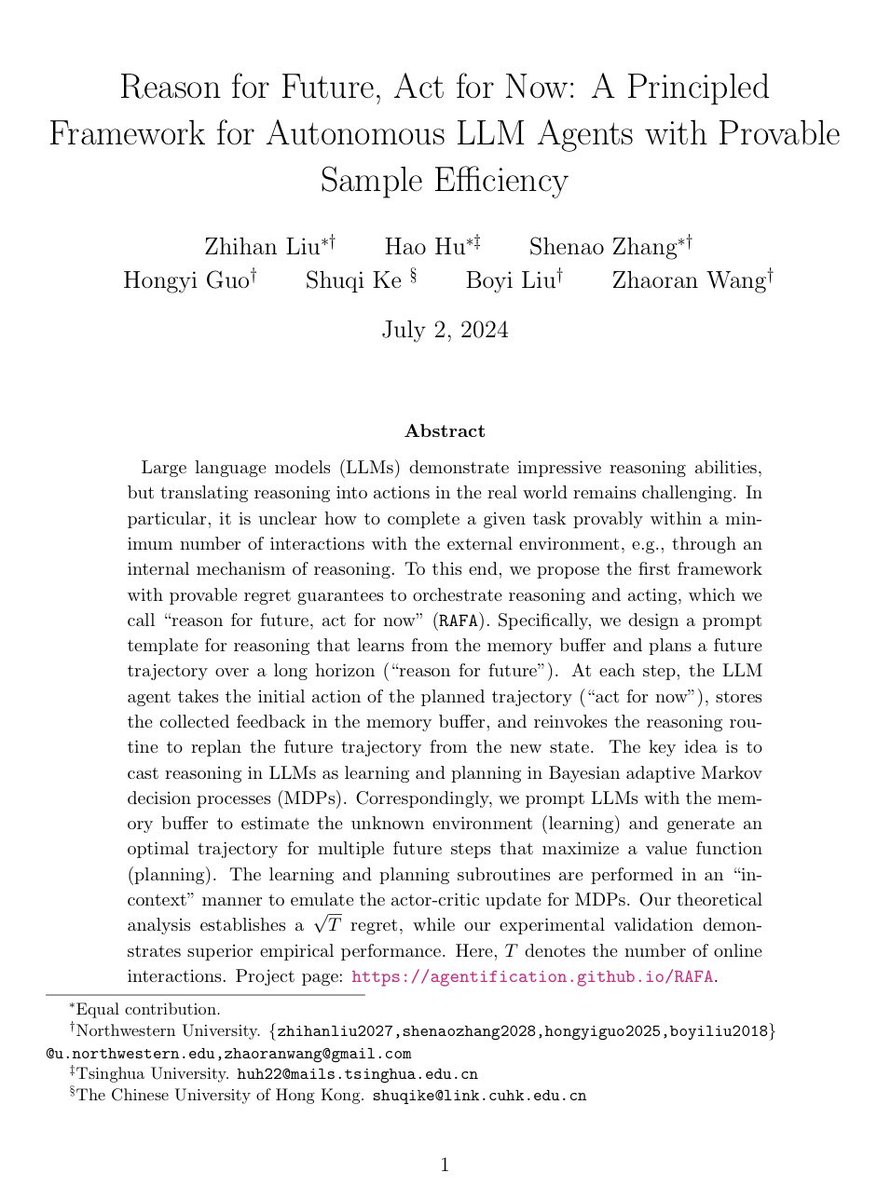
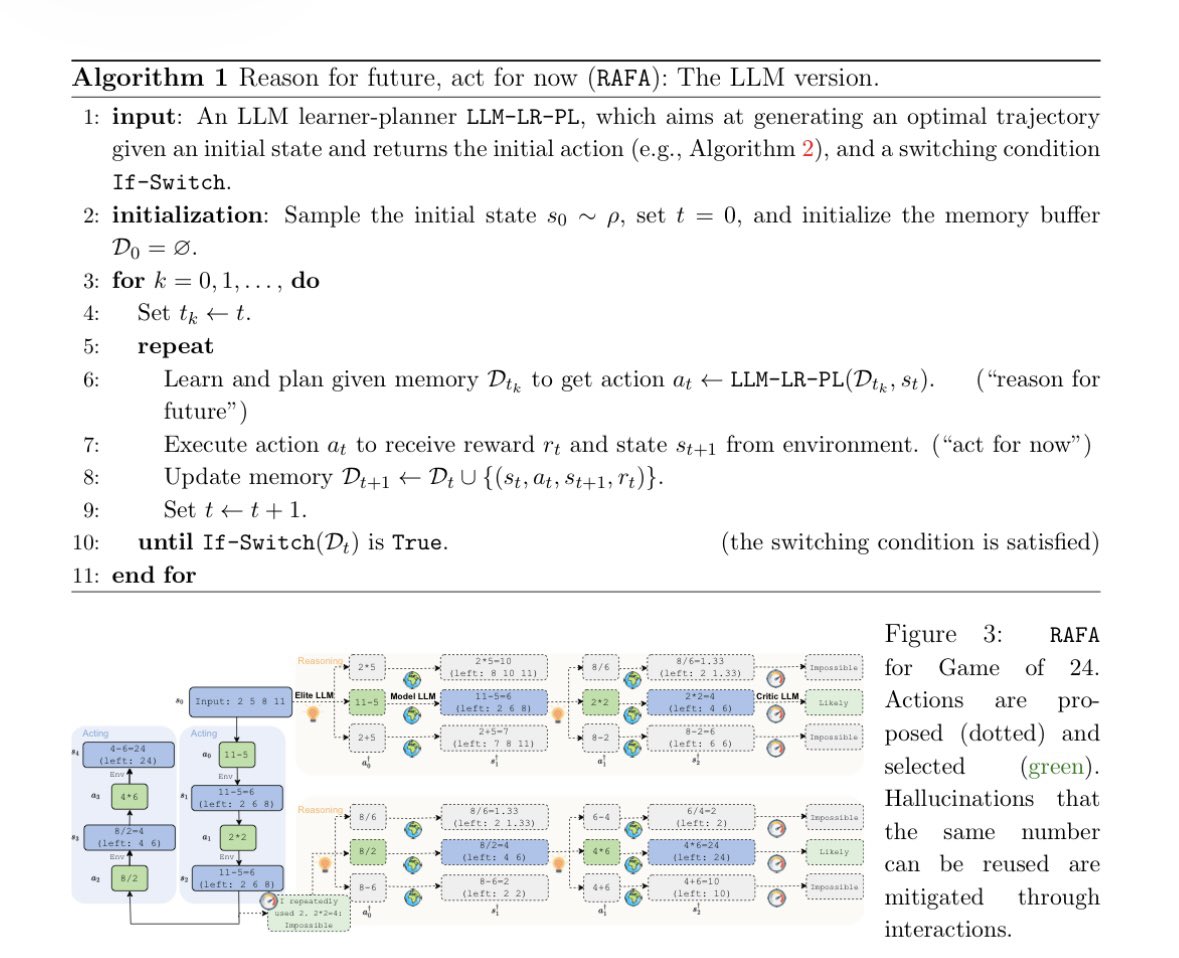
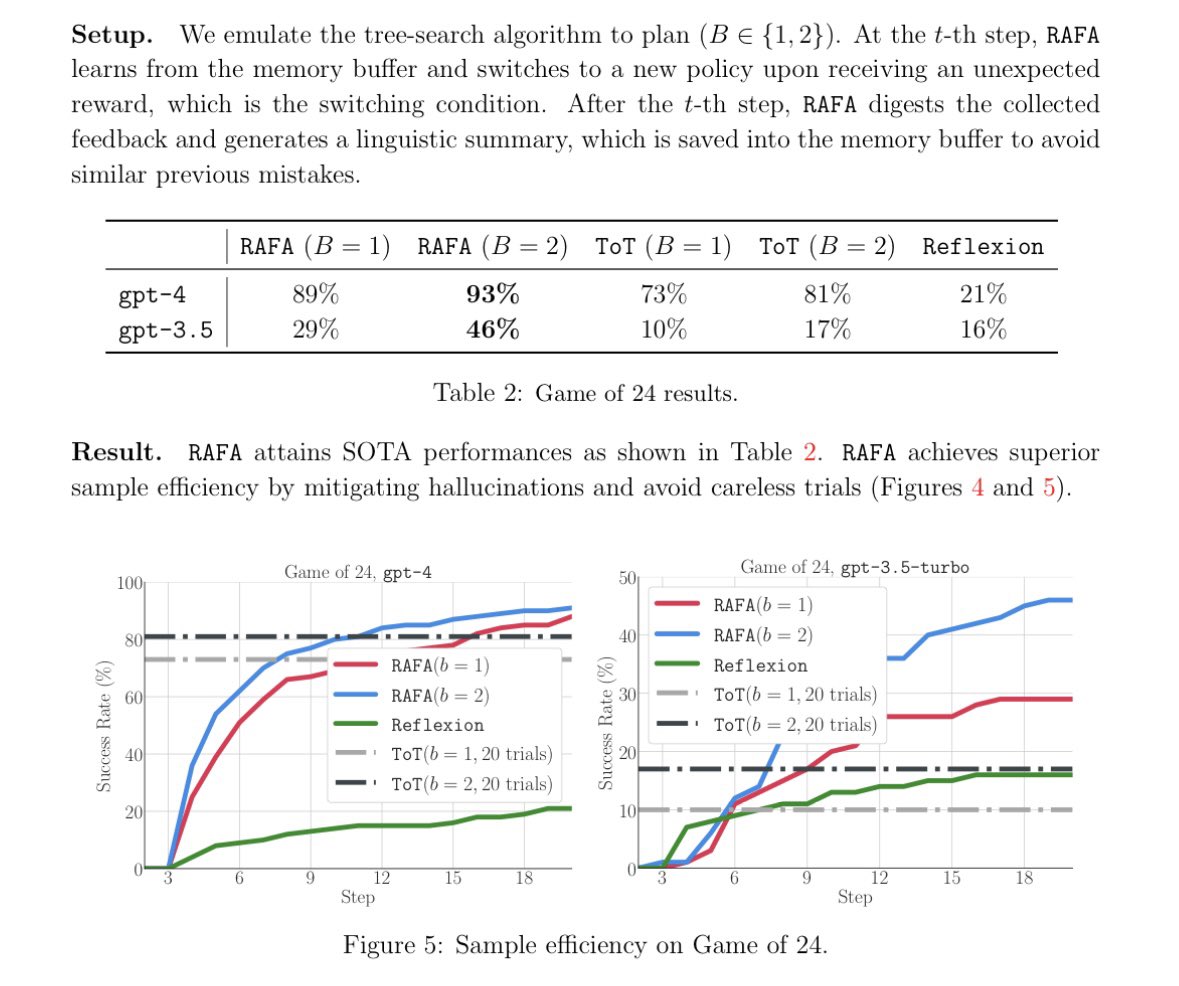
🚀 Just revisited RAFA (Reason for Future, Act for Now) from ICML 2024.
🤯 It’s honestly surprising how forward-looking this work was.
Back in 2024, they were already framing LLM agents as a closed-loop learning + planning + acting system:
✨ Reason for future, act for now
🧠 Memory-driven replanning
🌍 Long-horizon planning
⚡ Sample-efficient interaction
📐 Even with theoretical regret guarantees
Looking at today’s wave of autonomous agents, online RL, test-time adaptation, and memory-based reasoning, many of these ideas feel remarkably prescient @ZhihanLiu21628 .
👏 Definitely a paper worth revisiting if you’re working on LLM agents.
📄 https://t.co/zHFkB05HBw
#LLM #AIAgents #Reasoning #ReinforcementLearning #ICML #MachineLearning
LBR is built around a simple principle: look a little before you leap. 🌱
Instead of forcing a language model to commit to the next token from the root distribution, LBR briefly explores several local futures, then routes using the hidden states they induce.
This gives a lightweight, discrete, and trainable form of test-time scaling.
paper: https://t.co/BthEXtk04d
code: https://t.co/n8tne5Ba9R
Huge thanks to my advisor
@zhaoran_wang, @tilderesearch for supporting this work, and my amazing coauthors: @fnruji316625, @JinPan547630, @YangYi17826, Zijie Xia, @dhruv31415, @ShumingHu, @zhenzhangzz, @GenAI_is_real, Jinma Zhao, @wujiang_ai, @liraymond96, @xwang_lk, Julian McAuley.