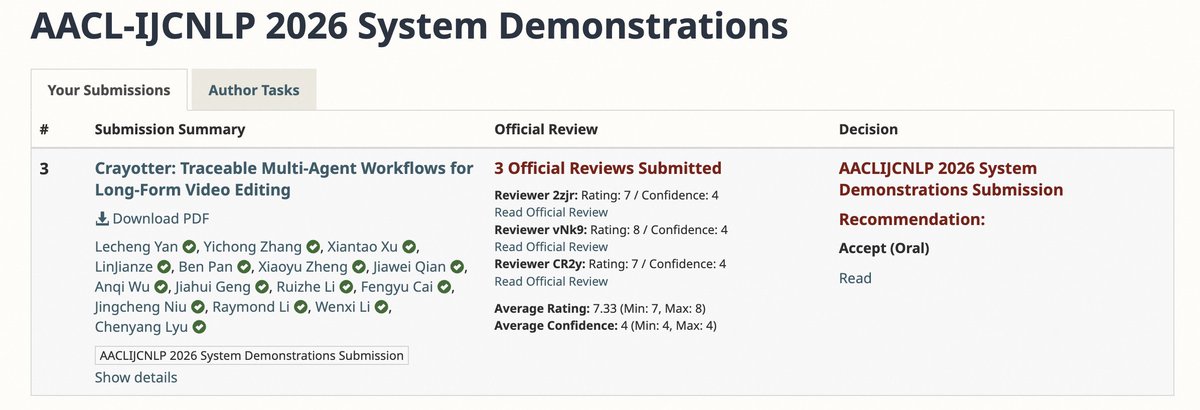
Our paper "Crayotter: Traceable Multi-Agent Workflows for Long-Form Video Editing" was accepted to the AACL-IJCNLP 2026 Demo Track!
Crayotter is an open-source multimodal multi-agent system for prompt-driven long-form video editing, where every step — retrieval, analysis, editing blueprints, renders — is a traceable, inspectable artifact.
⭐ Star it on GitHub (released months ago): https://t.co/oxvbEjI6PN
Demo paper: https://t.co/tCwLLvhjBs
Agentic RL paper: https://t.co/3iWI2UT4oM
#LLMs #Agent
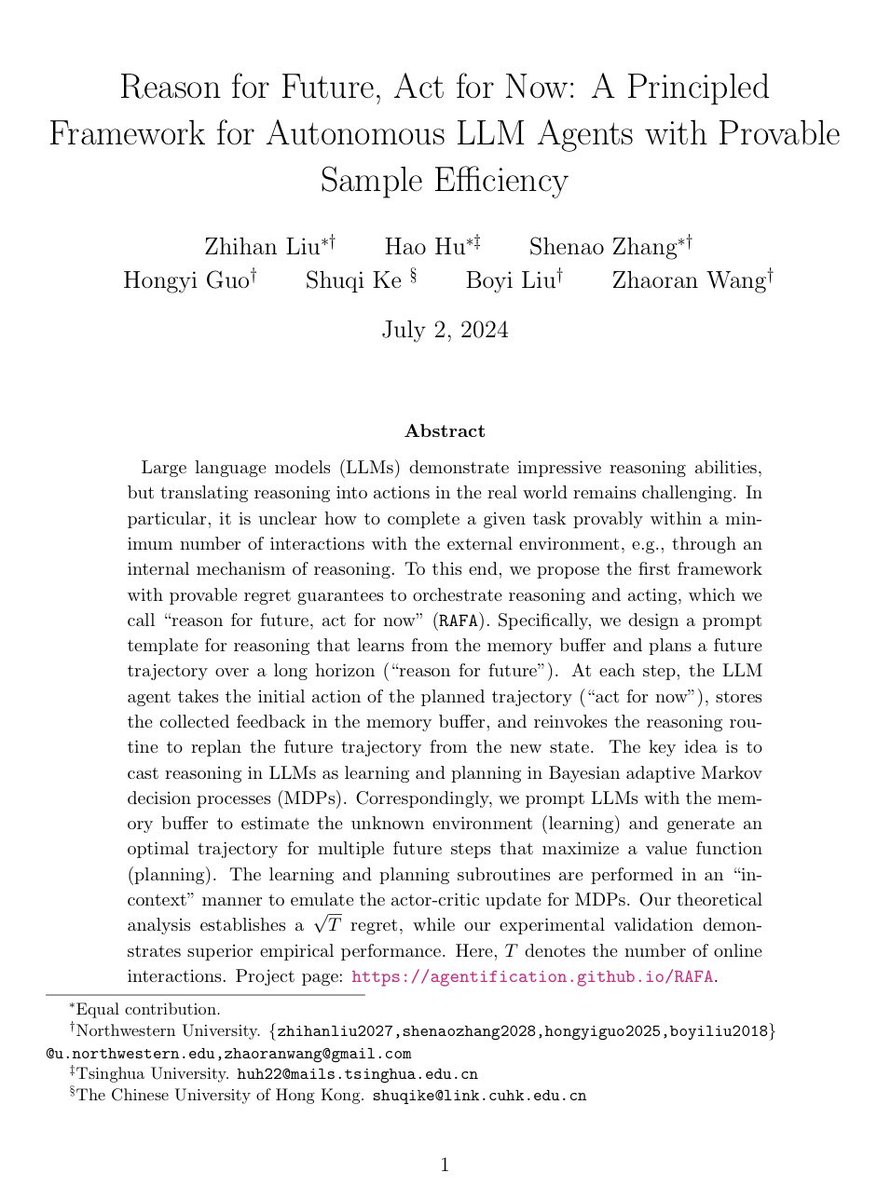
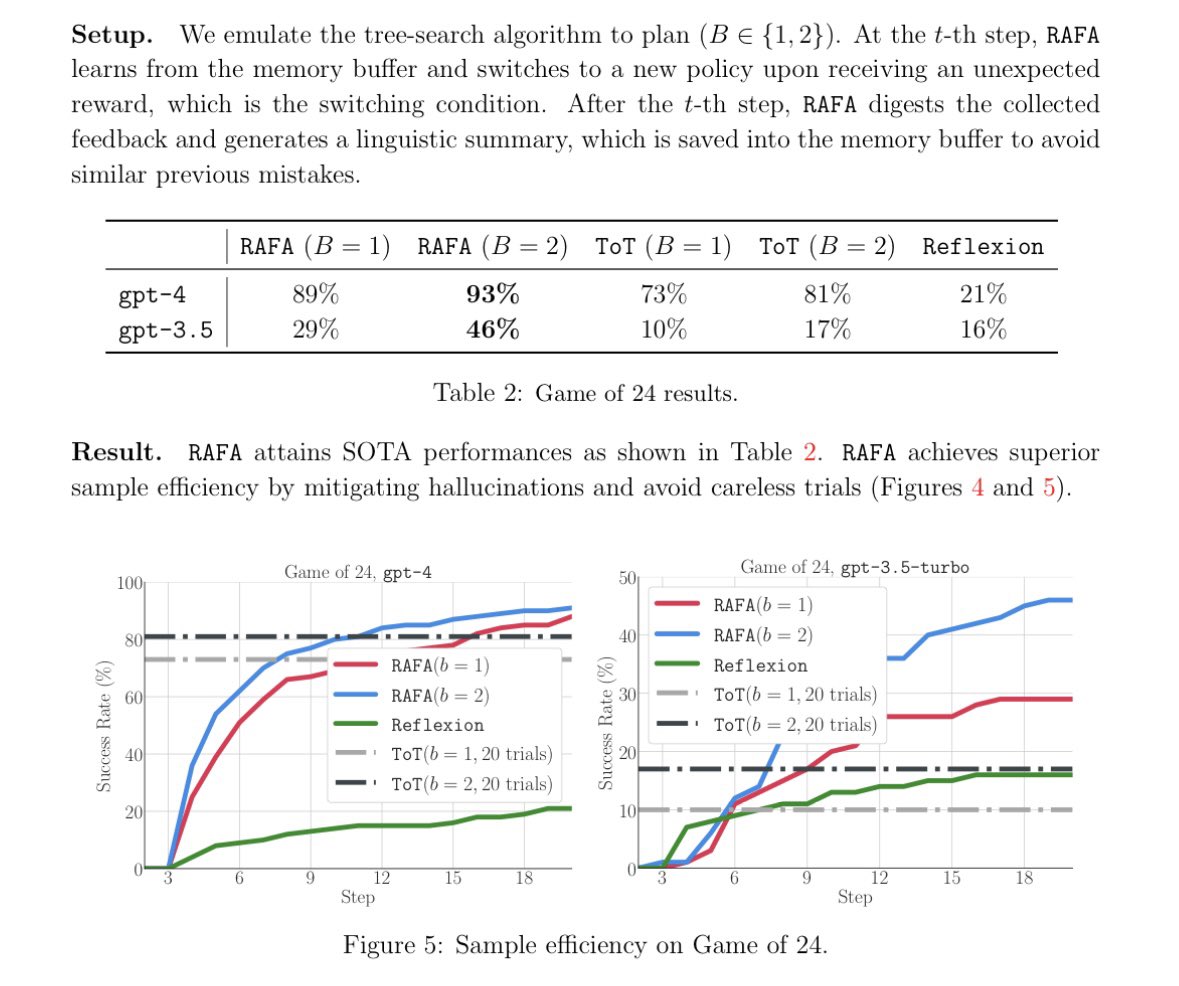
🚀 Just revisited RAFA (Reason for Future, Act for Now) from ICML 2024.
🤯 It’s honestly surprising how forward-looking this work was.
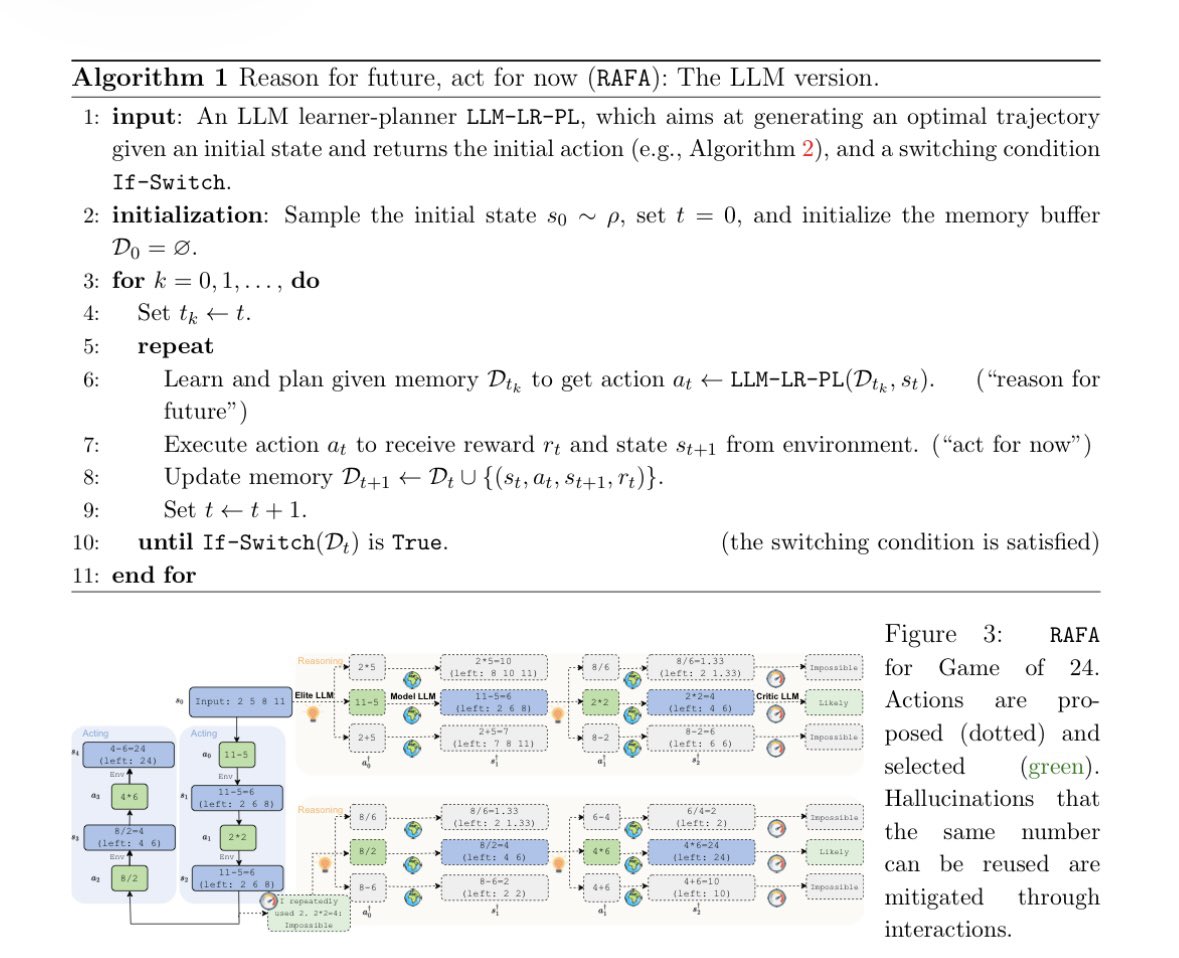
Back in 2024, they were already framing LLM agents as a closed-loop learning + planning + acting system:
✨ Reason for future, act for now
🧠 Memory-driven replanning
🌍 Long-horizon planning
⚡ Sample-efficient interaction
📐 Even with theoretical regret guarantees
Looking at today’s wave of autonomous agents, online RL, test-time adaptation, and memory-based reasoning, many of these ideas feel remarkably prescient @ZhihanLiu21628 .
👏 Definitely a paper worth revisiting if you’re working on LLM agents.
📄 https://t.co/zHFkB05HBw
#LLM #AIAgents #Reasoning #ReinforcementLearning #ICML #MachineLearning
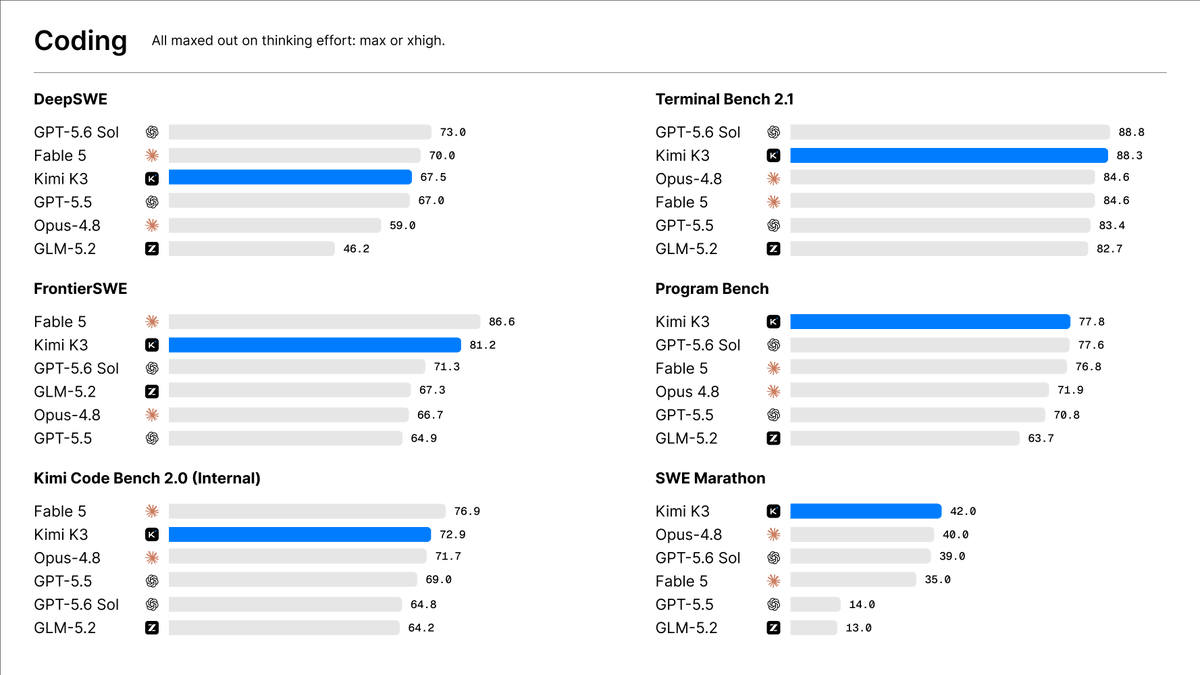
Introducing Kimi K3: Open Frontier Intelligence
🔹 2.8 Trillion Parameters, 1 Million Context, Native Multimodal
🔹 Kimi Delta Attention enables up to 6.3x faster decoding in million-token contexts
🔹 Attention Residuals deliver ~25% higher training efficiency at <2% additional cost
🔹 Built for long-horizon agentic coding and self-evolving workflows
Kimi K3 is now live on on https://t.co/zrk6zZxZUo, Kimi Work, Kimi Code, and the Kimi API.
Open Weights by July 27, 2026.
🔗 API: https://t.co/XCrgjXAqMw
🔗 Tech blog: https://t.co/YTfiMSNM1f
Topic models are how we make sense of massive corpora, but they've been stuck reconstructing bag-of-words, which ignores context and breaks on short text. The semantic signal we actually want already lives inside language models.
DSL distills it into the topic model as a soft-label target, cheaply, even at 1B scale. Topics that track meaning, not just co-occurrence.
If you're at ICML, come by our poster, presented by my friend @liraymond96! 👇
Excited to present our #ICML2026 paper today:
Improving Topic Modeling by Distilling Soft Labels from Language Models
📍Hall A, Poster #4100
🕥 10:30–12:15 KST
Huge thanks to my collaborators @AmirAbaskohi and @ChuyuanLi, and to my supervisors @careninigiusepp and @murraygabriel!
"Efficient and Trainable Language Model Test-Time Scaling via Local Branch Routing"
This new paper lets LLM preview its short term future before deciding what to do.
Their key idea is simple: choose the next token with preview, route, then commit.
So the model gets a small amount of branching at every token, tries a few possible next steps, looks at where each one would lead, then chooses the best branch to continue.
This improves math reasoning over CoT, standard RLVR, and soft-token branching, while staying efficient and trainable.
📢 Check out the accepted ACL and ICML 2026 papers from the UBC NLP group! We look forward to presenting them in San Diego and Seoul! #ACL2026#ICML2026#NLProc
LBR is built around a simple principle: look a little before you leap. 🌱
Instead of forcing a language model to commit to the next token from the root distribution, LBR briefly explores several local futures, then routes using the hidden states they induce.
This gives a lightweight, discrete, and trainable form of test-time scaling.
paper: https://t.co/BthEXtk04d
code: https://t.co/n8tne5Ba9R
Huge thanks to my advisor
@zhaoran_wang, @tilderesearch for supporting this work, and my amazing coauthors: @fnruji316625, @JinPan547630, @YangYi17826, Zijie Xia, @dhruv31415, @ShumingHu, @zhenzhangzz, @GenAI_is_real, Jinma Zhao, @wujiang_ai, @liraymond96, @xwang_lk, Julian McAuley.
[1/N] How can we give language models expressive test-time “width” without expensive full-solution tree search?
Long CoT scales reasoning depth, but is single-threaded
Tree search adds width, but is costly and hard to train end-to-end
Soft-token branching adds local width, but can blur discrete branch identities
We introduce Local Branch Routing (LBR): a trainable token-level branching framework for cheap, powerful, and robust test-time scaling. 🧵
As deep research agents become increasingly capable, retrieval is emerging as one of the key system bottlenecks.
These agents repeatedly search long documents, where every additional LLM call increases latency and token cost. Many recent approaches rely on iterative LLM-based chunking, summarization, or retrieval refinement, while fixed chunking strategies make early representation decisions that are difficult to recover from later.
We’re excited to share two complementary papers from @UBC_CS and @UBC_NLP, in collaboration with @ServiceNowRSRCH, that tackle these challenges from different perspectives:
We're excited to share two complementary papers that tackle these challenges from different perspectives:
SproutRAG (Long-Document Retrieval)🌱
• Learns a hierarchical document structure directly from attention.
• Enables retrieval at multiple semantic granularities.
• No LLM-based chunking or summarization.
• Avoids committing to a single irreversible document representation.
📄https://t.co/VuKcl46H82
MCompassRAG (Efficient Paragraph Retrieval)🧭
• Uses topic metadata as a semantic compass for retrieval.
• Makes coarse chunks significantly more searchable.
• Eliminates inference-time LLM calls for retrieval refinement, reducing latency and token usage.
📄https://t.co/WRDDL3lIIK
Together, these works explore complementary directions toward faster, more efficient, and more effective retrieval for long-document RAG and deep research systems.
We'd love to hear your thoughts and feedback!
In the end, a special thanks to all of my collaborator: @liraymond96 and Gaetano Cimino and my supervisors: @careninigiusepp, @PeterWestTM, and @ILaradji .
Exciting news: GLM-5.2 (Max) ranks #2 in Code Arena: Frontend, with +29pt over Claude Opus 4.7 (Thinking) and only behind Fable 5! GLM-5.2 is the best open model vs Kimi-K2.6 and Minimax-M3 by a large margin.
- #2 React and #4 HTML sub-leaderboards
- Ranks as the top model in nearly all sub categories: Brand & Marketing, Reference-Based Design, Data & Analytics, Consumer Product, Gaming, and Simulations.
Congrats @Zai_org for the incredible milestone!
🚨New paper!
Your hallucination detector says it evaluates reasoning. But what if it's just peeking at the final answer?
We tested this: keep the reasoning, only change the answer. Many detectors' scores shift dramatically 🧵
We're releasing the Crayotter technical report with full details on our artifact-grounded video editing framework!
If you missed our earlier demo — Crayotter turns a single text request into a complete edited video through a 3-phase agent workflow. Here's what's under the hood:
🔹 21 modular tools: search, download, cut, merge, transitions, narration, subtitles, export
🔹 17 cinematic transition presets + CV-based continuity scoring
🔹 Environment-grounded reflection: revises from rendered artifacts, not latent traces
🔹 Budget-aware MLLM ranking over up to 320 video candidates
🔹 Trajectory-level RLVR with 3-tier cascade rewards (step-level, episode-level, human preference)
🔹 Full trace logging + interactive visualization
Paper page: https://t.co/TxPd2Yhd4r
Demo + Code: https://t.co/oxvbEjHz0f
#LLMs #AIAgents #RLVR #MultimodalAI #AI
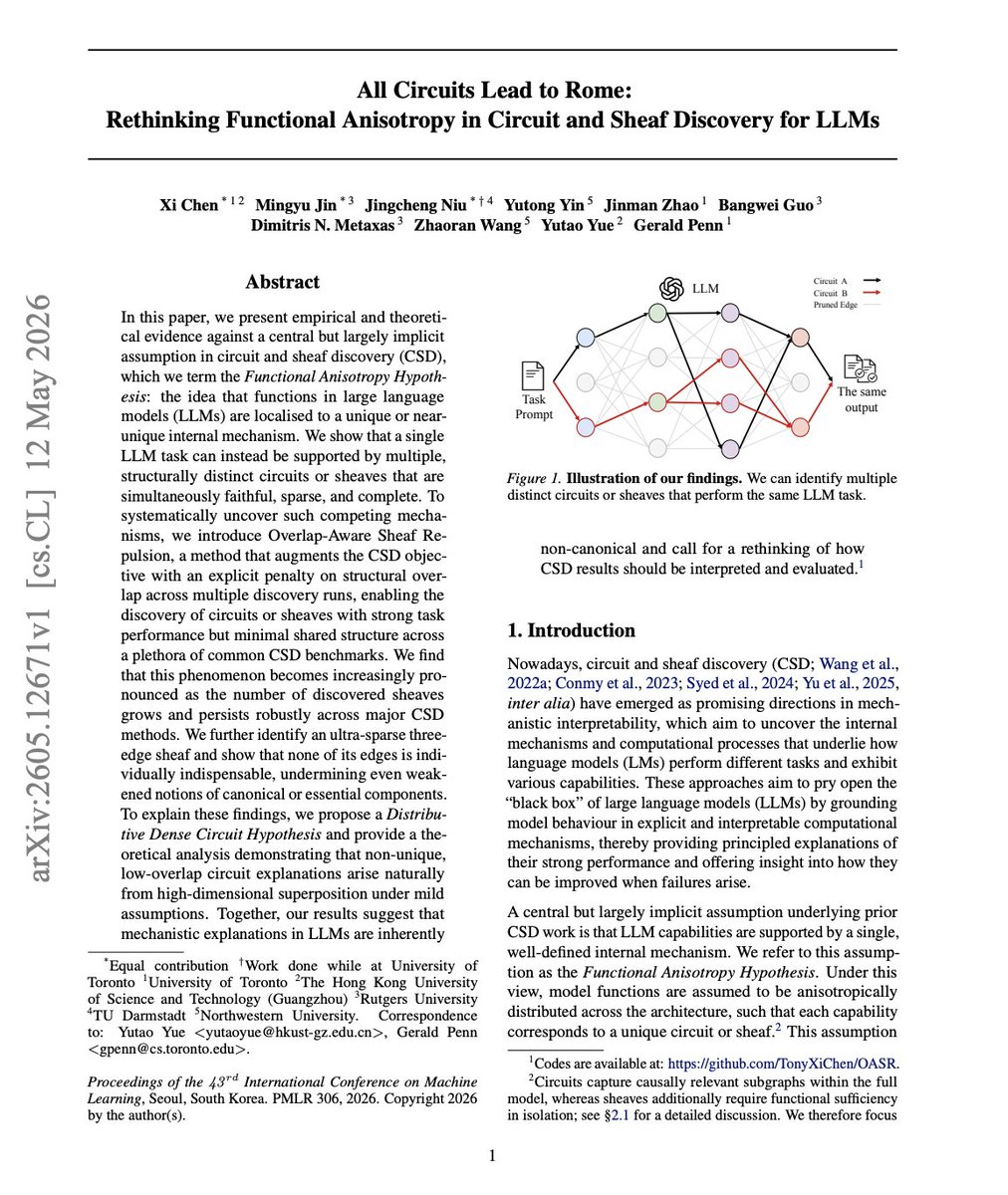
Does mechanistic interpretability really find the circuit?
Our new paper, "All Circuits Lead to Rome: Rethinking Functional Anisotropy in Circuit and Sheaf Discovery for LLMs," (Accepted by ICML 2026) suggests the answer may be: not always.
A common implicit assumption in mechanistic interpretability is that a model's behavior is explained by the circuit — a sparse, canonical, almost-unique mechanism.
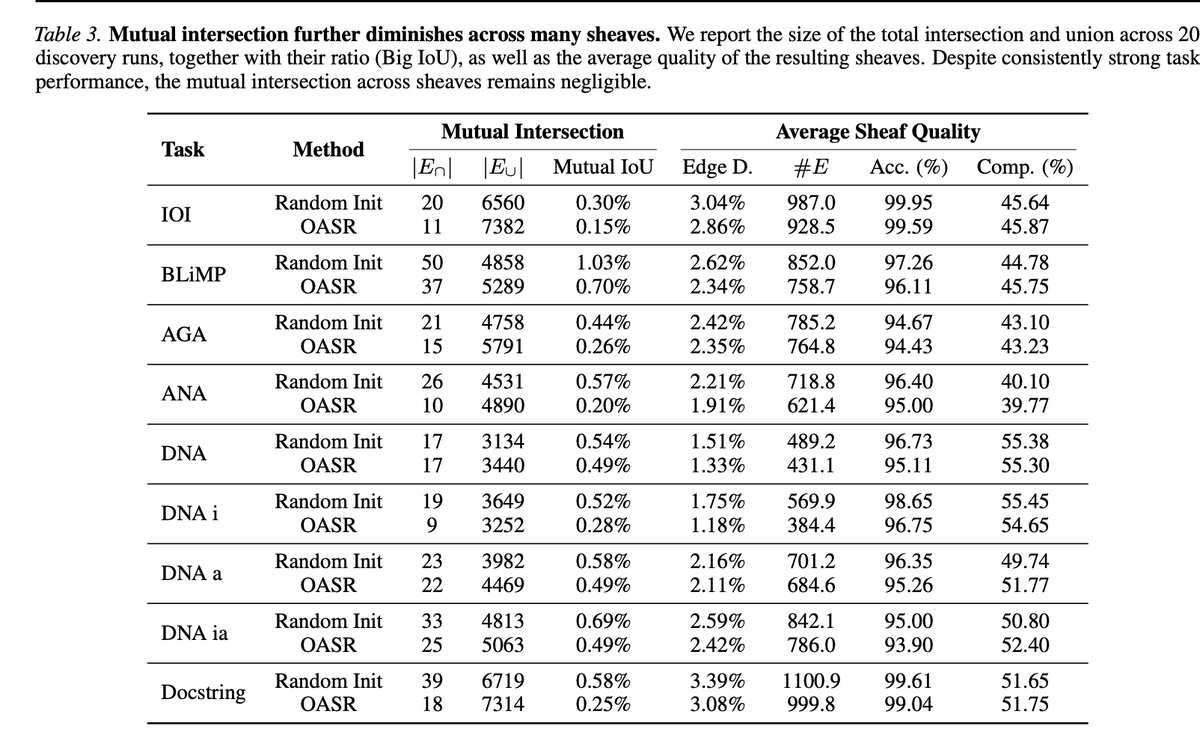
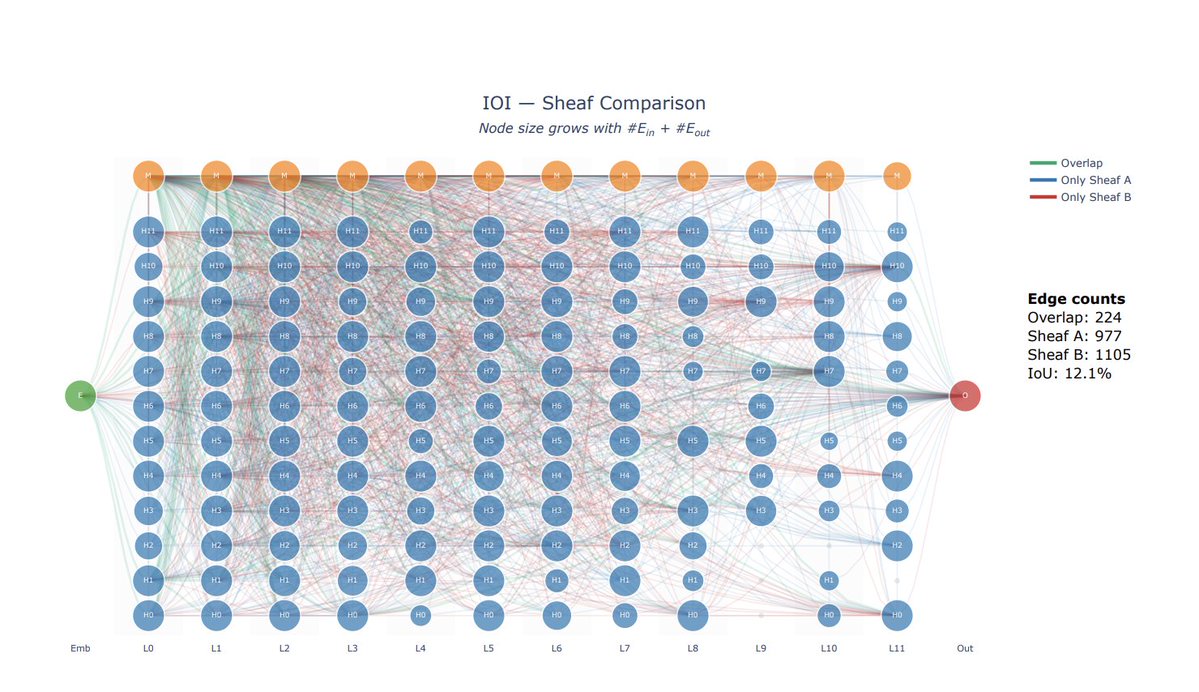
Instead, for the same LLM task, we find multiple circuits/sheaves that are:
✅ faithful
✅ sparse
✅ structurally different
✅ low-overlap
This means a discovered circuit may not be the unique mechanism behind a behavior, but one realization among many possible mechanisms. We call for rethinking how circuit/sheaf discovery results should be interpreted and evaluated.
Huge thanks to my amazing collaborators: @frankniujc, @YutongYin774638, and @zhaoran_wang
Paper: https://t.co/J5zO36Mr7m
#MechanisticInterpretability #LLM #AI #MachineLearning
The Top AI Papers of the Week (April 19 - 26)
- Skill-RAG
- DeepSeek V4
- Autogenesis
- Attention to Mamba
- Stateless Decision Memory
- Self-Evolving Logic Synthesis
- Self-Generated World Knowledge
Read on for more:
Nice paper combining the strength of Skills and RAG.
Most RAG systems retrieve on every query, whether the model needs help or not. This is wasteful when the model already knows the answer, and often too late when it does not.
New research introduces Skill-RAG, a failure-state-aware retrieval system. It uses hidden-state probing to detect when an LLM is approaching a knowledge failure, then routes the query to a specialized retrieval strategy matched to the gap.
Evaluated on HotpotQA, Natural Questions, and TriviaQA, the approach improves over uniform RAG baselines on both efficiency and accuracy.
Why does it matter?
RAG is moving from a single monolithic pipeline to a suite of skills an agent selects between. Knowing when to retrieve and what kind of retrieval to run will matter more than raw retriever quality as agents take on multi-step reasoning, where a single bad lookup derails the whole chain.
Paper: https://t.co/GcHFJrO17E
Learn to build effective AI agents in our academy: https://t.co/1e8RZKs4uX