The economics of a Neolab.
A neolab is loosely defined as a startup of AI researchers who raises a lot of money pre-production to be able to finance GPU compute to take on a large AI problem.
To buy 1000 GB300s or ~14 NVL72 racks will set you back $125-150M for 3yrs with 15-30% upfront. That’s about ~2-2.5MW.
Thats about enough to do 10^25 flops a quarter and get to a GPT-4 level model which is 1-2 OOMs off frontier for pretraining.
If you post-train on a great open source model, you have a better chance of getting to frontier. The risks are a) you need to spend millions on RL environments too and b) being lapped by another model release while being tied to a base model.
For this to payback, you need to give your customers a better and ideally cheaper inference service than a base model and serve them for long enough to recoup your large investment. Even at 50% margin on inference, to recoup $10M in training means serving ~10T tokens (!) if you price like Fable / Astra given a standard cache read / input / output split ($2/M blended). And you have to justify being better than a release like Opus 5.5 which is even cheaper. Often, you end up charging your customers a huge premium in terms of platform fees and compute fees on top of pure inference.
Meanwhile, every hour you’re not utilizing your GPUs you are burning money so you typically resell this compute back to a broker or run inference for open models / resell spot instances. At below a ~60% utilization on spot, you will still lose money.
Add to that insane cost of talent.
So what can you do with the compute?
- Not play the model game at all.
- Play an entirely different model game (Jev, World Labs) that if big labs played, would either a) cannibalize their business or b) be incrementally not significant revenue c) would cause too much distraction from the main main thing
- Acquire a proprietary data set (Peridodic Labs) in enough volume in a domain of usefulness to eclipse frontier quality. Often happens in robotics, biology, chemistry.
If you do overcome the challenge of building a model that is useful and well priced beyond big labs models, given the huge price of compute, you still need to play in an area where the revenue / compute ratio is signficant and market demand is large enough to payback your compute spend.
It is a difficult game.
Spend of OpenAI vs Anthropic vs Open
(Vercel AI Gateway, last 2 months)
• Anthropic still #1 in spend, but went 69% → 40%
• OpenAI: 10% → 24% in spend
• GPT-6 Astra + GPT 5.6 Sol are ripping
• OpenAI now leads in tokens #
• Kimi K3 + DeepSeek took ~half of Anthropic's loss
• Opus 5.5 is up to 10% of spend in 2 days
• OpenAI is 62% of image generations
Watch here: https://t.co/Gu7D9d7M8w
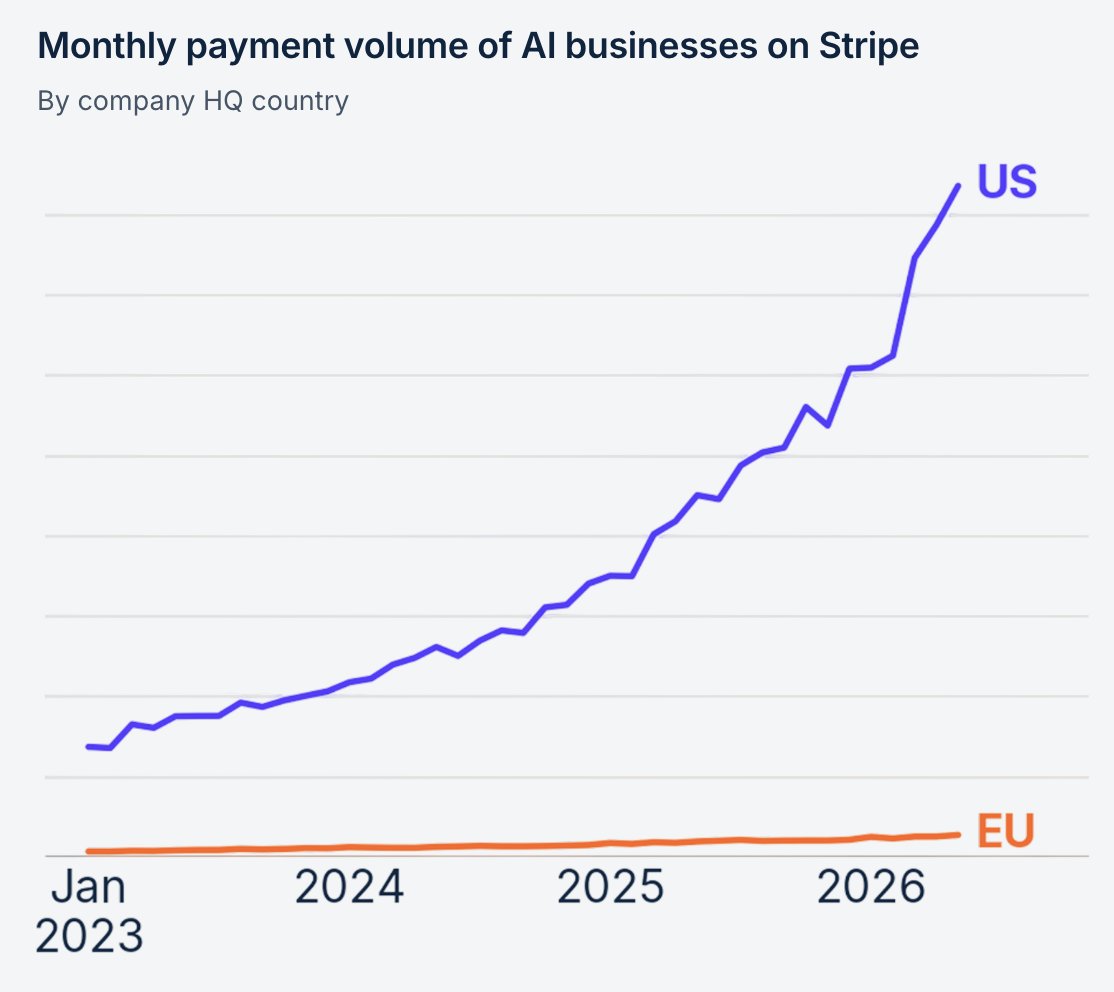
Some data we recently assembled on entrepreneurship/compute in Europe: https://t.co/x8pbpHLun7.
We hope that one of the useful roles that Stripe can play is in collecting and publishing empirical data pertaining to entrepreneurship and industry in Europe. There's growing appetite to get Europe on a better footing, and cross-sectional comparisons can often shine light on where opportunities lie. If you're interested in this kind of thing, we publish more at https://t.co/YoZDuYbaBi.
It's awesome that you can learn ANYTHING in this age
Taking the @huggingface "smol-course" to get experience with fine-tuning
Will share my experience here :)
It's awesome that you can learn ANYTHING in this age
Taking the @huggingface "smol-course" to get experience with fine-tuning
Will share my experience here :)