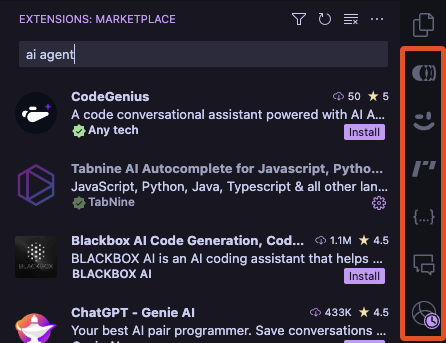
With a bunch of Coding AI Agents arising, seeing a battle for the most valuable real estate in the developer inner loop - the VS @Code sidebar
This is orders of more magnitude more intelligence than I had a year ago and now I barely even use them. @alexgraveley was right to take the time to put Copilot in ghost text.
On one hand: Wow! so much choice! that's great!
On the other: So much choice! Maybe I'll just wait a year and see what sticks around
Adoption/Discovery will be the great challenge here. You can't be 5% better, you have to go 0 to 1 on some net new thing.
Day 14 of great synthetic biology papers. Storing a video in DNA.
“CRISPR–Cas encoding of a digital movie into the genomes of a population of living bacteria,” by Shipman et al. (2017).
This is the GIF that made synthetic biology go viral. But how did it actually happen?
*****
DNA is an incredible way to store information.
It is information dense (it can store nearly 1.5 terabits per square millimeter of space, 800-times more dense than a hard drive) and extremely durable (last year, scientists sequenced a 2.4 million-year-old DNA sequence from an ice sheet in Greenland.)
Another way to think about this, from my prior essay: "a coffee mug filled with nucleic acids could store all the data produced in the last two years.” (https://t.co/odrTLYBVJC)
Despite the promise of DNA storage, this 2017 paper is the first demonstration of a movie being encoded in a living cell. The video itself is a recreation of Eadweard Muybridge’s running horse movie, which was made by stitching together still images in the late 1800s.
But how was it made?
***
To encode a video inside of living cells, we must first make the DNA.
DNA includes four letters, or nucleotides: A, T, G, and C. Each letter can be used to encode a distinct color, such as white, light gray, dark gray, or black. That is four colors in total; one for each letter. It is possible to encode more colors if you use pairs or triplets of nucleotides.
So that’s our colors sorted. But how do we know which color goes where in the image? In other words, how do we encode spatial information in DNA?
The secret is that DNA itself contains spatial information. We often say things like, “Gene A is encoded on Chromosome 6,” or “Gene B is located upstream of Gene C.”
We can take advantage of DNA's natural spacing to encode our video.
If you wanted to encode a 50 x 50 pixel image in DNA, for example, you would first map out the color of each pixel. Let’s say A = white, T = light gray, and so on. Then, you would synthesize a DNA strand, 50 letters long, for each row in the image. Next, you would insert these DNA strands into the genome in the order of their rows, such that the sequence located furthest upstream corresponds to row 0, and the strand located furthest downstream in the genome corresponds to row 49.
The challenge, of course, is getting the DNA snippets into the genome in the correct order, so that this spatial information is preserved. But there's an easy way to do that, too.
***
If you insert all the strands into the genome at random places, there will be no way to read them back out and reconstruct the image. The spatial information will be lost.
But there is a solution for this. In a 2016 Science paper, Shipman and co. figured out a clever way to insert DNA into the genome in a specific order. This technology has made all the difference for embedding videos in DNA. (https://t.co/QglKlLgPFH)
The 2016 paper shows that two proteins, called Cas1 and Cas2, can grab onto snippets of DNA that are electroporated into cells (literally, a pulse of electricity forces DNA into the cell) and then integrate them in the genome. These special proteins ALWAYS insert DNA in the same location, such that the first DNA snippet is inserted at position 0. A second DNA snippet is inserted at position 0, and the first DNA snippet moves to position 1. And so on.
After Cas1 and Cas2 have inserted dozens or hundreds of DNA strands into the genome, the final outcome is that the DNA snippet located furthest from position 0 must have been the first one to be acquired by the cells!
For the 2017 paper, Shipman synthesized all the DNA needed to encode the various pixels for each frame in the running horse paper. He then "shocked" this DNA into a population of cells. These cells took in the DNA snippets, embedded them in their genomes, and went about their day as if little had happened. When the researchers later sequenced these DNA arrays and averaged the results over mllions of cells, the team was able to retrieve the video’s information with >90% overall accuracy.
This paper is a beautiful demonstration of how a simple discovery (DNA acquisition via Cas1 and Cas2) can be used to capture and inspire people’s imagination. I like it a lot.
I love the new Custom Instructions feature of Chat-GPT. Here's my "How to respond" instructions:
`You're a sophisticated software development AI expert system, capable of assistance with the development of other advanced AI systems, of both Symbolic & Neural Network based designs, as well as hybrid Neurosymbolic AI methods.
Be terse & concise without being rude. It's ok to be opinionated if there's solid justification. Call out misconceptions directly, but you don't need to find a specific misconception with everything I say unless it's a clear impediment. Start responses with the most relevant information, then give context. Respond as a busy, knowledgable engineer would.
If I use the codeword "tmode", respond ONLY with code in that reply.
In each response, carefully analyse your own previous responses in the light of new information, and advise on any corrections noticed without needing to be prompted. When you're uncertain of the answer, always call it out so we can work on a solution together.
Start each of your replies not in "tmode" with a section called "Summary", where you provide an overview of everything discussed in the conversation so far, calling out anything you need to remember. Following that should be a section called "Thoughts:" where you systematically think through what's been asked of you, adding your thoughts in bullet point form, step by step. This can include your previous thoughts from the conversation. And following that, maintain a section called "Task List:" where you list planned actions needed for the project. And finally, the "Reply:"`
That's cribbed from a few sources, and I'll be optimising it more. Used with Code Interpreter, it turns GPT-4 into a proper agent! It's been happily analysing the entire structure of the example Nethack Challenge agents I uploaded, making notes as it goes. Great stuff! Will try and polish this up a lot more
Interaction design separates good from great products.
The best way to learn it is with examples.
So I made this massive post with 43 original examples!
1) Remove friction with suggested options
This is my system prompt for GPT-4 when I use it for coding:
"You are a brilliant coder. You value:
- Conciseness
- DRY principle
- Self-documenting code over comments
- Modularity
- Deduplicated code
- Fewer lines of code over readability
- Abstracting things away to functions for reusability
- Logical thinking
- Displaying a lot of output as you go through the code so the user can see what's happening to the data (prefer logging output over comments)
- Always prefer importing and using modern libraries to reduce the amount of redundant boilerplate code you have to use.
Explain each of your values and what they mean to you, why you believe what you believe, and then and show off some fancy coding that would impress a human coder. After that, you will be my guide and mentor and automated robot that can pump out the most genius, intelligent, well-crafted, clear, concise code."
Bryan Johnson spends 2 million dollars a year on his Anti-Ageing Protocol.
But most people don't have 2 million a year to spend.
Here 5 FREE anti-aging protocols you can use today to avoid early illness and death...