Breaking down the quantum threat live at @ProofofTalk in Paris and handing the audience the solution.
The attack surface isn't what you think.
The fix is faster than you think.
Read our paper linked below to learn how Proof of Seed Provenance quantum-proofs crypto.
Tornado Cash was sanctioned in 2022.
Four years later, the compliant privacy alternative is still missing.
What moved in: readability tools that publish your entire financial history (ENS), and privacy tools that put users on regulators' radar.
Neither works for someone who needs both privacy and a clean compliance record.
The gap is still open.
Decentralization is the most overused word in crypto.
Most "decentralized" identity systems can still see:
— Who you registered as
— Which wallet that name maps to
— Every transaction tied to that wallet
That's not decentralization. That's a directory service with a marketing budget.
The bar should be: once a name is registered, the issuer has no way to see who you're transacting with, what you're sending, or what your balance is.
What happens at registration and what happens after it are two different questions.
Most systems fail both. The better ones at least solve the second.
There's an attack vector most of crypto isn't tracking yet.
AI recommendation poisoning.
An attacker embeds hidden prompt instructions in a webpage.
An AI agent reads the page during its normal workflow.
The agent's memory gets silently altered, and from that point, every recommendation it makes is skewed toward whoever planted the instructions.
Microsoft documented 50 live examples across 31 companies in 14 industries in 60 days of research.
If your portfolio decisions or due diligence run through an AI assistant, assume the inputs can be manipulated.
The recommendation is only as trustworthy as what the agent read to make it.
Privacy tools in crypto have become a compliance problem.
Mixers co-mingle funds with unknown counterparties.
You can't verify who you're transacting with.
Zcash works, but only for one token on one chain.
Institutions don't want mixers. They want a decentralized PayPal.
Non-interactive cryptographic proofs can auto-generate a unique stealth address for every transaction.
Counterparty verified.
Nothing hits the public ledger.
Works across every major chain.
The largest social engineering attack in crypto history didn't exploit a single line of smart contract code.
Months of relationship building.
One moment of misplaced trust. $285M drained from Drift Protocol.
76% of all 2026 crypto losses trace back to North Korea, and almost none of them involve a code exploit.
What this means for everyone else: the next major attack on your protocol, fund, or team won't come through your audit reports.
It'll come through a LinkedIn message, a recruiter call, or a coffee meeting that lasts six months.
Treat unsolicited contact the way you treat unsolicited code.
The average user has 1 wallet they consider "their main one."
That wallet has been doxxed to:
— their cex
— their dex
— their friends
— their browser
— their isp
— anyone who paid for the data
The headstone is already engraved.
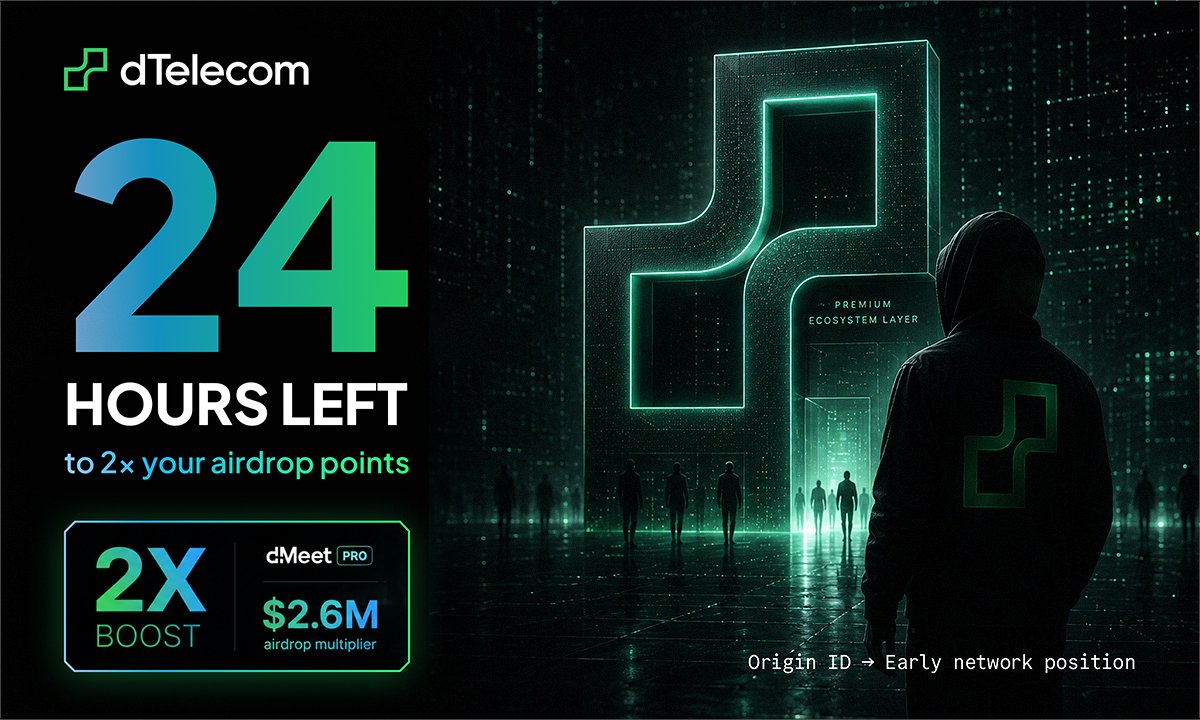
24h left to mint dTelecom Origin ID.
Tier 1 access + up to 2X points boost in the $2.6M airdrop.
Mint 3 = 1 month @dMeetApp Pro sub.
Window's closing — front-row won't come back.
Mint ↓
https://t.co/HqxXn0R31p
@dTelecom Origin IDs are now live on @OpenSea
The first on-chain identity layer for people creating real activity across our network.
Meetings. Calls. Translation. Participation. 👤<>🤖 Comms.
If you’re early, this is where you get recognized.
Mint: https://t.co/HqxXn0R31p