Microsoft open-sourced a 4B model that turns any image into a production-ready 3D asset in 3 seconds.
It’s called TRELLIS.2, a fully textured, physically accurate 3D models with PBR textures out of the box.
→ Full PBR (base color, roughness, metallic, opacity)
→ Handles hair, cloth, glass, non-manifold geometry
→ Exports .glb ready for Unity/Unreal/Blender
→ Runs locally, ships in 3 seconds
It's not a demo or a research preview. The full training codebase is public.
You can fine-tune it on your own asset library and get a model that generates in your studio's exact style.
100% Open Source
A slot antenna is a hole that radiates.
Cut a narrow rectangle out of a large conducting sheet and feed it across the short dimension. The radiation pattern looks almost exactly like a dipole of the same shape, except E and H are interchanged and the polarization is rotated 90°.
This is Babinet’s principle (optics to antennas via Booker, 1946). Take any thin conducting screen and its exact complement (metal where there was free space, free space where there was metal). Illuminate both with the same wave. The fields they produce, E₁ and E₂, must satisfy:
E₁ + E₂ = E₀
where E₀ is the field that would exist with no screen at all. In the geometric shadow the two diffracted fields are equal in amplitude and opposite in phase. Everywhere else they add to the unobstructed wave.
That’s why a slot and its complementary strip dipole are duals: the hole and the cover together recreate free space. Their impedances are locked by
Z_slot · Z_dipole = (η/2)²
(~35 000 Ω²). A 73 Ω half-wave dipole becomes a ~480 Ω slot.
The metal isn’t doing the radiating. The absence of metal is. And the sum of the structure and its hole is required to be nothing more exotic than ordinary free-space propagation.
Nature’s neatest antenna trick: the thing you remove is just as important as the thing you leave.
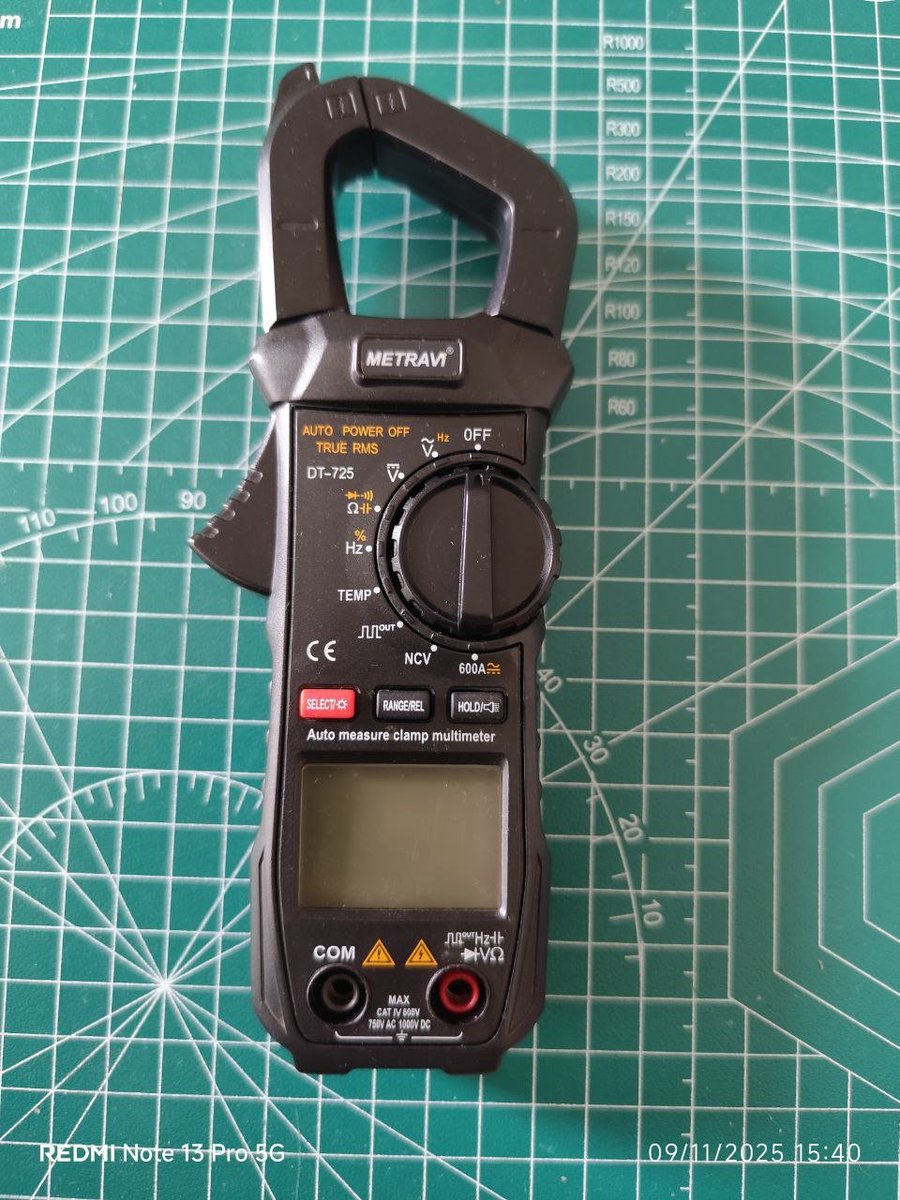
So in today's episode of teardown SUNDAY, we have a Metravi DT-725 Clamp meter as a test subject.
I get astonished, that an equipment, which is pocket sized, has insane capabilities. We are talking about Voltage measurement, all types of function tests like diode, resistance, continuity, capacitance, temperature, and even FREQUENCY GEN output. Besides all that, this thing can measure upwards of 600Amps AC/DC, via the clamp part of the meter.
It can do it non invasively. Meaning:
1. You don't need to cut the wire
2. No need to put the meter in series and wire anything physically.
It does so by something called hall effect sensors.
Learn more about hall effect here:
https://t.co/zVhMEPSENN
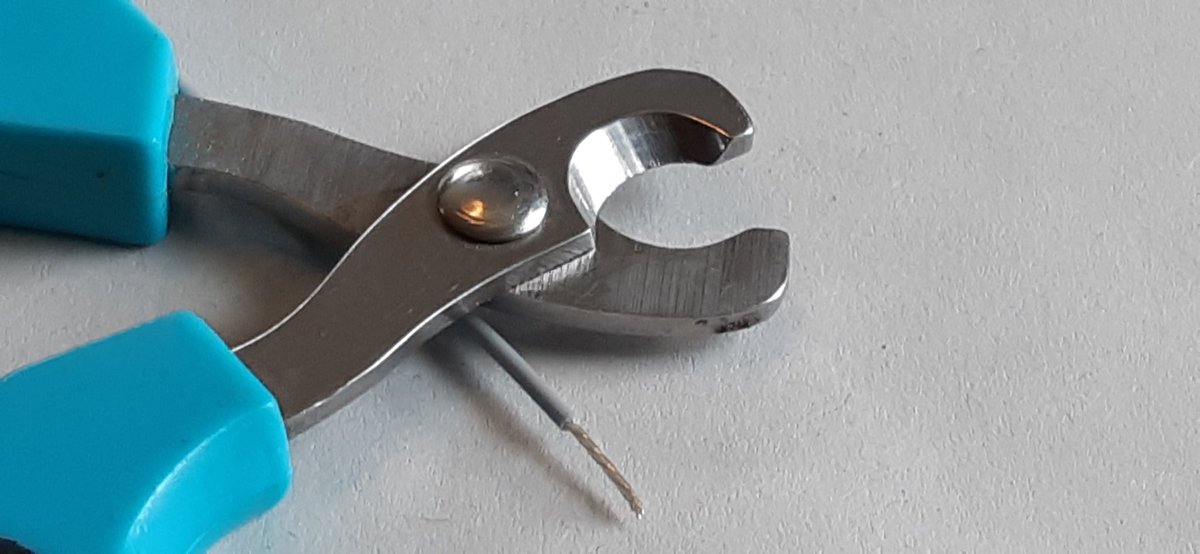
When an amount of electric current flows through an wire, it creates magnetic fields around the wire. These jaws, have two halfs of iron core inside them. This principle is coming from mutual electromagnetic induction.
Meaning, the emf fields in wire create similar fields inside the iron cores.
And, the linear hall effect sensor sits in between the jaw ends, picking up any magnetic fields created in the core via an air gap.
These sensors are incredibly sensitive, meaning they can check very small amounts of magnetic fields ranging from ±400 Gauss to ±1000 Gauss.
Also typically, these cores have some residual magnetism, due to obvious earth magnetic field deflections and changes. That's why these clamp meters have a RELATIVE or ZERO function. That function simply clears out any added error, and starts measurement from zero value.
This ensures you get a perfect accurate reading.
Even after that, these meters are not that much sensitive to very very small currents, like below 500milliamps or so. But it becomes obvious to use an normal multimeter with current sensor capacity at that current range.
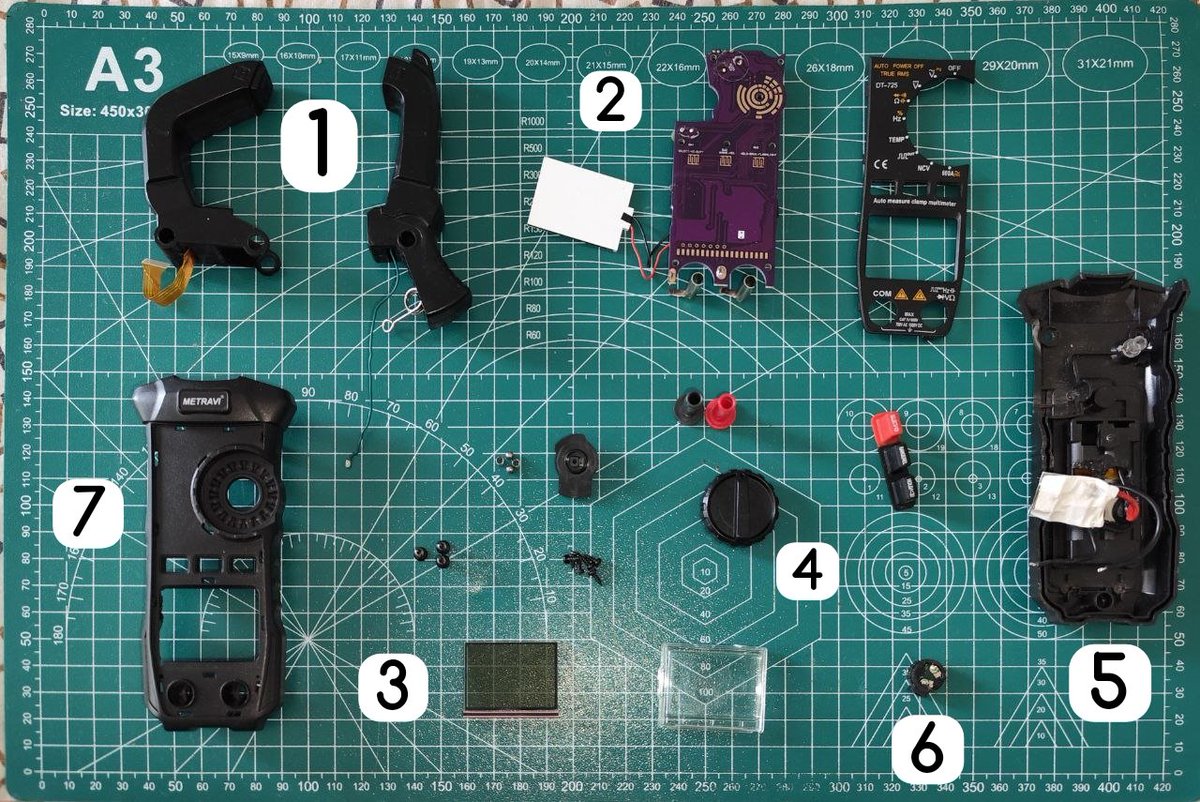
With that being said, we'll come to the description of parts:
1. Clamp Jaws
2. Main PCB with backlight board.
3. LCD display with elastomeric connector (pink)
4. Selector Knob switch
5. Main body housing (back)
6. Buzzer
7. Main body housing (front)
All these parts are self explaining, so I am leaving that part. Rest, feel free to ask any doubts down below!
See you tomorrow on Oscilloscopes 101 Series, COMRADES!
From Electronics Education
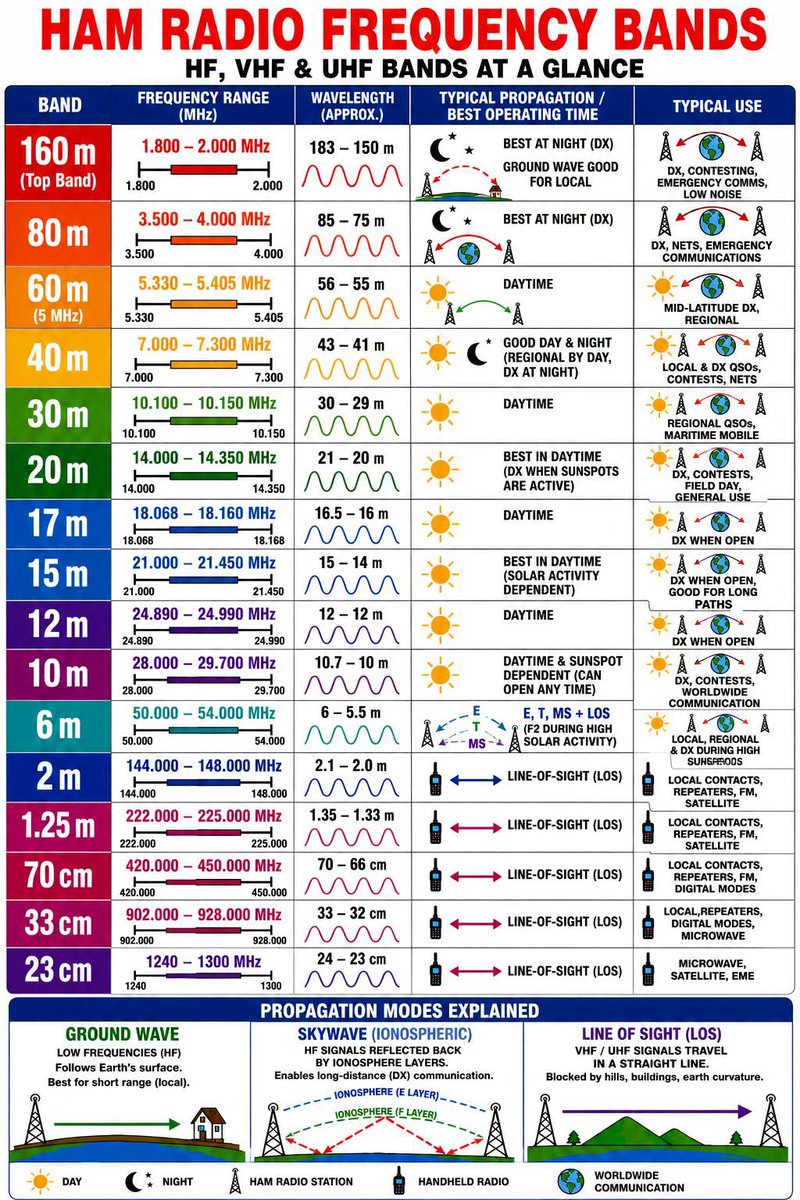
"HAM radio uses different frequency bands, and each band has unique characteristics for communication.
Lower-frequency HF bands, such as 160 m, 80 m, and 40 m, are excellent for long-distance (DX) contacts because their signals can reflect from the ionosphere, especially at night.
Mid-HF bands like 20 m, 17 m, and 15 m perform best during the daytime when solar activity is favorable, making them popular for worldwide communication.
Higher-frequency VHF and UHF bands, including 2 m, 70 cm, and 23 cm, mainly operate using line-of-sight propagation, making them ideal for local communication, repeaters, satellites, emergency operations, and digital modes.
Understanding frequency range, wavelength, propagation, and operating times helps amateur radio operators choose the best band for their needs.
Whether communicating across town or around the world, selecting the right HAM radio band ensures stronger, more reliable, and more efficient radio communication."
#HamRadio #AmateurRadio #ElectronicsRD #ElectronicsEducation #WirelessCommunication
FRAMEOSCOPE IS HERE
A fully open source oscilloscope(+FPGA) module for framework laptops!
I'd love to see more people make it, I made all software/firmware for it public too
And if you would buy it for $80 let me know, I might sell it
Also if you want a custom Framework module for you or your business, send your request in - [email protected], or dm me
"At the Analog Computing Days '26, Ludovico Minati showed (among other incredibly interesting things) chaotic circuits with only one or two transistors." - Bernd Ulmann
Being able to simulate stuff with KiCAD and Spice is amazing!
Predicts the tiny dip causes by the capacitance on the schottky diodes, as well as the transient spike when the FET comes on to drain the sampling capacitor in my peak detector circuit! 🤯
How to step up the voltage from 1 volt to 9 volt?
A thread 🧵
There are many ways.
The first and most important question is how much current do you need at 9V:
- if it's only a few milliamps you might choose a different way than if you need to run an LCD screen.
In this case report, a woman with bipolar 1 who had 10 psychiatric hospitalisations and tried many medications did 9 faecal microbiota transplants (FMT) over 11 months, using stool from her husband (no psychiatric history) as donor.
Within 6 months of starting FMT:
-Symptom-free from depression.
-No mania after September 2017.
-Remained completely symptom-free long-term (at least 5 years follow-up).
-Discontinued all psychiatric medications (under medical supervision).
-Lost 33 kg.
-Went from being functionally disabled to running a small business and publishing two books.
Our gut health is far more important and fascinating than most people initially think.
https://t.co/34VmAOhQ5E