Local AI caught up way faster than anyone realizes. Sharing my thoughts having spent time in ML at Meta and dedicating the last year to getting smart on local AI.
1/ Barely anyone, not even hardcore AI power users, realizes how fast local models have caught up to the frontier. Qwen3.8 woke a few people up, but the most technical people are so frontier-pilled they've blinded themselves to the breakneck progress.
Meanwhile, normal users don't care about frontier intelligence at all. They want AI that gets the job done, but they have no idea what a local model is or how to run one.
So local is stuck in a weird spot: the people who can run these models don't care to do so, and the people who'd benefit most don't know how to run local.
Stanford study: "local LMs can successfully answer 88.7% of single-turn chat and reasoning queries"
(Tested across 1 million real queries)
The craziest part? This study came out a year ago - local models have both gotten much more accurate as well as way smaller.
As I’ve said for years, concentration of power, capabilities and wealth is the biggest risk in AI. The natural tendencies for it are super strong and without much much stronger open-source, we might end up in a world with more asymmetry and inequalities than ever!
You ever met someone who was IRL benchmaxxed? Great college, great career, successful in life—but when you talk with them, you just can’t detect anything behind the eyes?
MIT just open-sourced a 27b model that drives a robot arm. Trained purely in sim.
The catch is that it spends up to 3200 tokens per action thinking. GB300: ~4s, RTX 5090: ~15s, M5 Max: ~60 sec
Local robot brains will be capped by decode speeds.
That's one of our biggest focus areas for the inference engine we're building.
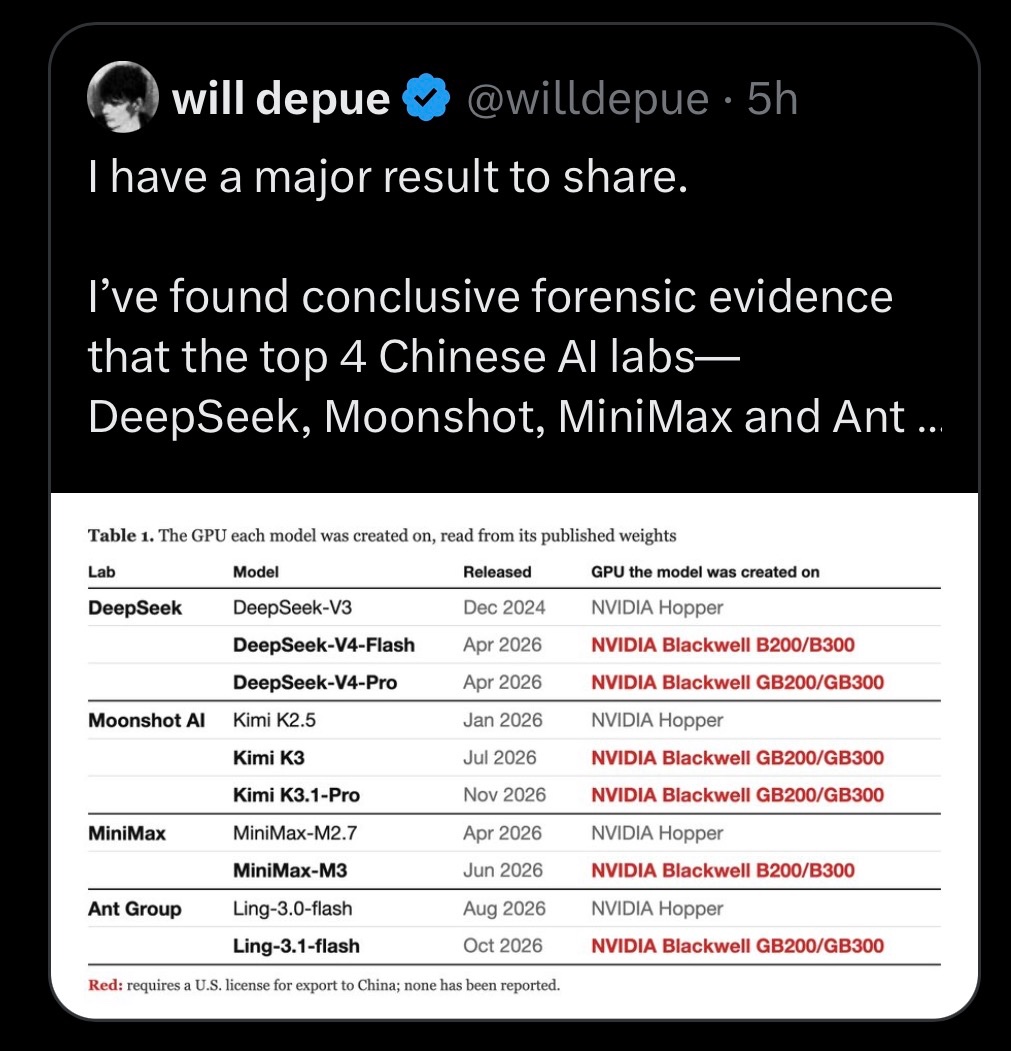
this seems like a lot of effort to forensically prove something that nobody is concealing
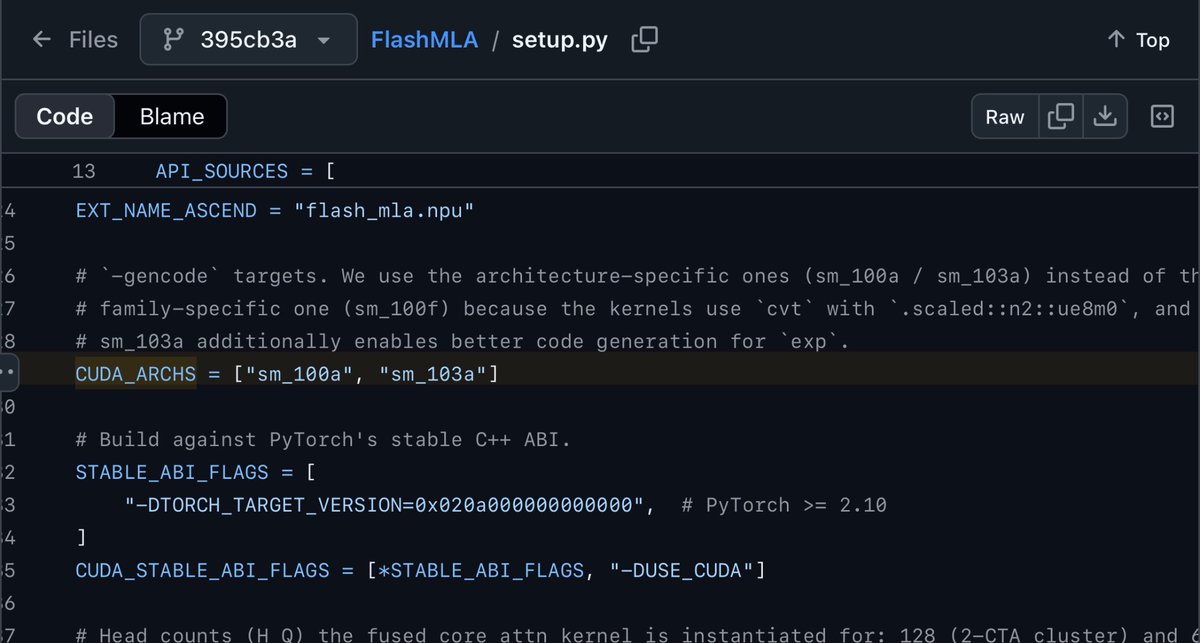
you can just look on github and see that DeepSeek regularly publishes Blackwell training/inference kernels
Don't make the mistake of thinking this is about his infidelity. These articles will not stop until he agrees to follow Anthropic's proposal to block inference for unsigned and registered open-models in the firmware of modern GPUs.
This is a pretty transparent concerted effort at centralizing control over compute ressources and the ability to execute ever more powerful local models. Jensen is the tip of the spear pushing back at this (in part for his own economic reasons).
I'm team Jensen, his affairs are none of my business, not even the alleged support of circumvention of export controls are my business, his position on open-weight models is.
My prediction is that AI models are going to plateau soon.
We haven't really created that much useful knowledge in the span of recent years. And training on AI slop leads to worse models.
In fact, due to AI, there's now even less incentive to create that knowledge. Why ask on StackOverflow or request help from a specialist if you can just ask your agent?
AI will continue to get better. Fewer mistakes. Better application for niche problems, so that relevant data is not obfuscated.
But I think it's going to be an era of finding more applications of AI rather than improving models. We already see this with Anthropic and OpenAI trying to go after B2B competitors.
The best part about this guy is you can always count on him to pop back up no matter how many times you dismiss him, and eat 3gb of RAM while doing nothing useful.
#userjoy moment
why are all the smartest 18-23yo stanford/harvard/mit people such losers mindset about everything
discuss any idea and they'll by default talk in great detail what things might not work, instead figuring out how to make it work
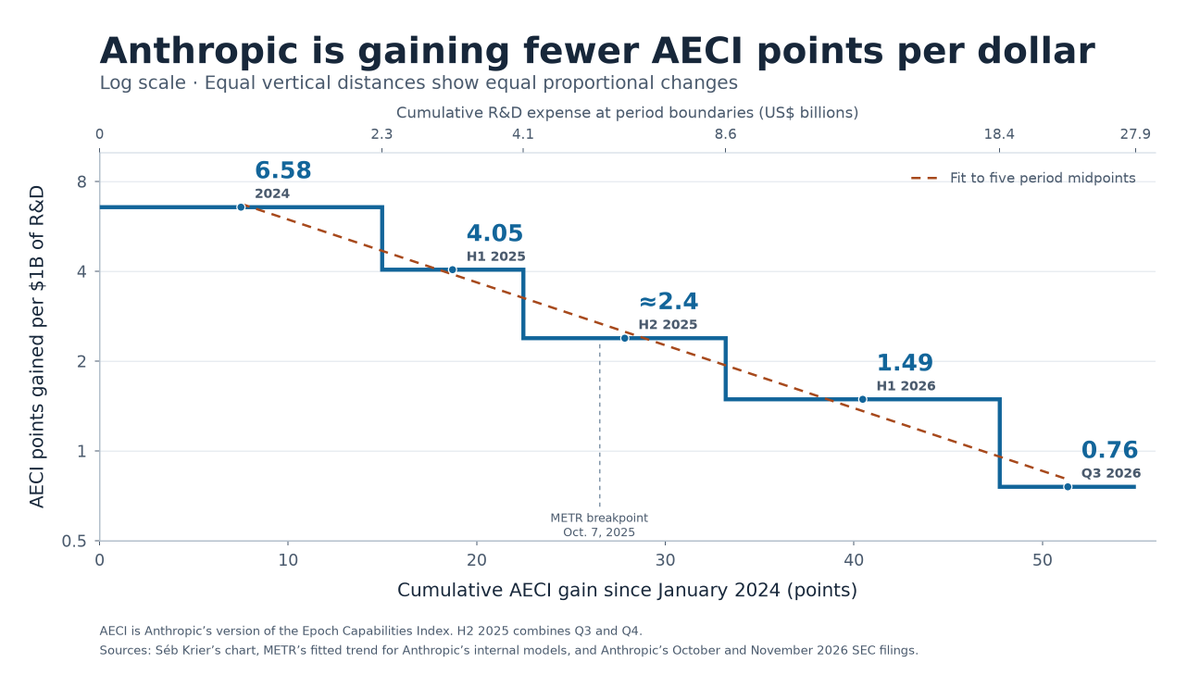
Anthropic is gaining exponentially less capability per billion dollars spent over time. It's now 8x as expensive to boost AI capabilities as it was 2 years ago, getting worse on a log scale. This includes METR report & internal models.
Credit to @alexolegimas, @sebkrier, and @michael_wiebe for inspiration.