The new software workflow is starting to look like this:
Idea>Prompt>Prototype>Iterate>Demo>Audit>Harden>Launch
The “audit and harden” step is going to matter more as AI-built apps become normal.
Not every project needs a massive engineering team.
But every serious launch needs someone checking the foundation.
That is where I think the market is going.
Would you pay for a pre-launch review before shipping an AI-built product?
Microsoft Senior AI developer just showed how they build AI agents with Claude at Microsoft.
34-minutes. free. By Microsoft team
Opus 4.7 + 1,400+ pre-built MCP tools
plug Claude into agent → give it tools → ship to production
worth more than any $500 vibe-coding course.
AI has made the first version of software cheaper.
But trust is still expensive.
Users do not care that your app was built fast if their data leaks, payments fail, or the product breaks under pressure.
Speed gets you to market.
Trust keeps you there.
That is the gap a lot of AI-built apps still need to close.
Build fast.
Then review hard.
What makes you trust a new software product?
The scariest AI-built app is not the one that crashes.
It is the one that silently works wrong.
- Wrong permission checks.
- Wrong payment logic.
- Wrong data access.
- Wrong assumptions in the backend.
- Wrong edge case handling.
Crashes are obvious.
Silent failures are expensive.
That is why launch reviews need to look deeper than “does it run?”
What is worse: an app that breaks loudly or one that fails quietly?
A lot of people are debating whether AI will replace developers.
I think the better question is:
How many more people will start building software because AI made the first step easier?
That is the real shift.
- More founders.
- More prototypes.
- More niche SaaS ideas.
- More internal tools.
More apps that would have never been built before.
But more software also means more broken software.
The review layer becomes more important, not less.
Are AI coding tools making software better, or just making more of it?
The best use of AI dev tools is not replacing judgment.
It is accelerating execution.
Use AI to:
- Build the first draft
- Explore features
- Create UI fast
- Generate boilerplate
- Debug obvious issues
- Move from idea to demo
Then use human review for:
- Architecture
- Security
- Scaling
- Edge cases
- Launch readiness
- Business-critical flows
That combo is where things get interesting.
What are you using AI coding tools for right now?
AI coding tools are creating a new type of founder:
Someone who can build before they can fully code.
That is powerful.
But it also creates a new risk:
Founders may not always know what they do not know.
The app works, but they may not see the hidden issues in auth, security, data handling, or deployment.
That is why review matters.
Not to slow founders down.
To help them launch with confidence.
Do you think AI-built apps should have a “code audit” before launch?
Founders using AI to build apps should have a simple pre-launch checklist:
- Are secrets hidden?
- Is auth actually secure?
- Are user permissions correct?
- Can users access data they should not?
- Are payments tested?
- Are errors handled?
- Is the database structured well?
- Can the app survive more than 10 users?
- Is there a rollback plan?
This does not kill speed.
It protects the speed you already created.
What would you add to this checklist?
One underrated problem with AI coding tools:
They make bad architecture feel productive.
You can keep prompting your way through bugs, adding patches, changing files, and getting things to “work.”
But eventually, the codebase becomes hard to reason about.
That is when speed turns into drag.
The earlier someone reviews the structure, the easier it is to fix.
AI is great for momentum.
But momentum without review can become technical debt fast.
Have you ever had an AI-built project get messy after too many prompts?
There is a big difference between a prototype and a product.
A prototype proves the idea can exist.
A product has to survive real users.
That means:
-Real auth
-Clean permissions
-Error handling
-Payment edge cases
-Database structure
-Deployment setup
-Security checks
-Performance review
-Basic monitoring
AI can get you to prototype insanely fast.
But productization is where discipline matters.
Where do most AI-built apps break first?
The future of software may not be “everyone becomes a developer.”
It might be:
Founders build the first version with AI.
Developers review, harden, and scale it.
Designers polish the experience.
Operators turn it into a business.
That feels more realistic.
AI lowers the starting line.
But serious products still need real judgment before launch.
What do you think the founder/developer relationship looks like 2 years from now?
AI-generated code can look impressive on the surface.
- Clean UI.
- Working buttons.
- Nice animations.
- Fast prototype.
But pretty does not mean secure.
A polished front end can still sit on top of broken permissions, exposed API routes, poor database structure, or fragile backend logic.
This is where a lot of AI-built products get dangerous.
The demo is not the product.
The product is what happens when real users start touching it.
What part of an app do you think founders underestimate the most?
A lot of founders are building apps with AI right now.
That is a good thing.
The barrier to creating software is dropping fast, and more people can test ideas without spending $50k upfront.
But building is only half the game.
The other half is knowing whether the thing is actually production-ready.
AI can help you move fast.
But before users touch it, a human should review the foundation.
Would you rather launch fast and fix later, or slow down slightly and launch cleaner?
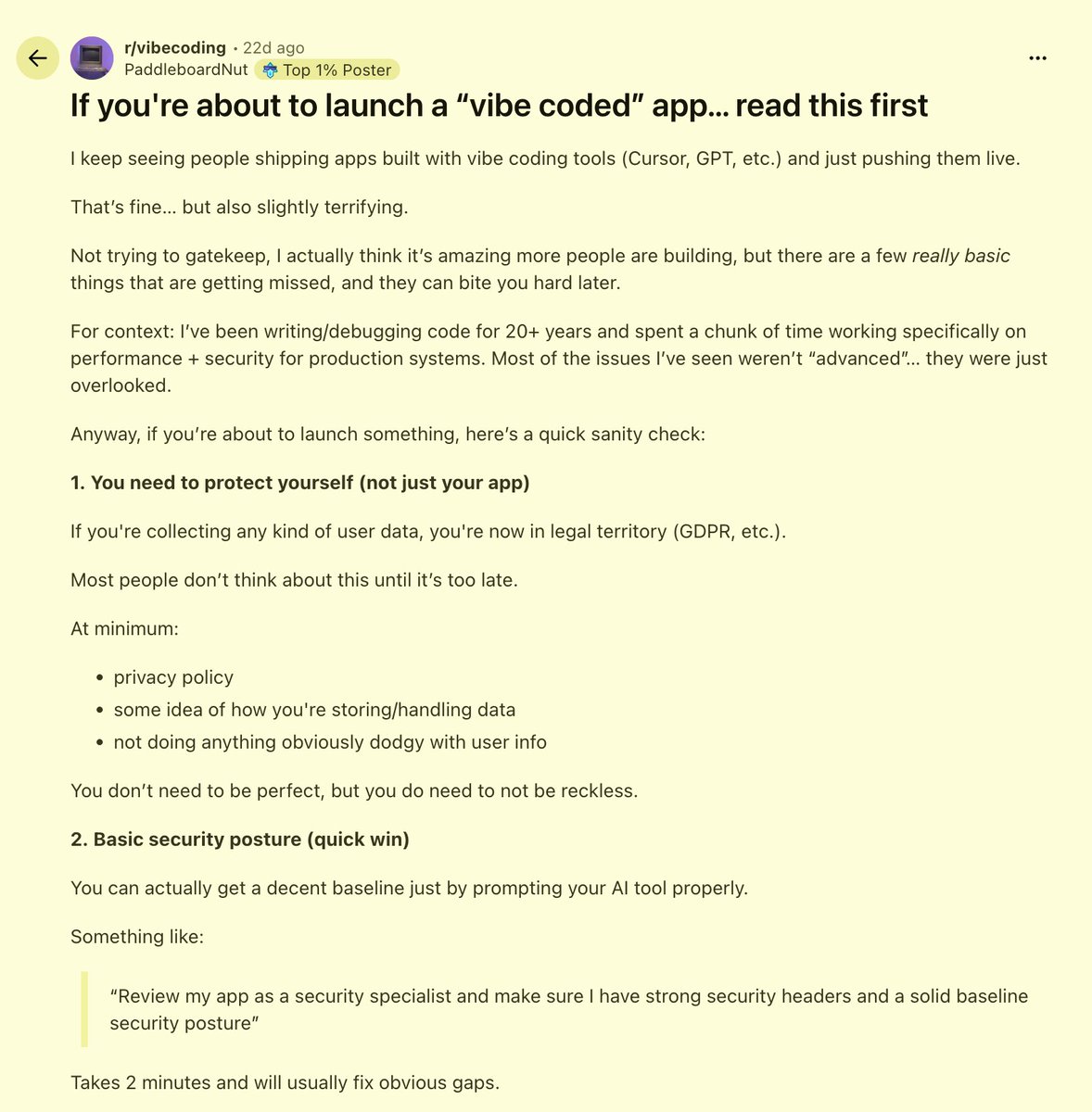
Vibe coders are getting sued.
People are launching apps with real users but skipping the boring stuff that can actually kill the product.
A developer with 20+ years of experience just shared the pre-launch checklist every AI builder should run:
→ privacy policy if you collect user data
→ know where user data is stored
→ check security headers
→ scan against OWASP basics
→ look for SQL injection / XSS / auth issues
→ make sure .env values are not leaking
→ check API responses for sensitive data
→ remove secrets from logs
→ never expose API keys in frontend code
→ move keys server-side or behind a proxy
→ add rate limits before someone burns your API bill
This is what most vibe coders are missing.
AI can help you build the app.
But if you launch without security, privacy, and abuse checks...
you didn't ship a product.
you shipped a liability.
@PrajwalTomar_ This is exactly why we are in business, AI has increased the speed of idea to reality but if you don't audit your codebase it turns into a liability.
If anyone needs a developer feel free to reach out.
This is the correct way of using these amazing tools. For a MVP to get you through a demo phase, AI is perfect.
For actual longevity it is essential to have senior eyes on a project, that's where we come in!
Vibe coding has made the process of developing an app smarter
But many engineers have become dumber with many just 1 system vulnerability away from a major debugging and potential escalstion.
Vibe coding for assistance✅️
Fully outsourcing work 2 Vibe coding 👎
Great things can often fail at scale, we are here to make sure that does not happen.
Whats something you are currently building that you are hoping you can bring to the next level?