Stanley Druckenmiller:
“That would be my #1 advice to young people: Do not invest in the present. The present is not what moves stock prices. Change moves them.”
Salah satu kesalahan paling umum dalam membaca data makro: terpaku pada angka absolutnya.
• "Inflasi naik ke 4%."
• "BI hike 25 bps."
• "GDP tumbuh 5%."
Refleksnya langsung menilai bagus/jelek dari angka itu.
Padahal pasar bereaksi terhadap "Surprise Factor".
"Surprise Factor" adalah selisih antara REALISASI dan KONSENSUS.
Harga itu sudah mendiskon faktor2 yang forward-looking.
Sebelum sebuah data rilis, konsensus tentang data tersebut sudah priced in di harga.
Market sudah antisipasi data makro yang belum keluar based on konsensus.
Ketika datanya riilnya keluar, satu2 informasi baru adalah selisihnya terhadap ekspektasi, dan itulah yang menggerakkan harga, bukan angkanya sendiri.
Kalau inflasi keluar di 4% dan konsensus memang 4%, market price most likely tidak akan kemana2.
4% itu sudah priced in.
Yang menggerakkan pasar adalah kalau yang keluar ternyata 4,5% (di atas dugaan) atau 3,5% (di bawah).
Implikasinya adalah, angka "bagus" bisa menurunkan pasar kalau di bawah ekspektasi, dan angka "jelek" bisa menaikkan kalau lebih baik dari yang ditakutkan.
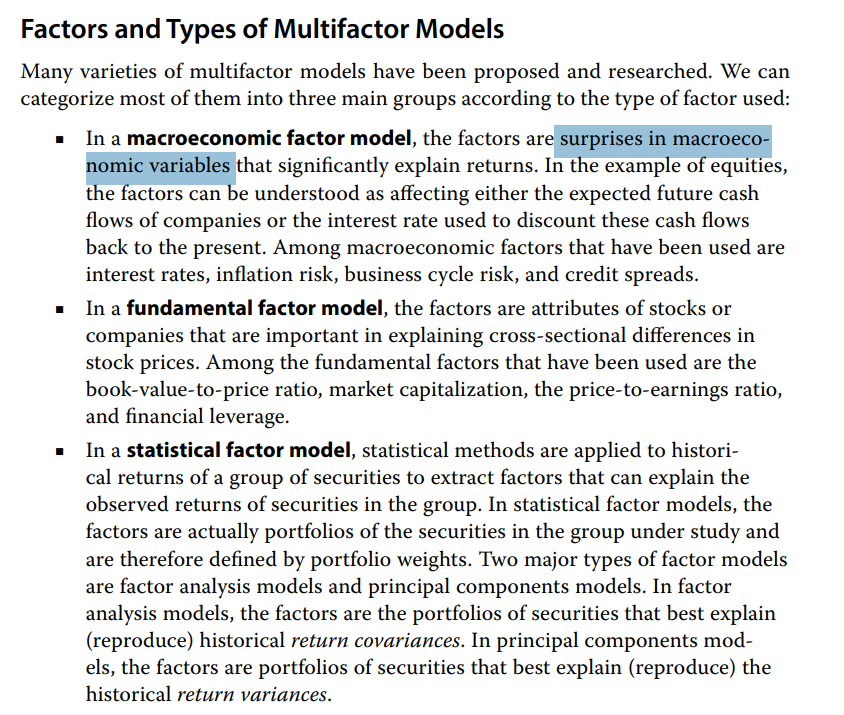
Di portfolio management, ini masuknya ke Macroeconomic Factor Model. (terlampir di gambar)
Di pasar global ada indeksnya: Citi Economic Surprise Index (Citigroup), yang mengukur data aktual vs konsensus.
Jadi kalau ada rilis data atau keputusan bank sentral, pertanyaan pertamanya bukan "angkanya berapa", tapi "angkanya berapa dibanding yang diperkirakan."
Yang sesuai ekspektasi, sekencang apa pun headlinenya, sebagian besar sudah priced in di harga.
Halo guys, gw mau kasih sedikit edukasi mengenai cara bandar akumulasi atau distribusi.
Disclaimer: ini pure apa yang gw pelajari di market secara real time
@ricky_hopmans@bigdigjohnny Oii rik, SME emg sepantasnya lbh gede credit yieldnya dibndg korporasi. +4% dr 10yr yield bond. Expected loss perbankan lbh gede jg sewkt menyalurkan kredit ke SME sktr 3.5% krn probability of default sktr 5% & loss given default 70%. Itu blm tmsk margin untuk bank. 9.5%-10% tuh
AI CAPEX ON TRACK TO EXCEED EVERY INVESTMENT BOOM IN MODERN HISTORY
Artificial intelligence investment is on pace to become the largest capital expenditure cycle ever recorded, with AI-related software and infrastructure spending projected to approach 9% of global GDP—surpassing even the great industrial investment waves that reshaped the modern economy.
Charlie Munger: “All good investing is value investing, by definition. There are just various places to fish for value investments.
And as the world gets tougher, you have to fish in places you didn't fish before.”
semoga dengan kejadian kemarin, membuat dek @primagnesius lebih humble, berfikir dampak dari tulisan maupun perkataan, instrospeksi.
Notes : bukan saya yang chat pak sabirin
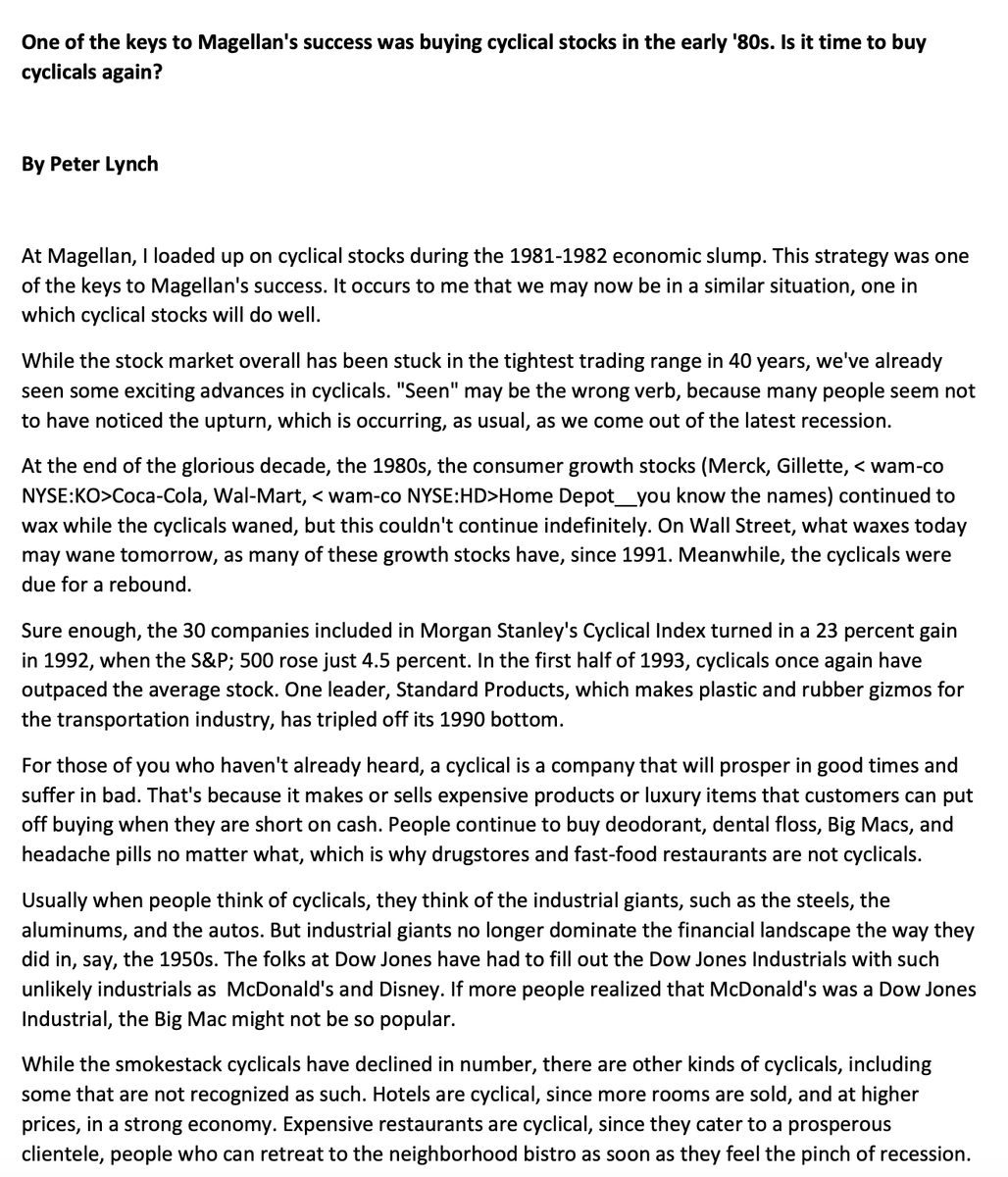
Peter Lynch on owning cyclical stocks
"At Magellan, I loaded up on cyclical stocks during the 1981-1982 economic slump.
This strategy was one of the keys to Magellan's success...
The best time to get involved with cyclicals is when the economy is at its weakest, earnings are at their lowest, and public sentiment is at its bleakest.
The staff at Standard & Poor's weekly newsletter, The Outlook, once reviewed the eight recessions since World War II to find out what happened to the prices of key cyclical stocks after the stock market hit bottom.
In every instance, the cyclical groups gained 50 percent or better in five months, more than double the advance of the S&P 500."
Data centers in Nevada are taking up so much power that Lake Tahoe residents are going to lose 75% of their power starting in May of 2027.
This is insane to me.
Why are American families & communities being steamrolled so big tech data centers can rake in profits & spy on us?
The power demands of AI mean that coal-fired power plants need relaxed rules on dumping toxic heavy metals into groundwater, EPA Administrator Lee Zeldin argued https://t.co/0ZKdqySxnt
The AI boom is now an infrastructure race.
This infographic from Guy Massey (source: LinkedIn) does one of the best jobs I’ve seen explaining hyperscalers in plain English.
A few takeaways that stood out:
• AI racks are moving from 10-20 kW → 100-300+ kW
• Cooling is becoming mandatory infrastructure
• Power availability is now a competitive advantage
• Edge computing may become just as important as centralized cloud
• AWS, Azure, Google & Meta account for ~70% of hyperscale capacity
Today, the U.S. faces a dilemma: political pressure to replace the nearly 20% of energy that comes from coal, and a massive need for new power generation capacity for AI data centers.
McKinsey estimates that data centers could make up 12% of U.S. electric demand in 2030, compared to 3-4% today.
As Mark Zuckerberg and others have stated, the energy requirements for training AI models could limit further development. If we don't increase energy output and drive costs down, U.S. companies could fail to compete long-term.
Nuclear provides an ideal solution. It is the densest energy source, and can operate at near total capacity, 24/7.
AI's electricity demand just opened a door nobody expected: nuclear and coal plants sitting idle for a decade are suddenly valuable again. The math is brutal and simple — a single data center cluster burns 500MW continuous. Utilities can't build new capacity fast enough. Here's what actually matters: the teams winning aren't waiting for greenfield projects. New AI tutorial every day. Follow to stay ahead. What's the biggest challenge you've faced with this? Reply below. https://t.co/N4YaW8eXA8
#NuclearEnergy #AIInfrastructure
Nobody talks about the real bottleneck in AI.
It's not the chip.
It's not the model.
It's not the data.
It's the power grid.
• AI data centers need 9% of US electricity by 2030
• ERCOT alone has 410 GW of large-load requests queued
• IEA projects data center demand doubles by 2030
The companies solving this:
$CEG – Nuclear PPAs with MSFT & META
$VST – 2,600 MW deal with META
$GEV – Rebuilding the US grid
$NEE – Largest renewable pipeline in the country
$ETN – Chip-to-grid power platform
You can't run AI without electricity.
Own the grid.
Every analyst report on AI mentions GPUs. Almost none of them mention copper.
You can't run a 500MW data center without ~50,000 tons of it.
You can't mine new copper fast enough to meet 2030 demand.
You can't tokenize what doesn't exist yet, unless you start now.
@totofinance
The green transition is being delayed to fuel artificial intelligence.
Over 15 gigawatts of scheduled US coal plant retirements have been postponed to prevent grid failure from data center demand.
Tech expansion is structurally extending the life of fossil fuels.
#AI
I've been talking a lot about software, corporate drama, and the OpenAI trillion-dollar IPO...
But i need to talk about the physical reality keeping all of this alive. Because right now, AI is running into a massive, terrifying wall: Electricity.
A report from Boston Consulting Group puts out numbers that are genuinely hard to wrap your brain around.
By 2030, data centres powered almost entirely by AI growth are projected to consume the same amount of electricity currently used by 40 million American homes. That's roughly one-third of every home in the United States.
Think about that. Every time we ask an AI to write code, generate an image, or summarize an article, a massive server farm somewhere is chugging power like an industrial factory. And there are millions of us doing this every single day.
Here’s the 10x reality check…
To put it into perspective: a single ChatGPT query uses 10 times more energy than a standard Google search.
When you search Google, it's just pulling indexed data. When you prompt an AI, thousands of chips are working together in real-time to generate something completely new from scratch. It is incredibly compute-heavy, and our current power grids were simply not built to handle this kind of sustained, exponential load.
US electricity demand grew by less than 1% annually for decades. Utilities have now doubled their annual forecasts and data centres could account for up to 9% of all US electricity consumption by 2030.
Suddenly, all the puzzle pieces from the last few weeks start to make sense:
• Why is Anthropic hitting a wall despite growing 80x in a single quarter? Because they can't get the data centres and the power to run their models
• Why is Elon Musk building massive, power-hungry superclusters for xAI? Because he knows whoever controls the energy and the hardware controls the tech
• Why did OpenAI partner so heavily with Microsoft? Because Microsoft has the cash to build their own dedicated power infrastructure
And here’s the ultimate irony…
The biggest companies in the world are trying to build the future of intelligence, but they're going to have to resurrect the past to do it.
Microsoft, Google, and Amazon have already signed deals to buy power from nuclear power plants just to keep their AI centres running 24/7 without crashing the public grid. Coal plants that were scheduled to shut down are being kept alive. New gas plants are being fast-tracked.
We are building AI faster than we can build power lines.
This isn't just a tech story anymore it's the defining infrastructure crisis of our generation.
So, let's look ahead:
Are we going to have to choose between scaling AI and keeping the lights on in our own homes? Or will AI figure out a way to optimise its own energy crisis before 2030?
Drop your thoughts below.
AI needs data. But data needs power.⚡
As the AI boom accelerates, the real constraint may not be chips - but electricity.
Emit Capital’s Matt Dever says nuclear is shifting from “unthinkable to unavoidable” as AI demand collides with a global energy squeeze.
Full conversation on the energy-AI nexus here🎥 https://t.co/BdnTWj2EZ5
#energycrunch #AIboom #nuclearenergy #ausbiz
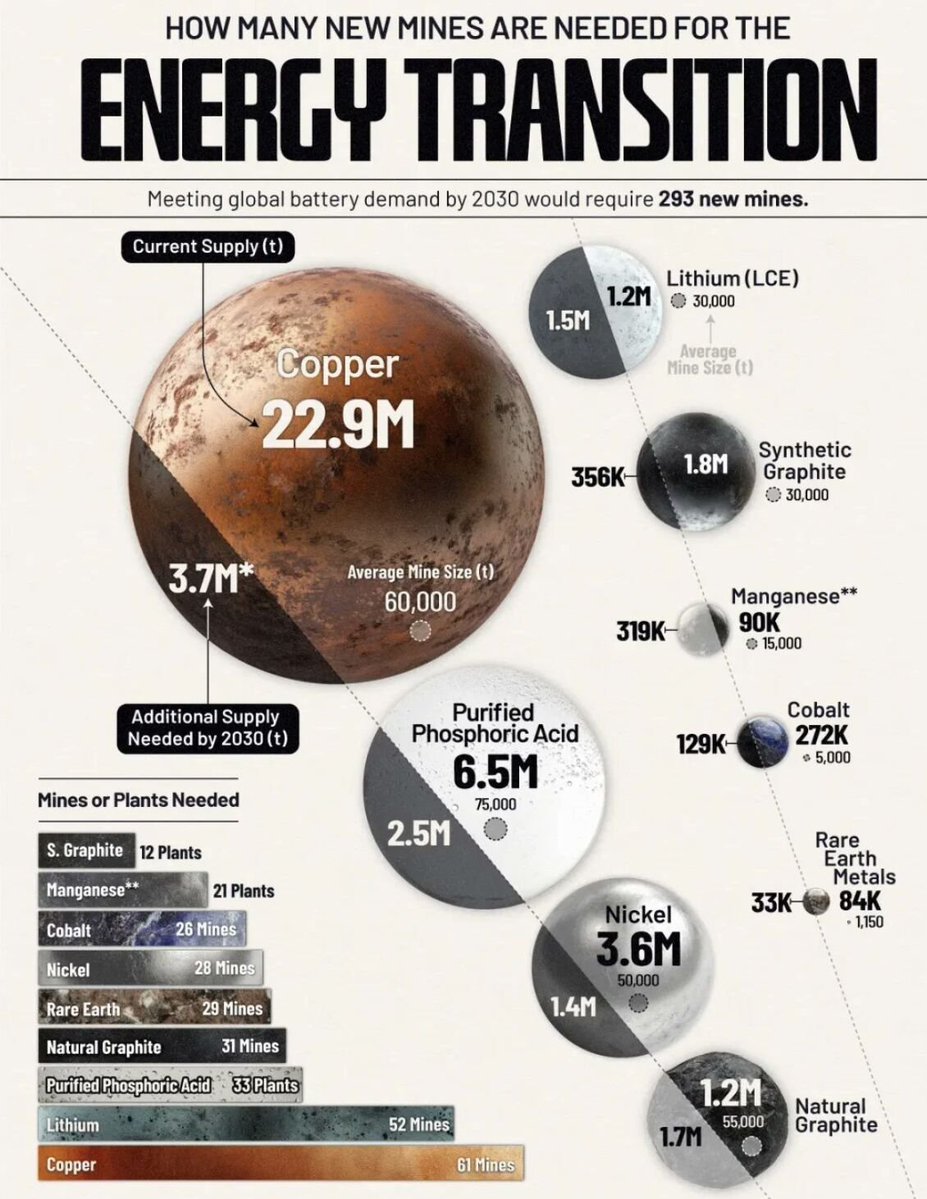
293 NEW MINES NEEDED BY 2030
🛢️THIS IS NOT AN OIL GLUT STORY
The energy transition does not face excess supply.
It faces structural mineral scarcity.
🔋 What Battery Demand Requires
By 2030:
• 61 new #copper mines
• 52 #lithium mines
• 31 natural graphite mines
• 29 rare earth mines
• 28 nickel mines
🟠 Copper Gap
• Current supply 22.9m tonnes
• Additional required 3.7m tonnes
That is a 16% increase on today’s base!
Permitting timelines 10–15 years.
Ore grades... Declining.
Capex Rising📈
Copper does not scale like shale oil.
🟢 Lithium Gap
• +1.2m tonnes required
Lithium projects face:
• Water constraints
• ESG scrutiny
• Processing bottlenecks
• Chinese refining dominance
The constraint is build speed
🛢️ Oil markets debate surplus.
Metals do not work that way.
You cannot bring 61 copper mines online in 2 years.
There is no mineral equivalent of a Permian surge.
If projects do not accelerate:
• Mineral inflation returns
• EV margins compress
• Grid expansion slows
• Energy transition timelines slip
This is a structural investment gap.
Fossil fuels face demand uncertainty.
Critical minerals face supply constraints.
Different cycles and Different risks.
The transition narrative focuses on demand.
The real bottleneck is geology and permitting.
If you want to understand which companies are positioned to win this supply race and where capital is flowing next, I break down the top opportunities in my newsletter.
Don’t miss it and Subscribe, link in the below comments
Untuk mahasiswa saya di FEB UI, berikut beberapa referensi untuk kuliah minggu depan topik financial crisis. Karena bahan2 ini mungkin bermanfaat buat mahasiswa lain yang bukan di kelas saya, saya share link nya
https://t.co/LWolQU0M11 (working paper saya di Harvard Kennedy School)
https://t.co/hMBrKK863r (bahan presentasi di Peterson Institute for International Economics, Role of Exchange Rates in Three Financial Shocks in Indonesia
https://t.co/AgfbDHcTwx (Twenty Years after the Asian Financial Crisis, free access chapter dalam buku)
https://t.co/yPP9HVLbB3 (bahan presentasi di Peterson Institute for International Economics, : The Impossibility of Impossible Trinity? The Case of Indonesia