This account has been sunset. For news on NASA networking and navigation capabilities, check out @NASASpaceOps, @NASA_Technology, and other NASA accounts.
Important update: This account is being consolidated, but we’ll continue to post about our networking and navigation capabilities over at @NASASpaceOps, @NASA_Technology, and on mission-specific accounts.
Learn about NASA's social media consolidation: https://t.co/klRFfwhiTC
SCaN recently advanced @NASA’s efforts to commercialize space communications services by issuing a Request for Information for insight into industry’s Earth proximity space relay services.
Respond to the solicitation before July 11, 2025, at 5:00 PM EDT: https://t.co/Kw48dmUpC3.
Venturing to the Moon & Mars will require stellar comm & nav services. @NASA selected Intuitive Machines to develop commercial lunar relays. These will allow assets & astronauts on the Moon to stay in near-constant contact with Earth.
Learn more: https://t.co/iEnEkvHZEA
PACE, AQUA, XRISM, SDO, & many more missions rely on our networks to get their data home.
How do we do it?
With a global system of gov & commercial antennas. Now, we’re adding more commercial antennas, so we can increase the Near Space Net’s capacity. https://t.co/OWCl8ipezN
@Space_Station@NASAHubble With commercial relays, NASA will be able to support more science and exploration missions transmitting data about our planet, the Moon, Mars, and the solar system beyond.
Watch a recording of a recent town hall to learn more: https://t.co/qFz01qv0BQ
With TDRS retiring, we’ve funded six commercial demos for near-Earth space relays. Each company is bringing their own unique approach and will demonstrate their capabilities by 2027.
Who’s participating? Viasat, Inmarsat, SpaceX, SES, Kuiper, and Telesat. https://t.co/pTBTamEtDe
But why do we need space relays?
Relays enable spacecraft that cannot see an antenna on Earth to transmit data home. Many missions transmit their data this way, including the @Space_Station, @NASAHubble, Fermi, Swift, and more.
Earlier this month, we met with the aerospace industry to discuss our plans for flying out our Tracking and Data Relay Satellite (TDRS) fleet and embracing commercial satellite communications capabilities.
Watch a recording of the meeting: https://t.co/P8sJ0mGwWF
Upgrade achieved. ✔
The @NASASCaN team upgraded the Near Space Network to support the SPHEREx mission. SPHEREx is mapping the sky and offering new insight into what happened a fraction of a second after the big bang. Learn more: https://t.co/CPijqDaTmH
SPHEREx is mapping the sky & surveying over 450 million galaxies!
To support SPHEREx, SCaN partnered with a commercial company & upgraded Near Space Network antennas. Now, SPHEREx can transmit ~20 gigabytes of data each day. https://t.co/NRZv8ltC2h
Let the cosmic mapmaking begin! ✨
SPHEREx has started its science mission, scanning the entire sky in 102 infrared wavelengths to chart the positions of hundreds of millions of galaxies and uncover the universe's hidden secrets. https://t.co/0XPWumDSXT
Taters the Cat won a Webby! 🐱
@NASA transmitted a video of Taters from the Psyche mission to Earth, testing laser comm links in deep space. The video traveled over 19 million miles & demonstrated laser comm as a viable technology for future exploration. https://t.co/MWRlCr3fSd
The results are in: We won 12 #Webbys, six of which were People’s Voice Awards! Thank you for voting for us – we love sharing space with you. https://t.co/sJZnLcscmF
Thirty-five never looked better!
Take a tour through Hubble's 35th anniversary images, narrated by senior project scientist Dr. Jennifer Wiseman.
Explore more here: https://t.co/gJl1BXffdJ
Today, @NASAHubble celebrates 35 years in orbit!
The historic mission, which relies on our Near Space Network to transmit data to Earth, has transformed our understanding of the universe and led to new discoveries. Learn more here: https://t.co/SrHLqKZXTx
On April 20th the #LucyMission flew by asteroid Donaldjohanson & surveyed the asteroid using its 3 science instruments. Lucy’s science data is transmitted home through our Deep Space Network, and will help us study how planets in our Solar System were formed! https://t.co/hTn8GZc0yK
See Earth through our eyes. 🌎
NASA studies our home planet like no one else, observing Earth from land, air and space for more than 60 years. Happy #EarthDay!
It’s #EarthDay! @NASAEarth-observing mission Landsat-9 uses SCaN’s Near Space Network to transmit over 1,400 images back to Earth every day.
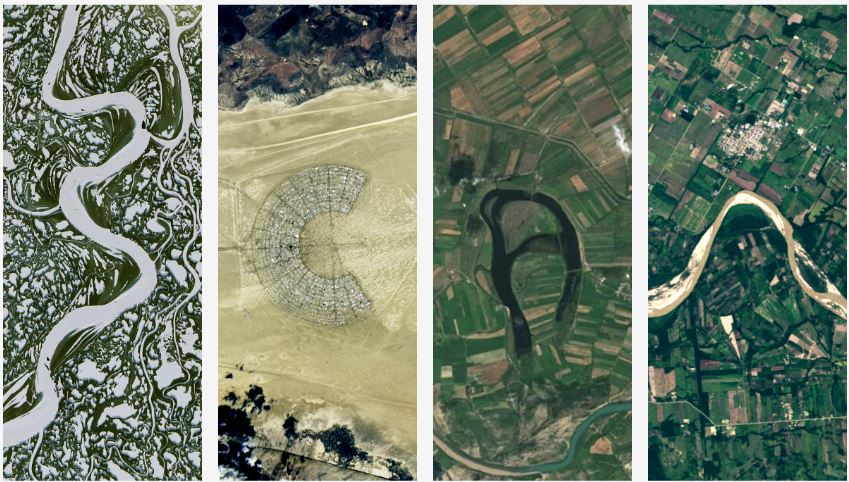
Now, you can use Landsat imagery to write your name. Check it out: https://t.co/4R6LmEixcP