NDF is a non-partisan progressive public policy institute based in Islamabad. We develop policy solutions that foster pluralism & inclusiveness in Pakistan.
In this episode of Geopolitical GupShup, @OtherImranKhan and @khansheharyar discuss the evolving geopolitical dynamics in Afghanistan, the Russia–Afghanistan military-technical cooperation agreement. The conversation also explores the broader regional implications for Pakistan, shifting strategic alignments, security concerns, and the future trajectory of regional power politics.
Please watch the full episode here and don't forget to like and subscribe:
https://t.co/x6Eks3ktFs
Distinguished expert and leader, Additional IGP AJK Dr Khalid Chauhan brings a wealth of exeprience in rule of law and peacebuilding to @NDF_Pak
We are very honored and excited to have him on board as a Distinguished Fellow.
Welcome Dr Chauhan.
We are honored to welcome Dr. Khalid Chauhan as a Distinguished Fellow at the National Dialogue Forum (NDF) in honorary capacity.
Currently serving as Additional Inspector General of Police (Addl IGP) Azad Jammu & Kashmir (AJK), Dr. Chauhan is an internationally recognized policy expert, academic, and practitioner in the fields of security governance, prevention of violent extremism (P/CVE), peacebuilding, and rule of law. He previously served as the National Coordinator of the National Counter Terrorism Authority (NACTA), where he played a leading role in shaping Pakistan’s National Prevention of Violent Extremism (PVE) Policy and advancing interagency coordination on national security and social cohesion. Over the course of his distinguished career, he has also held senior leadership positions in policing, governance, academia, and international policy engagement, with affiliations including the London School of Economics (LSE), SOAS University of London, Australian National University (ANU), and Simon Fraser University.
We look forward to benefiting from his experience, insights, and leadership as we continue advancing dialogue, peacebuilding, democratic governance, and resilient societies in Pakistan and beyond.
@khansheharyar@OtherImranKhan@jumainasiddiqui
In this episode of Geopolitical GupShup, @OtherImranKhan and @khansheharyar discuss the scope and strategic significance of Pakistan’s Rocket Force in light of discussions at the IISS Shangri-La Dialogue. The podcast also examines the visit of EU High Representative Kaja Kallas to Islamabad, key outcomes of the visit and Pakistan-EU relations.
Watch the full podcast on the link below:
https://t.co/vbWfLuJ83M
Imran Khan, Geopolitical expert says US warnings against Iran sound “hollow”. He questioned the value of renewed escalation, citing reports that Iran has used the ceasefire period to restore and reopen parts of its underground missile facilities, strengthening its position and re-strategizing its military assets amid ongoing tensions and uncertain prospects for a lasting agreement.
@OtherImranKhan@Mahnurqureshi@ImArslansherazi
#USIranTalks #Geopolitics #MiddleEastTensions #Iran #USIranConflict #StraitOfHormuz #PakistanTV
The National Dialogue Forum (NDF) was pleased to participate in the “From Insight to Impact: Lessons Learned in P/CVE” learning and collaboration event hosted at @USEFP , bringing together government institutions, development partners, researchers, civil society organizations, media practitioners, and P/CVE experts to reflect on lessons learned from prevention programming in Pakistan.
In the session “Adapting Programming for Impact,” NDF shared key lessons from the Promoting Social Cohesion in Punjab (PSCP) project, highlighting how vulnerability to violent extremism is often shaped by exclusion, social isolation, identity crises, weak institutional trust, and psychosocial challenges rather than ideology alone. The discussion emphasized the importance of moving beyond short-term or purely securitized responses toward long-term resilience-building, inclusion, social cohesion, and community trust-building approaches.
NDF also highlighted the importance of institutionalizing prevention efforts through sustainable state structures and policy integration. In this regard, the establishment of the Peace & Development Unit (PDU) within the Ministry of Planning, Development and Special Initiatives was discussed as an important step toward embedding peacebuilding, prevention, and social cohesion within broader national development planning frameworks.
We are grateful to the U.S. Embassy, The Asia Foundation, Peace & Development Unit (PDU), Incision, Centrum Media, IPSOS, GLOW, fellow panelists, and all participants for creating an important platform for collaborative learning, dialogue, and reflection on the future of peacebuilding and prevention in Pakistan.
@State_SCA@Asia_Foundation@ipsosinPakistan@INCISIONFILMSpk@TrustChromatic@usembislamabad@thecentrummedia@OtherImranKhan@shariqmktweets@talhaahad@PlanComPakistan@khansheharyar
Eid Mubarak from Team National Dialogue Forum (NDF)!
On this blessed occasion of Eid-ul-Adha, we extend our warmest wishes to all those celebrating around the world. May this Eid inspire us with the spirit of sacrifice, compassion, unity, and peace.
Wishing you and your loved ones happiness, prosperity, and countless blessings.
#EidMubarak #EidUlAdha #NDFPakistan
We are delighted to welcome Jumaina Siddiqui (@jumainasiddiqui) as a Senior Fellow at the National Dialogue Forum (NDF).
Jumaina is an accomplished international development and security professional with more than two decades of experience advancing democracy, governance, peacebuilding, and conflict prevention across South Asia and beyond.
Over the course of her distinguished career, she has worked with leading think tanks, development organizations, and nonprofits to strengthen institutions, promote inclusive governance, and support resilient societies.
Most recently, Jumaina directed the Global Security and International Affairs Program at the American Academy of Arts and Sciences, where she oversaw initiatives on nuclear security, climate-security, and humanitarian access. Prior to this, at the U.S. Institute of Peace (USIP), she led impactful research and field programs on governance and conflict prevention, significantly expanding the Pakistan portfolio into a major multi-year initiative in partnership with local and international stakeholders.
She currently serves as Vice Chair for the U.S.-Bangladesh NextGen Policy Fellowship and Institute, advising on strategic planning, governance, and programmatic priorities.
Jumaina brings a wealth of expertise in policy research, strategic engagement, partnership development, and peacebuilding. Her experience and insights will greatly contribute to NDF’s mission of advancing inclusive dialogue, research, & evidence-based policymaking.
Please join us in congratulating and warmly welcoming Jumaina Siddiqui to the NDF family.
@khansheharyar@OtherImranKhan
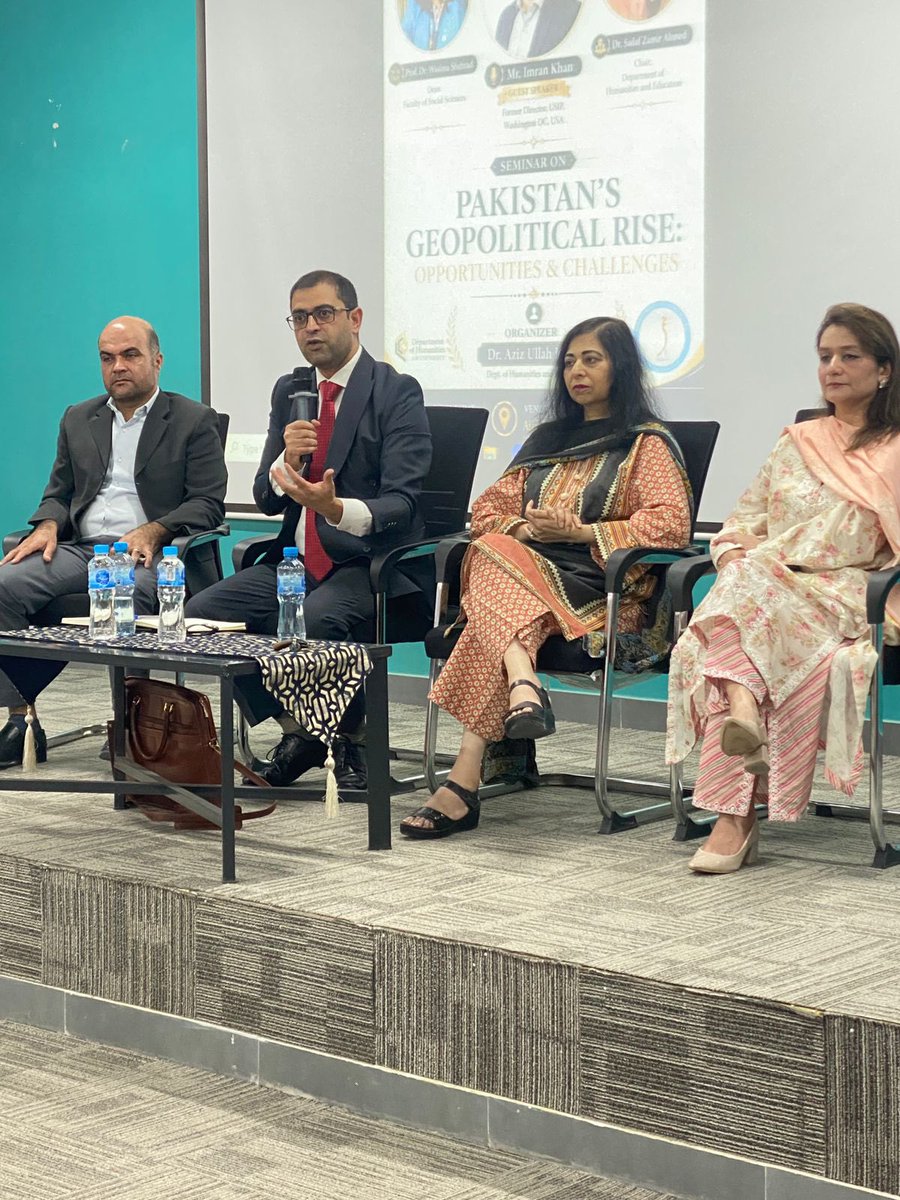
Senior Fellow NDF Imran Khan (@OtherImranKhan) was invited to Air University to give a lecture on “Pakistan’s Geopolitical Rise: Challenges and Opportunities”
Imran spoke to students from across the Faculty of Social Sciences on “ Pakistan’s Geopolitical Rise: Opportunities and Challenges”.
Dean of the Faculty of Social Sciences Professor Dr Wasima Shehzad, Chair Department of Humanities and Education Dr Sadaf Zamir Ahmed and Assistant Professor Aziz Kakar among others attended the event and shared their views.
Students from across Air University engaged in a robust debate and question and answer session
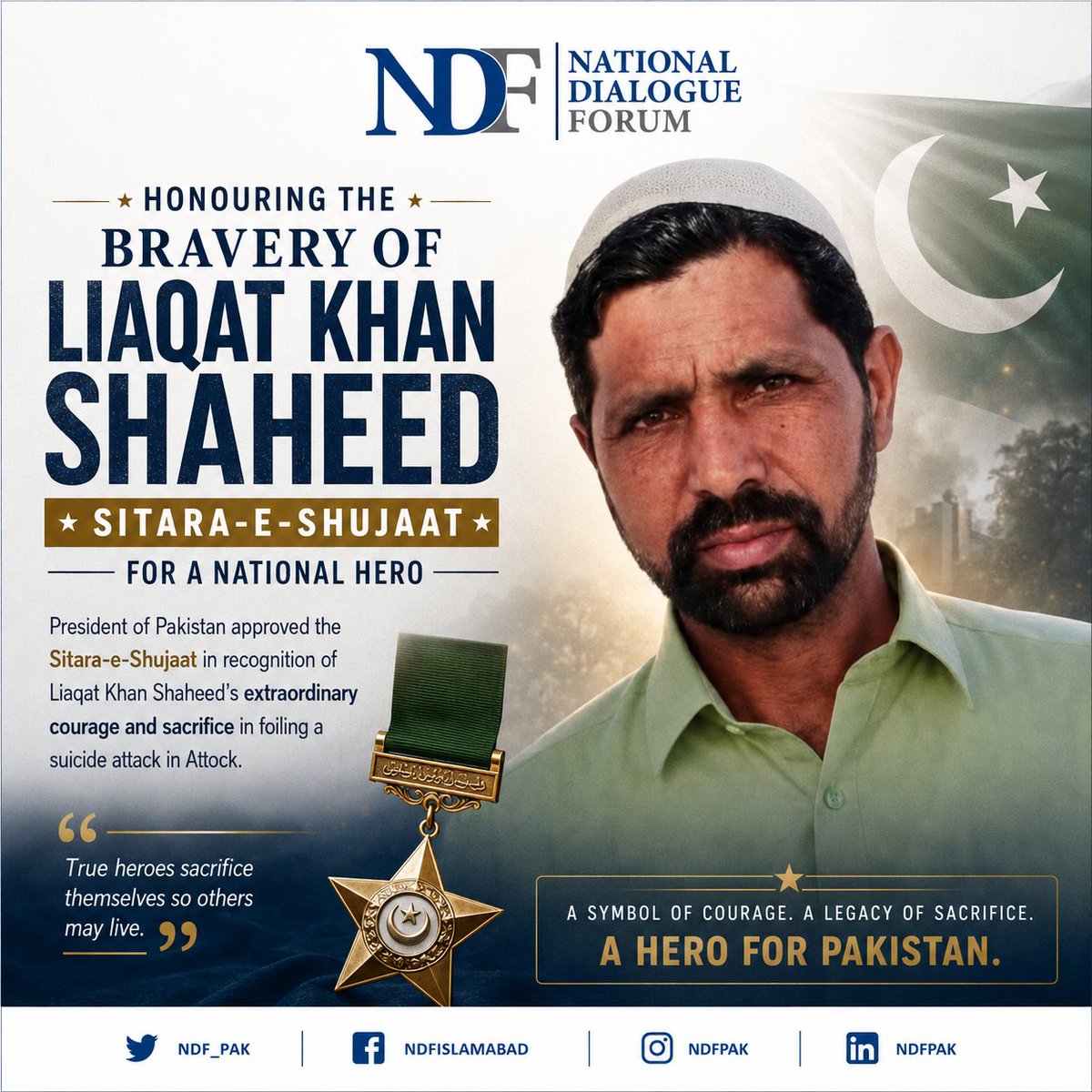
The National Dialogue Forum honours Liaqat Khan Shaheed, a brave citizen who sacrificed his life while courageously confronting a suspected suicide bomber near the Khushal Garh area in Attock’s Jand Tehsil. Liaqat prevented what could have been a major terrorist attack and saving countless innocent lives.
In recognition of his extraordinary bravery and selfless sacrifice, the President of Pakistan approved the Sitara-e-Shujaat for Liaqat Khan Shaheed (@PresOfPakistan)
His courage reminds us that true heroism often comes from ordinary citizens who rise in extraordinary moments.
Pakistan will remember his sacrifice.
#LiaqatKhanShaheed #SitaraEShujaat #Pakistan #NationalHero #NDF
In this episode of Geopolitical Gupshup, Imran Khan @OtherImranKhan and Sheharyar Khan @khansheharyar unpack the CBS News allegations that Pakistan allowed Iran to park military aircraft on its airfields despite Islamabad’s mediator role in the U.S.-Iran conflict. They examine Pakistan’s official rebuttal, the strategic logic of crisis diplomacy, and whether the report reflects deliberate disinformation aimed at undermining ongoing regional de-escalation efforts.
Watch the full episode on the link below and don't forget to share and subscribe:
https://t.co/H4r21Kz9dO
Senior Fellow NDF Imran Khan (@OtherImranKhan) had a productive meeting with Pakistan’s Foreign Office Spokesperson, Ambassador Tahir Andrabi, on the sidelines of a think tank event.
@TahirAndrabi@ForeignOfficePk@fsaisbpk
What a delight it was to have a brief exchange of ideas on the sidelines of a think tank event with Ambassador @TahirAndrabi one of the most iconic contemporary diplomats of Pakistan and the inimitable current Spokesperson of @ForeignOfficePk
Since I was in primary school, I have always found Pakistani diplomats, especially spokespersons of MoFA, very inspiring personalities.
From Ambassador Aziz Khan to Ambassador Masood Khan to Ambassador Tasnim Aslam and now Ambassador Andrabi, MoFA spokespersons have always been very confident, poised, humble, suave, learned and eloquent.
One watched their press briefings to learn how to respond to tough questions in stressful situations and how to be flawlessly bilingual.
@ForeignOfficePk has kept its illustrious traditions all these years.
In this episode, @OtherImranKhan & @khansheharyar examine Iran’s strategic outreach to Oman/Russia. The discussion breaks down Oman’s historic role as a neutral "backchannel" mediator and Russia’s growing influence in Middle Eastern diplomacy, exploring how Iran aims to counterbalance Western pressure and reshape the regional security architecture.
Click on the link below and don't forget to subscribe:
https://t.co/mi0Y7KFHIN
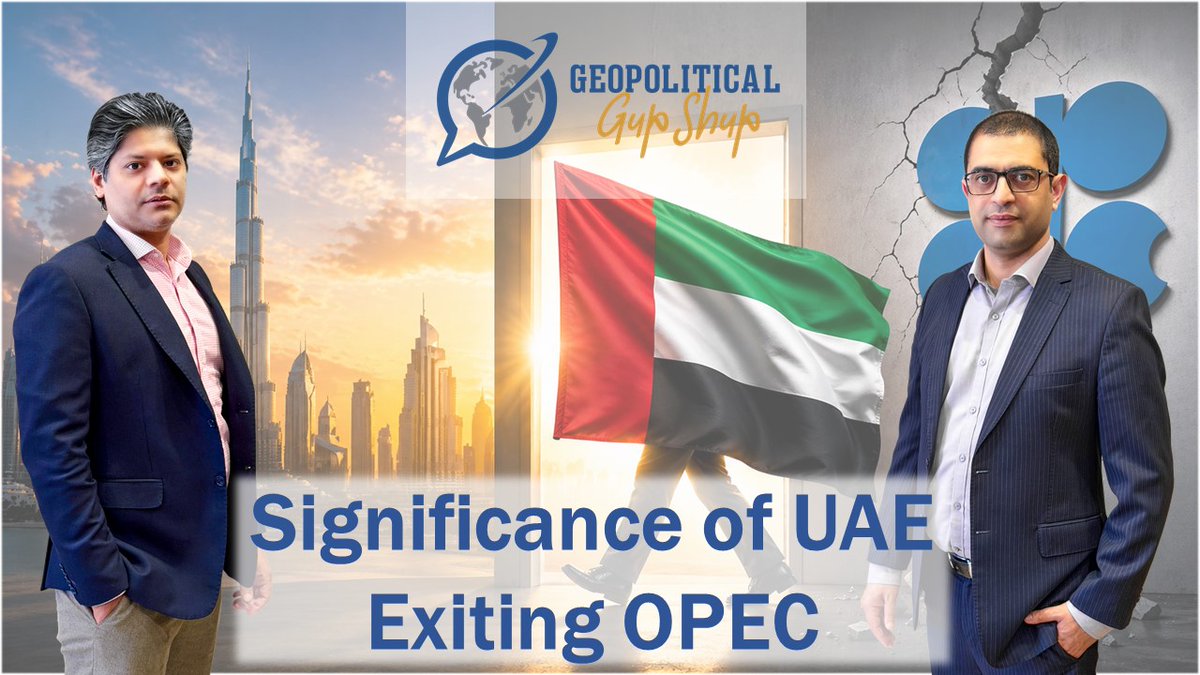
In this episode of Geopolitical GupShup, @OtherImranKhan & @khansheharyar analyze the strategic implications of the UAE’s potential exit from OPEC. They explore how this shift could redefine regional energy dynamics, impact global oil prices, and signal a broader change in the UAE’s independent economic foreign policy. check the latest episode on the link below:
https://t.co/AW2ZpH5hDE
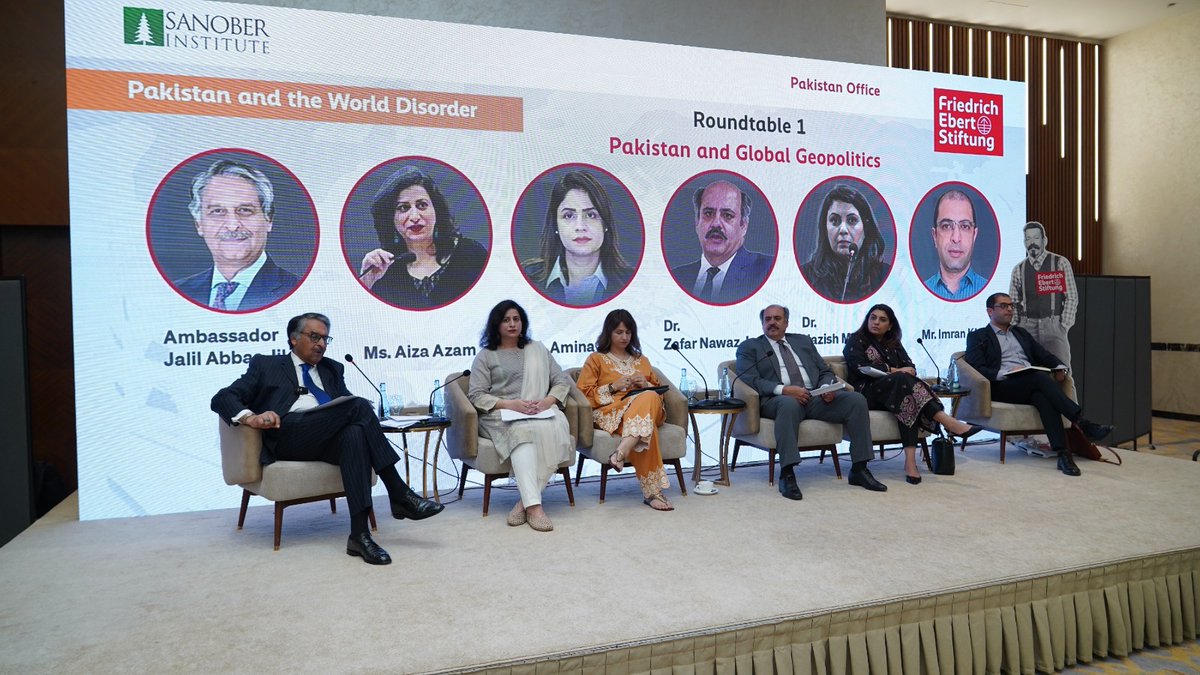
Senior Fellow NDF Imran Khan gave a talk at the SI @sanoberInsti -FES (@FES_PAK) conference on Pakistan and new world disorder. Imran spoke on the session titled: Pakistan and Global Geopolitics.
Since I am on a self-promotion spree these days (too excited to be professionally proactive after being on a sabbatical for a while), please allow me to share my speech at "Pakistan and the World Disorder Conference" organized by Sanober Institute led by seasoned foreign policy thought leader @Qamarcheema under the chairmanship of Ambassador @aizaz1101 Pakistan's storied diplomat and foreign foreign secretary.
My topic was Pakistan and Global Geopolitics.
What an honor for a smalltown Pakistani to be on the panel with Pakistan's most eminent experts and to be introduced by former foreign minister Ambassador Jalil Abbas Jillani.
Former chairman Joints Chiefs of Staff Committee, General (r) Zubair Hayat attentively listened to all the spekaers in our panel.
I was personally impressed by General Zubair's thoughtful keynote speech earlier. More on his keynote speech later in this space.
Anyways, if you want to indulge me, please listen to my speech and let me know what you think of my ideas. Grateful to @NDF_Pak & @khansheharyar for giving me the institional support that makes my current professional endeavours possible while I am on a short visit to Pakistan.
https://t.co/05BVTcUznF
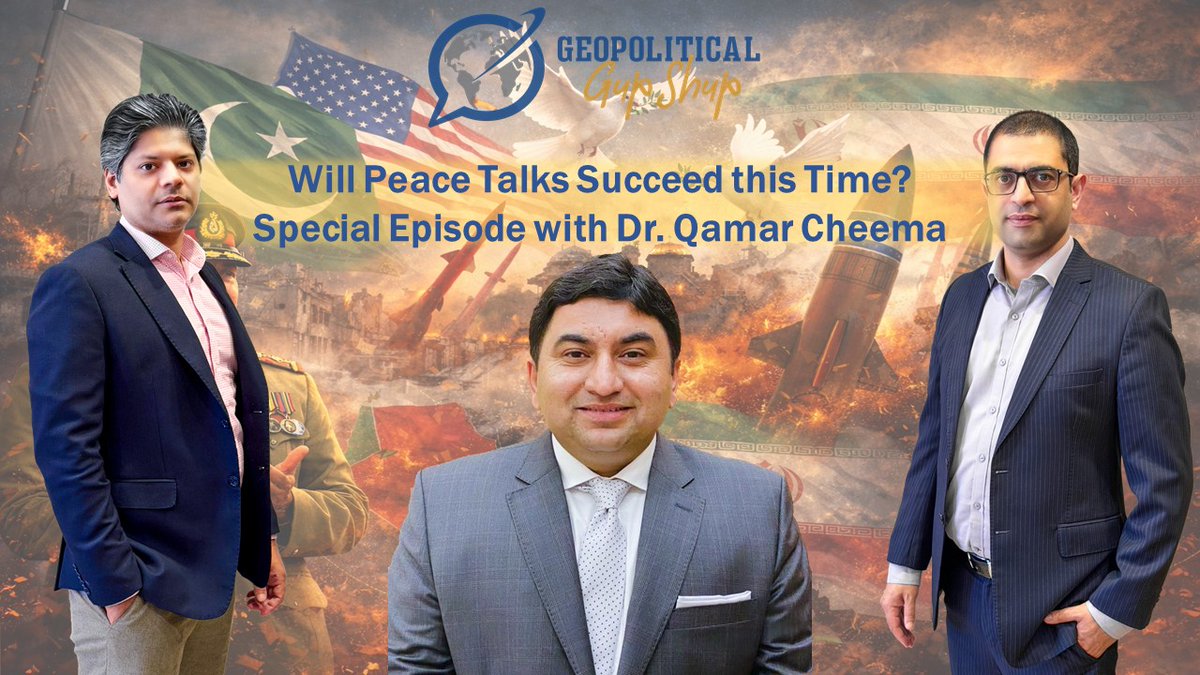
We at @NDF_Pak sit down with a top foreign policy expert @Qamarcheema & ask:
1) If US-Iran peace talks will succeed
2) how Pakistan can further its foreign policy goals after peace settlement (assuming there is a peace deal between US and Iran)
3) how the new Middle East would look like with Pakistan's expanded role along with other Middle Powers such as Turkiye, KSA and Egypt.
Check out the latest episode below:
https://t.co/iAXRGDB8pZ
In the timely episode with a special guest Dr. Qamar Cheema (@Qamarcheema), Imran Khan and Sheharyar Khan discussion what to expect from the upcoming round of talks in Islamabad, the shifting geopolitical architecture of the Middle East.
@OtherImranKhan@khansheharyar
Watch the full episode here: https://t.co/t9qqfoFU7O Don't forget to subscribe: https://t.co/eRHV3kkWGu
In this episode Sheharyar Khan (@khansheharyar) and Imran Khan (@OtherImranKhan) discuss a hypothesis: whether Pakistan deserves to get the Nobel Peace Prize, what's the history of this award, how the selection committee operates and who in Pakistan deserves to receive it?
Watch the full episode here:
https://t.co/jEsA6JePNt
Don't forget to subscribe:
https://t.co/eRHV3kkWGu
Reflections: My Homecoming to Islamabad - Part I
I had been away from Pakistan for more than a year when I arrived in Islamabad on February 28, just less than a day before US-Iran-Israel War started.
The purpose of my trip to Pakistan was primarily to reconnect with my professional community in Islamabad, go to my favorite trails and eat at my usual restaurants. While I was in the US, I missed Pakistan everyday. My homesickness was so severe that it was debilitating me from thinking about future. I was stuck, thinking about my eventful life in Pakistan.
I thought a low-key trip to Pakistan would indulge my nostalgia, enable me to relive some of my best memories, give me the emotional closure and help me move on with life back in the US.
However, the US-Iran-Israel changed the purpose of my trip immediately. From a purely personal pilgrimage to the friends and community I had until one year ago, it became a purely business trip in the sense that I started having more professional meetings and events than I had expected.
Most of my friends who work on foreign policy and defense and security matters were closely following the war, and I also got sucked back into my erstwhile think tank role I had in Islamabad for years with US Institute of Peace, though this time I was doing it for myself without being encumbered by an elaborate institiontal structure. @NDF_Pak provided me very nimble support without the constraints.
Even during the early days of the war when Pakistan was not actively positioning itself as the key mediator, it was clear that Islamabad foreign policy scene had changed while I was away. I had come back to a country that was already making big strides in foreign policy, shrewdly walking the tightrope of balancing its relations with different countries in West Asia, including Iran, while further winning respect and affection from both China and the US.
However, after it became evident around two weeks ago that Pakistan is playing the role of the leading mediator in the war, the excitement in Islamabad foreign policy community, both Pakistanis and foreign diplomats, has been uncontrollable and unprecedented.
Even foreign diplomats haven't seen a Middle Power such as Pakistan diplomatically so buoyant and playing such a key role in war mediation. A lot of diplomats who were until recently looking at Pakistan from the same old and outdated paradigm of a struggling state must be incredulous, even shocked.
As a Pakistani who has worked in international organizations for a better part of two decades now, my country's new role on the global stage felt like a personal validation. Pakistan has been an underdog on the global stage for most of my career. A country that was always in the news for the wrong reasons.
Pakistan has been dubbed "fragile state", "failing state", "hard country" and so on for a while now, not only in academic literature written by Western journalists but also by practitioners of foreign policy and international organizations.
Here was Pakistan rising up to the occassion and saving the world from World War III. As someone who has always believed in the value propostion Pakistan has to offer to the world, even I was a little surprised. Had Pakistan finally gotten its act together? Was Pakistan being proactive this time, exercising its agency as a confident nuclear power state of 250 million people?
The excitement about Pakistan's new role has kept me mostly awake all these weeks. It is hard to sleep when you are witnessing history from a ringside seat. In that excitement, after a long time, I am trying to engage with the world and put myself out there. Lately, I had totally withdrawn to myself due to pessimism stemming out of the war and suffering in the world, primarily of the Palestinian people.
The best part of my trip has been a podcast called Geopolitical GupShup that my colleague @khansheharyar and I started under the institutional support of @NDF_Pak You can check out our YouTube channel Geopolitical GupShup. In our podcast, which is still in its early and nascent days, Sheharyar and I present our analysis on geopolitical issues in a casual and conversational manner.
The other thing I have really enjoyed is to engage with the amazing foreign policy and defense strategy community of Pakistan who primarily work in think tanks and academia.
Earlier this week, I had the honor of spekaing at a conference called Pakistan and the World Disorder organized by @sanoberInsti It was so well-curated by think tank's Executive Director @Qamarcheema and Chairman Ambassador Aizaz Chaudhary who is also Pakistan's former foreign secretary.
Sanober Institute organized the conference in collaboration with @FES_PAK a German political foundaiton, in Pakistan led by @FKolbitz their very thoughtful country director. FES has gone some amazing work in Pakistan with civil society organizations, academics and students. I have followed their work for decades and it still amazes me how dedicated and thoughtful team they have. FES and their wider community are true friends of Pakistan and Pakistanis.
Coming back to the conference, General (R) Zubair Mahmood Hayat, former chairman of the Joint Chiefs of Staff Committee gave the inaugural address at the conference, which was followed by the panel I was spekaing in.
Ambassador Jalil Abbas Jilani, the former Foreign Minister of Pakistan chaired my panel which had the most eminent experts from Pakistani academia and think tanks. I spoke about "How the World Views Pakistan's Role in Global Geopolitics", sharing my perspective from the vantage point of someone who has worked on US-Pakistan relations for a while. I gave a bit of an insider account of working on this relationship when it was fraught between August 2021 and until early 2025.
I will share the gist of my talk and insights from General Zubair's riveting inaugural keynote later. Will also try to present the summary of other speakers' arguments. For now, I just wanted to share my reflections on my time in Islamabad while the city has been at the centre of global peacemaking. Check out some pictures here.