Most AI privacy comes down to a policy you have to trust.
With Leo on @near_ai, your prompt is encrypted in Brave and only opens inside an enclave that signs a proof of where it ran and which model answered.
We walk through how it works and how to set it up:
https://t.co/VXJrBbWQzE
Builders!
⚠️ Deprecation announcement ⚠️
The Graph will start winding down their integration with NEAR blockchain from 16th Oct onwards if you are using their service in any way, you should consider migration to an alternative:
• Goldsky indexer: they have a guide for the migration from The Graph - https://t.co/An0FXYVyP2.
• Neardata API - https://t.co/lLl0TDhfF3
Shipping a mobile app on NEAR AI?
Your API key is extractable the moment someone downloads it. @joespano_ did a walkthrough on how to keep it off the binary and your prompts out of any middleman.
https://t.co/202CMLRM0n
Want to learn how to build with private AI? It's easy to get started so we built a bank statement analyzer on NEAR AI cloud and recorded the whole thing.
Upload a statement, model processes it inside a TEE, get back categorized transactions plus a proof panel.
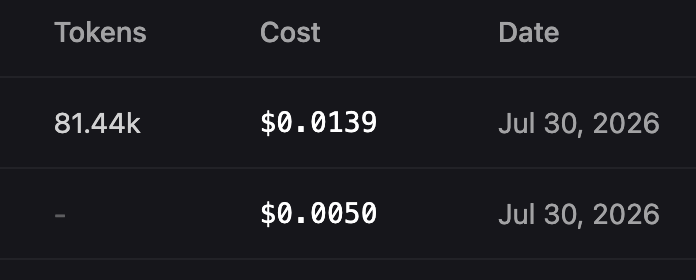
Whole run cost two cents. Watch how easy it is to get started.
https://t.co/IuIfUacvWc
Every AI app says it protects your data. Here's what that looks like in actual code.
Four lanes, ranked by privacy. An audit record written before the route commits, not after. A ratchet so a conversation can move to a more private lane but never back.
Plus the log chain running on the phone.
https://t.co/aHvcKzgNKI
In case you missed them, three videos on the same problem from different angles: how do you build an AI product without handing your users' data to whoever runs the model.
Read in this order they build on each other.
1. Trusted Execution Environments, explained
We encrypt data at rest and in transit. Then it reaches the model and has to be readable, because nothing can process ciphertext. That's the hole. A TEE seals the processor so the operator of the machine is locked out along with everyone else, and it hands you an attestation report you can verify against the silicon vendor. You're checking a promise rather than accepting one.
https://t.co/WTHUnr3Rvp
2. Switching to private inference
The migration is a base URL change. NEAR AI's cloud API uses the same setup as OpenAI, so your calls start hitting a TEE-hosted model without a rewrite. The video also covers scope, which matters more than the switch itself. That guarantee applies to the model on that path, not your app, not your company. If you log the request before it leaves, the enclave can't help you.
https://t.co/Bkfk9SK2gs
3. The safety layer that runs first
This one argues against the previous two in a useful way. Before you call any model, private or otherwise, run an emergency check locally, then ask whether you need a model at all. Someone asking for their latest blood pressure reading is asking for data already sitting on their phone. That's a lookup. Adding an outside party to it, even a sealed one, makes it less private rather than more.
https://t.co/guqGBR8FQk
Questions welcome.
Moving from the OpenAI API to private inference is one line. Swap the base URL to NEAR AI's cloud endpoint and your calls now hit a TEE-hosted model with an attestation report.
https://t.co/MH90C9NlkQ
NEP-641 has been just approved.
"Offchain Authorizations for Smart Contracts"
This standardizes the flow for signing and verifying offchain messages for smart contracts that power Passkey, EVM, multisig, and other wallet contracts.
The first version of this standard was live and tested on Trezu, and now it is a standard for the whole NEAR ecosystem.
Encryption protects data at rest and in transit. Then AI needs to read it, and it goes plaintext. TEEs fix that.
Your data goes into a room that locks from the inside. The host, the admin, even the people who built the service can't see in. And you can verify it yourself.
Here's how it works.
Every AI product makes a decision about where user data goes. Most make it by accident.
Joe's building Microwave OS, a private place for your family's health information, so he made that decision on purpose and recorded how.
The prompt gets audited inside the app before anything leaves it.
https://t.co/2V2f3lXR0i
Most AI agents request your API keys and expect you to trust the model with them.
IronClaw, on the other hand, securely stores credentials in an encrypted vault and injects them at the tool layer, ensuring that the agent never sees the raw values. This approach provides the same functionality without exposing your credentials.
I set up IronClaw, executed a research task, and generated a daily automated report. It’s completely free to start using it.
https://t.co/EwI4GjXOpl
Got a weekend project in mind?
Try this, instead of using expensive, NON-private agents to help, I recommend trying https://t.co/V4kzOMqzMW out.
Six simple reasons why:
1. There is a completely free version (everyone likes free)
2. It is private, no one is harvesting your data
3. It has ways to easily add a regular routine/automation
4. It does research well
5. Its inexpensive, I made a react-based webapp yesterday for 2 cents, literally.
6. The benchmarks are solid against other agents.
I'll be sharing my experience using Ironclaw as well as building on a full product on NEAR AI a lot over the coming weeks.