🏆 Neo Scholar applications are open!
Are you a college student who excels at CS?
Follow in the footsteps of Neo Scholars who founded Cursor, Chai Discovery, Applied Compute, Flint, Cognition, & more.
Apply to join one of tech’s strongest communities. https://t.co/gzG3lS8Bbw
Genetic engineering in human embryos is here.
Today, in a world first, @Columbia and @nucleusgenomics announce high-efficiency editing of human embryos.
The study, led by Dr. Dieter Egli's lab at Columbia University, with Nucleus Genomics’ Dr. Nathan Treff as a senior co-author, achieved editing efficiencies of up to 100% at targeted loci. Simultaneously, we showed no detectable editing-induced chromosomal abnormalities and low off-target activity.
In other words, this is the closest we've come to practical, high-precision gene editing in human embryos.
We are also excited to announce we will be funding and participating in the next phase of this research, alongside Columbia and Dr. Egli.
We see ourselves as a natural pathway for eventually bringing technologies like this into clinical care as part of a broader genetics platform — a full "Genetic Optimization" stack.
@nytimes broke the news in what is a historic moment for Genetic Optimization. See story in thread.
Although LLMs aren’t conscious, this isn’t an intrinsic limitation of the transformer architecture
Natural language and video/audio are only a small slice of cognitive output, which also includes motor control, emotion, hormone regulation, etc. So learning a generalized representation of this slice is unlikely to precipitate anything close to human consciousness
However, consider a model defined by the following
Inputs: current neuronal state + sensory inputs
Outputs: neuronal state at the next timestamp
Loss: comparison of predicted neuronal state against the ground truth
A sufficiently strong model with this parametrization should be able to explicitly model the interior process and state of human consciousness, albeit via a different underlying mechanism. If consciousness is empirically determined by neuronal state and a functional model of consciousness holds, the quality of consciousness should be indistinguishable from that of a biological human
When President Trump’s Q1 financial disclosures came out, many people assumed he was actively trading individual stocks. It turns out he was most likely using some form of an automated, managed strategy like direct indexing.
Our team helped Bloomberg’s @justinaknope investigate the nature of the trades. She published her findings in an article that came out a few days ago, linked in the thread.
Here’s the back story.
President Trump’s recent financial disclosures included thousands of securities transactions in Q1 2026, including 3,642 equity transactions. Reporters and commentators quickly raised questions about whether the president was personally trading individual stocks.
During a White House press briefing on May 19, Vice President JD Vance was asked about the trades by @AndrewFeinberg of The Independent. The VP rejected the idea that Trump was personally placing trades, saying, “The president doesn’t sit at the Oval Office on his computer on his, like, Robinhood account buying and selling stocks. That’s absurd.”
Eric Trump later posted on X that the president’s holdings were maintained by third-party advisers through “automated, model-based portfolios and direct indexing strategies.”
Our own analysis points in the same direction. A typical direct indexing account on @frecfinance can generate hundreds or even thousands of trades in a quarter, depending on the index, account size, cash flows, tax-loss harvesting activity, and rebalancing needs.
We also saw patterns that looked consistent with tax-loss harvesting, including sales around market drawdowns.
So there we have it. POTUS most likely uses direct indexing. And with Frec, direct indexing is no longer just for institutions and the ultra-wealthy.
Today, Ramp raised $750M at a $44B valuation.
Last time we grew this fast, we were 1/20th the size.
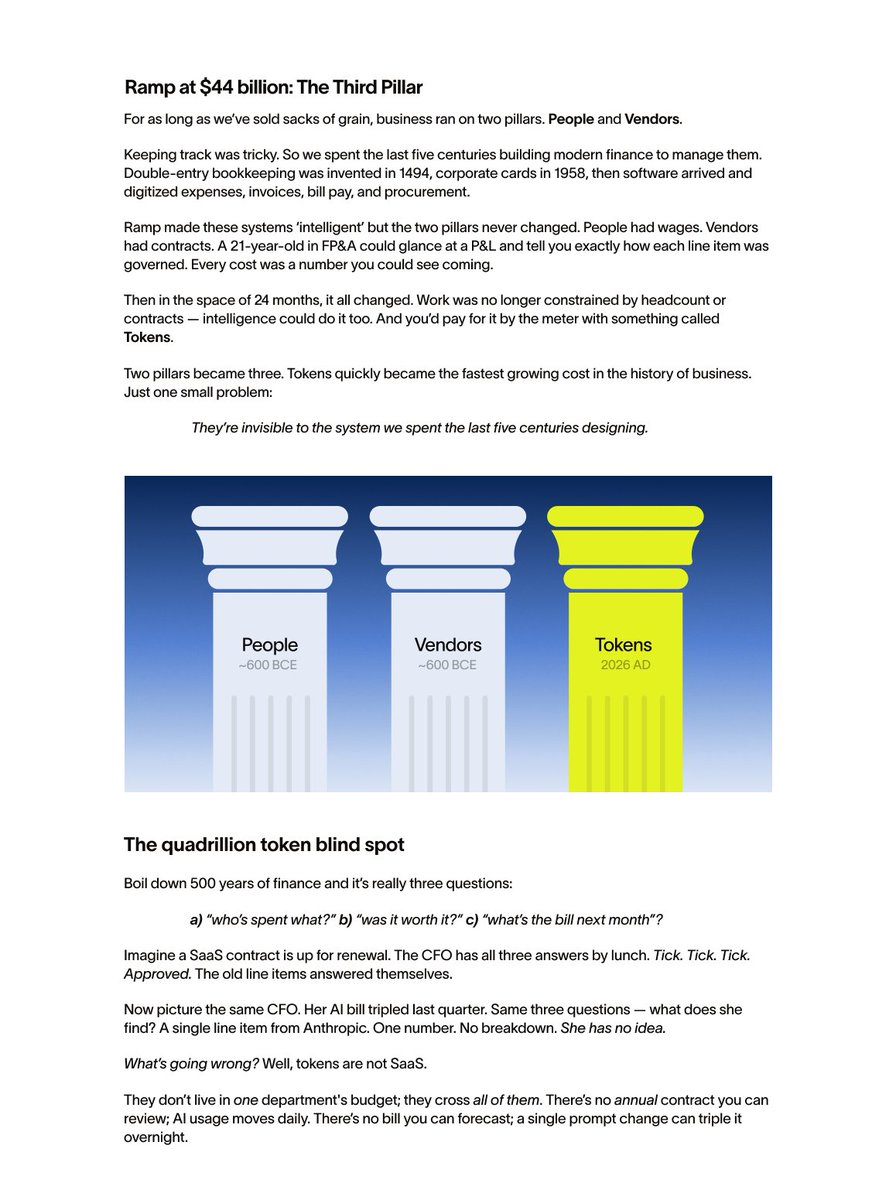
For 2000 years, business was built on two pillars. Today, a third: intelligence.
It’s your least governed cost. It’s also your single greatest opportunity.
Today we are announcing our collaboration with Pfizer to put Chai's frontier AI—including our latest model, Chai-3—directly into the hands of one of the world's leading pharmaceutical teams.
One year ago today, we launched Nucleus Embryo. The biggest leap in embryo screening since IVF began. At the time, IVF patients were choosing their future baby randomly — with no health information.
Today, Nucleus Embryo is one of the fastest-adopted technologies in modern fertility care.
In just 12 months, we've expanded to 165+ fertility clinics globally, kicking off an international patient-led movement on genetic optimization.
What a privilege it is to serve our patients, and help couples all over the world build generational health.
Learn more below.
I’m delighted to announce @chaidiscovery's collaboration with @pfizer. Their scientists will deploy our AI platform to accelerate drug discovery, including early access to our latest frontier model Chai-3.
You can learn more about this partnership and our momentum in @amyfeldman's feature in @Forbes out today
https://t.co/VBoynDgPCz
If you use conductor, codex, claude, devin, etc you can now use them all from one place AND get builtin devin review + IDE
Windsurf has evolved into Devin Desktop
Introducing Stack.
The AI operating system that lets accounting firms take on more clients without hiring. Learns your firm's process, runs the close, posts the journals. Fully auditable.
We’re living through the biggest shift in accounting since the spreadsheet.
Search agents have no explicit belief state or value function.
I think that’s why long-horizon agents degrade and test-time search saturates.
A few small experiments and thoughts:
https://t.co/OKy70XfEF7
Cognition’s $492M run-rate, your personal property manager, & more | Neo & Noteworthy
Check out our May recap of learnings and announcements by Neo portfolio companies and community members 💙
https://t.co/07WdZfZ4tF
This is the original 1953 Disneyland prospectus.
Walt created it to pitch bankers to lend him $17M for ‘a new experience in entertainment’.
He had no land and no design. So he called Herb Ryman on a Friday to sketch the entire park from scratch through the weekend without sleeping.
On Monday morning, his brother Roy carried these eight pages and the hand-drawn map to New York.
All three banks turned him down. (ABC funded it eventually).
This is the a purest version of Walt’s original design philosophy of Disneyland and all its attractions, before they even broke ground.
Disney Parks do >$30B in yearly revenue today. This is a first draft of one of the most extraordinary things ever built.
______________________
Growing up in Paris, I used to go to Disneyland every weekend.
I remember the first time we went on Thunder Mountain and I stopped at the bridge because the wood at my feet looked off.
It didn’t feel fresh. It looked like a hundred years of miners' boots had worn down the wood. And I realised someone aged the wooden flooring on purpose to feel that way.
Someone 30 years ago built it that way, everyone maintained it that way, and nobody walking past it would likely ever notice.
I remember thinking to myself, ‘Have they done the whole park like that?’ Every inch of the entire 140 acre park was like this.
The world’s largest alternative asset manager, @blackstone, leverages TextQL to enhance its data and analytics capabilities.
John Stecher oversees technology at Blackstone and across its portfolio. After evaluating a wide variety of analytics tools, he chose TextQL.
In John's words, "When I walked out of the first meeting with TextQL, I thought, wow, this is a product that many of our portfolio companies could benefit from."
Today @MeckaAI is announcing $60M in funding to become the data and deployment layer for physical AI
This raise will allow us to scale our data infrastructure, invest into new verticals, and deploy robots into the real world
This is a cool feature, but it also represents a completely new extensibility strategy for Claude Code: typescript. You can invoke typescript from within the Claude Code process and program against an API, just like you can in Pi. Workflows just first use case. A Big Deal™.
for anyone worried about “losing your mind” or becoming obsolete, this pattern matters.
socrates worried that writing, when it was invented, would hollow out the mind. our fear of AI is no different.
we didn’t develop civilization by becoming biologically smarter. we did it by building better external scaffolding - writing, the printing press, calculators, now ML models.
what we call intelligence has always been a collaboration between a brain and its tools.
wrote about this recently: https://t.co/amwEePvdR7