India's renewable energy sector is entering a more complex and consequential phase of growth.
For much of the past decade, India's renewable energy story was defined by expanding wind and solar capacity. The next phase will be driven by the ability to deliver reliable, dispatchable and grid-integrated clean power at scale.
As renewable penetration rises, solutions such as RTC power, FDRE projects, energy storage systems and hybrid renewable configurations are expected to play a central role in shaping India's energy transition.
Prafulla Pathak (@sarngarava) from NFPRC Foundation spoke to Business Standard (@bsindia) on these emerging trends and the evolving structure of India's renewable energy market.
Read the full story:
https://t.co/BqnFaRgYoO
Assam’s UCC creates a common civil framework for marriage, divorce, succession and maintenance while preserving religious ceremonies and exempting Scheduled Tribes. It also brings live-in relationships, registration systems and inheritance rules into a unified legal architecture.
Our latest legislative brief examines what the law changes, what it leaves untouched, and why it matters for the future of family law reform in India.
Read the full analysis here -
https://t.co/ZJXosUr8xj
Assam has become the first North-Eastern state and the fourth in India to enact a Uniform Civil Code, creating a single civil framework for marriage, divorce, succession and maintenance across communities while exempting Scheduled Tribes.
The law preserves religious marriage ceremonies, mandates registration of marriages and divorces, enforces monogamy uniformly, guarantees equal succession rights for daughters and widows, and formally recognises live-in relationships with legal protections for partners and children.
This brief unpacks the legislation, its constitutional foundations, key provisions, implementation architecture, and what it means for the future of civil law reform in India.
Read the full analysis below on our Substack -
https://t.co/GQjYkNHMgj
A 3.49% fiscal deficit. ₹9.56 lakh crore in debt. 15.4% of India's factories but 10.1% of manufacturing output. Only 8 districts above the state-average income level.
The data offers a useful lens into Tamil Nadu's fiscal and economic trajectory.
Read CAIG-NFPRC's latest report on Tamil Nadu's Fiscal and Economic Status -
https://t.co/XYvpX7T2Xv
1/5
Tamil Nadu remains one of India’s largest state economies, but fiscal pressures have persisted alongside economic growth.
In FY25, the State’s gross fiscal deficit stood at 3.49% of GSDP, compared to 2.44% in Maharashtra and 1.86% in Gujarat.
A look at the data:
Odisha has budgeted ₹72,100 crore towards capital outlay in 2026–27, equivalent to 6.51% of GSDP which is more than twice the national average.
Combined with a debt-to-GSDP ratio of just 14.1%, the state continues to maintain substantial fiscal capacity for long-term investment and asset creation.
Read the latest Odisha Budget Analysis 2026 on Substack -
https://t.co/piRThV7LhL
1/ NFPRC's analysis of Odisha’s 2026–27 Budget offers an interesting case study in fiscal management.
The state is projected to spend only 22.63% of its revenue receipts on salaries, pensions and interest payments which is among the lowest committed expenditure burdens among major states.
Thread🧵
🔷Our latest analysis finds that Karnataka’s interest payments are projected to rise from ₹45,600 crore in 2025–26 (RE) to ₹53,332 crore in 2026–27 which is a jump of nearly ₹7,700 crore in a single year.
Interest expenditure is now the fastest-growing component of the state's committed spending obligations.
Read the full analysis by CLPG - NFPRC Foundation on Substack:
https://t.co/NfABHjZmmq
1/ Karnataka State Budget Analysis 2026-27 by CLPG - NFPRC Foundation
Karnataka’s fiscal position remains constrained by a high level of committed expenditure. In 2026–27, the state will spend ₹1.86 lakh crore on salaries, pensions and interest payments equivalent to 59.12% of its revenue receipts.
That means nearly ₹59 of every ₹100 earned is already pre-committed.
Thread🧵
Following the Quad Foreign Ministers’ Meeting on 26 May 2026, the member nations announced new initiatives on Indo-Pacific energy security and critical mineral supply chains reinforcing the growing strategic importance of resilient energy and logistics networks.
In this context, NFPRC Foundation’s Ritik Bhandari (@bbhandarii), Team Lead at the Centre for Law, Policy and Governance, spoke to BusinessWorld on why diversified access to lithium, cobalt, graphite, shipping corridors, and processing ecosystems will be crucial for India’s long-term economic and clean energy security.
Read the full article here:
https://t.co/EFzo29fTpR
Thank you, Dr. C.N. Manjunath (@DrCNManjunath) , for joining the workshop on “Advancing Health and Education Reforms: Building Viksit Bharat @ 2047” and for sharing your valuable insights on Ayushman Bharat and healthcare reforms.
Your perspectives on strengthening India’s healthcare ecosystem and advancing accessible, quality healthcare added immense value to the discussions on building a developed India by 2047.
We are grateful for your presence and contribution to this important dialogue.
Honoured to speak at the workshop on “Advancing Health and Education Reforms: Building Viksit Bharat @ 2047”.
A platform to exchange ideas and discuss transformative reforms in healthcare and education—key drivers in India’s journey towards becoming a developed nation by 2047
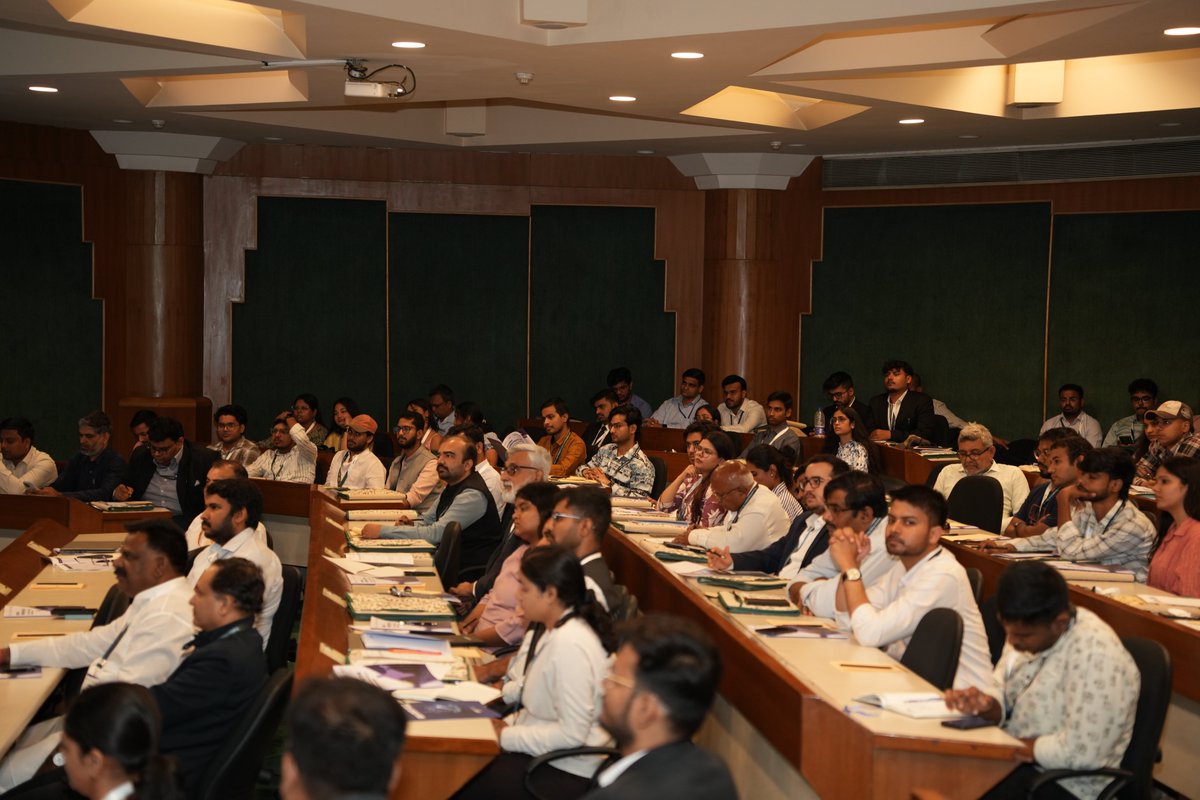
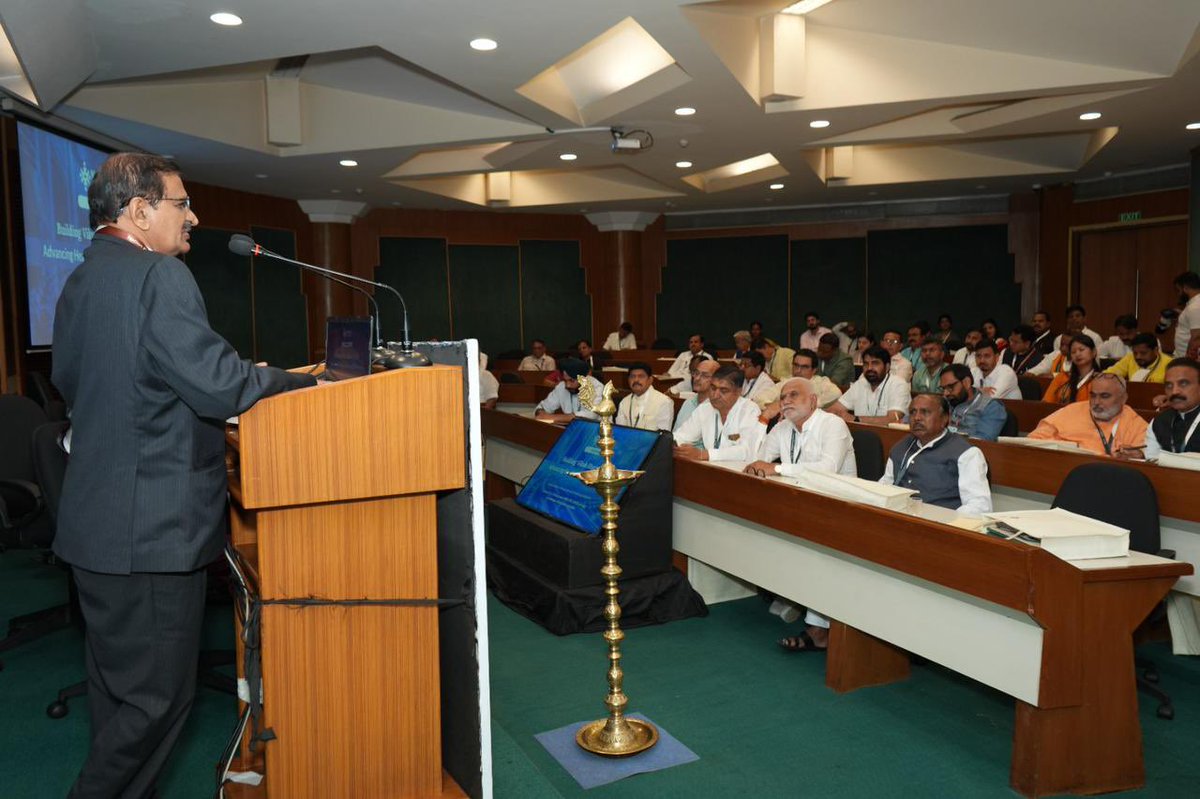
The NFPRC Foundation successfully organised a workshop for Parliamentarians and Legislators on the theme “Building Viksit Bharat @ 2047: Advancing Health and Education Reforms” at India Habitat Centre, New Delhi.
The workshop featured insightful sessions by Dr. C.N. Manjunath, MP, Lok Sabha (@DrCNManjunath) on Ayushman Bharat, Dr. Sambit Patra, MP, Lok Sabha (@sambitswaraj) on digital communications and public engagement, Shri Aashish Chandorkar (@c_aashish), Permanent Counsellor to India at WTO, through a special video address on India’s Covid-19 vaccine success story, and Shri Saurabh Chopra of Central Square Foundation on the reforms and vision of NEP 2020.
Shri Tarun Chugh (@tarunchughbjp), Chairman, NFPRC Foundation, and Shri Abhinav Prakash (@Abhina_Prakash), Board Member, NFPRC Foundation, were also present during the programme.
We extend our sincere gratitude to all speakers, legislators, participants and dignitaries for their valuable insights and contributions towards strengthening governance, public policy and institutional capacity in the journey towards Viksit Bharat @ 2047.
Today, @NFPRC_Ind convened a focused Workshop for Parliamentarians & Legislators at India Habitat Centre, New Delhi — bringing together MPs, MLAs & policy experts for meaningful dialogue on healthcare, education & legislative communication.
Under the visionary leadership of PM Shri @narendramodi ji, historic reforms like Ayushman Bharat & NEP 2020 have transformed India's health & education landscape. Today's workshop deepened our understanding of how to take these reforms to the last mile — to every citizen, every constituency.
From strengthening Ayushman Bharat's financial protection framework to advancing competency-based learning under NEP 2020 & sharpening digital outreach for legislators — the discussions were insightful, action-oriented & future-focused.
Achieving the vision of Viksit Bharat@2047 demands effective implementation, institutional coordination & citizen-centric governance. Grateful to @DrCNManjunath, @sambitswaraj, Shri Saurabh Chopra from @CSF_India & @c_aashish for their valuable contributions.
Data-backed policymaking is the foundation of a stronger, more prosperous India.
Thank you Shri Aashish Chandorkar (@c_aashish) ji for your thoughtful video address to the parliamentarians and legislators at the NFPRC Foundation workshop.
Your reflections on India’s Covid-19 vaccine journey and the broader lessons in public policy, governance and communication added valuable perspective to the discussions on building a future-ready Viksit Bharat @ 2047.
We are grateful for your contribution and support to the initiative.
Grateful to @NFPRC_Ind and @tarunchughbjp ji for inviting me to deliver a video based talk in this workshop for Parliamentarians and legislators.
I spoke on "Braving A Viral Storm: India's Covid-19 Vaccine Story", my book coauthored with @surajbrf and published by @Rupa_Books in January 2023.
Thank you Shri Sambit Patra (@sambitswaraj) ji for sharing your insights at the NFPRC Foundation’s capacity building programme on “Building Viksit Bharat @ 2047: Advancing Health and Education Reforms.”
Your insights on strategic communication, digital media and effective public engagement highlighted an increasingly vital pillar of governance in evolving India.
We are grateful for your valuable participation and contribution to the discussions.
Participated as a speaker in the capacity building programme for legislators on the theme “Building Viksit Bharat @2047: Advancing Health and Education Reforms”, organised by the NFPRC Foundation in New Delhi, and addressed the gathering on the critical role of health, education and policy-driven reforms in shaping India’s development journey towards 2047.
The interaction witnessed insightful discussions on strengthening human capital, improving governance outcomes and building a future-ready and Vikasit Bharat!
Participated as a speaker in the capacity building programme for legislators on the theme “Building Viksit Bharat @2047: Advancing Health and Education Reforms”, organised by the NFPRC Foundation in New Delhi, and addressed the gathering on the critical role of health, education and policy-driven reforms in shaping India’s development journey towards 2047.
The interaction witnessed insightful discussions on strengthening human capital, improving governance outcomes and building a future-ready and Vikasit Bharat!
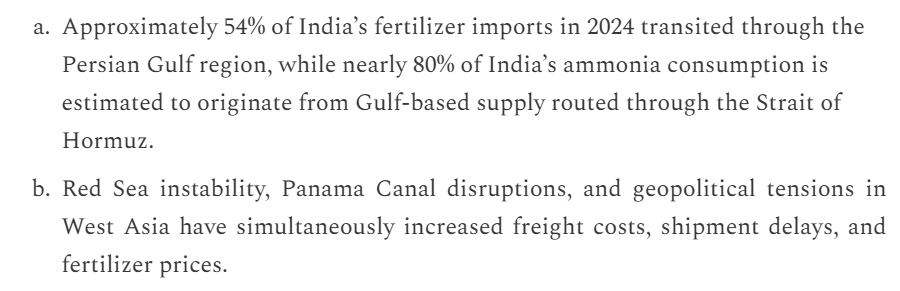
➡️Nearly 54% of India’s fertiliser imports in 2024 transited through the Persian Gulf region, while close to 80% of ammonia consumption remains linked to Gulf-based supply routes through the Strait of Hormuz.
With Red Sea disruptions and wider geopolitical tensions affecting freight and input costs, supply-chain resilience is becoming increasingly important for India’s agricultural economy.
Read the our latest analysis here:
https://t.co/xS7lZhUo0C
➡️India imported nearly 177 LMT of fertilisers in 2023–24, while urea import prices rose from around $508 per tonne in late 2025 to nearly $935–959 per tonne by April 2026.
At the same time, the emergence of El Niño conditions has renewed concerns around monsoon variability, agricultural output and food inflation.
Our latest analysis examines the intersection of climate risks, fertiliser dependence and agrarian vulnerability in India.
Read the full analysis here:
https://t.co/cRsQlXKWL0
🔷On 16 May 2026, ASML signed a strategic partnership with Tata Electronics to support India’s first commercial semiconductor fabrication facility in Dholera, backed by an US$11 billion investment.
India’s semiconductor market is projected to grow to US$100–110 billion by 2030.
Read CLPG - NFPRC's full analysis here:
https://t.co/gZnrNuPXSh
1/ On 16 May 2026, ASML and Tata Electronics signed a strategic partnership to support India’s first commercial semiconductor fabrication facility in Dholera, backed by an US$11 billion investment.
The agreement marks one of the most consequential developments yet in India’s semiconductor ambitions.
Thread🧵
🔷CAIG - NFPRC’s latest analytical study examines Kerala’s fiscal resilience, debt burden, expenditure quality and structural economic vulnerabilities through a multi-dimensional data framework.
The report finds that Kerala’s Fiscal Resilience Index declined from 37.01 in 2016–17 to 21.41 in 2024–25, alongside persistently low capital investment and rising debt pressures.
Read the full analysis on India Public Finances Substack by CAIG - NFPRC Foundation
https://t.co/JYrhMO5ccv
1/ Kerala’s Fiscal Resilience Index has fallen from 37.01 in 2016–17 to 21.41 in 2024–25.
Over the same period, Odisha rose to 73.13.
A widening divergence that raises deeper questions about Kerala’s fiscal model and long-term sustainability.
Thread🧵
NFPRC Foundation convened a closed-door roundtable on 20th May, 2026 on the theme “Distributed Solar and The Future Grid: Grid Integration, Market Reform, and the Future of Decentralised Energy in India.”
The discussion brought together regulators, DISCOM representatives, grid and system experts, storage manufacturers, renewable energy developers, technology providers, policy researchers, and practitioners working across India’s distributed energy ecosystem.
Building on India’s remarkable progress in renewable energy deployment and distributed solar adoption, the roundtable focused on the next phase of the energy transition: strengthening grid integration, enabling flexibility, modernising market design, and unlocking the full system value of decentralised energy resources.
Key themes discussed included:
• The growing role of storage, flexibility, and demand-side participation in supporting high-renewable grids
• Emerging approaches around net billing, time-of-day pricing, and future tariff design
• The importance of feeder-level visibility, forecasting, hosting-capacity assessments, and digital infrastructure
• The evolving role of DISCOMs in managing increasingly decentralised and dynamic electricity networks
• Opportunities for battery aggregation, smart energy management, and consumer participation
• The need for harmonised standards, faster innovation pathways, and long-term ecosystem development for storage technologies
A strong consensus emerged that distributed renewable energy, storage, and digital energy systems will play an increasingly important role in supporting reliability, resilience, consumer participation, and economic growth in India’s future power system.
NFPRC Foundation thanks all participants for contributing to a rich and forward-looking discussion on the future of decentralised energy in India.
@caig_nfprc
Gujarat now raises 71.4% of its revenue receipts through its own resources, indicating relatively lower dependence on central transfers compared to many large states. That fiscal capacity is central to understanding the state’s long-term development model.
Read the full NFPRC analysis below.
https://t.co/0phKIvHNdz
Gujarat’s 2026–27 Budget reflects a continued focus on investment-led growth and fiscal stability. With projected GSDP growth of 11.4%, a 25% increase in capital outlay to ₹1.07 lakh crore, and fiscal deficit contained at 1.97% of GSDP, the state continues to prioritise infrastructure expansion while maintaining fiscal discipline.
Our latest NFPRC analysis breaks down the key trends, numbers and policy direction shaping Gujarat’s growth trajectory. Read here -
https://t.co/bBe3pc5UZt
On 8th May, NFPRC Foundation launched the report titled “Beyond Infrastructure: India’s Data Centre Pathway to Digital Sovereignty” in the distinguished presence of Hon’ble Minister Shri Jitin Prasada (@JitinPrasada) ji, Hon’ble MP Shri Sujeet Kumar (@SujeetKOfficial) ji, Hon’ble MP Shri Ashok Kumar Mittal (@DrAshokKMittal) ji, and NFPRC Foundation’s Chairperson Shri Tarun Chugh (@tarunchughbjp) ji.
The report examines India’s rapidly expanding data centre ecosystem and outlines a strategic roadmap for strengthening digital sovereignty, AI readiness, resilient infrastructure, and trusted digital growth. It also highlights the policy and infrastructure priorities required to position India as a global hub for secure digital ecosystems.
The launch was followed by a panel discussion featuring experts and industry stakeholders on the future of India’s digital infrastructure landscape.
Read the full report here: https://t.co/6WmhWeVUlh
@NFPRC_Ind #DigitalSovereignty #DataCentres
Grateful for the opportunity to present NFPRC’s work and policy research to Hon. CM Shri Devendra Fadnavis ji. (@Dev_Fadnavis)
As India enters a decade of competitive federal growth, states like Maharashtra will play a defining role in shaping the country’s economic and governance trajectory.
NFPRC remains committed to producing rigorous, actionable and institution-oriented policy research that bridges ideas with implementation.
Looking forward to deeper engagement on growth, governance and public policy.
Got an opportunity to present the work of @NFPRC_Ind to Hon. @Dev_Fadnavis ji in Delhi earlier today.
Hoping to collaborate with the Maharashtra govt closely on policy topics related to economic growth going forward.
He serves as an inspiration to us policy wonks!
At the NFPRC Foundation launch of the report “Beyond Infrastructure : India’s Data Centre Pathway and Digital Sovereignty .” Along with Shri @tarunchughbjp ji and MP Shri @SujeetKOfficial .
India today is not merely adopting technology, but shaping the future of trusted digital ecosystems for the world.
During the conference discussions focused on digital resilience, sovereign cloud infrastructure, AI readiness and the roadmap for sustainable data centre capacity growth .
The Government remains committed to enabling innovation while ensuring security, trust and inclusion. 🇮🇳
#DigitalSovereignty @NFPRC_Ind