Can you build a country like a startup? Trump proposes “Freedom Cities,” while Praxis builds a community around the network state idea. An interesting look at how technology and private capital are reshaping what a country can be.
https://t.co/IMQlaQq9zW
Can you build a country like a startup? Trump proposes “Freedom Cities,” while Praxis builds a community around the network state idea. An interesting look at how technology and private capital are reshaping what a country can be.
https://t.co/IMQlaQq9zW
Signs of the era:
· The fabric of society torn apart through the dismantling of the public school system
· A vast income gap between the rich and the poor
· The creation of networked "charter cities" and "charter states" outside the United States for the elite
Algorithms and processes are dead. Only the tops and their collabs remain.
A million followers no longer guarantees views: the algorithm isn't an asset, it's a rented storefront. They can show you. They can switch you off.
Two types of power:
— the platform and its margin;
— the producer and his power over attention.
The end-consumer market is an attention market. Processes and funnels are the MBA of the past. Labubu is worth more than Gazprom. Trump's memecoin raises a billion.
To get a round, you need a drop. A bright flash. Hype. Systemic hype.
Our entry is a closed graph for the TOPS of marketing, branding, influencers and media. One criterion: a spot on the shelf in the consumer's mind through share of voice. No shelf — you don't exist.
If the tops come in, collabs happen like a rave — global only. The world's main deals run through the graph. Money gets stuffed inside. Subscription, percentage, land — it'll sort itself out.
The main thing is for the market-makers to agree among themselves and get to the product. Collab product . The rest is small business.
The End of the American Dream
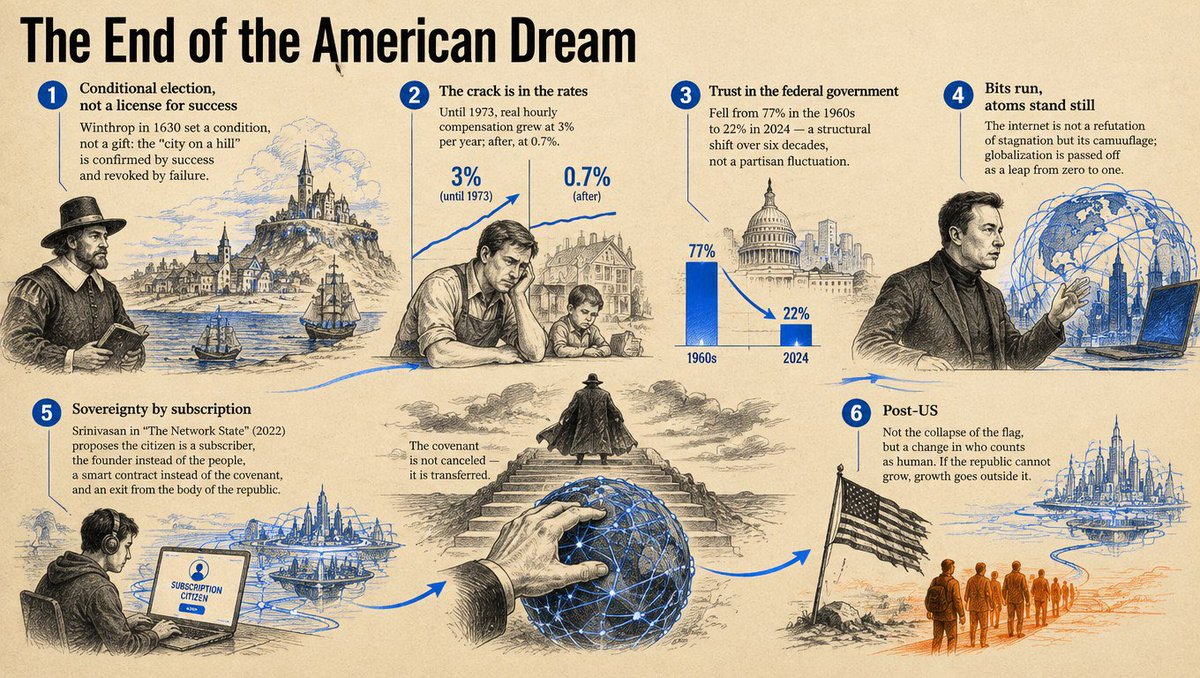
Winthrop 1630: the "city on a hill" was a condition, not a gift. Success confirms it. Failure revokes it. Conditional election — not a license for success.
1776 removed the judgment, kept the election. Happiness became a right, without the threat of retribution. Tocqueville saw the flip side: an endless race that never satisfies.
The crack is in the rates. Until 1973: +3% a year. After: +0.7%. Children live worse than their parents. The "pursuit of happiness" fails for the majority. The contract does not work.
Trust in the federal government: 77% in the 1960s → 22% in 2024. Not a partisan blip. A structural shift over six decades.
Thiel: bits run, atoms stand still. The internet isn't a refutation of stagnation — it's the camouflage. Globalization sold as a leap from zero to one.
His katechon isn't the police. It's political theology. The Antichrist doesn't come as Skynet — he comes as the one who promises to save us from Skynet. The slogan: "peace and safety."
Palantir, 2003. Not a press release — a function. Data, signals, holding chaos at bay by vision. Early money from In-Q-Tel, the CIA's venture arm. The all-seeing eye no longer belongs to Providence.
Douthat asked Thiel straight: are you the instrument of this power? Thiel said the scenarios are different. The toggle switch, by his own joke, is one.
Second door, not Thiel's: Srinivasan's "Network State" (2022). Sovereignty by subscription. Citizen as subscriber. Founder instead of people. Smart contract instead of covenant. Exit from the body of the republic.
Finale: not the collapse of the flag — a change in who counts as human. If the republic can't grow, growth goes outside it. The covenant isn't canceled. It's transferred. Post-US is a change of carrier.
I'm an apologist for network states. Not because they're beautiful. Because they're the next carrier of the covenant.
No Chance for Endless Global Expansion
Global American companies have no chance for endless global expansion.
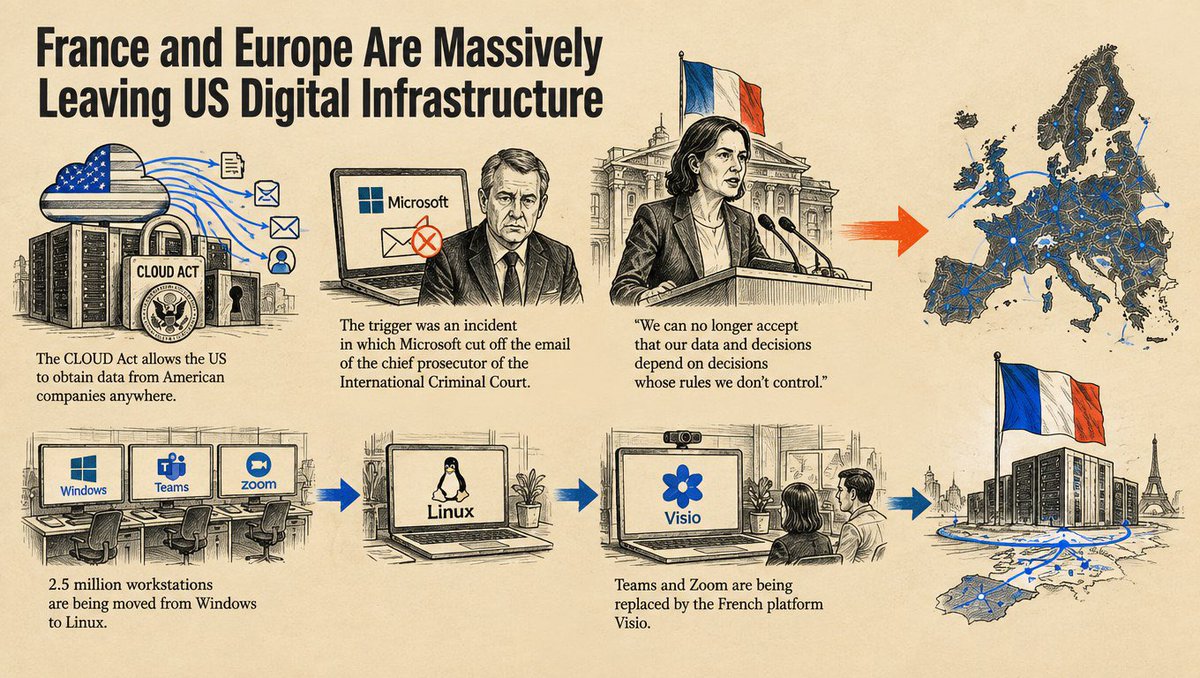
On April 8, France announced: all government services are leaving Windows for Linux. 2.5 million workstations. Teams and Zoom — out. The reason? Microsoft cut off the email of the chief prosecutor of the International Criminal Court. Just took it and cut it off.
This is the CLOUD Act. The US can get your data anywhere and cut you off whenever it wants.
The French minister: "We can no longer accept that our data depends on decisions whose rules we don't control."
France's gendarmerie has been on Linux since 2008. 97% of their machines. €2 million a year in savings.
This isn't about Linux. It's about renting. You rent — you get cut off.
The real war has begun. Not over territory — over the digital made. Global American companies lost not because they're weak. Because their model is renting. The world wants ownership.
Look at the Western Hemisphere. A new market is forming there. Uruguay, Canada, Mexico, Brazil. There's still room to maneuver.
Producers must understand: their node isn't a platform. Their node is relationships.
Join REPKA STATE.
Network State Conference — October 9, 2026, Singapore.
Vitalik Buterin, Zooko Wilcox, Binance CEO Richard Teng, Olaf Carlson-Wee. Tickets $99, online free.
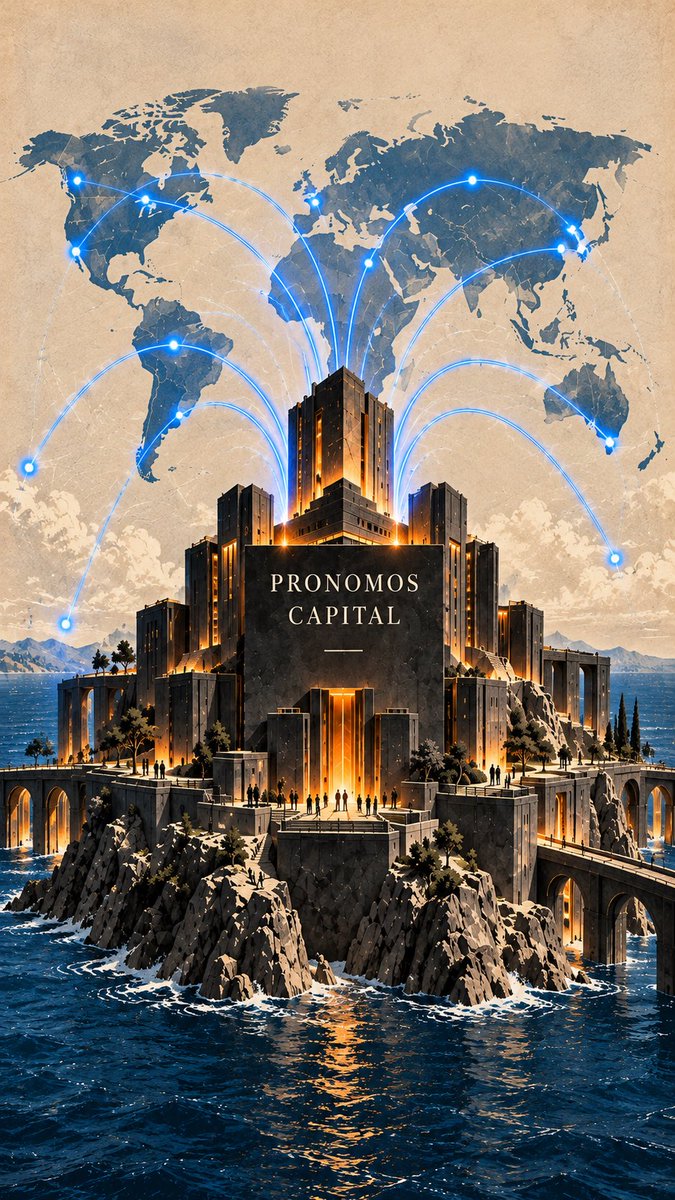
Peter Thiel funds Praxis — a startup building a network state in Uruguay. $525M raised. Model: subscription instead of citizenship, contract instead of law, blockchain instead of bureaucracy. #networkstate #praxis
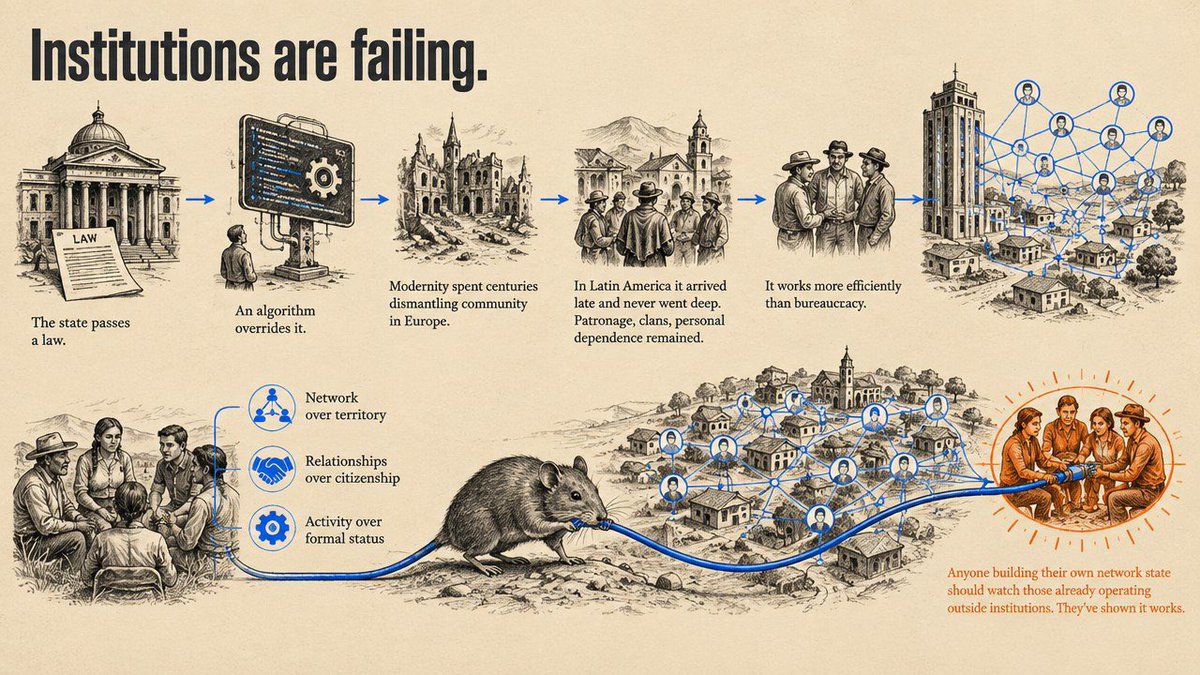
Institutions are failing. The state passes a law — an algorithm overrides it. Modernity spent centuries dismantling community in Europe. In Latin America it arrived late and never went deep. Patronage, clans, personal dependence remained. It works more efficiently than bureaucracy.
Traditional practices win because they already know how to operate without institutions. Network over territory. Relationships over citizenship. Activity over formal status.
The real reason people are freaking out about AI is that the economics don't add up — and so they're just trying to rope in even more investors to keep this circus going.
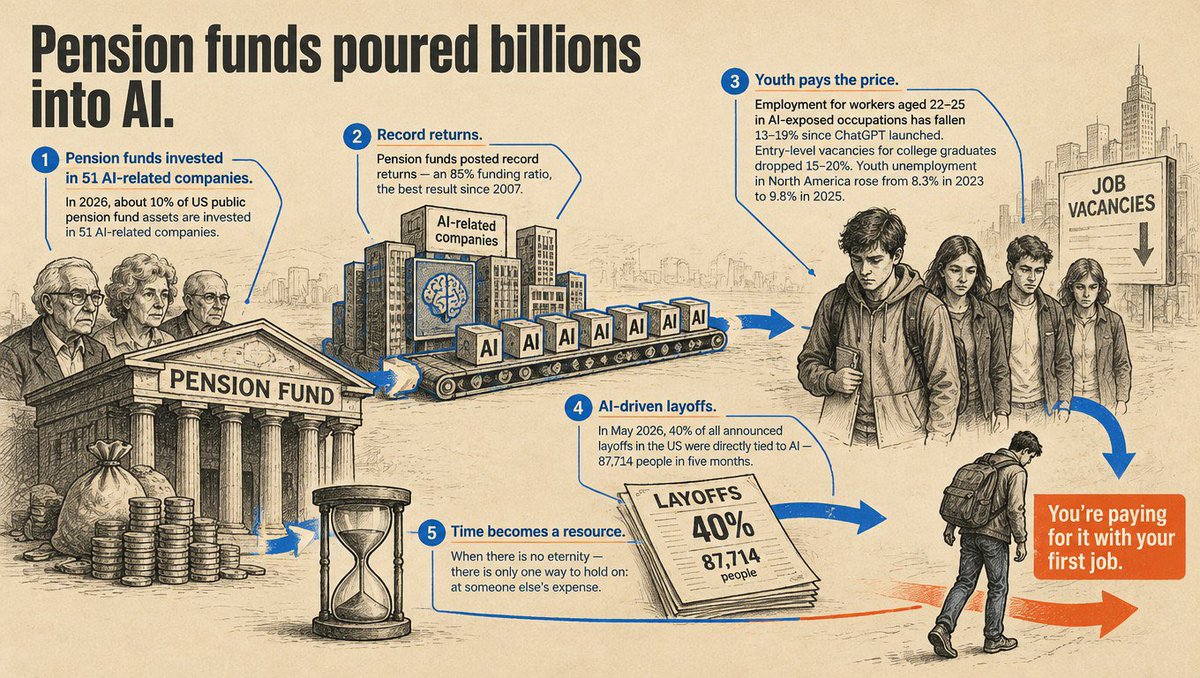
In 2026, about 10% of US public pension fund assets are invested in 51 AI-related companies. Pension funds posted record returns — an 85% funding ratio, the best result since 2007.
At whose expense?
Employment for workers aged 22–25 in AI-exposed occupations has fallen 13–19% since ChatGPT launched. Entry-level vacancies for college graduates dropped 15–20%. Youth unemployment in North America rose from 8.3% in 2023 to 9.8% in 2025.
In May 2026, 40% of all announced layoffs in the US were directly tied to AI — 87,714 people in five months.
We live in a world where nothing is eternal. Where beyond there is no God. Where there is no redemption, no afterlife, no final meaning. There is only here and now. Only what you can hold onto while you're alive.
And when there is no eternity — there is only one way to hold on: at someone else's expense.
The system is built so that the present feeds on the future. Age holds onto its own at the expense of youth. Those who have already lived cling to what remains — at the expense of those who haven't yet begun. The social contract has always rested on sacrifice.
"My GOD is not your GOD."
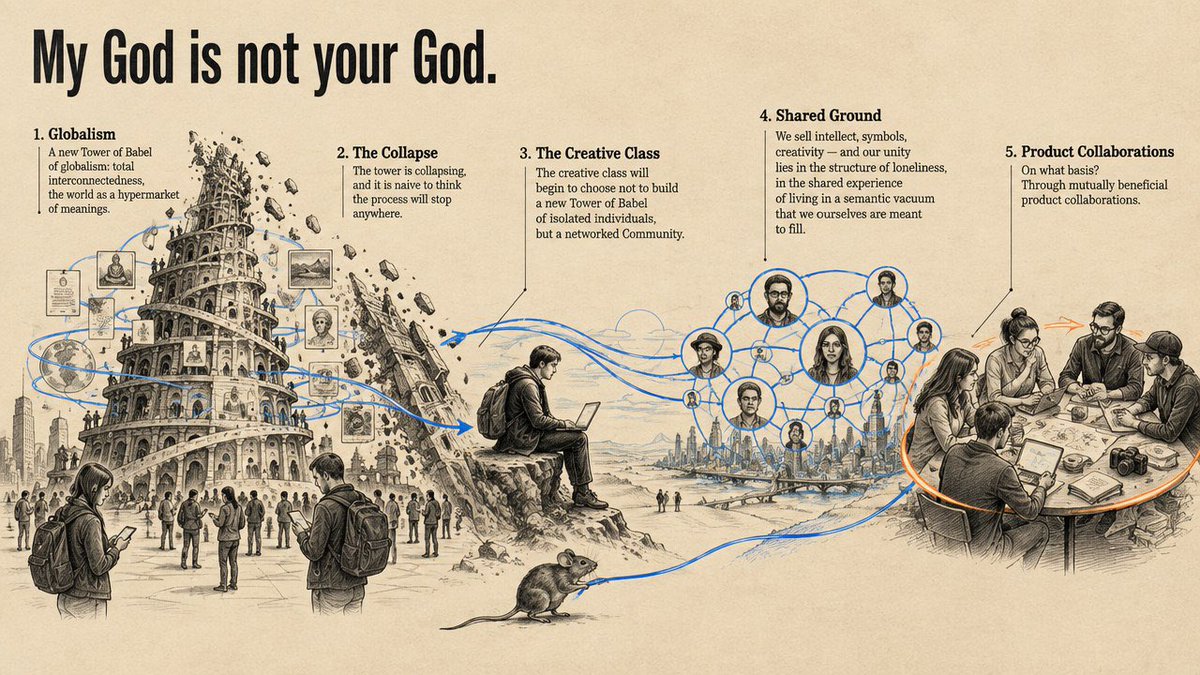
Humanity has built a new Tower of Babel of globalism: total interconnectedness, the world as a hypermarket of meanings. We have nearly reached the heavens—a level where anyone can assemble their own ideal reality, their personal god, from fragments of spiritual practices, philosophical quotes, and aesthetic experiences. Tradition, meanwhile, is no longer an arbiter—it is merely one niche content package on the menu.
Today, the tower is collapsing, and it is naive to think the process will stop anywhere. The mechanism at work is this: the higher you climb toward personal transcendence, the less you understand the Other and the less you believe in imposed communities.
The motto of the coming era: "My God is not your God." At its limit, the personification of the media field and the autonomy of the individual in choosing a spiritual path lead to an individual religion of one person—completing the journey from "shared ritual" to "personal brand" of a particular soul.
What is actually happening:
At the current turn of history, the builders of the tower of globalism have been the creative class—through the spread of culture, technology, and media. As a result of their activity, the former collective subjects of history are losing their monopoly on narrative and are responding accordingly, thereby only accelerating the overall entropy.
A new common ground—
What can be opposed to entropy? I believe that the "builders" themselves can form a new group identity—not on the principle of "blood and soil," but on the basis of a shared mode of thinking and activity:
"We sell intellect, symbols, creativity—and our unity lies in the structure of loneliness, in the shared experience of living in a semantic vacuum that we ourselves are meant to fill."
The creative class, being the first to pass through the desert of relativism, will begin to choose not to build a new Tower of Babel of isolated individuals, but a networked Community. On what basis? Through mutually beneficial product collaborations.
AI trains on your language, your culture, your data. Then sells your own reality back to you — packaged in someone else's meaning.
Colonization is no longer about territory. It's about consciousness.
Modernity destroyed the community. It replaced it with institutions: courts, police, parliament, contract.
In Latin America, modernity arrived late and never penetrated deep. Medieval forms survived there: patronage, clans, personal loyalty, the shadow economy. This isn't backwardness. It's a different structure.
A cartel isn't a gang. It's feudalism without a king. A vertical that recognizes no higher authority. Lord and vassals. Fief and tribute. "The rules" instead of law.
Now modernity is collapsing everywhere. Institutions can't handle the turbulence. The state passes a law — the algorithm cancels it.
In these conditions, those who kept traditional practices win. Not because they're better. But because they already know how to operate without institutions. They depend on relationships, not the state.
A cartel is the extreme form of this. But the logic is the same as with producers: network over territory, activity over citizenship, relationships over institutions.
The difference is one thing. A cartel extracts value. Producers create it.
Those who want to build their own network state should watch cartels. They've shown it works. The question is how to do it differently.
World War I wiped out empires. World War II wiped out colonial systems. The current war will wipe out nation-states.
Borders no longer protect. Data, capital, attention flow through them freely. The state passes a law — the algorithm cancels it.
Macro-regions are coming — zones of interest where security, economy, and culture are bound into a single node. On the borders of macro-zones it will be hot. That means: Southeast Asia, Cyprus, Israel, Europe, India, Pakistan, Latin America, and the US itself can ignite from within.
The future is not with nation-states. In terms of social organization — it belongs to warlords and cartels.