We are pleased to share that the following data sets are available:
➡️Final versions of the National Study of Caregiving (NSOC) IV Round 13
➡️Additionally, updated NHATS Round 12 files have been released.
We recommend users working with Round 12 download the reissued files (Version 3). Updates are provided in a crosswalk of changes between versions 2 and 3.
Data files are available in SAS and Stata formats.
To apply for access to the sensitive NSOC data, please visit https://t.co/ytbA8XfoYe
📣 #NHATS/#NSOC Webinar Noon to 1 PM ET on Fri., April 4th:
Speaker: Dr. Andrew Jopson (Johns Hopkins University)
Topic: “#Variation in Characteristics and #Outcomes Among #Older Dual-Enrollees Living in Areas with Managed #Longterm#Services and #Supports (#MLTSS)”
Register: https://t.co/ePw5E0a0pG
.@JuliaBurgdorf, Vicki Freedman & @jwolff_sph examined data from @NHATS_NSOC on people with dementia who live in the community & their caregivers to understand the implications of Medicare's new Guiding an Improved Dementia Experience model https://t.co/C4YsVeshdH
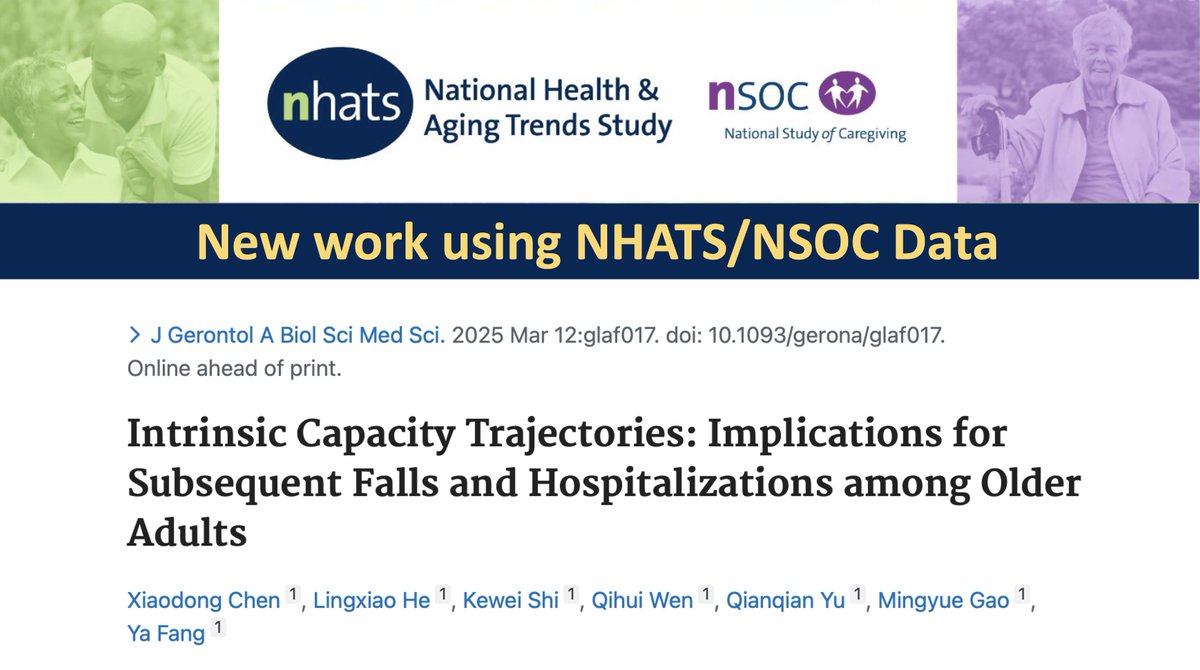
New work using #NHATS/#NSOC data by Dr. Xiadong Chen et al. in The Journals of #Gerontology Series A:
#Intrinsic#Capacity Trajectories: Implications for Subsequent #Falls and #Hospitalizations among #OlderAdults
"#IC trajectories were associated with falls and hospitalizations. Strategies focusing on improving and maintaining IC at a higher level over time could help reduce the subsequent risk of falls and hospitalizations."
Read the research: https://t.co/tBNvD4y5Qd
📣 #NHATS/#NSOC Webinar Noon to 1 PM ET on Fri., April 4th:
Speaker: Dr. Andrew Jopson (Johns Hopkins University)
Topic: “#Variation in Characteristics and #Outcomes Among #Older Dual-Enrollees Living in Areas with Managed #Longterm#Services and #Supports (#MLTSS)”
Register: https://t.co/ePw5E0a0pG
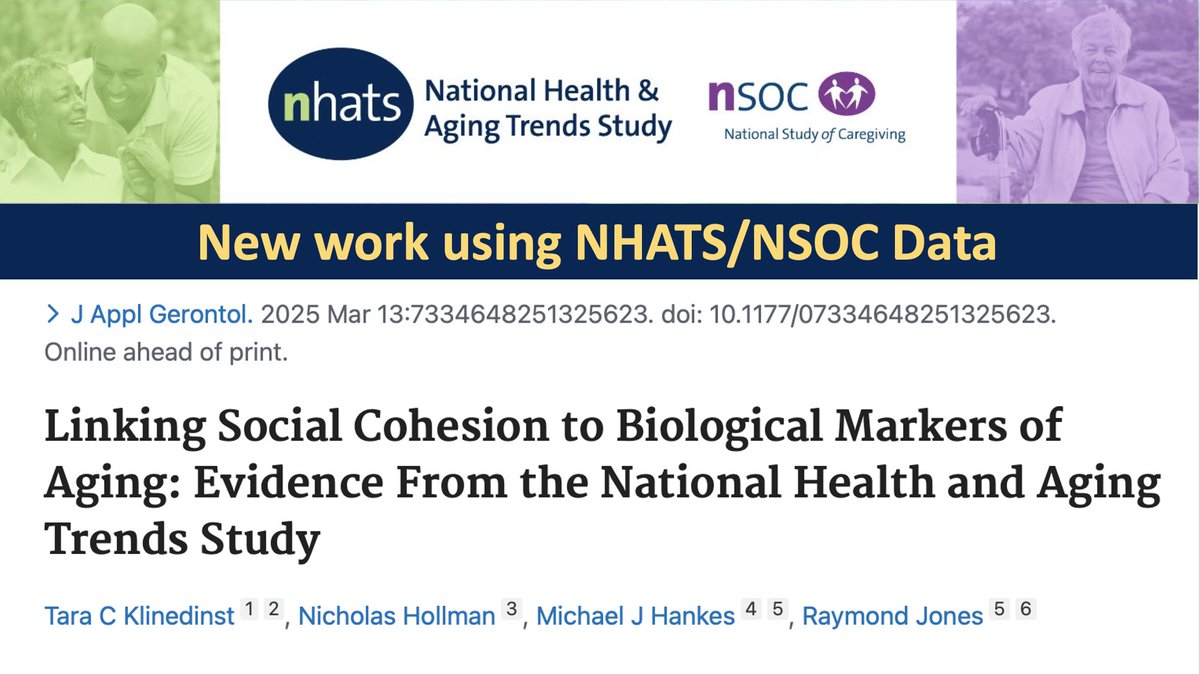
New work using #NHATS/#NSOC data by Dr. Tara Klinedinst et al. in the Journal of Applied Gerontology:
Linking #Social#Cohesion to #Biological#Markers of #Aging: Evidence From the National Health and Aging Trends Study
"Social cohesion, a measure of #community#belonging, and #inflammatory #biomarkers, like #interleukin-6 (#IL6) and c-reactive protein (#CRP), have emerged as significant factors influencing age-related chronic conditions and functional #decline among #olderadults. Understanding the link between social cohesion and #inflammation is particularly relevant in aging populations, as with age, social networks often diminish, and the prevalence of inflammatory conditions increases. Using data from the National Health and Aging Trends Study (NHATS), we assessed the relationship between low social cohesion and IL-6 and CRP. We found that low social cohesion was associated with higher levels of CRP and IL-6 after adjusting for the influence of sociodemographic variables. These findings could inform health policies and community-level interventions designed to enhance social cohesion for aging adults."
Read the research: https://t.co/Gu3a2n5iwG
📣 #NHATS/#NSOC Webinar Noon to 1 PM ET on Fri., April 4th:
Speaker: Dr. Andrew Jopson (Johns Hopkins University)
Topic: “#Variation in Characteristics and #Outcomes Among #Older Dual-Enrollees Living in Areas with Managed #Longterm#Services and #Supports (#MLTSS)”
Register: https://t.co/ePw5E0a0pG
We are pleased to share that the following data sets are available:
➡️Final versions of the National Study of Caregiving (NSOC) IV Round 13
➡️Additionally, updated NHATS Round 12 files have been released.
We recommend users working with Round 12 download the reissued files (Version 3). Updates are provided in a crosswalk of changes between versions 2 and 3.
Data files are available in SAS and Stata formats.
To apply for access to the sensitive NSOC data, please visit https://t.co/ytbA8XfoYe
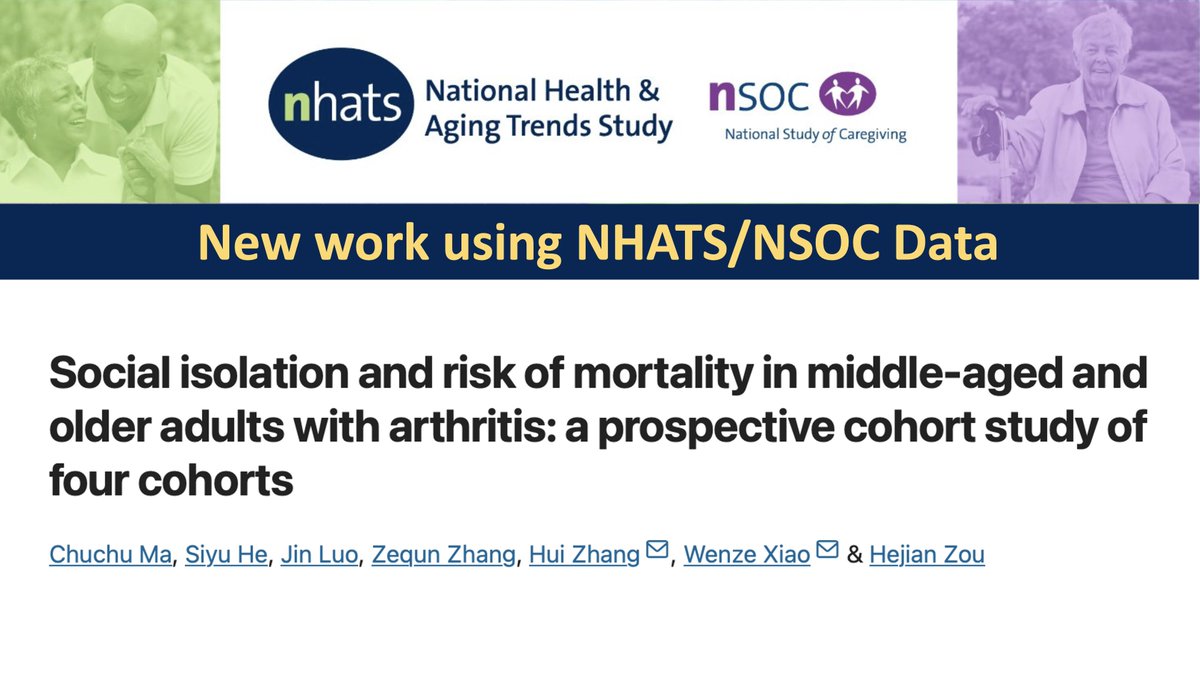
New work using #NHATS/#NSOC data by Dr. Ma et al. in Scientific Reports:
#Social#isolation and risk of #mortality in #middle-#aged and #olderadults with #arthritis: a prospective cohort study of four cohorts
"Overall, this study systematically reveals, for the first time, the association between social isolation and #increased risk of mortality in individuals with arthritis. This finding underscores the importance of social isolation in chronic disease management, particularly for arthritis patients. Further study should explore the causal relationship between social isolation and arthritis prognosis and consider temporal changes to better understand and intervene in this risk factor."
Read the research: https://t.co/pLkYjNIUbq
NEW: In the United States, over 24 million people provide unpaid care for older adults—a 32% increase from a decade ago.
These relatives, friends & neighbors report increasing demands on their time, as well as financial, emotional & physical challenges. https://t.co/u68U0WYNK0
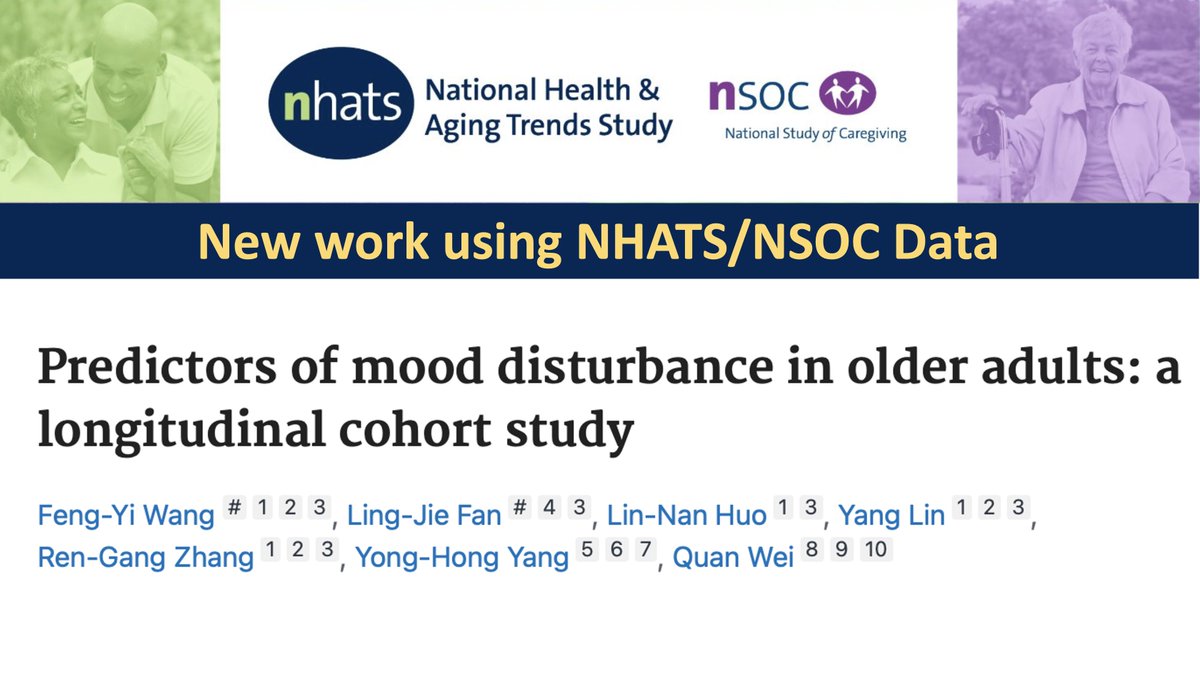
New work using #NHATS/#NSOC by Dr. Feng-Yi Wang et al. in European Geriatric Medicine:
#Predictors of #mood#disturbance in #olderadults: a longitudinal cohort study
"#Socioeconomic status, #race, #health conditions, and #cognitive function are significant predictors of mood disturbances in older adults. These findings suggest the importance of developing targeted interventions based on #income levels and addressing #modifiable #risk #factors."
Read the research: https://t.co/cYco7uGExr
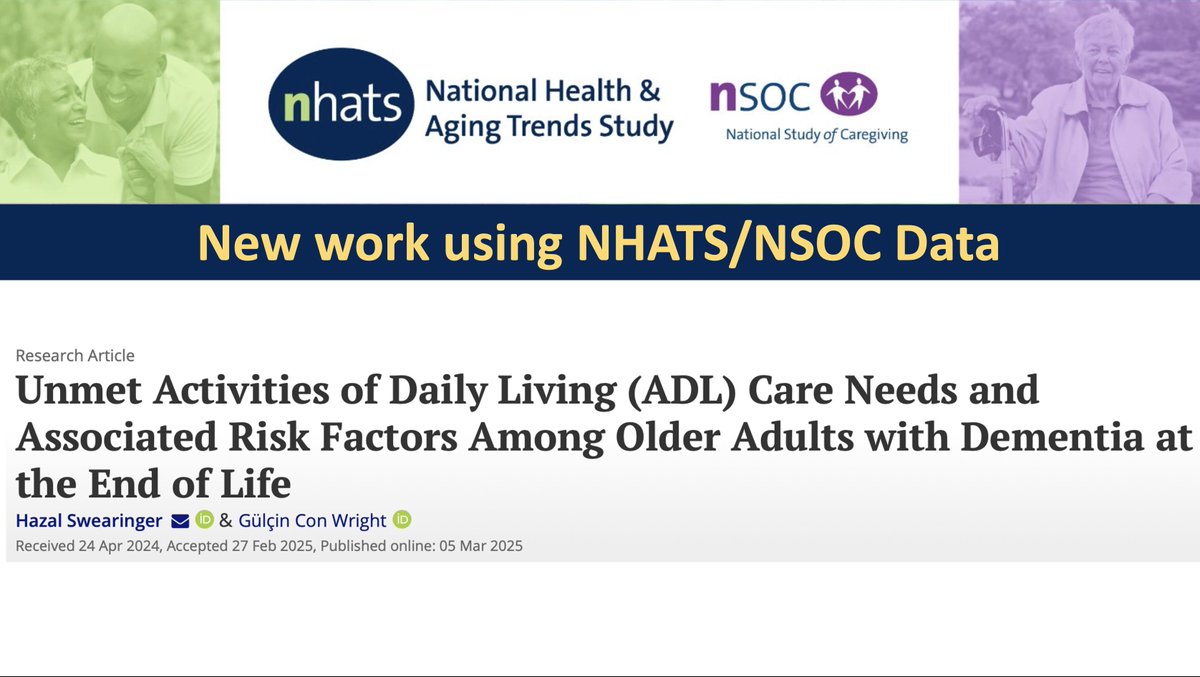
New work using #NHATS/#NSOC data by Drs. Hazal Swearinger & Gulcin Con Wright in the Journal of Gerontological Social Work:
#Unmet Activities of Daily Living (#ADL) Care #Needs and Associated Risk Factors Among #OlderAdults with #Dementia at the #EndofLife
"This paper examined the prevalence of and #risk #factors associated with unmet needs for activities of daily living (ADL) for older adults dying with dementia. We focused on a sample of 632 older adults in the National Health and Aging Trends Study. Employing #Andersens #behavioral #model of health, we investigated the association of #predisposing, #enabling, and need factors and found that #older age, using #hospice, receiving #residential care, and severity of ADL #disability were associated with fewer unmet care needs. This study emphasizes the #timing of end-of-life care preferences and the #quality of care services for older adults with dementia."
Read the research: https://t.co/1XQ09wU1kA
New work using #NHATS/#NSOC data by Drs. Bae & Gell in The Journal of Geriatric Oncology:
#Longitudinal #associations between #symptom #burden and #fall #risks in #olderadults with a #cancer #history: Findings from the 2011–2015 National Health and Aging Trends Study
"Symptoms that are more prevalent in cancer survivors are also strongly associated with fall risk, including pain [3], sleep disturbance [4], fatigue [5], depression [6], and anxiety [7]. These symptoms persist in cancer survivors even after treatment is completed [8]. Further, these symptoms often occur together, thereby increasing the burden and subsequent impact on functioning [9]. While symptom clusters and their clinical significance in cancer survivors have been described previously [10], few studies have comprehensively examined the association between symptoms and longitudinal fall risk in this population.
"We found a high symptom burden in older adults with a cancer history, with more than 70 % reporting at least one of the five symptoms. The impact of symptoms was substantial on both recurrent fall rates at baseline and longitudinal incidental fall risk. Importantly, we observed an increase in fall risk with increasing the number of symptoms.
"The observed associations between symptom burden and fall risk highlight the potential importance of targeting symptom management in fall prevention."
Read the research: https://t.co/iT3QpKVnIl
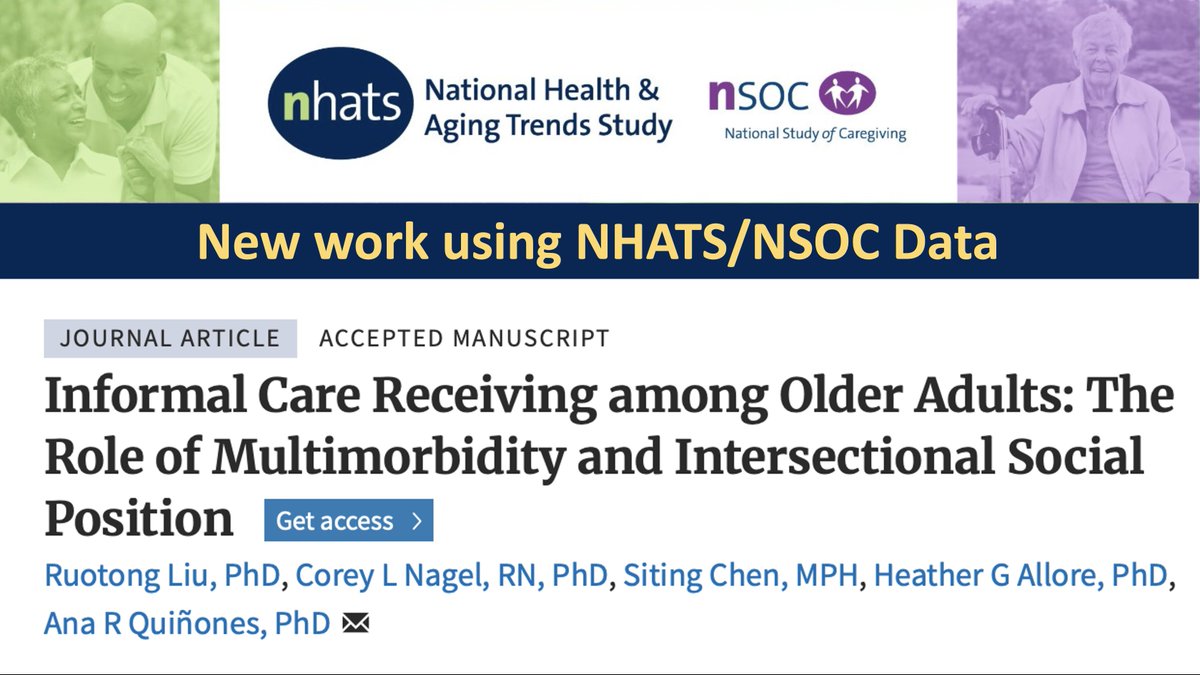
New work using #NHATS/#NSOC data by Dr. Ruotong Liu et al. in The Gerontologist:
#Informal#Care Receiving among #OlderAdults: The Role of #Multimorbidity and #Intersectional#Social Position
"The study highlighted the complexities of informal care-receiving characteristics among older adults, particularly among those with #cognitive difficulties, and the ways in which #race/#ethnicity and #sex are associated with care-receiving patterns. The findings highlight a need for #person- and #family-#centered #interventions sensitive to the #diverse needs of care-#recipients and #caregivers."
Read the research: https://t.co/3IK9hYAk1i
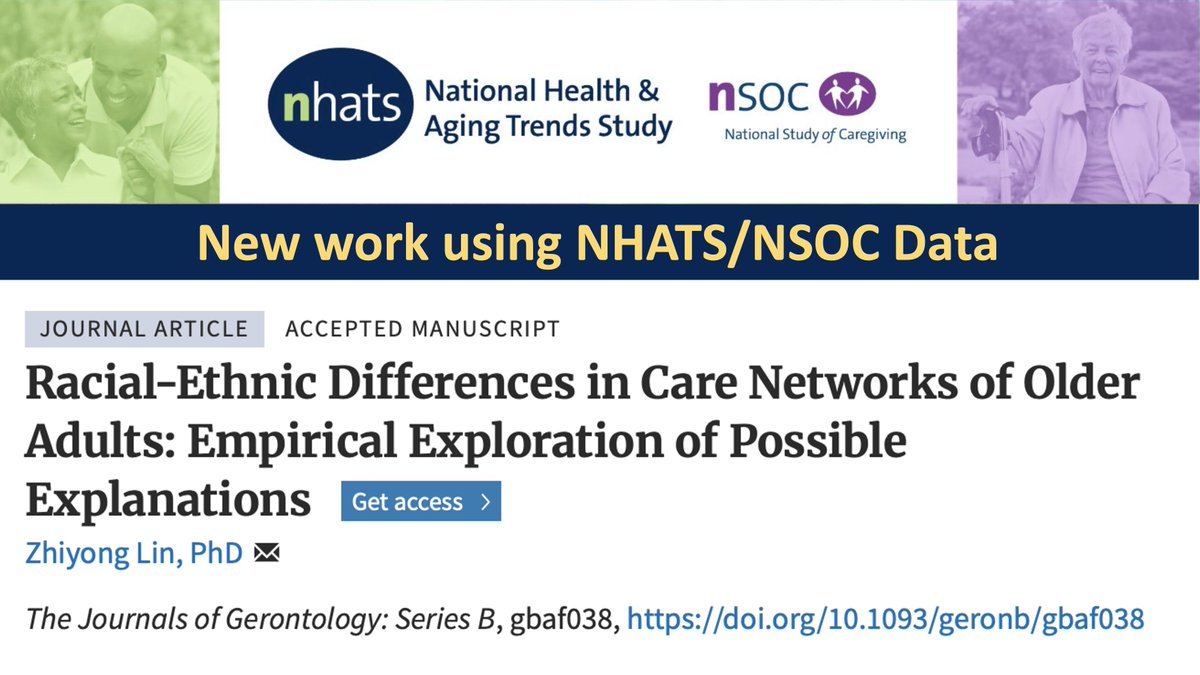
New work using #NHATS/#NSOC data by Dr. Zhiyong Lin in The Journals of Gerontology Series B:
#Racial-#Ethnic#Differences in #Care#Networks of #Older#Adults: Empirical Exploration of Possible Explanations
"#Black and #Hispanic#olderadults tended to receive care from children and extended kin #caregivers, while #White older adults were more likely to receive care from their #spouses and perform #selfcare with assistive technologies. Mediation analyses revealed that racial-ethnic differences in care networks were primarily attributable to enabling factors, including #family configurations, #social networks, and #socioeconomic status....
"The findings highlight the need for more research and policy interventions to address the diverse challenges faced by #socially #disadvantaged older adults."
Read the research: https://t.co/JkZOyxsS84
New work using #NHATS/#NSOC data by Dr. Yeajin Ham et al. in #Aging & #MentalHealth:
#Association between #chronic #illnesses in older adults and caregiver burden: a #crosssectional study in the #UnitedStates
"#Dementia was significantly associated with ##caregiver burden related to #emotional #difficulty (odds ratio [OR] = 2.04; 95% confidence interval [CI], 1.34–3.09) and physical difficulty (OR = 1.67, 95% CI, 1.01–2.78), but not #financial difficulty. Furthermore, relationship with #olderadults, positive and negative #selfesteem, the number of #assistive #activities of caregivers, and #gender and #physical #capacity of older adults were significantly associated with caregiver burden.
"These findings clarify the definition of caregiver burden and provide integrated results on caregiver burden in chronic illnesses and the characteristics of caregivers and older adults."
Read the research: https://t.co/Rozeq18IUx
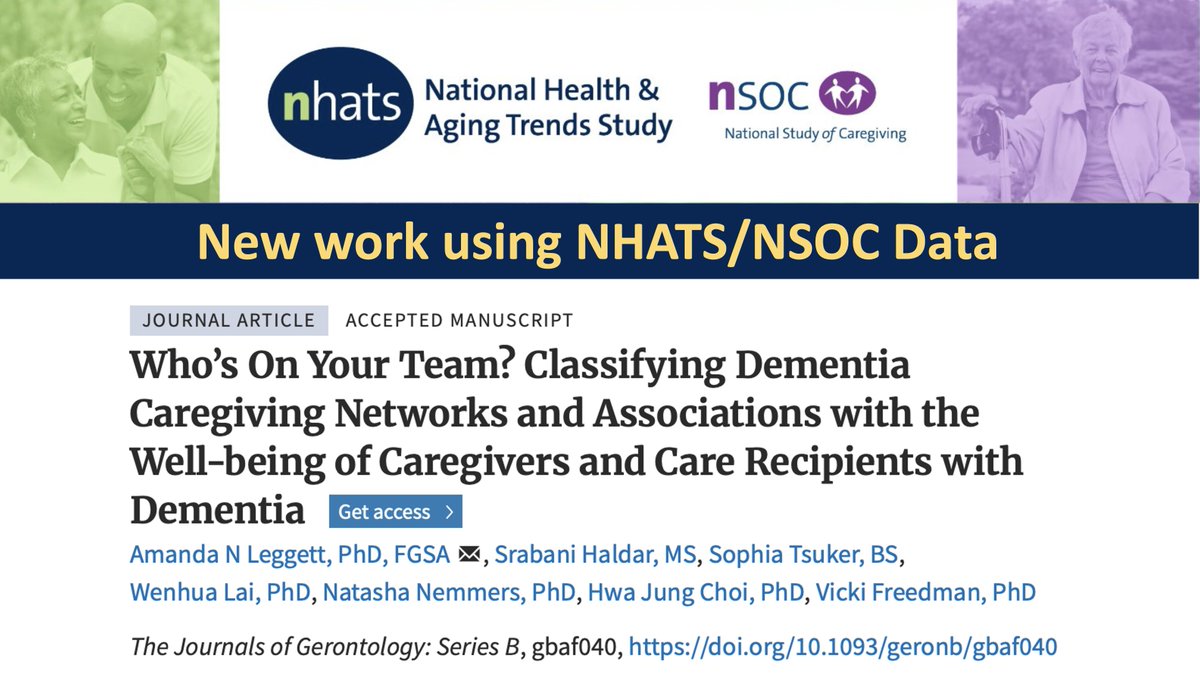
New work using #NHATS/#NSOC data by Dr. Amanda Leggett et al. in The Journals of Gerontology, Series B:
Who's On Your Team? Classifying #Dementia#Caregiving#Networks and Associations with the #Wellbeing of #Caregivers and Care Recipients with Dementia
"Three network types were identified: “Siloed”- small networks, limited task sharing (29.8% of networks); “Small but mighty”- small networks, high task sharing (23.0% of networks); and “Complex”- large networks, diverse membership, members who share and specialize in task assistance (47.2%). Individuals with dementia with a “Siloed” network had significantly poorer #sleep quality and caregivers in “Siloed” networks reported receiving less #social support from family and friends than those in “Small but mighty” and “Complex” networks.
"Caregiver networks that are less collaborative may need supports to reduce #isolation amongst caregivers and improve health outcomes for individuals with dementia."
Read the research: https://t.co/5WnVUw1u1d
📣 NHATS/NSOC Webinar: Fri., 3/7, Noon to 1 pm ET
Speaker: Aisha Dickerson (Johns Hopkins University)
Topic: “To Breathe or Not to Breathe: What was the Question?”
Register: https://t.co/DGnVJ9jw2D







![NHATS_NSOC's tweet photo. New work using #NHATS/#NSOC data by Drs. Bae & Gell in The Journal of Geriatric Oncology:
#Longitudinal #associations between #symptom #burden and #fall #risks in #olderadults with a #cancer #history: Findings from the 2011–2015 National Health and Aging Trends Study
"Symptoms that are more prevalent in cancer survivors are also strongly associated with fall risk, including pain [3], sleep disturbance [4], fatigue [5], depression [6], and anxiety [7]. These symptoms persist in cancer survivors even after treatment is completed [8]. Further, these symptoms often occur together, thereby increasing the burden and subsequent impact on functioning [9]. While symptom clusters and their clinical significance in cancer survivors have been described previously [10], few studies have comprehensively examined the association between symptoms and longitudinal fall risk in this population.
"We found a high symptom burden in older adults with a cancer history, with more than 70 % reporting at least one of the five symptoms. The impact of symptoms was substantial on both recurrent fall rates at baseline and longitudinal incidental fall risk. Importantly, we observed an increase in fall risk with increasing the number of symptoms.
"The observed associations between symptom burden and fall risk highlight the potential importance of targeting symptom management in fall prevention."
Read the research: https://t.co/iT3QpKVnIl](https://pbs.twimg.com/media/GmA96x0WIAA0-py.jpg)
![NHATS_NSOC's tweet photo. New work using #NHATS/#NSOC data by Dr. Yeajin Ham et al. in #Aging & #MentalHealth:
#Association between #chronic #illnesses in older adults and caregiver burden: a #crosssectional study in the #UnitedStates
"#Dementia was significantly associated with ##caregiver burden related to #emotional #difficulty (odds ratio [OR] = 2.04; 95% confidence interval [CI], 1.34–3.09) and physical difficulty (OR = 1.67, 95% CI, 1.01–2.78), but not #financial difficulty. Furthermore, relationship with #olderadults, positive and negative #selfesteem, the number of #assistive #activities of caregivers, and #gender and #physical #capacity of older adults were significantly associated with caregiver burden.
"These findings clarify the definition of caregiver burden and provide integrated results on caregiver burden in chronic illnesses and the characteristics of caregivers and older adults."
Read the research: https://t.co/Rozeq18IUx](https://pbs.twimg.com/media/GlwtNrkXMAAWJ8J.jpg)